
- The Trap: Telling an adjuster to “come whenever” usually leads to a rushed inspection and missed damage.
- The Fix: Treat the scheduling call as a business transaction where you confirm the scope, the timing, and the specific areas needing access.
- The Output: A written text or email confirming exactly when they will arrive and what tools (ladder, moisture meter) they need to bring.
The “Whenever You Can Make It” Mistake
When you finally get that call from the adjuster to schedule an inspection, the relief is overwhelming. After days of radio silence, you just want them to show up. The most common instinct is to be overly accommodating. You might say, “I work from home, just stop by whenever you are in the area.”
In claims operations, I see the fallout of this approach constantly. “Whenever” signals to the adjuster that your claim is low priority or that you are not preparing for their arrival. It often results in “drive-by” inspections where they show up 30 minutes before sunset. They rush through the exterior and miss the subtle interior damage because they didn’t want to disturb you. You must shift the dynamic. You are not asking for a favor. You are scheduling a critical site survey.
From this first phone call onwards, start logging every date and promise in your claim follow-up log. Memories fade, but written logs protect you.
Step 1: Know Who Is Coming
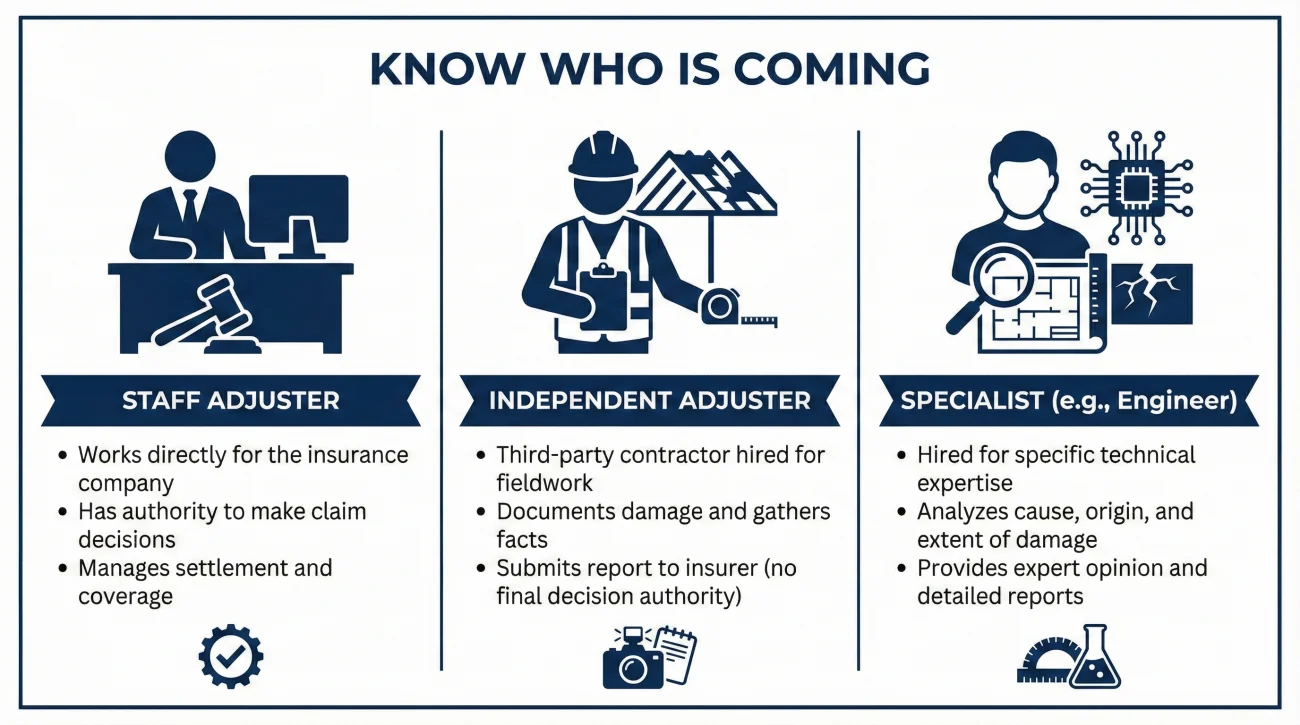
Before you agree to a time, you need to know who is actually walking onto your property. The person calling you is often not the person who will write the check. They might be an “Independent Adjuster” (IA) hired on a contract basis, or a specific specialist like a roof engineer. In some cases, carriers assign a “Field Adjuster” who only takes photos and sends them to a “Desk Adjuster” in another state.
When they call to schedule, I always recommend clarifying their role immediately. Ask: “Are you the Staff Adjuster assigned to my file, or are you an Independent Adjuster handling the field work?”
💡 Why this matters: If they are an Independent Adjuster, they typically have no authority to make coverage decisions on site. Knowing this prevents you from wasting energy trying to negotiate with someone who is just there to take photos.
The “Multiple Adjuster” Confusion
On larger claims, you might get calls from three different people. One for the structure, one for contents, and one for “ALE” (Additional Living Expenses). If you do not ask “what specific part of the claim are you handling,” you might schedule the contents person to look at the roof. They will arrive, look at the roof, shrug, and tell you that is not their job. Now you have wasted a morning and still have no roof inspection.
Step 2: The Logistics Checklist
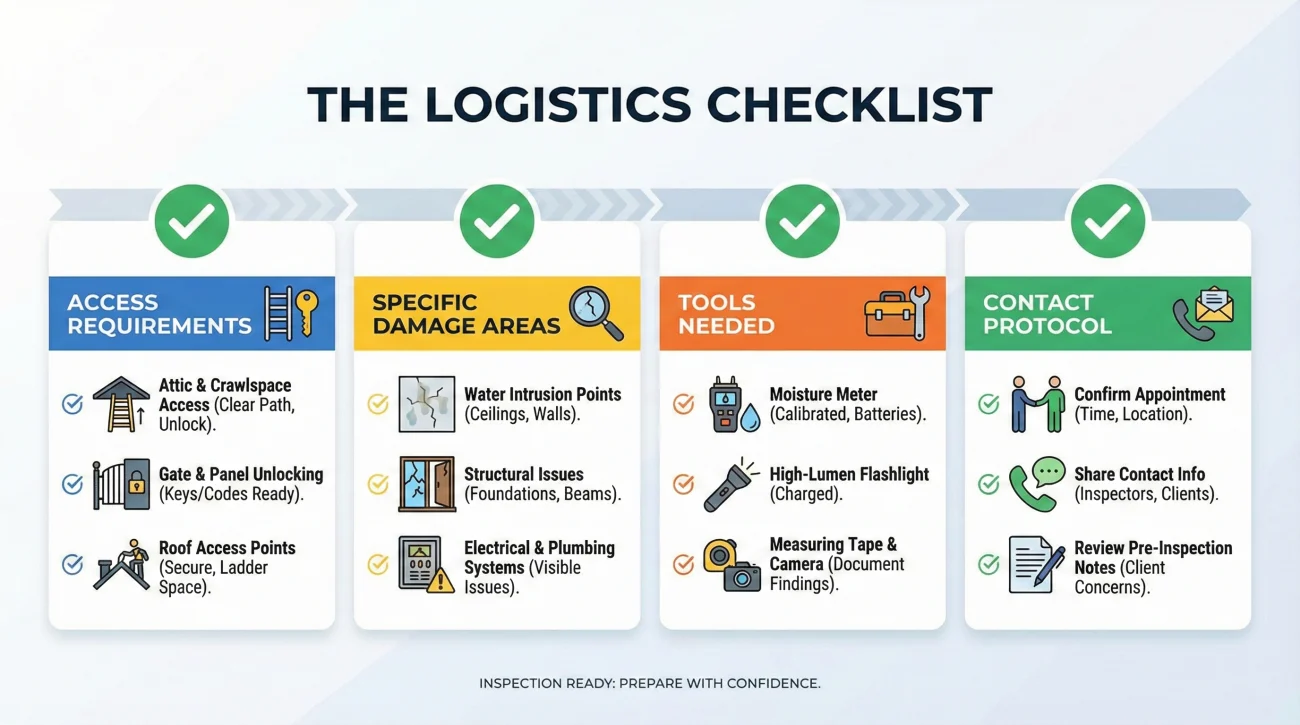
An inspection is useless if the adjuster cannot see the damage. I cannot count the number of times I have seen an adjuster arrive without a ladder for a two-story roof, or without specific tools for a water leak, simply because the scheduling call was vague.
During the call, verify these four points:
- ✅ Access Requirements: “The leak is in the attic crawlspace. Do you have a ladder, or do I need to arrange access?”
- ✅ Specific Damages: “I need you to look at the roof AND the bedroom ceiling. Please allocate enough time for both.”
- ✅ Tools: “There is moisture in the wall. Will you be bringing a moisture meter if applicable?”
- ✅ Contact Number: “What is your mobile number in case I need to guide you in?”
Operational Field Note: The “Gate Code” Delay
I once managed a file where the inspection was delayed by five days because the adjuster arrived at the gated community, didn’t have the code, and the policyholder didn’t answer an unknown number. The adjuster marked the file “Access Denied” and moved to the next town. Five days of delay, purely because entry logistics were not discussed during the scheduling call.
Mini-Checklist: High-Risk Access Points
Before you hang up, check your property mentally for these common blockers:
- 🔒 Attic Hatch: Is it painted shut or locked?
- 🕸️ Crawlspace: Is the entry blocked by heavy storage?
- 🐕 Pets: Can you secure them for 2 hours?
- 🔢 Gate Codes: Does the community require a fresh code for vendors?
- ⚡ Power/Water: Do they need utilities on to test anything?
Handling the “All-Day Window”
Adjusters often try to give you a broad window, like “I’ll be there sometime between 8 AM and 5 PM.” This locks you in your house all day. While you should be flexible, you can professionally push for clarity.
If they offer an all-day slot, try these questions:
- “Can we narrow that to a morning (8-12) or afternoon (1-5) block so I can manage my work calls?”
- “Can you give me a ‘first stop’ or ‘last stop’ of the day?” (These are the most reliable slots).
- “Can you commit to sending me a text when you are 30 minutes away?”
Step 3: Lock It Down in Writing
Verbal appointments are slippery. In busy seasons, adjusters manage a high volume of files simultaneously. If you are just a sticky note on their dashboard, you might get bumped. Send a brief confirmation text or email immediately after the call.
Subject: Confirming Inspection – Claim #12345 – [Your Address]
Hi [Name],
Confirming our appointment for [Day/Date] between [Time Window].
As discussed, I will show you the roof damage and the water spots in the guest bedroom. I have the receipts for the emergency tarping ready for you to review.
Please call or text me 30 minutes before arrival so I can secure the dogs and open the gate.
If anything changes on your end, please reply here so we keep this thread updated.
Thanks,
[Your Name]
The Rise of “Virtual Inspections” (Risk Management)
It is becoming increasingly common for carriers to suggest a “Virtual Inspection” for small to mid-sized claims. They might send you a link to an app (like Hover or specialized video tools) and ask you to walk around with your phone camera while they direct you from a desk.
If they propose this during the scheduling call, pause. Ask yourself if you are comfortable acting as the camera operator. If the damage is in a dangerous spot (like a steep roof) or a dark crawlspace, refuse the virtual inspection on safety grounds.
⚠️ Warning: In a virtual inspection, the adjuster only sees what you show them. If you miss a wet spot on the drywall because the lighting is bad or your hand is shaky, that damage does not make it into the estimate.
If you agree to a virtual inspection, treat it as a risk management exercise:
- ✅ Lighting: Only schedule for full daylight hours. Never do it at dusk.
- ✅ Support: Have a second person present to hold a flashlight, ladder, or tape measure so you can focus on filming steadily.
- ✅ Backup: Take your own high-res photos before the call starts, in case the video feed is blurry.
Preparing the Site
You want the inspection to be smooth, but you also want it to be thorough. “Preparing” does not mean cleaning up the damage. Never clean up the evidence. It means clearing the path to the evidence.
If the adjuster has to move a heavy dresser to see the mold, they might just take a photo from a distance and guess the extent. Don’t let them guess. Move the dresser (if safe) before they arrive. Ensure the attic hatch is unlocked. Make the damage undeniably easy to measure.
A dark basement with boxes stacked in front of the water damage. Adjuster uses a flashlight and leaves in 2 minutes.
Boxes moved, lights turned on, and a tape measure already taped to the wall next to the water line. Adjuster takes a clear photo and notes the exact dimension.
Create the “Kitchen Table” Packet
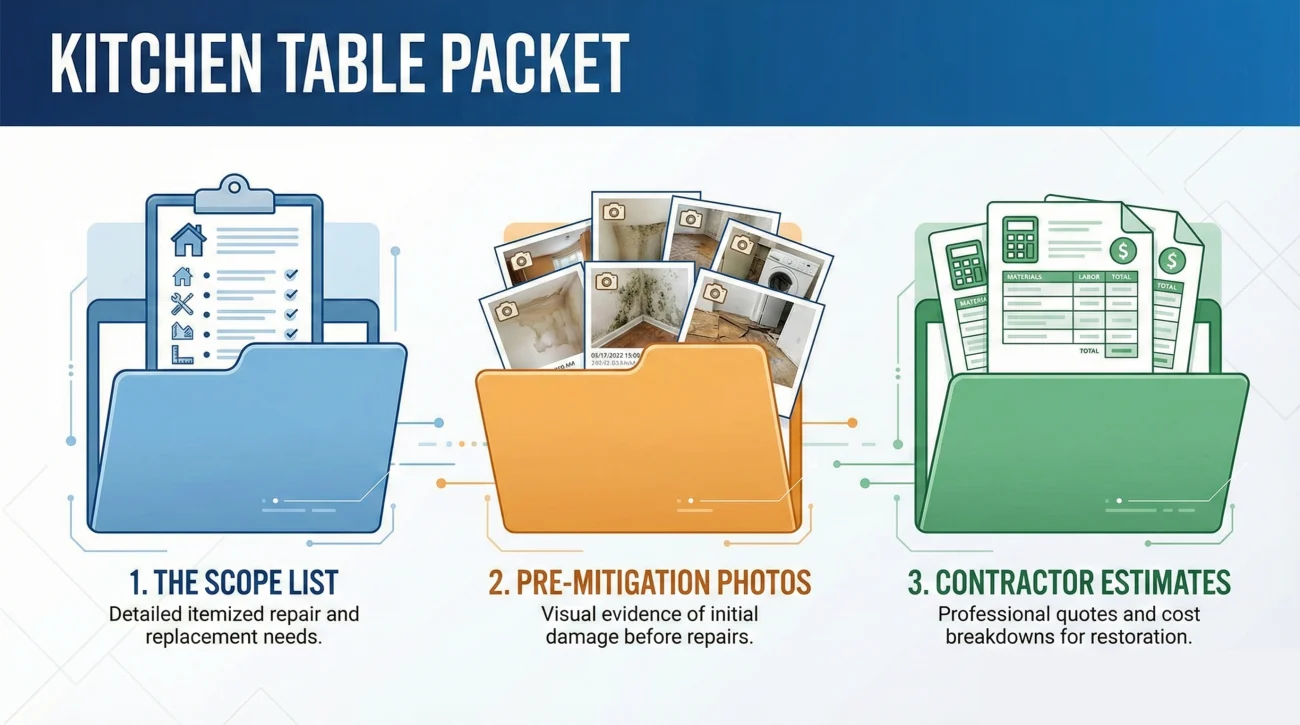
Adjusters are used to disorganized homeowners. When they walk in, they expect to spend 20 minutes asking basic questions about when the loss happened. Surprise them. Have a folder ready on the kitchen table. This folder should contain copies of documents you can physically hand to them.
Include these three items:
- 📄 The Scope List: A bulleted list of every damaged area you want them to check.
- 📄 Pre-Mitigation Photos: Color printouts (standard paper is fine) of what the house looked like before the water was pumped out or the debris was cleared.
- 📄 Contractor Estimates (If any): If you already have a quote, have a copy ready.
Why do this? Because an adjuster holding a physical list is, in my experience, much more likely to check every item on that list. It acts as a guide for them. If you just verbally say “check the back bedroom,” they might forget by the time they reach the hallway. If it is on the paper in their hand, they will check it.
The Walkthrough Protocol
The scheduling is done. The day arrives. Now, how do you behave? This is a delicate balance. You do not want to hover over their shoulder like a helicopter parent, but you absolutely cannot go sit in the living room and watch TV while they roam your house.
I call this the “Helpful Shadow” technique.
1. The Initial Greeting
Meet them at the door. Hand them the “Kitchen Table Packet” we discussed above. Say this: “I made a list of the damaged areas so we don’t miss anything. I’ll walk with you to point them out, and then I’ll let you do your measurements.”
2. Point and Step Back
Lead them to the first room. Point to the damage. “Here is the water stain on the ceiling.” Then, physically take two steps back. Give them space to work. This body language signals that you are helpful, not aggressive. If you stand two inches from them while they work, they will rush to get away from you.
3. The Roof Question
If they are going on the roof, you likely cannot follow them (unless you are a contractor). Do not climb the ladder unless invited. However, ask them to take photos of specific things you are worried about. “Can you please get a close-up photo of the vent pipe on the back slope? I think that is where the leak started.”
Key Point: If your contractor is available, schedule them to be there. The best dynamic is Adjuster + Contractor talking shop on the roof while you wait on the ground. They speak the same technical language.
Common Scheduling Mistakes
I see policyholders make tactical errors during scheduling that weaken their position before the adjuster even parks the car.
1. Accepting “Drop-Ins” Without You
The adjuster might ask, “Can I just inspect the exterior while you are at work?” Unless it is a minor fence claim, say no. You need to point out the specific damage. If they look alone, they will only see what is obvious, not what you know is broken. They will not see the hail damage on the AC unit. They will not see the cracked siding behind the bushes. You are the guide.
2. Not Mentioning Safety Hazards
If you have a dog that bites or a broken step on the porch, tell them during the scheduling call. If an adjuster gets injured on your property, the inspection stops immediately. You now have a workers’ comp investigation on your property and a delayed claim. Be professional and warn them about loose dogs, aggressive neighbors, or unstable floorboards.
3. Scheduling Too Late in the Day
Try to avoid the 4:00 PM slot in winter. Lighting is critical for photography. Flash photography often washes out water stains or hail dents. Aim for mid-morning or early afternoon when natural light is best. If they insist on a late slot, ask: “Will you have enough light to see the roof granules, or should we push to tomorrow morning?” Most honest adjusters will admit the morning is better.
What If They Don’t Show Up?
It happens. Adjusters get stuck at a previous inspection, their truck breaks down, or they just run out of time. If the time window passes and you haven’t heard from them, do not get angry. Get documented.
Send a text or email immediately: “Hi [Name], our 1-3 PM window has passed. Are you still coming, or do we need to reschedule?”
If they ghost you (no show, no call), document it in your claim follow-up log. Then call the carrier’s main dispatch line the next morning. “The adjuster missed the appointment and did not call. I need to reschedule.” This puts a note in the main system that the delay is their fault, not yours. This is crucial if the claim drags on later.
Final
The inspection is the physical anchor of your claim. It is the moment your story becomes their data. By managing the schedule professionally, confirming the time, defining the scope, and ensuring access, you remove the friction that leads to vague reports and lowball estimates. Don’t just open the door. Manage the visit. Treat it like a crucial business meeting, because that is exactly what it is.
❓ FAQ
📅 How long should I wait for an adjuster to schedule?
Typically, an adjuster should contact you within 24 to 48 hours of the claim assignment to schedule, though this can vary during catastrophe events. If you haven’t heard from them by day 3 or 4, call the carrier’s main line and ask for the “adjuster status.”
🚫 Can I refuse an inspection time?
Yes. You have the right to be present. If they propose a time when you are unavailable, propose a specific alternative. Do not feel pressured to let them inspect without you.
⏱️ How long does a home insurance inspection take?
It depends on the damage. A simple roof inspection might take 30 to 45 minutes. A complex fire or water loss involving multiple rooms can take 2 to 4 hours. Ask the adjuster for an estimate so you can plan.
👷 Should I have my contractor present?
Ideally, yes. Having your contractor walk with the adjuster is the best way to ensure they agree on the scope of damage immediately. It prevents “he said, she said” arguments later.
🌧️ What if it rains on the day of my roof inspection?
Adjusters usually cannot inspect roofs safely during rain or high wind. They will likely reschedule. Confirm this with them the morning of the appointment so you don’t wait around for no reason.
🏠 Do I have to let the adjuster inside my house?
If you are claiming interior damage, yes. They must verify the loss. If the claim is “exterior only” (like a fence), you can technically keep them outside, but it is usually better to establish a cooperative relationship.
🚪 What if the adjuster says they don’t do interior inspections?
If you have interior damage, clarify this immediately. Some field adjusters are only assigned to the roof. If they refuse to look inside, ask them to note in their report that “interior was not inspected” so you can request a supplemental inspection later.
📱 Is it okay to record the inspection?
Laws vary by state. Instead of secretly recording, just take your own photos alongside them. It is less confrontational and serves the same purpose of documenting what they saw.
📧 Should I confirm the appointment by email?
Absolutely. Sending a quick “Confirming our meeting at 10 AM Tuesday” creates a paper trail. If they don’t show up, you have proof that the appointment was set.
🔄 Can I reschedule without restarting my claim?
Yes, rescheduling an appointment does not close your claim. However, try to avoid multiple reschedules as it can delay your payout. Always offer a clear alternative date when you cancel.
⚠️ Disclaimer: PropertyClaimChecklist.com provides practical guidance, process checklists, and example follow-ups to help you organize a property claim and move it forward. It is not policy language, claim documentation, legal content, or a substitute for your insurer's instructions. Always rely on your carrier's requirements and your actual policy terms for what must be submitted and how decisions are made.