

- The “Unstuck” Core: Delays rarely happen because of malice; they happen because of friction. Your goal is to identify the specific missing item or blocked step and provide exactly that.
- The “Loop” Technique: Never end a call without a specific “Next Action,” a specific “Owner” (who is doing it), and a specific “Date” (when it will be done).
- Escalate the File, Not the Person: When requesting a supervisor, frame it as a need for “additional authority” to move the file, not as a complaint about the adjuster’s character.
- The Volume Reality: Adjusters often handle a very high volume of files. To get yours to the top of the pile, you must be the “Easy File” (organized and clear), not the “Noise File” (scattered info that is hard to process).
The Operational Reality of “Stuck” Claims
In my years working in claims operations, I have seen thousands of files that seemed to be completely frozen. The homeowner is usually sitting at home, staring at a hole in their roof or a stripped-out kitchen, wondering if the insurance company is intentionally ignoring them to save money.
While that feeling is valid, the operational reality is often more mundane – and more frustrating. Most delays are not grand conspiracies. They are administrative bottlenecks. A file sits in a “Pending Review” queue because one photo is blurry. An adjuster is waiting for a vendor report that was sent to the wrong email address. A claim is transferred to a new adjuster who hasn’t opened the file yet.
Waiting for the system to fix itself is not a strategy. The system is designed to handle volume, not speed. To get your claim moving, you have to stop acting like a passive passenger and start acting like a project manager. You need a system to diagnose the stall, communicate the fix, and reset the timeline.
This guide is that system. It covers the operational “Unstuck” framework: how to find the bottleneck, how to follow up without being ignored, and how to escalate internally when the timeline slips. We will move beyond the vague advice of “just keep calling” and look at the specific triggers that move a file from “Pending” to “Paid.”
Step 1: Diagnose the Stall Point
Before you send an angry email or demand a supervisor, you need to know exactly where the claim is stuck. In operations, we call this the “Stall Point.” If you push on the wrong part of the process, nothing moves.
Imagine pushing a car. If the parking brake is on, pushing harder won’t help. You have to release the brake first. In claims, the “brake” is usually a missing piece of information.
Most delays fall into one of three operational buckets:
| Stall Bucket | Operational Signs | The Likely Bottleneck |
|---|---|---|
| Input Stall | “Pending Info,” “Waiting for Customer,” silence after you sent documents. | The system thinks you still owe them something (a form, a photo, a list) or they haven’t logged what you sent. This is one of the most common reasons for early delays. |
| Process Stall | “Under Review,” “Pending Approval,” “With Management.” | The file is sitting on a desk (or in a digital queue) waiting for a signature or a higher authority level. This often happens when a payment exceeds the adjuster’s “authority limit.” |
| Vendor Stall | “Waiting for Report,” “Pending Engineer,” “Scheduling.” | The insurer is waiting on a third party (engineer, contractor, accommodation service) who hasn’t uploaded their findings. The adjuster often forgets to chase them. |
💡 Pro Tip: Your first question when you call shouldn’t be “Why is this taking so long?” It should be “What specific document or action is currently preventing this file from moving to the next step?” This forces them to look at the “tasks” list in their software.
The “Hidden” Input Stall
A common scenario I see is the “Hidden Input Stall.” You sent the inventory list three weeks ago. You assume they have it. But because you sent it as a JPEG image instead of a PDF, or because you sent it to the wrong email alias, it never got indexed to the file.
The adjuster’s dashboard shows “Waiting for Inventory,” so they ignore the file. You are waiting for a check; they are waiting for a list. Silence ensues. Always confirm receipt 48 hours after sending any major document.
To confirm indexing without guessing, ask this specific question: “Can you please read back the title of the document you see on my file?” If they cannot see the specific file title, it likely hasn’t been indexed to your claim number yet.
The “Silent” Vendor Stall
If the delay is due to a vendor (like an engineer or leak detection service), do not just wait. Ask the adjuster: “Do you have an ETA for their report? Or can you share the vendor’s contact info so I can follow up with them directly to schedule?” Often, the vendor is just waiting for a scheduling call.
Step 2: The Follow-Up Cadence
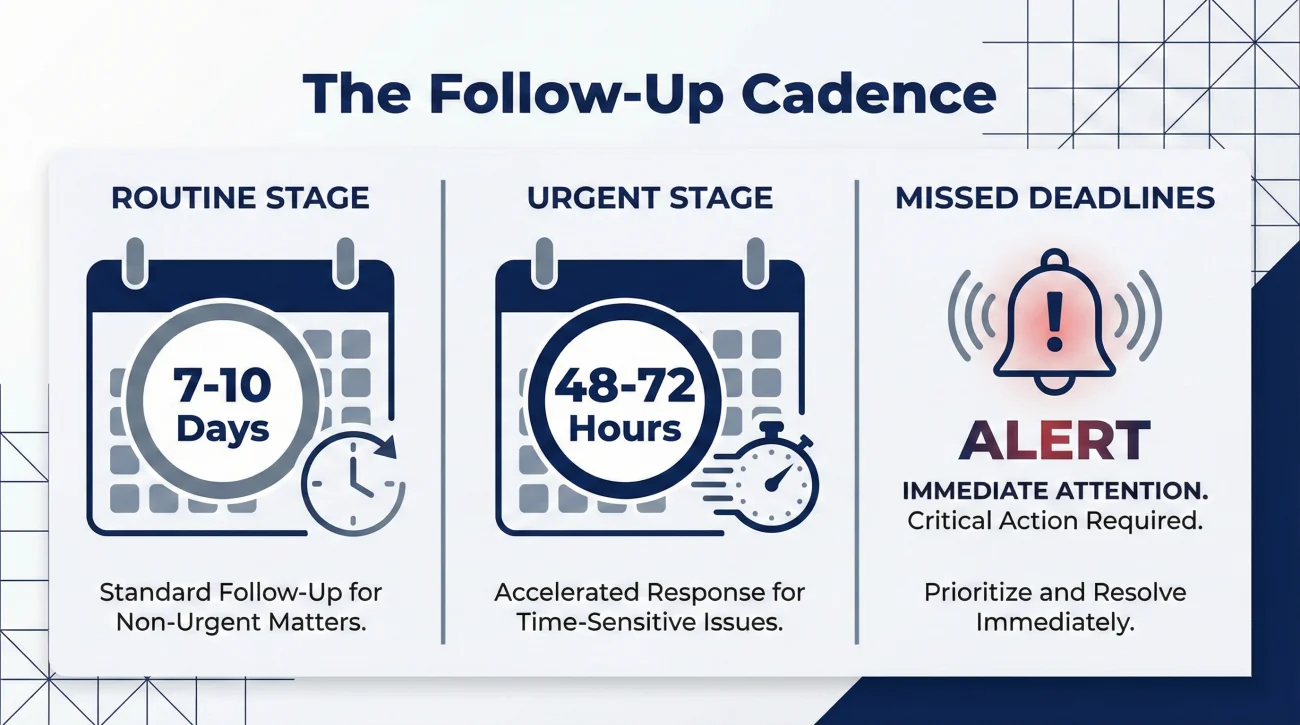
One of the most common mistakes I see is the “Daily Grind.” A homeowner calls every single morning at 9:00 AM to ask for an update. This often backfires. It trains the adjuster to screen your calls because they have no new news since yesterday. If you become “white noise,” you lose leverage.
The opposite mistake is the “Silent Hope.” The homeowner waits three weeks, assuming “no news is good news.” In claims, no news usually means the file is gathering dust or fell off the dashboard.
You need a professional, rhythmic cadence. This signals that you are organized and paying attention, but not frantic. It frames you as a professional equal, not a pest.
- ✅ Routine Stage (Waiting for routine reports): Email once every 7-10 days.
- ✅ Urgent Stage (Active Leak/Displacement/No Heat): Email or call every 48-72 hours.
- ✅ Missed Deadline: Contact immediately the day after a promise was broken.
Here is a template for a routine status check that demands a response without being aggressive:
Subject: Claim #[Number] – Status Update Request – [Date]
“Hi [Adjuster Name],
It has been [Number] days since our last contact regarding [Topic, e.g., the repair estimate]. My records show we were waiting for the engineer’s report.
Can you please confirm:
1. Have you received the report yet?
2. If not, have you followed up with the vendor?
3. If the file is with a supervisor for review, do you have an estimated date for completion?
I will follow up again on [Day of Week] if I haven’t heard back.”
Step 3: The “Loop” Technique

In operations, vague promises are the enemy of speed. “We’ll get to it soon,” “It’s being processed,” or “It’s on my list” are non-answers. They are designed to get you off the phone. To unstuck a claim, you must close the loop on every interaction.
The Loop Technique consists of three components that you must extract from the adjuster before you hang up or stop emailing. You do not let the conversation end until you have these three variables:
- The Next Action: What exactly happens next? (e.g., “Review the engineer’s report” – NOT just “review”).
- The Owner: Who exactly is doing it? (e.g., “The field manager” – NOT just “we”).
- The Date: When will it be done? (e.g., “By Friday close of business” – NOT just “soon”).
Mini-Scenario: Closing the Loop
The Situation: You call the adjuster because you haven’t received your ALE (Additional Living Expenses) check. They say, “Oh yeah, I see that here. I’ll send it up for approval.”
The Weak Response: “Okay, great, thank you so much.” (Result: You hang up. Three weeks later, still no check. You call back, and they say, “Oh, I forgot to send it up.”)
The “Loop” Response: “Okay, thank you. Just so I can track this on my end: You are sending it to your supervisor today, correct? Who is the supervisor that approves it? And realistically, how long does that approval take – should I expect the confirmation by Friday?”
By asking for the “Who” and the “When,” you create accountability. If Friday comes and there is no confirmation, you have a specific promise to reference in your follow-up.
Step 4: The Delay Log
If your claim drags on for weeks or months, your memory will fail you. You will know it has been “a long time,” but you won’t remember if the adjuster promised the report on the 12th or the 14th. Without specifics, you cannot hold anyone accountable, and you certainly cannot escalate effectively.
You do not need a complex spreadsheet. A simple “Delay Log” in a notebook or phone note is sufficient. It serves as your evidence when you need to speak to a manager.
What to log:
- Date and time of contact.
- Who you spoke to (Name).
- What they promised (The Action).
- When they promised it (The Deadline).
- Outcome (Did it happen?).
    Example Log Entry:
    Oct 4: Spoke to the adjuster. He said field report is in. Promised to write estimate by Oct 7.
    Oct 8: No estimate received. Emailed to ask for update.
    Oct 10: Adjuster replied. Said he got busy. Promised estimate by Oct 12.
    Oct 15: Still no estimate.
When you eventually speak to a manager, reading from a log is powerful. “I spoke to the adjuster on June 1st, he promised an update by June 4th. I called again on June 8th, he promised it by June 10th. It is now June 20th.” This is operational fact, not emotional complaint. Managers cannot argue with a timeline of broken promises.
⚠️ Warning: Do not just say “You guys are always late.” That is an opinion. Say “You missed the deadline of Oct 7 and Oct 12.” That is a fact.
Step 5: Internal Escalation Ladder
There comes a point where the adjuster cannot – or will not – move the file. Maybe they are overloaded, maybe they are out of the office, or maybe the issue is above their pay grade. This is when you escalate. But how you escalate matters.
Do not start by threatening lawsuits or Department of Insurance complaints. Those are last resort options that often shut down communication and force the carrier into “defense mode” (where they stop talking to you and start talking to their legal team). Start with the Internal Escalation Ladder.
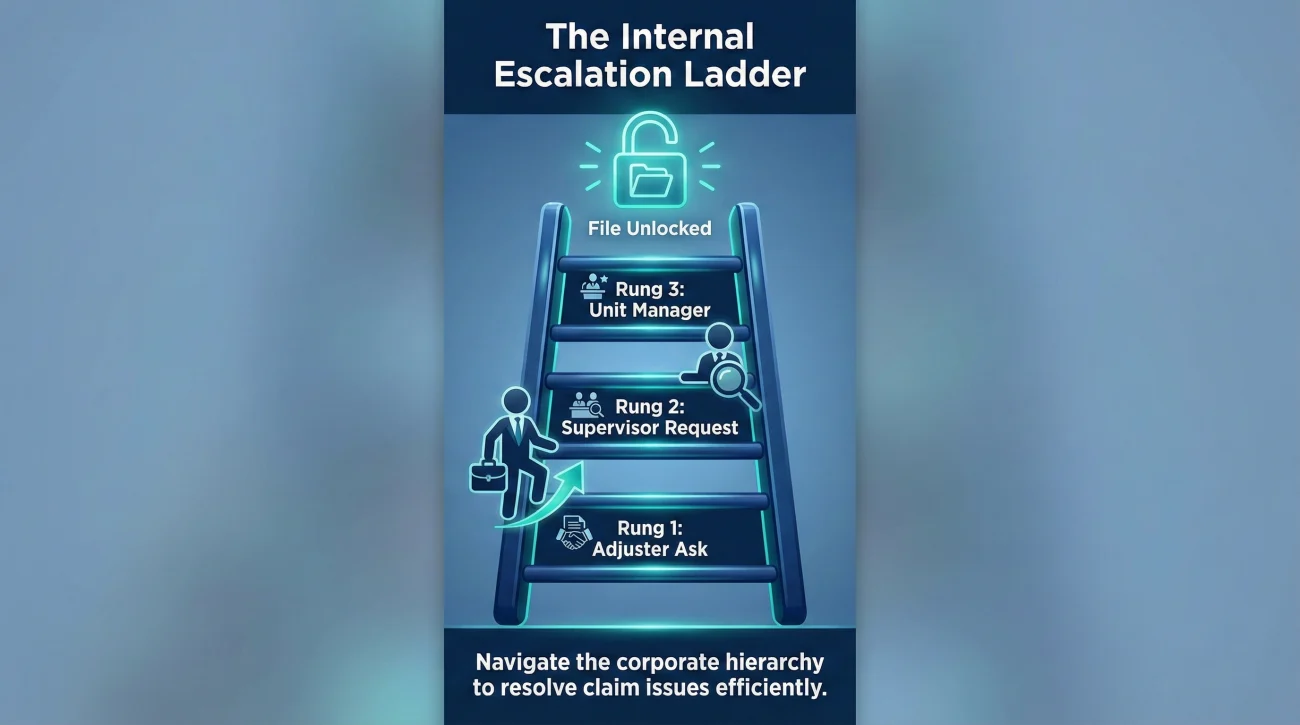
Rung 1: The “Help Me Help You” Ask
This is a soft escalation directly to your adjuster. It gives them a way to save face while admitting they are stuck.
“It seems like this file is stuck at your level. Do we need to get a supervisor involved to approve this? I am happy to hop on a call with them if it helps clear the bottleneck. I just want to get this closed so we can both move on.”
Often, the adjuster is relieved to have you ask, as it gives them an excuse to push the file up to their boss without looking incompetent.
Rung 2: The Supervisor Request
If Rung 1 fails, call the main claims line (not the adjuster’s direct line) and ask for a supervisor. Use the “Status Check” frame.
“I am not calling to file a formal complaint yet, but I need a status check from a supervisor. The timeline for [Item] has been missed three times, and I haven’t received a response to my email from [Date]. I need to know who is managing the file.”
When you get the supervisor, do not re-hash the entire claim. Focus on the stall: “The adjuster is helpful, but deadlines were missed on X, Y, and Z. I need you to step in and ensure the estimate is released by Friday.”
Rung 3: The Manager / Unit Leader
If the supervisor is unresponsive, ask for the “Unit Manager.” This is the operational leader responsible for the metrics of the team. They care about “cycle time” (how fast claims close). Present your Delay Log facts. They are usually motivated to clear the “problem file” off their team’s dashboard. A stalled claim hurts their team’s numbers.
Deep Dive: Common Invisible Bottlenecks
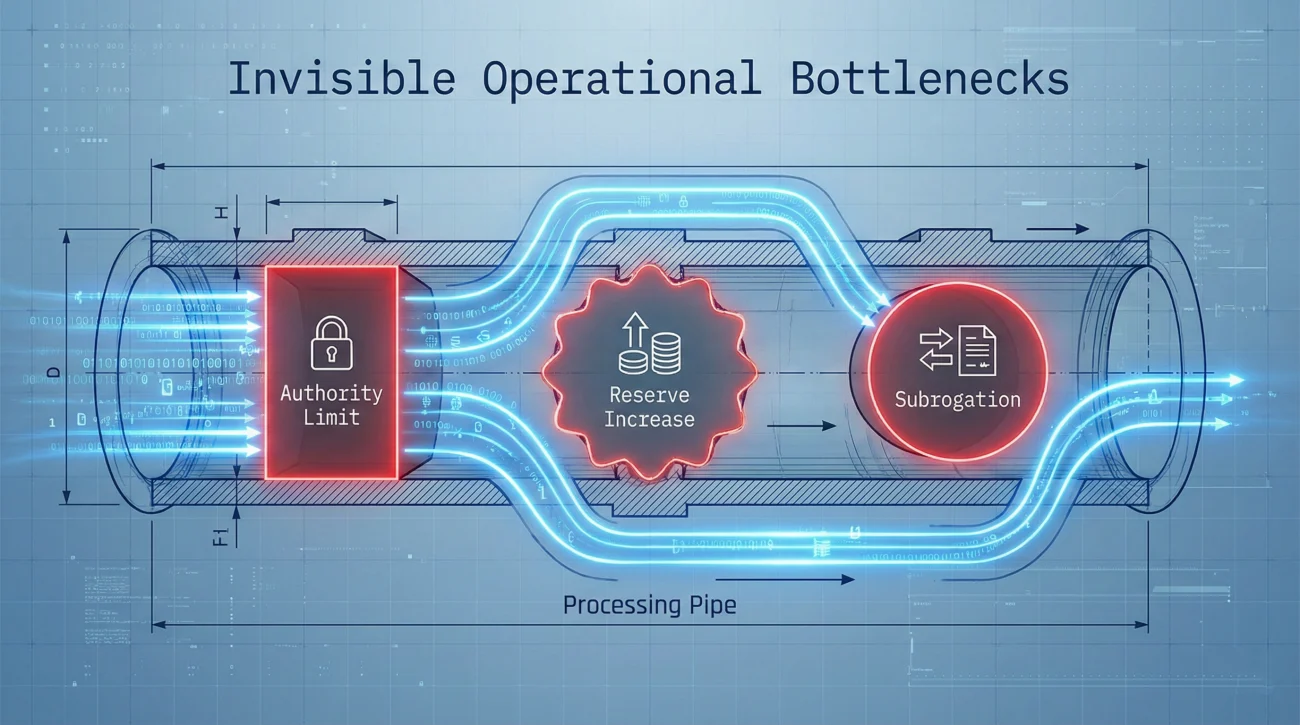
Sometimes you can’t even get to the escalation phase because you don’t know what is wrong. Here are a few “invisible” operational bottlenecks I see frequently, and the specific question to ask to clear them.
The “Authority Limit” Stall:
Every adjuster has a dollar limit (e.g., $10,000). If your claim is $12,000, they cannot pay it without a manager’s signature. They might be waiting for that signature for weeks.
Ask: “Does this payment amount require manager approval? If so, when was it submitted for approval?”
The “Reserve” Stall:
Insurers have to set aside money (“reserves”) for your claim. If the reserve was set too low initially (e.g., $5,000) and the estimate comes in at $15,000, they have to request a “reserve increase” before they can cut the check. This is an internal accounting process that takes time.
Ask: “Is the payment delayed because of a reserve issue? Do you need to increase the reserves?”
The “Subrogation” Stall:
If someone else caused the damage (e.g., a neighbor’s tree), the insurer might be waiting to see if the neighbor’s insurance accepts liability.
Ask: “Are you waiting on subrogation or liability determination before you can release my undisputed funds?”
Pick the Guide That Fits Your Delay
Every delay is different. A payment that is missing requires a different fix than an adjuster who has ghosted you. Open the section below that matches your specific bottleneck.
📞 Adjuster Not Responding & Communication Issues
When you are being ghosted or can’t get a straight answer, these guides help you re-establish contact.
| Guide | Why it helps |
|---|---|
| Insurance Adjuster Not Responding? The “Loop” Technique to Get a Reply | Gives you a simple follow-up loop that forces clarity: who owns the next step, what exactly is needed, and the next date you should expect an update. |
| Insurance Follow-Up Cadence: How Often to Call Your Adjuster | Helps you follow up often enough to keep momentum, without looking frantic. You get a timing rhythm by claim stage and the best channel to use each time. |
| Stop Phone Tag: How to Schedule a Call with Your Insurance Adjuster | Turns endless voicemail tag into a scheduled window. It shows the wording that gets a real appointment and confirms the decision-maker on the file. |
| Email vs. Phone: The Best Way to Contact Insurance Adjusters by Stage | Explains when email beats phone (and vice versa) depending on where your claim is stuck, so your message lands with the right level of urgency and proof. |
| New Insurance Adjuster Assigned? Preventing the “Start Over” Nightmare | Prevents a new adjuster from restarting your claim from zero. It teaches you how to hand over a clean summary, key dates, and the exact open items. |
| Insurance Claim Delay Log: Tracking Promises to Hold Them Accountable | Keeps a clean record of promises, deadlines, and missing items, so you can quote facts instead of emotions when you follow up or escalate. |
⏳ Status Stalls & Process Delays
Use these when the portal says “Pending” or “Under Review” and nothing is happening.
| Guide | Why it helps |
|---|---|
| Insurance “Pending Review” Status: Decoding the Delay That Means Nothing | Breaks down what “pending review” usually means inside a carrier, then shows the questions that pull out the real hold-up, the missing item list, and a realistic ETA. |
| Why Insurance Claims Stall: Common Operational Bottlenecks (And Fixes) | Gives you a menu of the most common stall points, so you can identify your bottleneck fast and pick the one move that unblocks it. |
| Insurance Portal Statuses: What “Open,” “Closed,” and “Pending” Mean | Decodes vague portal labels into practical meanings, then tells you the next question to ask so you do not get stuck staring at the same status. |
| Insurance Claim Stuck After Inspection? How to Trigger the Estimate | Shows what to do when inspection is done but nothing happens. You get a short checklist of what often blocks the estimate and how to trigger the next internal step. |
| No Insurance Estimate Yet? Why It’s Delayed and How to Speed It Up | Helps you diagnose why an estimate has not been written yet and what to request to move it forward, including ownership, timeline, and missing reports. |
| Waiting on Vendor Reports: Don’t Let Third Parties Stall Your Claim | Stops vendor delays from becoming your problem. You learn how to confirm what is outstanding, who is responsible, and when the adjuster will proceed without it if possible. |
🔄 Restarts, Reopens & Corrections
For when things go wrong, get closed too early, or need a hard reset.
| Guide | Why it helps |
|---|---|
| Insurance Adjuster Missed a Deadline? How to Reset the Timeline Firmly | Gives you a firm, professional way to restate the missed date, ask what blocked it, and lock in a new owner plus deadline that you can track. |
| Insurance Claim Closed Unexpectedly? How to Reopen It Immediately | Walks you through the most common “closed by mistake” scenarios and the exact information to provide so the file is reopened quickly. |
| Restarting a Stalled Insurance Claim: The “Ghosted” Protocol | Provides a clean restart script for ghosted claims, plus a one-page recap format that makes it easy for anyone on the carrier side to pick up the file. |
| Reopening an Insurance Claim: The Protocol for “Forgotten” Files | Shows how to revive a file that has gone quiet for weeks or months, including how to summarize history, confirm coverage is still open, and get a fresh list of requirements. |
| Duplicate Claim Numbers: Consolidating Your Insurance File Safely | Helps you avoid delays and confusion when two claim numbers exist. It explains how to confirm which file is active and how to merge documents safely. |
💸 Payment Delays & Checks
When the claim is approved but the money is nowhere to be found.
| Guide | Why it helps |
|---|---|
| Insurance Payment Delayed? Tracking Down Your Missing Payout Check | Covers the usual reasons payments go missing after approval, then gives you the verification steps and escalation path to locate the check or reissue it. |
| Insurance Check “In The Mail”? Verifying Payment Status Like a Pro | Teaches you how to verify “sent” claims payments without guessing, including tracking details to request and what status updates actually prove it was mailed. |
| Mortgage Company on Insurance Check? Why You Can’t Cash It Yet | Explains why a mortgage company is often listed as co-payee and what you need to confirm next, so you understand the process without getting stuck. |
| ALE Reimbursement Delays: Getting Paid for Temporary Housing Bills | Helps you get ALE reimbursements moving by identifying the common missing items, formatting issues, and the key questions that force an ETA and owner. |
🚫 Denials & Escalations
When polite follow-up stops working and you need to move up the ladder.
| Guide | Why it helps |
|---|---|
| Escalating an Insurance Claim: How to Demand a Supervisor Correctly | Shows the right way to ask for a supervisor without sounding hostile. You get a clear escalation ladder and how to request manager ownership of a specific next step. |
| Insurance Escalation Checklist: When Are You Ready to Demand a Manager? | Makes sure you escalate at the right moment. It lists the signals that you are ready, and the documents and timeline notes you should have in hand. |
| Insurance Claim Denied? The Operational Checklist (Before Lawyers) | Organizes denial reasons into practical buckets and gives you the questions that reveal gaps in the file, missing evidence, and the precise next step to request. |
| Insurance Reconsideration Request: How to Ask Them to Look Again | Gives you a strong reconsideration checklist so your request is easy to review: what facts to restate, what gaps to highlight, and what decision you want them to make. |
| Closed vs. Denied: Reading Your Insurance Claim Status Correctly | Clarifies the difference between “closed” and “denied” in real workflows, so you respond correctly and ask the right questions to reopen or appeal. |
Final Thoughts
An insurance claim is a project, and like any project, it requires management. It is unfair that you have to manage a process you didn’t ask for, but it is the operational reality. By using the “Unstuck” system – diagnosing the stall, keeping a clean cadence, closing the loop, and escalating with facts – you remove the friction.
Remember, the goal is not to be the angriest caller; the goal is to be the most organized caller. When your file is easy to read, easy to process, and easy to approve, it moves faster. Stay calm, stay organized, and keep the file moving one step at a time.
❓ FAQ
🕒 Why is my insurance claim still under review after 30 days?
It typically means the adjuster is waiting for a specific document (like a final report) or management approval. Ask specifically: “What item is missing to complete the review?”
📧 What to do if the insurance adjuster ignores my emails?
Switch channels. If they ignore emails, call to leave a voicemail referencing the email. If that fails, call the main customer service line and ask for a status update from the file notes.
📅 How long does an insurance company have to pay a claim?
This varies by state, but most companies pay within a set period after agreement, depending on state rules and policy language. Check your policy’s “Loss Payment” provision for the specific timeline.
👤 Can I ask for a new adjuster if mine is too slow?
Yes, but it’s often better to ask a supervisor to “assist” the current adjuster first. A new adjuster has to learn the file from scratch, which can sometimes cause more delays.
🔒 Why did my claim status change to closed without payment?
Automation often closes “inactive” files if no one touches them for 30 days. It doesn’t always mean a denial. Call to ask if it was “administratively closed” and ask to reopen it.
📞 Does calling the insurance company every day help?
Usually, no. It can cause adjusters to screen your calls. A structured cadence (e.g., every Tuesday/Friday) is often more effective at getting real answers.
⏳ What does “pending carrier review” actually mean?
It usually means the field adjuster has finished their estimate but needs a manager inside the company to sign off on the dollar amount before they can send it to you.
🗣️ How do I talk to a supervisor without getting the adjuster in trouble?
Frame it as a process need, not a complaint. Say, “I think this file needs higher authority approval to move forward, so I’d like to speak with a supervisor to help unblock it.”
🏦 Why is the mortgage company name on my insurance check?
Because they technically own part of the house. You will need to contact their “Loss Drafts” department to endorse the check so you can cash it for repairs.
💸 My claim is approved but I haven’t received the check, what now?
Ask for the “issue date” and the “mail date.” Sometimes a check is “issued” in the system but sits in a mailroom queue for days. Also, confirm they have your correct current address.
⚠️ Disclaimer: PropertyClaimChecklist.com provides practical guidance, process checklists, and example follow-ups to help you organize a property claim and move it forward. It is not policy language, claim documentation, legal content, or a substitute for your insurer's instructions. Always rely on your carrier's requirements and your actual policy terms for what must be submitted and how decisions are made.