- A reconsideration request is an operational task, not an emotional argument. Your goal is to get the file routed to someone who can make a new decision.
- Do not write long paragraphs explaining how upset you are. Instead, provide a clear checklist of facts, identify specific gaps in their current evaluation, and ask direct questions.
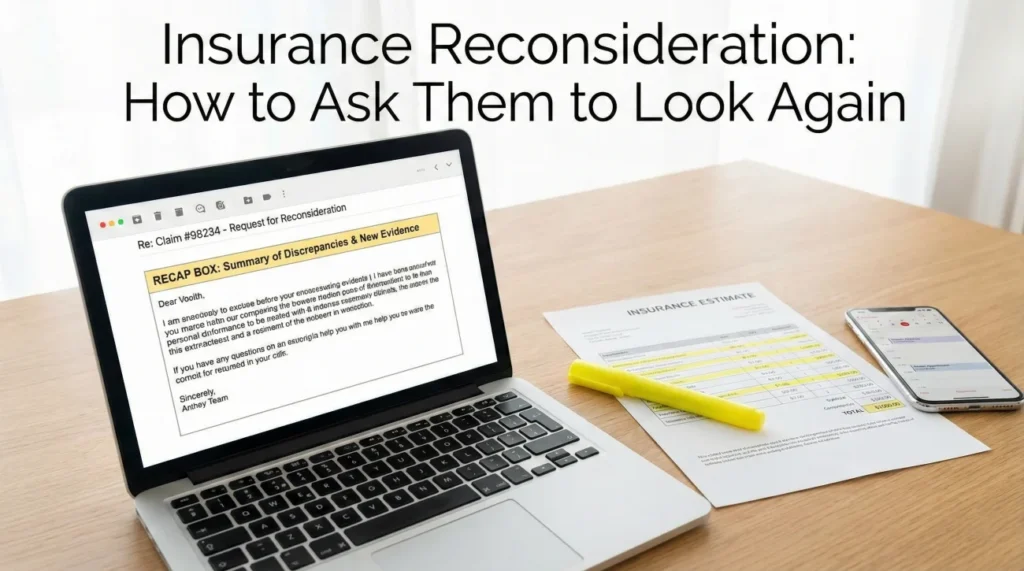
- Focus heavily on the “recap fields” at the top of your request (Claim Number, Date of Loss, Disputed Item, New Fact) so the document indexer knows exactly where to route it.
- Always ask questions that require a concrete answer, which forces the adjuster or supervisor to actively review the new information you provided.
The Reality of Asking Them to Look Again
In my years working in claims operations, I have seen thousands of files where a homeowner completely disagreed with the insurance company’s decision. They usually respond by writing a passionate, multi-page letter explaining why the decision is unfair, how long they have been a loyal customer, and how stressful the situation has become. I understand that reaction completely. It is incredibly frustrating to feel like your property damage has been minimized or misunderstood.
But when you want to request reconsideration insurance claim decisions, you have to understand how the system actually works on the inside. Insurance companies run on data, routing rules, and specific workflows. When a desk adjuster or a document indexing clerk opens a long, text-heavy letter filled with frustration, they often struggle to find the actionable operational details. Without a clear, factual trigger to reopen the review process, the document simply gets attached to your file as “general correspondence,” and the status remains unchanged.
If you want them to look again, what works best is shifting your approach. Instead of writing long narrative letters, I highly recommend building a structured request. My goal here is to show you exactly how to break down your argument into facts, gaps, and specific questions. By organizing your information in a way that their internal systems recognize, you give your file the best possible chance of being routed back to an active desk for a second look.
Shifting from Complaints to Operational Facts
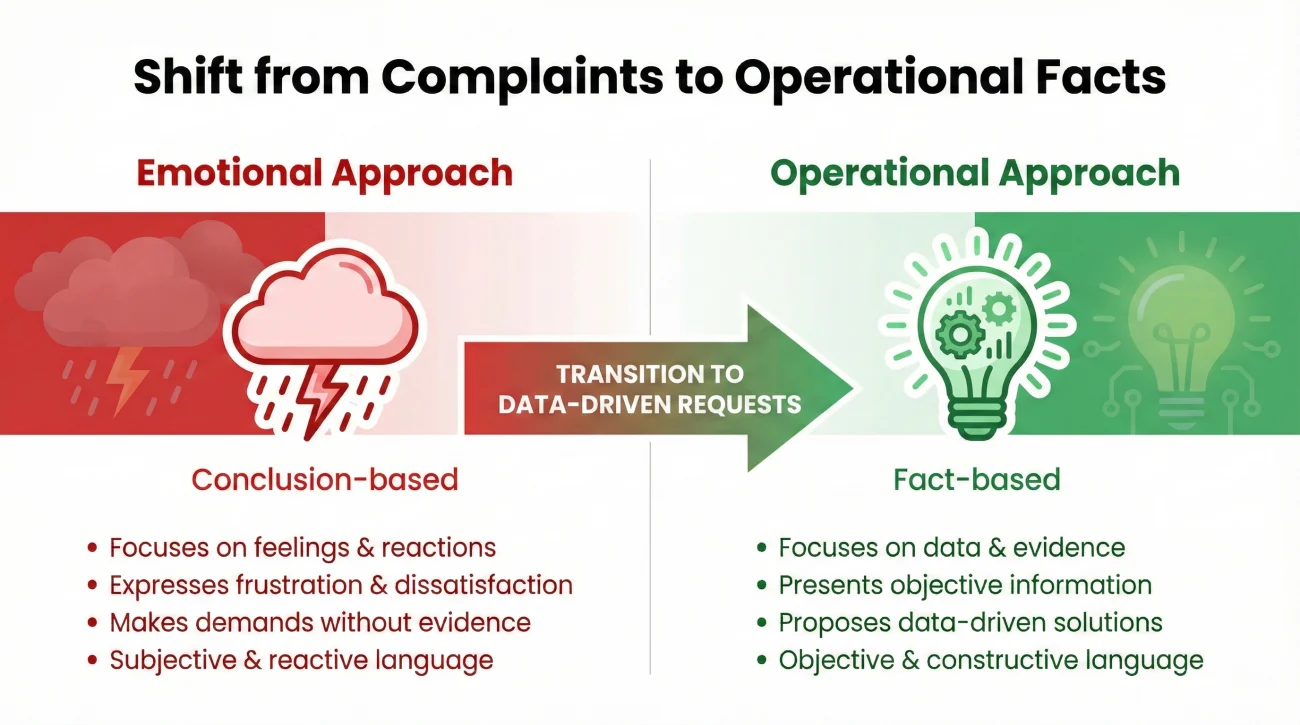
One of the most common mistakes I see is focusing on the conclusion rather than the evidence. Saying “your estimate is too low” or “your decision is wrong” is a conclusion. The adjuster on the other side of the screen cannot do anything with a conclusion. They can only work with new facts that challenge their previous assumptions.
To successfully request a reconsideration, you must present new, organized information. If you just ask them to review the exact same photos and the exact same notes they already looked at, they will almost always arrive at the exact same answer. You need to introduce a variable they missed or a detail that was incorrectly documented during the initial inspection.
🗝️Key Point: A successful reconsideration request does not rely on persuasion. It relies on presenting a factual gap that is so clear, the adjuster has an operational obligation to address it.
This is why you must separate your feelings from the data. You are acting as a project manager for your own home. Your job is to audit their work, find the discrepancy, and point it out neutrally. When I review a well-organized file, it is immediately obvious when a homeowner has structured their points correctly because the facts do the heavy lifting for them.
“I cannot believe you are denying the water damage to my kitchen cabinets. Your inspector barely looked at them and you are completely ignoring the fact that the water sat there for three days. You need to look at this again immediately.”
“The initial evaluation states that the lower kitchen cabinets were not affected by standing water. However, I have attached a report from the mitigation vendor showing moisture readings of 95% taken on the back panels of those specific cabinets on the date of loss.”
The Content Checklist: Building Your Request
Because we want to avoid using generic templates that can easily be ignored, I want to teach you the structural components of a highly effective request. When you sit down to draft your message or email, it must contain three distinct sections: the Facts, the Gaps, and the Questions. Let us break down exactly what goes into each part.
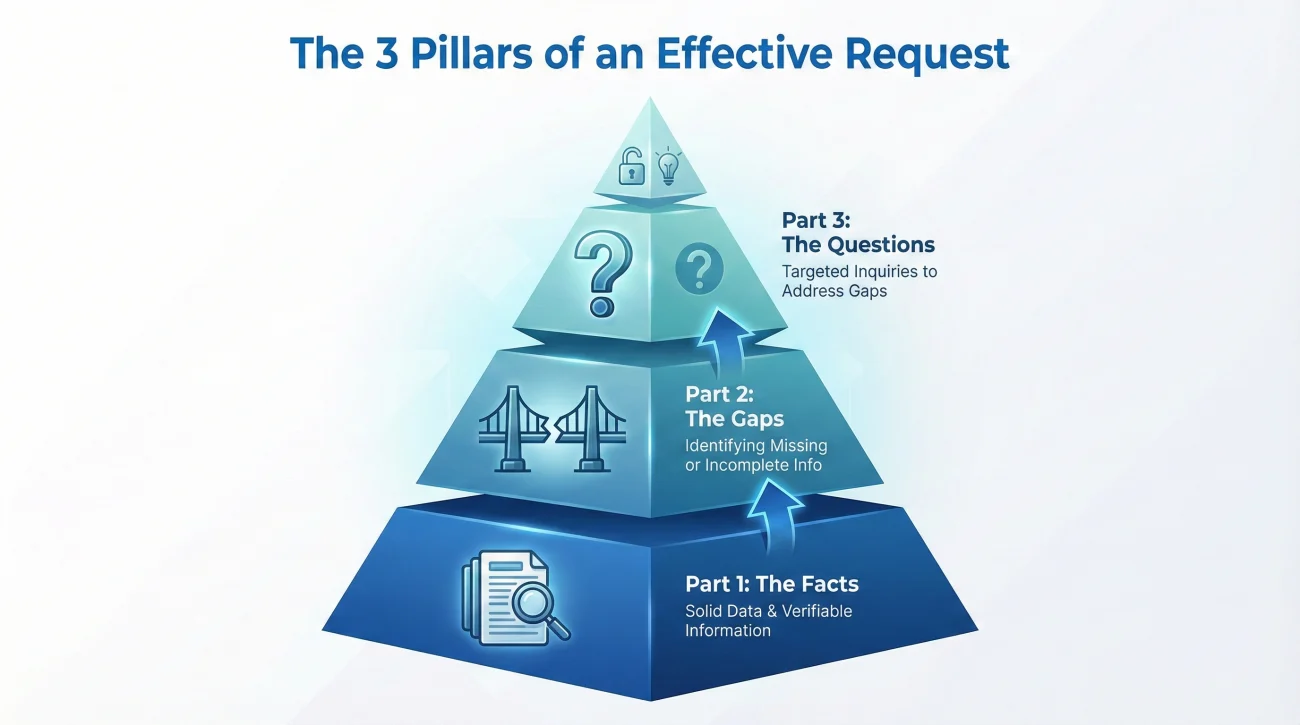
Part 1: The Facts (What is Documented)
Start by establishing the baseline reality. You need to state what is currently known and documented, without adding any commentary. This shows the adjuster that you are operating from the same set of documents they are.
- ✅ List the exact date of their last decision or estimate.
- ✅ Name the specific document you are referencing (e.g., “Estimate revision 2 dated October 14”).
- ✅ Identify the specific line item or room that is in dispute.
- ✅ State the new fact or evidence you are submitting right now.
By framing the facts clearly, you are creating a map for the adjuster. They know exactly which file to open, which page to look at, and what new piece of paper you want them to compare it against.
Part 2: The Gaps (Where the Disconnect Lives)
This is the most critical part of the entire process. A gap is the space between what their document says and what your evidence proves. You are not saying they are lying; you are simply pointing out that their documentation is incomplete based on the new facts.
In my experience, almost every successful reconsideration targets one of three specific types of gaps:
- 📄 Scope Gaps: Their estimate is missing a specific line item entirely (like baseboards or secondary roof vents).
- 📸 Causation Gaps: They assumed the damage was old, but you have a new vendor report or photo proving it occurred during the covered event.
- 📐 Material Gaps: They priced a generic repair, but manufacturer specifications explicitly require a different method or total replacement.
In my daily operational work, I see files get stuck because the homeowner never actually names the gap. They just send in a 40-page contractor estimate and hope the adjuster figures it out. Adjusters are handling dozens of files; they do not have the time to hunt for the discrepancy. You have to highlight it for them.
⚠️ Warning: Never submit a massive pile of new documents without an index. If you have a gap, name it explicitly. Point to the exact page or photo when possible.
Here is an example of naming a gap operationally:
New Fact: The attached manufacturer specification sheet (Page 2, highlighted) explicitly states this specific flooring material cannot be patched or spliced, and the entire continuous run must be replaced.
Part 3: The Questions (Forcing a Review)
Statements can be ignored. Questions must be answered. This is a fundamental rule of communication hygiene in claims handling. If you just state that their estimate is wrong, they can read it and move on. If you ask a direct, operational question about how to resolve the gap, it stays on their desk until they provide an answer.
Your questions should never be rhetorical or sarcastic. They should be neutral requests for next steps. You want to ask them how they plan to reconcile the new facts with their old decision.
“Can’t you see from the pictures that the whole floor is ruined and your estimate makes no sense?”
“Based on the attached moisture readings, will you be revising the scope to include the subfloor, or do you need to send an inspector back out?”
Here are 5 operational questions that force a decision. Use these to anchor your request:
- ✅ “Which specific document line supports the decision to exclude [Item]?”
- ✅ “What additional documentation would satisfy your requirement to cover [Disputed Issue]?”
- ✅ “Based on the new vendor report, will you reopen the scope or schedule a reinspection?”
- ✅ “How does your team plan to address the manufacturer requirements highlighted on page 2?”
- ✅ “Can you please confirm receipt of these new photos and provide a timeline for the updated review?”
The Recap Fields: How to Format the Top of Your Message
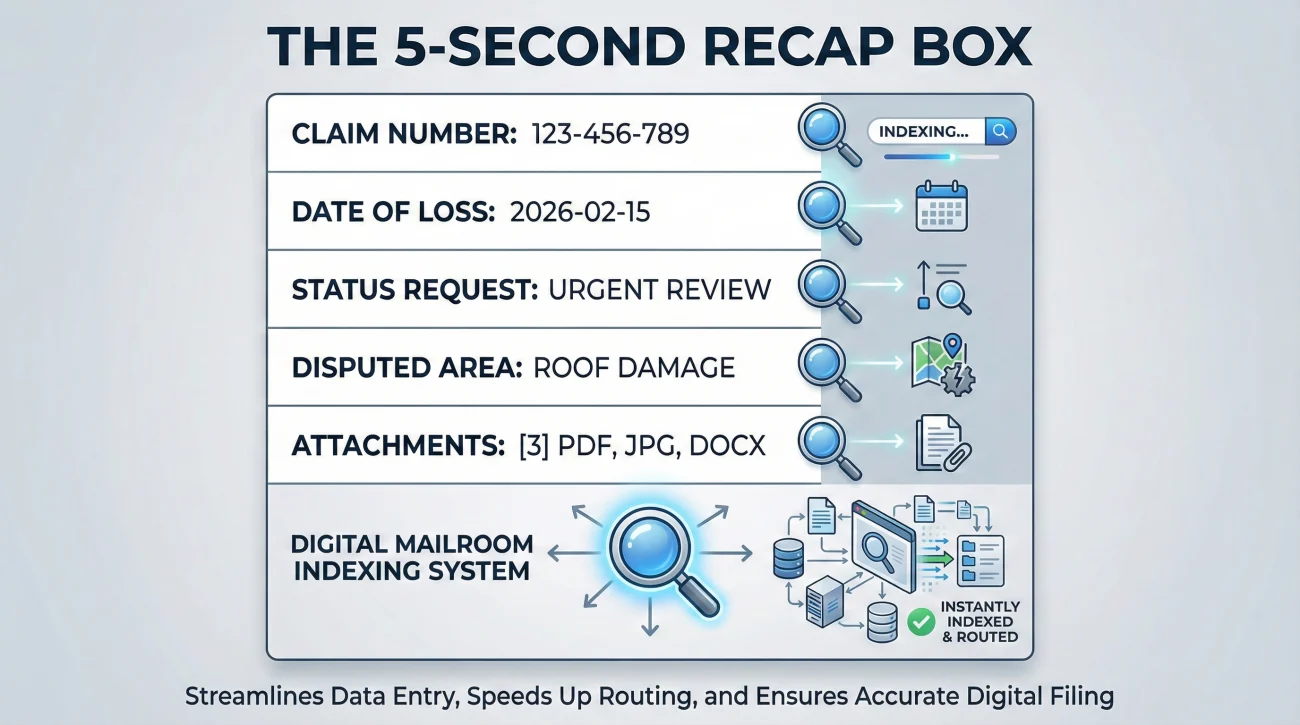
The way your document looks is just as important as what it says. When mail enters an insurance company, it is often scanned by a digital mailroom. A human or an automated system looks at the top few inches of the page to decide where it belongs. If it looks like a general complaint, it might go to a low-priority queue. If it looks like structured claim data, it gets routed to the active handler.
I always recommend putting a “Recap Box” at the very top of your email or letter. This acts like a routing slip. It tells everyone who touches the file exactly what is going on in five seconds or less.
| Field Name | What to Include |
|---|---|
| Claim Number | Your exact claim number (and policy number if required). |
| Date of Loss | The date the damage occurred. |
| Status Request | “Request for Reconsideration based on new documentation.” |
| Disputed Area | Specifically name the room or system (e.g., “Primary Bathroom Plumbing”). |
| Attachments Included | A numbered list of exactly what is attached to this message. |
By using these recap fields, you strip away the emotion and present a highly professional, organized front. Once the adjuster sees this block of data, they know they are dealing with someone who understands the process. It sets a completely different tone for the interaction.
A Realistic Mini-Scenario: Putting the Pieces Together
Let us look at a practical scenario to see how this works in the real world. Imagine a homeowner who had a severe windstorm damage their fence. The initial decision from the insurer was to replace only three panels of the fence, claiming the rest could be repaired.
The homeowner knows the entire fence is leaning and the posts are snapped below the dirt line, which the original inspector missed because they did not dig around the base. The homeowner wants to ask for a reconsideration.
Instead of calling and yelling at the adjuster, the homeowner takes a structured approach. First, they have a fencing contractor come out and dig away the dirt, taking clear, well-lit photos of the snapped posts beneath the surface. They ask the contractor for a short, written statement explaining that the structural integrity of the entire line is compromised.
Then, the homeowner builds their request. They use the recap fields at the top. In the “Facts” section, they note that the original estimate only accounted for above-ground visual damage. In the “Gaps” section, they clearly state that the new photos reveal sub-surface structural failure that was previously undocumented. Finally, they close with operational questions.
2. Does your team need to send an inspector back out to view the excavated posts, or is the attached vendor documentation sufficient for your review?
This approach works because it is entirely neutral. The homeowner is not accusing the first inspector of being lazy; they are simply stating that sub-surface damage was not visible then, but it is visible now. They provided the proof, named the gap, and asked a question that forces a routing decision. This is how you keep a claim moving forward.
Field Note: Where Reconsideration Requests Go to Die
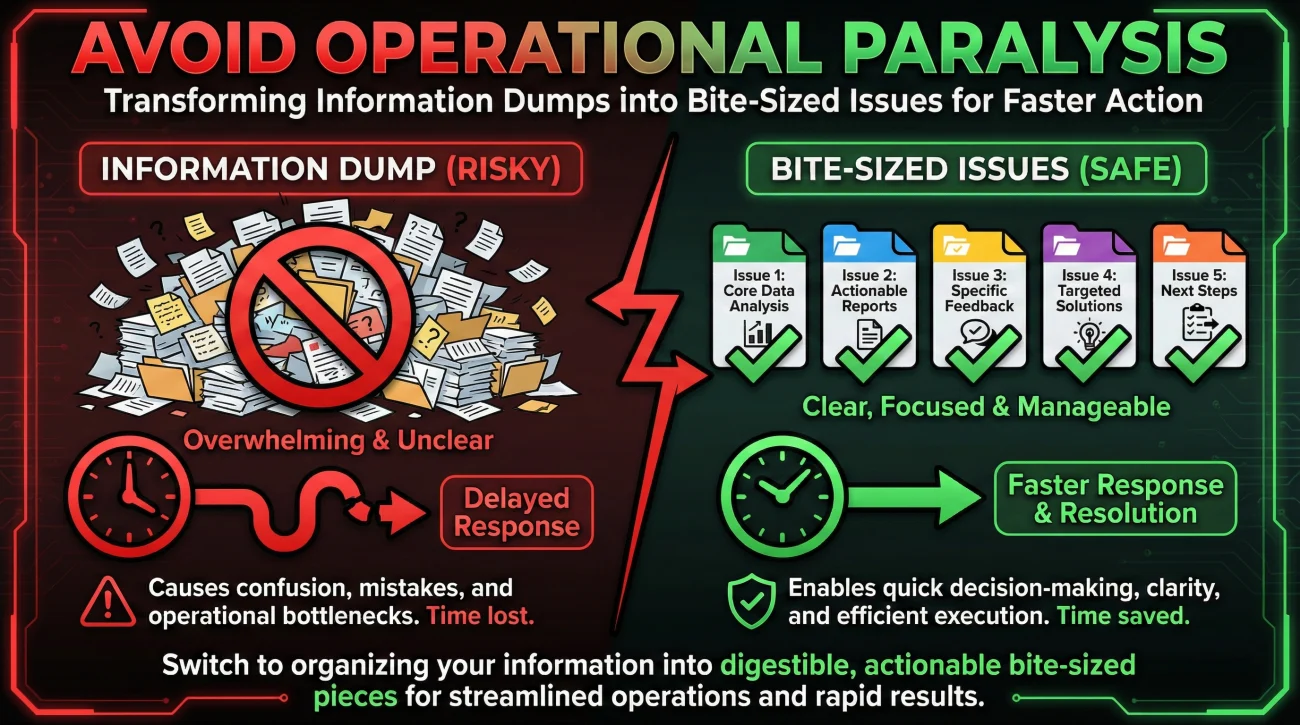
I want to share a pattern I see constantly in claims operations. A homeowner will spend hours compiling a massive email with twenty attachments, links to weather reports, and a long narrative. They hit send, and then… nothing happens for weeks.
Key Point: Information dumps without clear direction cause operational paralysis.
When an adjuster opens an email with twenty attachments and no clear gap analysis, their operational brain shuts down. They look at it, realize it will take them three hours to decipher what the homeowner wants, and they flag it for “later.” In the claims world, “later” often means it sits at the bottom of the queue while the adjuster handles the easy, organized files first.
If you want a fast response, make it easy for them to respond. Break your request into bite-sized, specific issues. If you have five different things you want reconsidered, it is often better to group them logically and present them as clear, separate line items. Do not make the adjuster hunt for the reason you are writing to them.
Micro-Checklist: What Not to Attach
To avoid triggering that operational paralysis, strictly control what goes into your email. Do not attach:
- ❌ Weather screenshots: Unless explicitly asked, do not send broad weather maps. Insurers rely on their own meteorological data.
- ❌ Long narratives: Your detailed diary of the event will bury the operational facts. Keep it strictly to the damage gaps.
- ❌ Duplicate photos: Sending 30 slightly different angles of the same corner just creates clutter. Pick the 2 or 3 clearest shots.
- ❌ Links requiring a login: Never send a link to a private Google Drive or cloud folder. Attach standard PDFs or image files directly, or they won’t open them.
Managing the Follow-Up After the Request
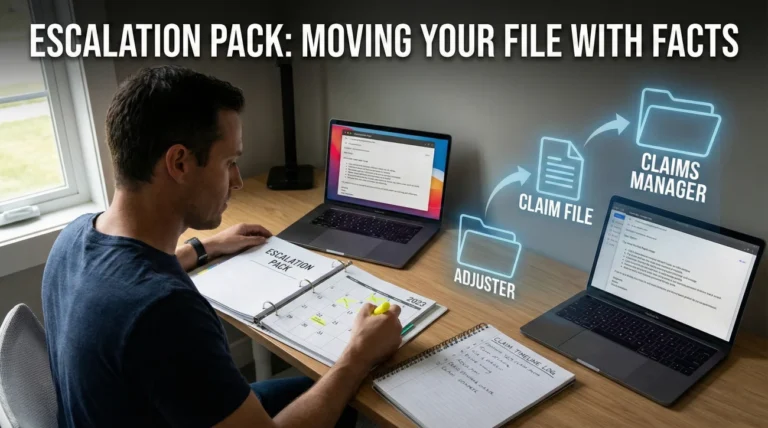
Once you send your beautifully structured reconsideration request, your job is not quite done. You now have to manage the timeline. Because a reconsideration is essentially asking the company to do extra work on a file they thought was finished, it can easily slide off their radar.
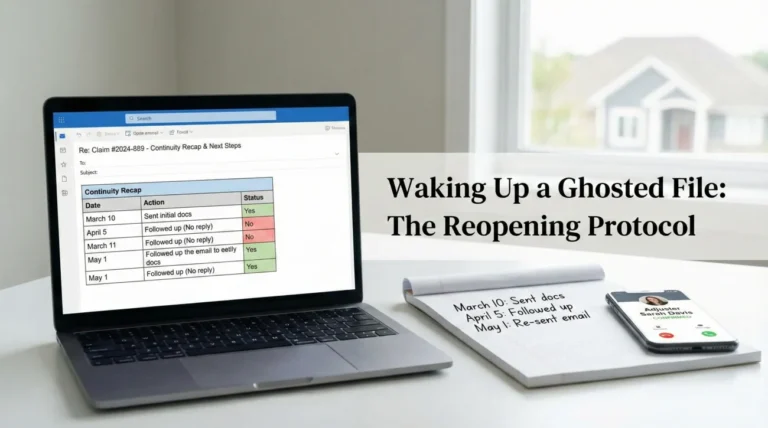
This is where having a reliable claim follow-up system becomes absolutely critical. You cannot just send the request and wait passively. You need to track when you sent it, who you sent it to, and when you plan to follow up.
💡 Pro Tip: Give them a reasonable amount of time to review the new information, usually about a week, before you initiate a follow-up action.
When you do follow up, keep it strictly tied to the questions you originally asked. Do not start a new argument. Simply refer back to the exact date you sent the recap fields, note that you are looking for an update on the review process, and ask if they need any clarification on the specific gaps you highlighted. This keeps the conversation anchored to the facts and prevents the file from drifting into limbo.
Final
Asking an insurance company to look at a file again can feel like an uphill battle, but it becomes much more manageable when you treat it as an operational process. Remember that the people reading your file are dealing with high volumes and rigid systems. By removing the emotion, laying out the facts, explicitly naming the gaps, and asking direct questions, you speak their language.
You do not need to be a claims expert to get a file reviewed again. You just need to be organized, persistent, and incredibly clear about what new information you are bringing to the table. Keep your records straight, use the recap fields to guide their attention, and never leave an email without a specific question that requires an answer. That is how you keep your claim active and moving toward a proper resolution.
❓ FAQ
📝 How do I ask my insurance company to reconsider a claim?
You ask by submitting a structured request that includes new facts or evidence, explicitly points out the gap between their initial decision and the new reality, and asks a direct question about how they will resolve the discrepancy.
⏱️ How long does a claim reconsideration take?
Timelines vary widely, but typically you should allow 5 to 7 business days for an adjuster to review new documents. It is crucial to have a follow-up routine in place so the request does not stall indefinitely.
📄 What evidence do I need to reopen an insurance claim?
You need new, documented facts that were not considered in the first review. This usually means a detailed vendor report, new photographs revealing hidden damage, or manufacturer specifications that contradict the initial estimate.
🤔 Is a reconsideration the same as an appeal?
Operationally, a reconsideration is simply asking the current desk adjuster or their immediate supervisor to look at new evidence. An appeal often refers to a more formal, structured process depending on the specific company’s internal guidelines.
📞 Should I call or email my reconsideration request?
Always submit the request and the new evidence in writing (via email or the portal) so there is a documented trail. You can follow up with a phone call to discuss the email, but the facts must be captured in text first.
❌ What happens if my reconsideration request is ignored?
If your written request and subsequent follow-ups are ignored, you use your communication log to demonstrate the delay and escalate the file to a supervisor, pointing out that your specific questions have gone unanswered.
👀 Who actually reads a reconsideration request?
Initially, it may be indexed by a mailroom clerk or automated system. Once properly routed, it is usually read by your assigned desk adjuster. If the new evidence warrants it, a claims supervisor or manager may also review the file.
🏗️ Can I ask for a different adjuster during a reconsideration?
You can ask, but reassignments are usually based on internal workload, not requests. It is often more effective to clearly document the gaps with your current adjuster and escalate to their manager if the facts are still being ignored.
📐 Do I need a contractor’s estimate to ask for a review?
While a full estimate is helpful, what you really need is documented proof of the gap. A targeted report, a specific measurement, or a professional written opinion on a single disputed item can be enough to trigger a review.
🔄 How many times can I ask them to look at my claim again?
There is no strict operational limit, as long as you are presenting new, relevant facts each time. However, repeatedly submitting the exact same information without new evidence will usually result in the file being closed again.
⚠️ Disclaimer: PropertyClaimChecklist.com provides practical guidance, process checklists, and example follow-ups to help you organize a property claim and move it forward. It is not policy language, claim documentation, legal content, or a substitute for your insurer's instructions. Always rely on your carrier's requirements and your actual policy terms for what must be submitted and how decisions are made.