
- The “Math First” Rule: Never file a claim until you know your deductible amount and have a rough estimate of the repair costs; if the damage is close to the deductible, filing is often a financial loss.
- The “Zero-Pay” Trap: Opening a claim just to “ask a question” or “have someone look at it” can create a record on your C.L.U.E. report, even if the insurance company pays nothing.
- Long-Term Impact: A single claim can lead to rate increases or non-renewal; preserve your policy for catastrophic losses (fires, major storms) rather than maintenance issues or small repairs.
The “Free Money” Myth vs. Operational Reality
In the claims operations world, there is a specific type of phone call that is difficult to handle. It usually happens about six months after a minor incident. A homeowner calls in, frustrated and confused, asking why their insurance premium just jumped or why they received a non-renewal notice. They often say, “But the insurance company didn’t even pay me anything! I just called to ask about the damage.”
This is the harsh reality of property insurance: it is not a maintenance plan, and it is not a savings account you draw from when things break. It is a risk transfer mechanism designed for catastrophic financial loss.
Deciding whether to file a home insurance claim is one of the most critical financial decisions a homeowner makes, yet it is often done in a moment of panic. The water is spreading, or the window is broken, and the instinct is to “get the process started.” But once that lever is pulled, it can be hard to reverse, and a record is often created.
From an operational perspective, “nuisance claims” – small losses that fall near the deductible – often cause more long-term financial friction than the repair cost itself. This guide acts as a decision checklist to help you gather facts and do the math before you alert the insurance carrier, distinguishing between a viable claim and a repair best handled out of pocket.
The “Math First” Rule: Deductible vs. Damages
The very first step in your decision process has nothing to do with calling an agent. It has to do with your own policy documents. You need to know your deductible. In many modern policies, this is no longer a flat $500 or $1,000. It is often a percentage of your home’s insured value (Coverage A), especially for wind or hail claims.
If your home is insured for $400,000 and you have a 2% wind deductible, your responsibility is the first $8,000 of damage. If a storm blows off a few shingles and the repair cost is $6,500, filing a claim is mathematically the wrong move. You would receive $0, but you would still get a “claim filed” mark on your claim history.
⚠️ Warning: Do not guess your deductible. Log into your portal or check your declarations page (the “Dec Page”) specifically for the type of peril you are facing (e.g., “Wind/Hail Deductible” vs. “All Other Perils”).
The general operational rule is simple: if the estimated repair cost is not significantly higher than your deductible, the claim is likely not worth the long-term cost.
| Damage Estimate | Deductible | Potential Payout | Operational Verdict |
|---|---|---|---|
| $1,200 | $1,000 | $200 | Do Not File. The $200 payout is not worth the surcharge risk. |
| $4,000 | $1,000 | $3,000 | Pause. Consider claim history and future insurability. |
| $25,000 | $1,000 | $24,000 | File. This is what insurance is for. |
To get these numbers, you need a rough idea of repair costs. This does not mean you need a forensic estimate, but you do need a sanity check. Call a local handyman or contractor for a “ballpark” figure or a cash bid. If you’re still deciding, you can ask for a cash estimate first.
How C.L.U.E. Records Work

Many homeowners believe that if the insurance company doesn’t pay, the claim “didn’t happen.” This is often not how it plays out. Insurance carriers contribute to a shared database called the Comprehensive Loss Underwriting Exchange (C.L.U.E.).
When you call your carrier’s claims department to “just ask a question” about damage, or when you open a claim that falls below the deductible, an entry can often be created. This entry records the date, the type of loss (e.g., “Water”), and the status. A status of “Closed Without Payment” (CWP) is often recorded as a claim. To future insurers, this may signal that the property has issues or that the homeowner is prone to filing claims.
Key Point: Your insurance history often follows you and the house for around 5 to 7 years, depending on carrier rules and state regulations. Too many inquiries or low-value claims can limit your options in the standard market.
I have reviewed files where a homeowner filed three small claims in three years – one for a lost ring, one for a minor fence repair, and one for a small kitchen leak. Each payout was under $2,000. When their policy came up for renewal, they were dropped. The only replacement coverage they could find was significantly more expensive with higher deductibles.
Before you pick up the phone, ensure you are following the correct order of operations. Start with your agent or policy services for general policy details. If you decide to file, then call claims.
Sudden vs. Gradual: The Coverage Filter
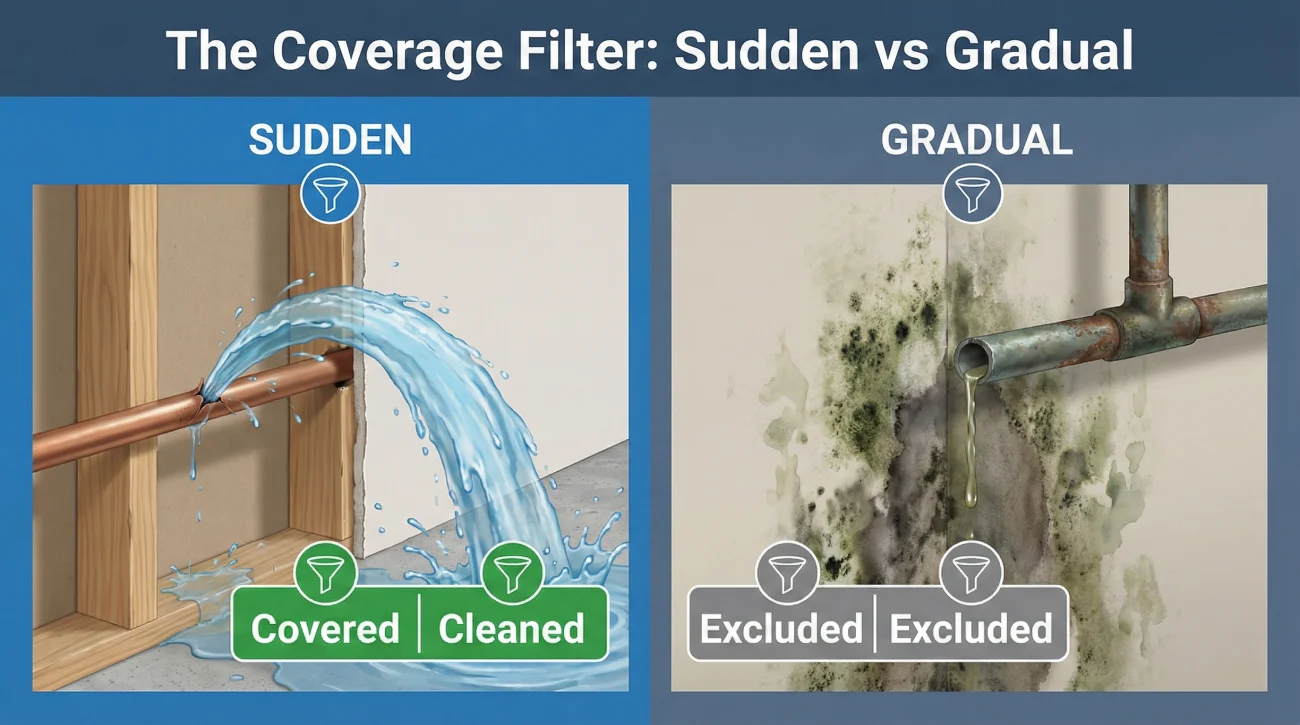
Insurance covers “sudden and accidental” loss. It typically excludes “maintenance, wear and tear, and gradual deterioration.” A common mistake I see in operations is homeowners filing claims for issues that have been happening slowly over time.
If a pipe bursts at 2:00 PM on a Tuesday and floods the kitchen, that is sudden. If a shower pan has been slowly leaking behind the tile for six months and you finally notice rot in the subfloor, that is often considered maintenance or long-term neglect. Filing a claim for the latter frequently results in a denial.
Review the facts of your loss. Can you pinpoint the exact moment the damage occurred? If the answer is “no, it just sort of appeared over time,” you may be at higher risk of a denial. A denial can be a difficult operational outcome: it can still leave a record depending on how it’s handled, but you may receive zero dollars to fix the problem.
Scenario: The “Just Checking” Mistake
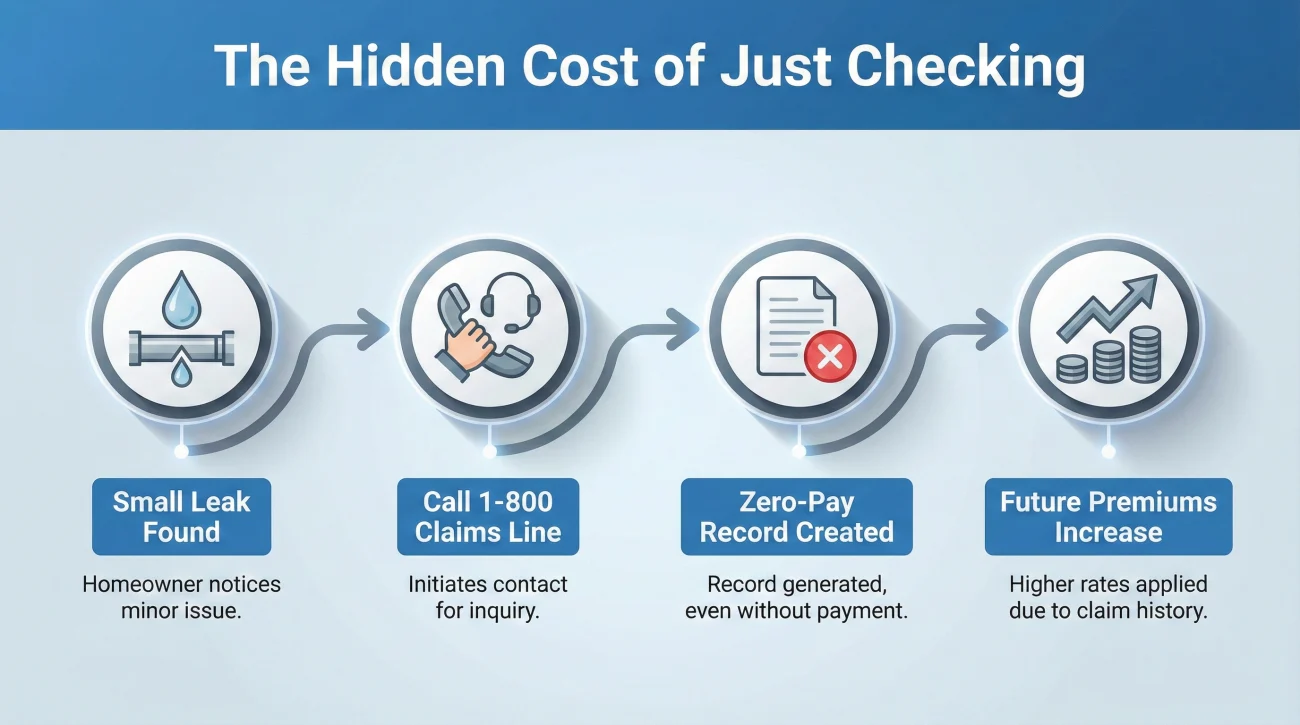
Let’s look at a realistic operational scenario to see how this plays out in the real world. This is a composite of many files I’ve seen.
The Situation:
A homeowner notices a water stain on their living room ceiling. They aren’t sure where it’s coming from – maybe the upstairs bathroom. They panic and call their insurance company’s 1-800 number. They say, “I have a leak, I don’t know how bad it is, I just want to see if it’s covered.”
The Operational Trigger:
The representative may be required to open a claim to document the call. They assign a claim number. They send out an adjuster.
The Outcome:
The adjuster arrives and finds that the toilet wax ring upstairs has been leaking for months. The cost to replace the drywall and paint the ceiling is $900. The wax ring replacement is maintenance (not covered).
The deductible is $1,000.
The carrier may issue a denial letter for the wax ring and a “below deductible” letter for the ceiling damage. The homeowner may receive $0.
The Aftermath:
Six months later, the homeowner shops for new insurance. The new quote may come back higher, especially with a water-related record. Over the next five years, that phone call costs them significantly in extra premiums.
The Better Path:
The homeowner should have called a plumber first to stop the leak ($150) and a painter to estimate the ceiling repair ($750). Realizing the total ($900) was under their deductible, they would pay out of pocket, keep their insurance record clean, and save the insurance policy for a major disaster.
How to Clarify Your Policy Before Opening a Claim
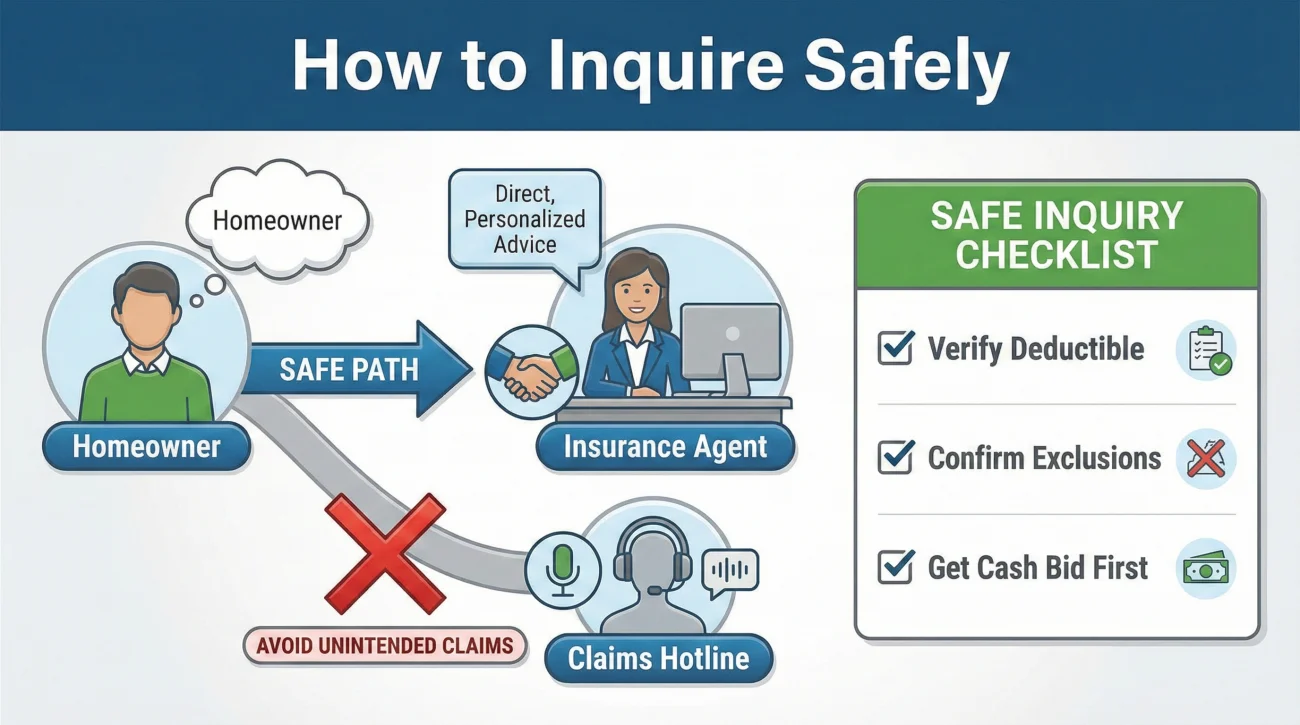
If you need to understand your coverage but are unsure if you should open a claim, you need to know who to ask and how to ask. If you’re not ready to open a claim yet, start with your agent or policy services.
If you deal directly with a large call center carrier, you can ask to speak to “Policy Services” or “Customer Service” to review your deductible and coverage limits for general policy clarification.
Here is a script for checking your policy limits before opening a claim:
Context: General Policy Review”Hi, I am reviewing my household budget and need to clarify my current policy details. I am not reporting a loss right now.Can you please confirm what my deductible amount is for wind damage versus other types of damage? Also, does my policy currently have any exclusions for water damage or cosmetic roof damage?I just need the current coverage numbers for my records.”
💡 Pro Tip: If you are unsure about the damage cost, pay a reputable local contractor a “trip charge” (usually $75-$150) to inspect the damage and write a cash estimate. Tell them explicitly: “I am deciding whether to file a claim, so I need a realistic cash price for the repair.”
The Decision Checklist
Before you dial the claims hotline, run through this checklist. If you answer “No” to the financial logic questions, you should strongly consider handling the issue yourself.
- ✅ 1. Is everyone safe? (Safety is always priority one).
- ✅ 2. Is the source of damage stopped? (You have a duty to mitigate damages).
- ✅ 3. Do I know my deductible? (Check your Dec Page).
- ✅ 4. Do I have a rough repair estimate? (Is it at least 2x or 3x the deductible?).
- ✅ 5. Is the damage “sudden and accidental”? (Not rot, rust, or long-term wear).
- ✅ 6. Is my claim history clean? (Have I filed other claims in the last 3-5 years?).
If the repair estimate is $5,000 and your deductible is $1,000, filing usually makes sense. If the estimate is $1,200 and the deductible is $1,000, paying out of pocket is the smart operational play.
Remember, filing a claim is the start of a long administrative process involving inspections, documentation, and negotiations. It requires time and energy. Save that energy for losses that you truly cannot afford to cover yourself.
Field Note: The “Loss of Use” Factor
One variable that homeowners often forget in their math is “Additional Living Expenses” (ALE) or Loss of Use. In my experience with large claims, this is often the tipping point.
If your kitchen has a small fire, the physical damage might be $10,000. But if the smoke damage means you cannot live in the house for three months while they remediate, you will incur thousands of dollars in hotel bills or temporary rental costs. This makes the claim value much higher than just the repair bill.
However, for a small bathroom leak where you can still live in the home, ALE is rarely triggered. When doing your “should I file” math, only include ALE if the home is genuinely uninhabitable (no running water, no electricity, active biohazard, or structurally unsafe). If you are just inconvenienced, do not assume insurance will pay for a hotel.
What to Do Next
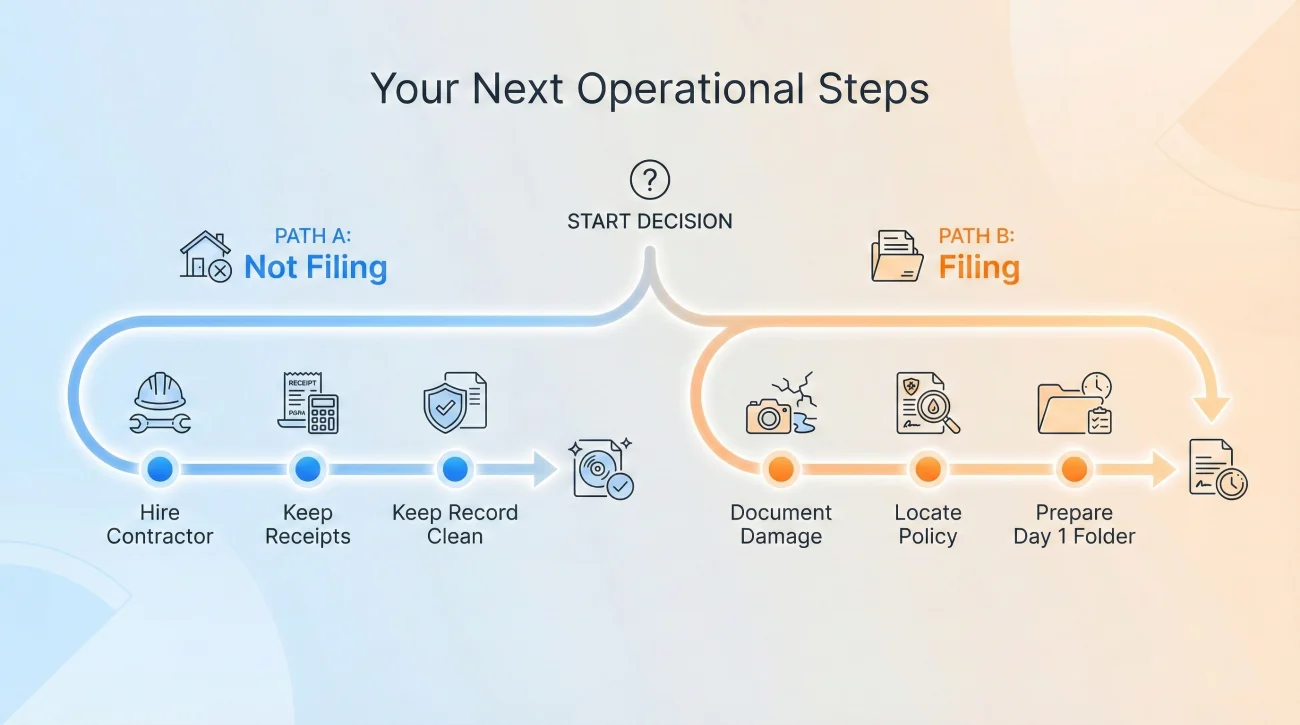
If you have gone through the checklist and decided NOT to file:
- Proceed with repairs using your chosen contractor.
- Keep the receipts anyway (just in case further hidden damage is discovered later that turns it into a major loss – though this gets tricky with “late reporting,” having proof of what you fixed helps).
- Monitor the repair to ensure the root cause is fixed.
If you have decided TO FILE:
- Document everything before you clean up (photos, videos).
- Locate your policy number.
- Prepare your “Day 1” folder.
- For a detailed guide on what paperwork you will need next, review the Proof of Loss Playbook to understand the documentation road ahead.
Final Thoughts
The insurance system is designed to protect you from financial ruin, not financial inconvenience. By treating your policy like a shield for major battles rather than a tool for minor repairs, you keep your coverage healthy and your premiums stable. Use the checklist, get a cash bid first, and make the decision with a calculator, not just emotion.
❓ FAQ
🏠 Is it worth claiming $1000 on house insurance?
Usually, no. If your deductible is $500 or $1,000, the small payout isn’t worth the risk of a premium increase or a “claim filed” mark on your history, which can affect you for years.
💰 How much does insurance go up after a claim?
It varies by state and carrier, but premiums can often see a noticeable increase after a single claim. Two claims in a short period can lead to a non-renewal notice.
🛠️ Can I fix it myself and then file a claim?
You can do emergency repairs to stop further damage, but do not complete permanent repairs before the adjuster inspects. If you destroy the evidence of the damage, they may deny coverage.
📞 Should I call my insurance agent to ask a question?
Be very careful. If you call the claims line or describe specific damage to a representative, they may open a file depending on how the call is handled, even if you just wanted advice.
🌧️ Is water damage covered by homeowners insurance?
Generally, yes, if it is “sudden and accidental” like a burst pipe. Slow leaks, seepage, or maintenance issues (like an old roof leaking) are typically excluded.
🛑 Can I cancel a claim after I file it?
You can withdraw a claim, but the record of the claim usually stays on your C.L.U.E. report as a “zero pay” claim, which can still affect your rates or eligibility.
⏳ How long do I have to file an insurance claim?
Policies vary, but most require “prompt” reporting. Some states allow up to a year or more, but waiting makes it harder to prove the cause of loss. Check your policy’s “Duties After Loss” section.
📉 Does filing a claim affect my mortgage?
Not directly, but if the claim check is large, the check may be made out to both you and your mortgage company, requiring their endorsement to release funds for repairs.
🔎 What is a C.L.U.E. report?
It is a database shared by insurers that lists your claim history. Insurers check this when deciding whether to offer you a policy and how much to charge you.
🌪️ Does wind damage count toward my deductible?
Often, wind and hail damage have a separate, higher deductible (like 1% or 2% of the home’s value) compared to your standard deductible for fire or theft.
⚠️ Disclaimer: PropertyClaimChecklist.com provides practical guidance, process checklists, and example follow-ups to help you organize a property claim and move it forward. It is not policy language, claim documentation, legal content, or a substitute for your insurer's instructions. Always rely on your carrier's requirements and your actual policy terms for what must be submitted and how decisions are made.