
- The “Scope First” Rule: Try not to argue about price ($) until you have agreed on scope (items). Most low estimates are not “underpriced”; they are “under-scoped” (missing line items).
- The Software Reality: Adjusters use software (like Xactimate) that relies on specific inputs. If you don’t give the software the right input (e.g., “high-grade shingle” vs. “standard”), it will output the wrong price.
- The “Supplement” Process: It is normal for the first estimate to be wrong. The “Supplement” is the standard operational workflow to correct it using photos and documentation, not anger.
- Contractor Alignment: A contractor’s bid usually looks different from an insurance estimate. Your job is to translate the contractor’s “lump sum” into the adjuster’s “line items.”
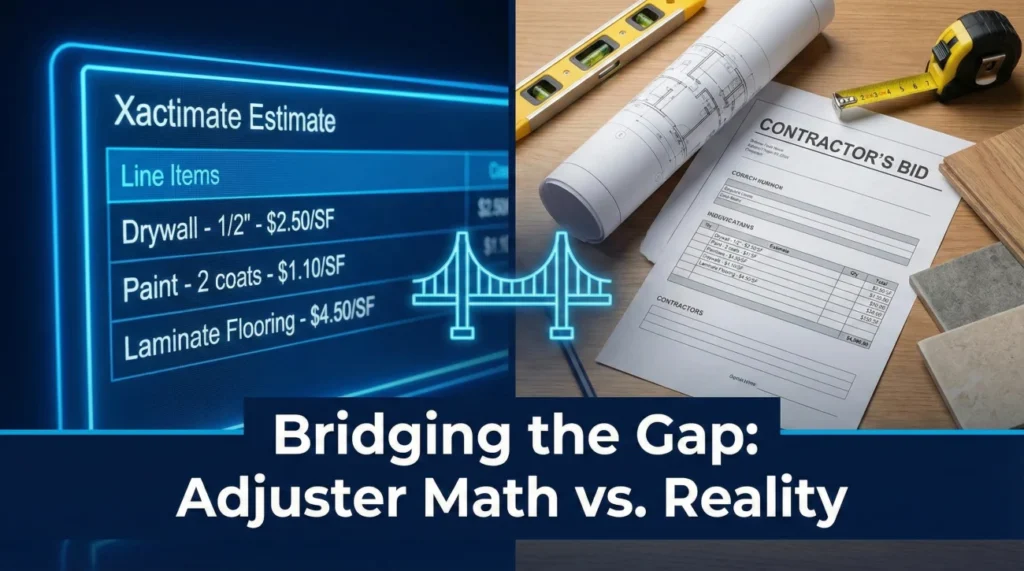
The Gap Between “Adjuster Math” and Construction Reality
Receiving an initial insurance estimate that is significantly lower than your contractor’s bid is a standard part of the claims process. While the immediate reaction is often to assume the insurer is intentionally “lowballing” you, the operational reality is usually less malicious and more mechanical.
Field adjusters often inspect multiple properties a day, spending limited time on site. They input rapid measurements into rigid software (like Xactimate) that relies entirely on specific inputs. If the adjuster forgets to click a specific box – like “debris removal” or “high-grade trim” – the software simply calculates $0 for that item. It is often a data entry error rather than a negotiation tactic.
To bridge this gap, you must stop treating the estimate as a final offer and start treating it as a rough first draft. The system to fix this draft is called the “Supplement Process.” It allows you to audit the line items, identify missing scope, and present a data-backed request to release the funds you are owed.
Phase 1: Decoding the Artifact (Reading the Estimate)
Before you can find what is missing, you have to understand what is there. Insurance estimates are intentionally dense. They are not written for homeowners; they are written for other adjusters. To find the money, you have to learn to read the code.
The Three Layers of an Estimate
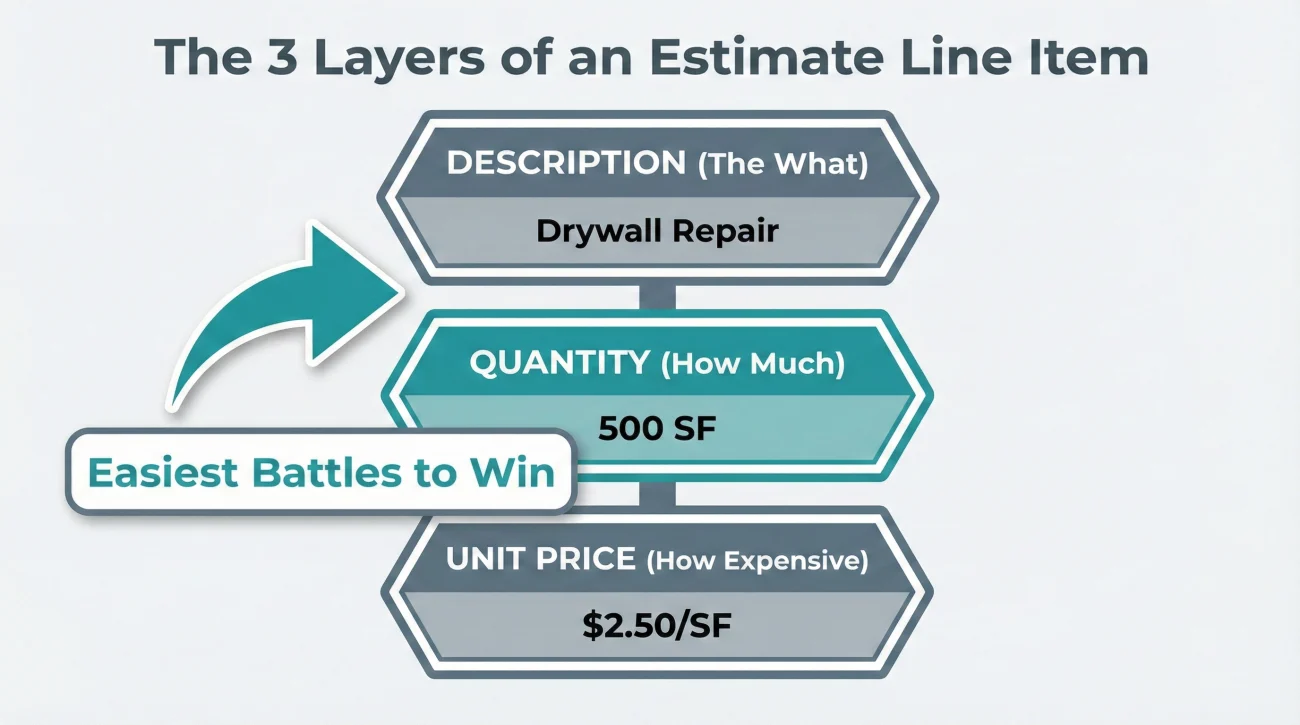
Every line item in a standard estimate tells you three things. If any one of them is wrong, the price is wrong.
- ✅ 1. The Description (What): This is the specific task. Example: “Remove and Replace 1/2 inch Drywall.”
- ✅ 2. The Quantity (How Much): This is the math. Example: “500 SF” (Square Feet).
- ✅ 3. The Unit Price (How Expensive): This is the market rate per unit. Example: “$2.50 per SF.”
Most homeowners argue about #3 (The Price). They say, “My contractor charges more!” This is the hardest battle to win.
The easiest battles to win are #1 and #2. If the adjuster wrote “Repair Drywall” but you need “Replace Drywall,” that is a scope error. If they wrote “400 SF” but the wall is “500 SF,” that is a math error. These are facts, not opinions.
ACV vs. RCV: The “Held Back” Money
You will likely see three columns of numbers at the bottom of the summary page. Misunderstanding these numbers leads to panic.
| Term | What It Means Operationally |
|---|---|
| RCV (Replacement Cost Value) | The total cost to fix the damage with new materials today. This is the “real” number you are aiming for. |
| Depreciation | The value the item lost due to age. If your roof is 10 years old, they deduct value. Crucially, check if this is “Recoverable.” |
| ACV (Actual Cash Value) | The RCV minus Depreciation. This is usually the amount of your first check. |
💡 Pro Tip: If you have a Replacement Cost policy (most homeowners do), the Depreciation is usually “Recoverable.” This means they owe you that money, but they hold it back until you prove you actually finished the work. Do not assume the ACV check is the final amount.
Phase 2: The Scope-Gap Audit (Finding Missing Items)
Now we go on the hunt. You need to walk through your house (or climb into your attic) with the insurance estimate in hand. You are looking for things that exist in the real world but do not exist on the paper.
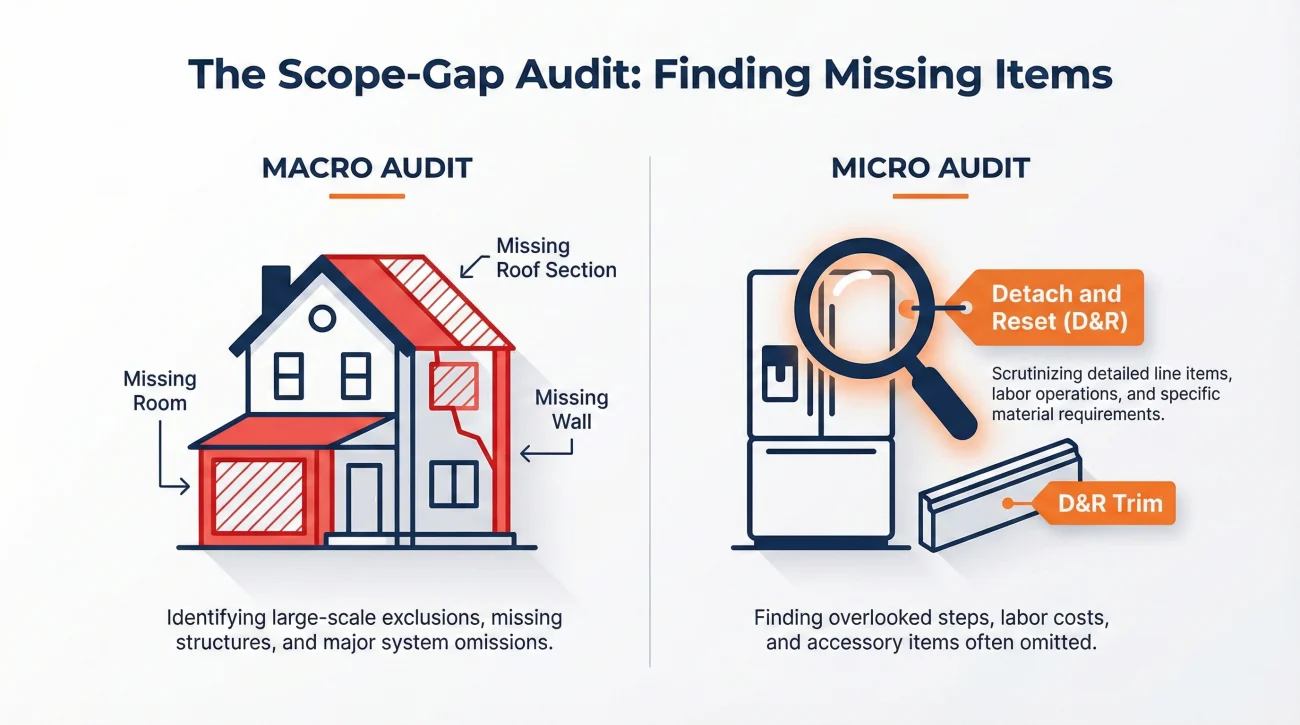
The Macro Check: Missing Rooms and Trades
Start big. Did they include every room that was damaged?
I often see water damage claims where the water ran from the upstairs bathroom, through the ceiling, and onto the living room floor. The estimate covers the ceiling and the floor but completely ignores the walls in between. Or it covers the painting but ignores the baseboards that had to be ripped off to dry the wall.
Ask yourself:
– Does the estimate include painting the entire continuous wall, or just the patch? (Matching paint is nearly impossible; usually, you paint “corner to corner”).
– Does it include moving the furniture (“Content Manipulation”) so the workers can work?
– Does it include covering the floors (“Surface Protection”) so the workers don’t ruin the carpet?
The Micro Check: “Detach and Reset”
This is where thousands of dollars are lost. “Detach and Reset” (D&R) refers to items that are not damaged but must be removed to fix the damaged item behind them.
The estimate pays for: Flooring materials + Labor to install.
The Gap: To install flooring, you must remove the refrigerator, the stove, and the dishwasher. You might need to detach the baseboards. You might need to detach the toilet in the adjacent powder room if the floor runs through.If the estimate does not have line items for “Detach/Reset Refrigerator,” “Detach/Reset Range,” and “Detach/Reset Toilet,” it is under-scoped. The contractor will charge you for this labor. The insurer owes for it.
The Waste Factor
Materials don’t fit perfectly. To cover a 100 SF roof, you need more than 100 SF of shingles because you have to cut them to fit edges and valleys. This is called “Waste.”
Industry standards for waste often range from 10% to 15%. However, for complex roofs with many hips and valleys, the necessary waste factor can be higher, sometimes reaching 20% or 25%. If the estimate allows 10% and your contractor needs 20%, that is a mathematical gap you can prove with a calculation report.
Phase 3: The Contractor Disconnect
You send the adjuster your contractor’s bid. The adjuster rejects it. Why?
Because contractors and adjusters speak different languages.
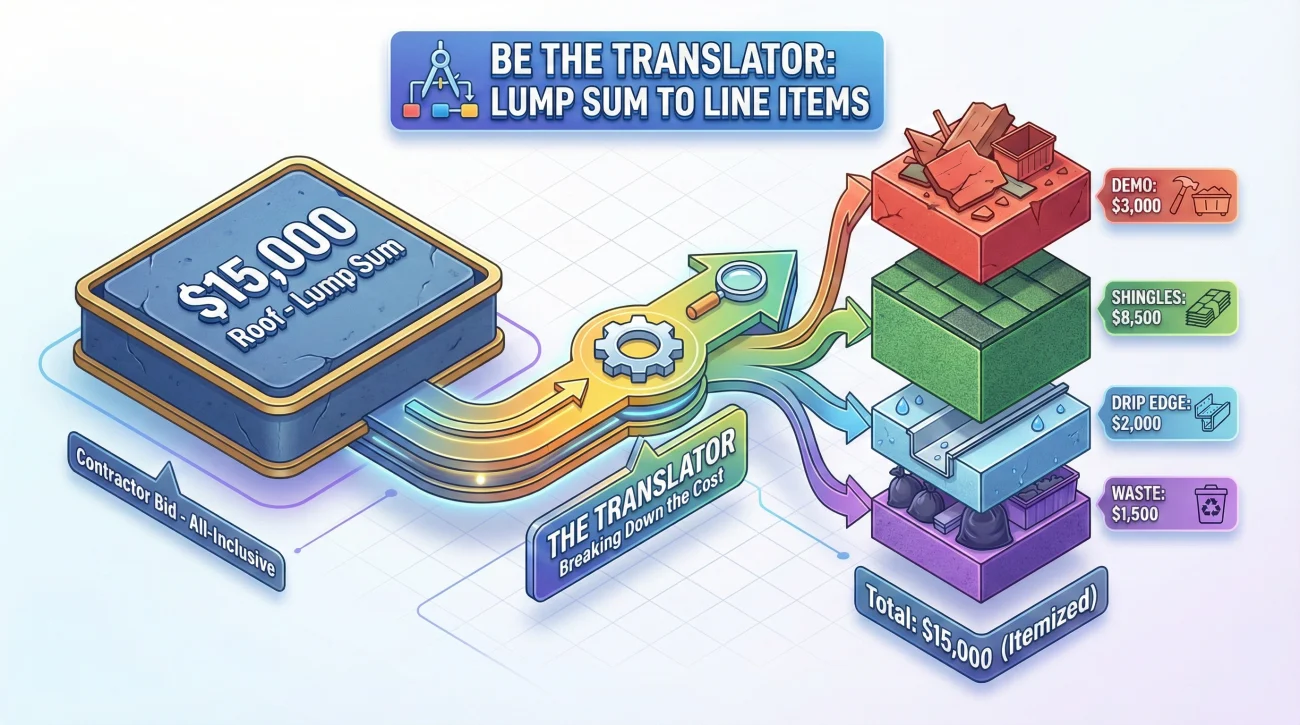
Contractor Language: “Replace Roof: $15,000.” (Lump Sum).
Adjuster Language: “Remove 3-tab shingle: $400. Remove felt: $50. Replace drip edge: $120…” (Line Item).
When you send a lump sum bid, the adjuster cannot “audit” it against their software. They can’t see why it costs $15,000. They just see that it’s higher than their $12,000 total. Their software doesn’t have a button for “Just pay the contractor’s price.”
Your Job: The Translator
Do not just forward the PDF and hope for the best. You (or your contractor) must break down the bid to match the adjuster’s format. You don’t need to use their software codes, but you need to break it down by task.
Instead of “Kitchen Repair: $5,000,” break it down:
- Masking/Protection: $200
- Demolition: $500
- Drywall Hang/Tape/Texture: $1,500
- Painting (2 coats): $800
- Cabinet Detach/Reset: $1,000
- Debris Removal: $300
Now the adjuster can compare line-by-line. They might say, “Okay, we agree on the drywall and paint, but we think the cabinet price is high.” Now you are negotiating $1,000, not the whole $5,000.
Phase 4: Building the Supplement Packet
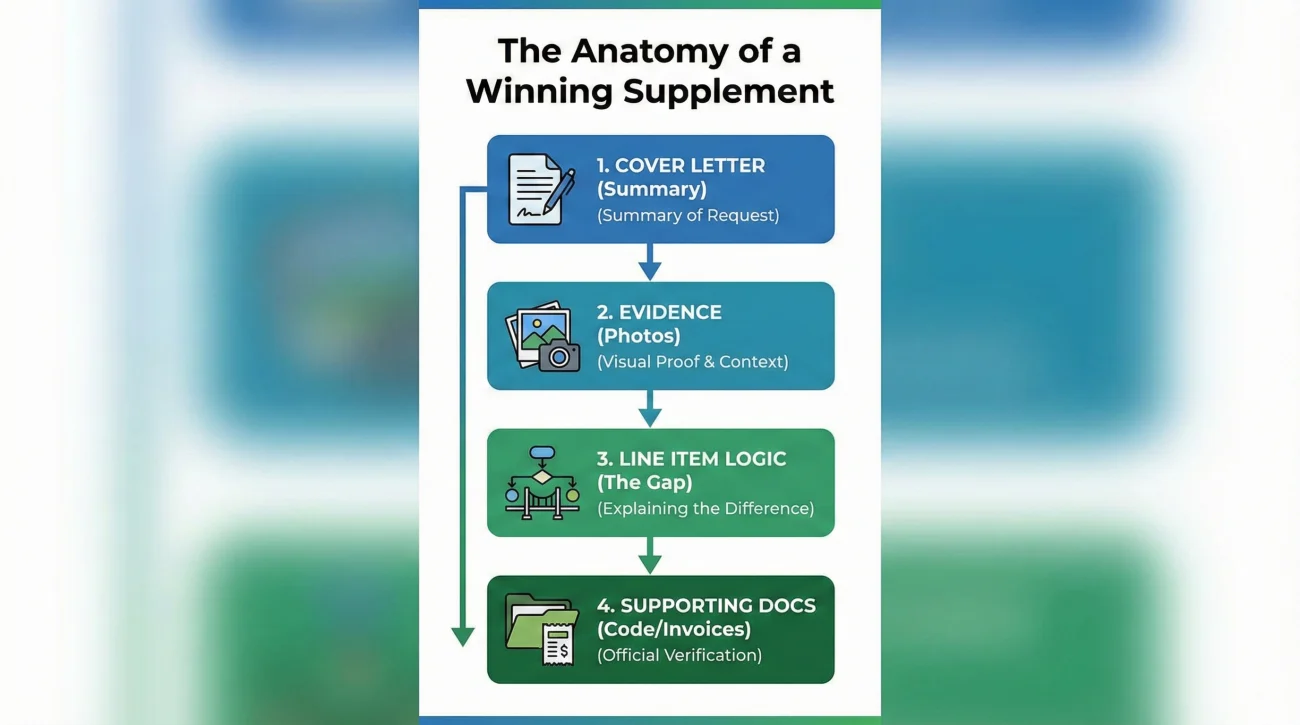
This is the core deliverable of this system. A “Supplement” is a formal request for additional funds based on new information. It is not a complaint; it is a documentation package.
A winning Supplement Packet has a specific order:
- The Cover Letter: A simple summary. “Please find attached documentation supporting a scope correction for Claim #123. Total requested increase: $3,400.”
- The Evidence (Photos): Photos of the specific items missed. If you are asking for “Ice and Water Shield” (a roofing layer), show a photo of the code requirement or the existing layer being removed.
- The Line Item Logic: A list of the specific missing items.
- Supporting Docs: Invoices, sub-bids, or code snippets.
Mini-Scenario: The Roof Supplement
ℹ️ Situation: An adjuster inspects a hail-damaged roof. They write an estimate for “remove and replace shingles.”
💢 The Gap: The contractor points out that the local building code requires “drip edge” (metal flashing) to be installed on all rakes and eaves. The old roof didn’t have it, but the new code says you must add it when replacing the roof.
💡 The Action: The homeowner builds a packet.
1. Photo: Close-up of the roof edge showing no drip edge exists.
2. Document: A PDF download of the City Building Code, highlighting the section “R905.2.8.5 Drip Edge.”
3. Request: “Please add line items for ‘Drip Edge’ material and labor as required by attached ordinance.”
👉 Result: The adjuster adds the line item. It’s an “Ordinance and Law” coverage update. That’s an extra $800 simply by showing the rule.
Phase 5: The Advanced Battlegrounds (O&P and Code)
Two major buckets of money are often left off initial estimates entirely: Overhead & Profit (O&P) and Ordinance & Law.
General Contractor Overhead & Profit (O&P)
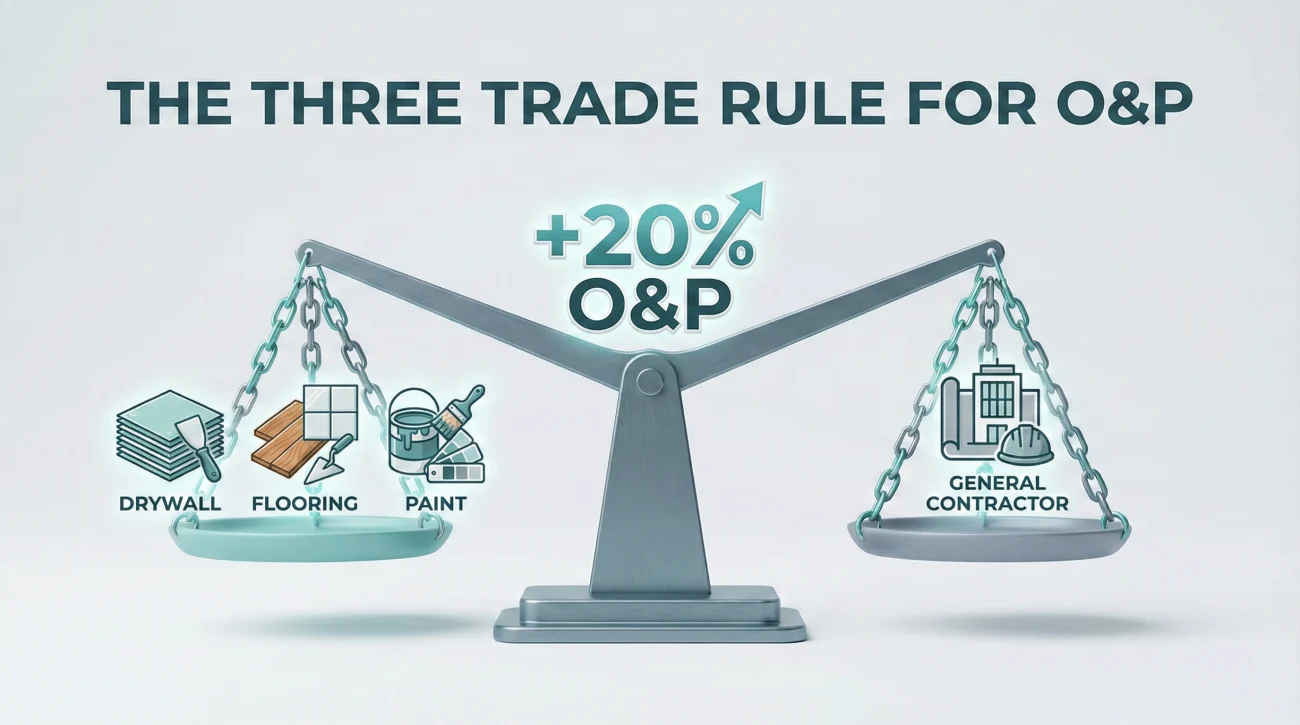
O&P is commonly calculated as “10 and 10” (10% for overhead, 10% for profit) added on top of the total estimate. This pays for the General Contractor’s time to coordinate the job.
Some carriers may not include it initially, stating, “This is a simple job, you don’t need a GC.” The operational rule of thumb (though it varies by state/policy) is the “Three Trade Rule.” If the job involves three or more trades (e.g., Drywall, Paint, Flooring), a GC is reasonably required to coordinate them. If you have significant damage spanning multiple trades, you should request O&P be added.
Ordinance and Law (Code Upgrades)
Standard policies pay to put back “like kind and quality.” But if “like kind” is now illegal because building codes have changed, you need “Code Upgrade” coverage.
Common examples:
– Upgrading electrical panels.
– Adding insulation to an attic.
– Adding ice/water shield to a roof.
Adjusters rarely add these upfront. They wait for you to prove they are required. To trigger this coverage (if applicable to your loss and included in your policy), you typically must send the specific code citation from your local municipality.
Field Note: The “Visual Inspection” Trap

In claims operations, I often see files where the adjuster wrote the estimate based solely on photos taken by a drone or a “ladder assist” vendor. They never physically touched the material.
I recall a file where the estimate listed “vinyl siding.” The photos looked like vinyl. But when the homeowner actually tapped on it, it was aluminum. Aluminum siding is significantly more expensive and often cannot be patched (it dents, doesn’t bend). Because the adjuster never physically verified the material, the estimate was off by $8,000. Always verify that the material listed on the estimate matches what is actually on your house.
Pick the Guide That Fits Your Gap
Finding the gap is only the first step. Fixing it requires a specific approach depending on what is missing. Use these targeted playbooks to build your supplement packet.
🔢 Understanding Estimates & Money
| Guide | Why it helps |
|---|---|
| How to Read an Insurance Estimate: Line Items, Quantities, Notes | Decodes the confusing codes, columns, and definitions so you know what you’re looking at. |
| Depreciation, ACV, RCV: What the Numbers Usually Mean | Explains why money was held back (depreciation) and the difference between “Actual Cash Value” and “Replacement Cost.” |
| Claim Payments Explained: How Estimates Turn Into Checks (High-Level) | Walks through the flow of how the bottom line number on the estimate turns into the check in your hand. |
| Deductibles: Where They Actually Show Up in the Payment Flow | Clarifies where the deductible is subtracted so you don’t think you were underpaid. |
| Holdbacks: Why the Final Payment Waits (And What Unlocks It) | Explains why the insurer holds onto the final check and what triggers them to release it. |
| Recoverable Depreciation: The Operational Checklist to Unlock It | A checklist of exactly what to send to prove repairs are done and get your depreciation check. |
🔎 Finding Scope Gaps & Missing Items
| Guide | Why it helps |
|---|---|
| Estimate Missing Items: The Scope-Gap Master Checklist | A room-by-room list of the most commonly forgotten line items to check against your estimate. |
| Wrong Quantities: Spot Quantity Errors and Present Clean Corrections | How to prove the square footage is wrong using simple math and a correction list. |
| Estimate Notes and Assumptions: Where the Real Scope Often Hides | Finds the “hidden rules” the adjuster typed into the notes that limit your payout. |
| Scope Mapping: Link Line Items to Rooms So Gaps Become Obvious | A method to map every line item to a specific room so you can see exactly what is missing. |
| Detach and Reset: The Scope That Commonly Gets Missed | How to get paid for moving items around the damage (toilets, lights, cabinets) during repairs. |
| Demo, Disposal, Debris Removal: Where Estimates Often Under-scope | Ensures you are paid for the mess, the dumpster, and the hauling fees, not just the repairs. |
👷 Contractors, Bids & Supplements
| Guide | Why it helps |
|---|---|
| Contractor Bid Higher Than Insurance: Compare Scope Before Price | How to align the “apples vs oranges” comparison so the adjuster accepts the bid. |
| Contractor and Supplements: How the Workflow Usually Works | Explains the roles: what your contractor does versus what you need to do to get the supplement approved. |
| Supplement Packet Content: What to Include So Reviewers Understand the Ask | The exact layout of a winning supplement PDF so it doesn’t get ignored. |
| Overhead and Profit: When It Shows Up and Why It Sometimes Does Not | When you can legitimately ask for that extra 20% for General Contractor fees (O&P). |
| Supplement Approved But Still Short: Do a Second Gap Check | What to do when they agree to some changes but the total is still not enough. |
| Final Invoice Higher Than Estimate: Frame the Delta as Scope Categories | How to justify the final bill when it comes in higher than the original estimate. |
| Supplement Timeline: Questions to Get an Owner and an ETA | Questions to ask to find out who is reviewing your supplement and when it will be done. |
⚖️ Disputes, Rules & Partial Denials
| Guide | Why it helps |
|---|---|
| Reinspection: When to Ask and What to Have Ready | When to stop arguing over email and make them come back to the house to see the damage again. |
| Partial Denial or Exclusions: Read the Reason and Ask for Clarity | How to handle it when they pay for the floor but deny the wall (reading the exclusion logic). |
| Repair vs. Replace: Present Decision Factors Without Turning It Technical | Arguments to push for a full replacement when they only want to patch (like matching issues). |
| Code Upgrades and Ordinance and Law: The Operational Questions to Ask | How to use local building codes to force an upgrade payment for older homes. |
Final Thoughts
The difference between a frustrating claim and a fair settlement is often just documentation. The adjuster cannot pay you because you are “nice,” and they cannot pay you because you are “angry.” They can only pay you because you have “proof.”
By treating the estimate as a draft and building a professional Supplement Packet, you give the adjuster the operational permission they need to update the file and release the funds. It is not a battle of wills; it is a trade of information.
To keep everything in one place the next time this happens, you can bookmark our Low Estimate hub and come back to it whenever you need a fast reset on scope, documentation, and the right follow up.
❓ FAQ
🏠 Why is my insurance estimate so much lower than my contractor’s bid?
Insurance estimates use “average” regional pricing and often miss specific scope items (like waste, permits, or difficulty factors). Contractors bid on the reality of the job. The gap is usually missing line items, not just labor rates.
📉 What if the insurance check is less than the repair cost?
Do not cash the check as “final payment.” Contact the adjuster, submit a “Supplement Request” detailing the difference, and provide photos/invoices to support the higher cost before work begins.
💰 What is recoverable depreciation?
It is money the insurance company owes you but holds back until repairs are done. Once you prove you spent the money to fix the item, they release this second check.
📊 How do I challenge an insurance adjuster’s estimate?
Don’t just say “it’s too low.” Create a list of specific missing items (e.g., “missing drip edge,” “wrong square footage”). Send this list with photos as a formal supplement request.
🏗️ Does insurance pay for code upgrades?
Only if you have “Ordinance and Law” coverage. Standard coverage usually pays for “like kind and quality,” but if local law requires an upgrade (like new wiring), O&L coverage kicks in to pay the difference.
👷 Can I hire my own adjuster?
Yes, you can hire a Public Adjuster. They handle the claim for you but typically take a percentage of the settlement (fees vary, often 10-20%). This is different from the “Independent Adjuster” who works for the insurer.
📋 What is Xactimate?
It is the software most insurance adjusters use to write estimates. It calculates prices based on line items and zip codes. Understanding that they are just “data entry” operators helps you communicate better.
🗑️ Does insurance cover debris removal?
Yes, usually. It should be a separate line item. If you have to rent a dumpster or pay hauling fees, make sure “Debris Removal” is listed on the estimate.
🔄 Can I ask for a reinspection?
Yes. If the adjuster missed major damage or denied a room that is clearly damaged, request a reinspection. Have your contractor present during the second visit to point out the specific issues.
💵 What is Overhead and Profit (O&P)?
It is an extra ~20% added to the estimate to pay for a General Contractor’s supervision. It typically applies if the job requires three or more trades (e.g., drywall, paint, flooring) to coordinate.
⚠️ Disclaimer: PropertyClaimChecklist.com provides practical guidance, process checklists, and example follow-ups to help you organize a property claim and move it forward. It is not policy language, claim documentation, legal content, or a substitute for your insurer's instructions. Always rely on your carrier's requirements and your actual policy terms for what must be submitted and how decisions are made.