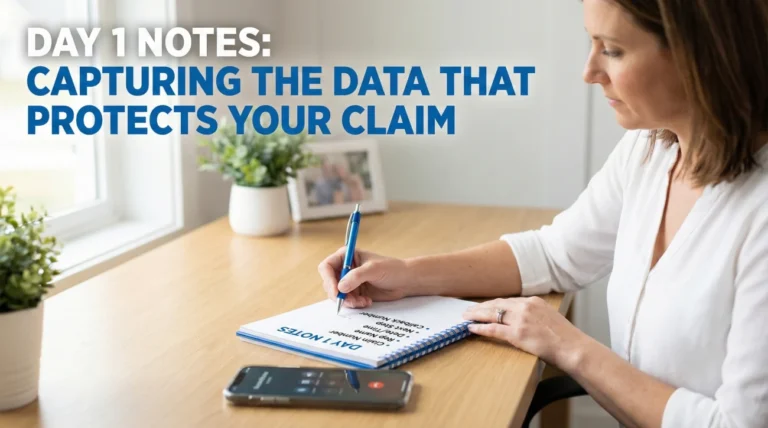
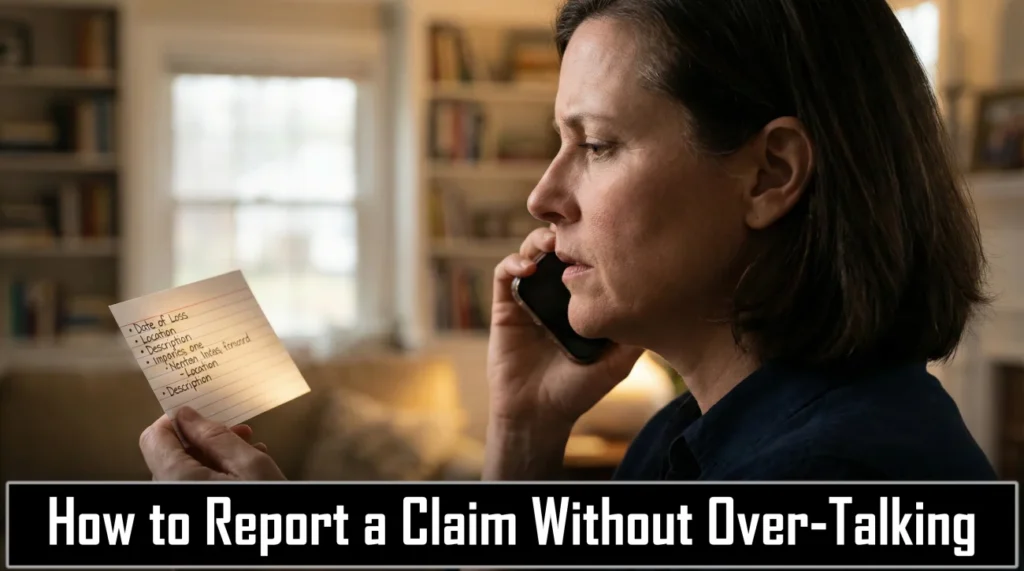
- When reporting a claim, providing too much backstory can unintentionally confuse the intake process. Limit your initial report strictly to what you can see, hear, or feel.
- Guessing the root cause of the damage on day one often leads to incorrect file routing and unnecessary coverage reviews.
- State exactly when you found the damage to keep the record factual, rather than guessing when a leak may have started.
- Avoid downplaying the severity of the damage to sound polite. This can create contradictions when your contractor later submits a comprehensive repair estimate.
The Danger of Thinking Out Loud
Finding sudden damage in your home is an incredibly overwhelming experience. When you finally get an insurance representative on the phone, the adrenaline is usually running high. You want them to understand exactly how bad the situation is, how stressed you are, and how quickly you need help.
In that heightened state, it is completely natural to start “over-talking.” You might find yourself rambling about how old the plumbing is, how hard the wind was blowing, or how you always suspected that one window was drafty. I completely understand the need to vent. However, the intake representative on the other end of the phone is not a therapist, and they are usually not a field inspector either. They are typing your spoken words into a highly structured database.
If you offer theories or unnecessary backstory, those comments get permanently logged as your official statement of facts. This guide is about learning how to describe damage to insurance companies using safe, neutral, and observable terms. By stripping away the guesswork, you give the claims system exactly what it needs to process your file.
The Intake Translation Problem
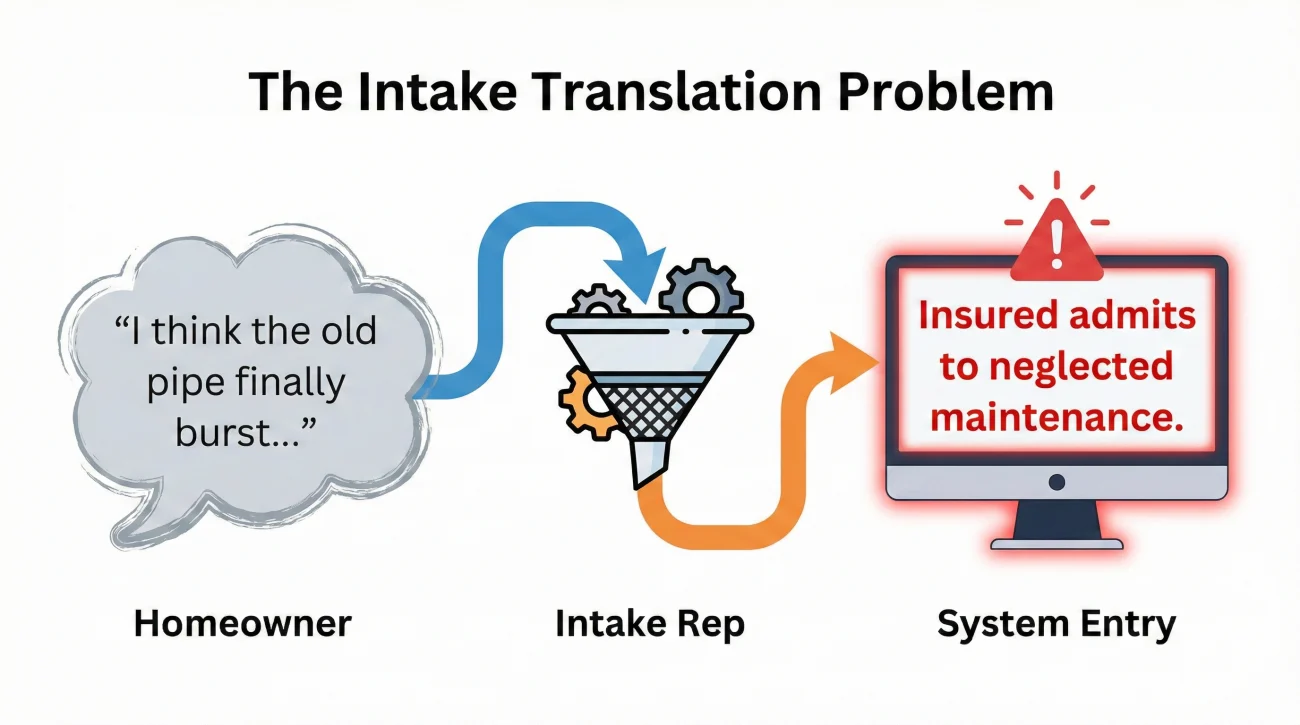
To understand why over-talking is risky, it helps to look at how your words are actually processed. When you call a 24-hour claims hotline, you are typically speaking to an intake specialist. Their primary job is data entry. They listen to your story and summarize it into a few short sentences in a text box.
This creates a massive translation problem. Let us say you tell the representative, “I came home and water was everywhere. The washing machine hose must have finally given out, it is pretty old and I probably should have replaced it last year.”
The intake representative does not write down your exact quote. They summarize it for the system. The note that lands on the desk adjuster’s screen might simply read: “Insured states old washing machine hose failed due to lack of maintenance.”
You were just guessing about the hose because you were stressed. But the adjuster reading that note sees a potential “wear and tear” maintenance issue, which often requires a specialized coverage investigation. An innocent guess can easily slow down your estimate by weeks. In claims operations, we rely heavily on the very first notes entered into the system. If those notes contain your unverified theories, the entire trajectory of the claim may shift.
Field Note: I once reviewed a file for a collapsed ceiling. The homeowner had told the intake rep, “The roof has looked bad for a while, it probably just gave way.” Based on that note, the file was routed to a desk that handles long-term deterioration. Two weeks later, a field inspector actually climbed on the roof and found a massive, fresh tree branch hidden from ground view that had clearly caused the sudden collapse. A simple guess can derail a claim. Always let the physical evidence tell the story.
Core Principles of Observable Fact Reporting
Reporting a claim safely is not about hiding information. It is about practicing strict fact hygiene. You only want to report the things you know to be absolutely true. To do this, rely on the principles of observable reporting.
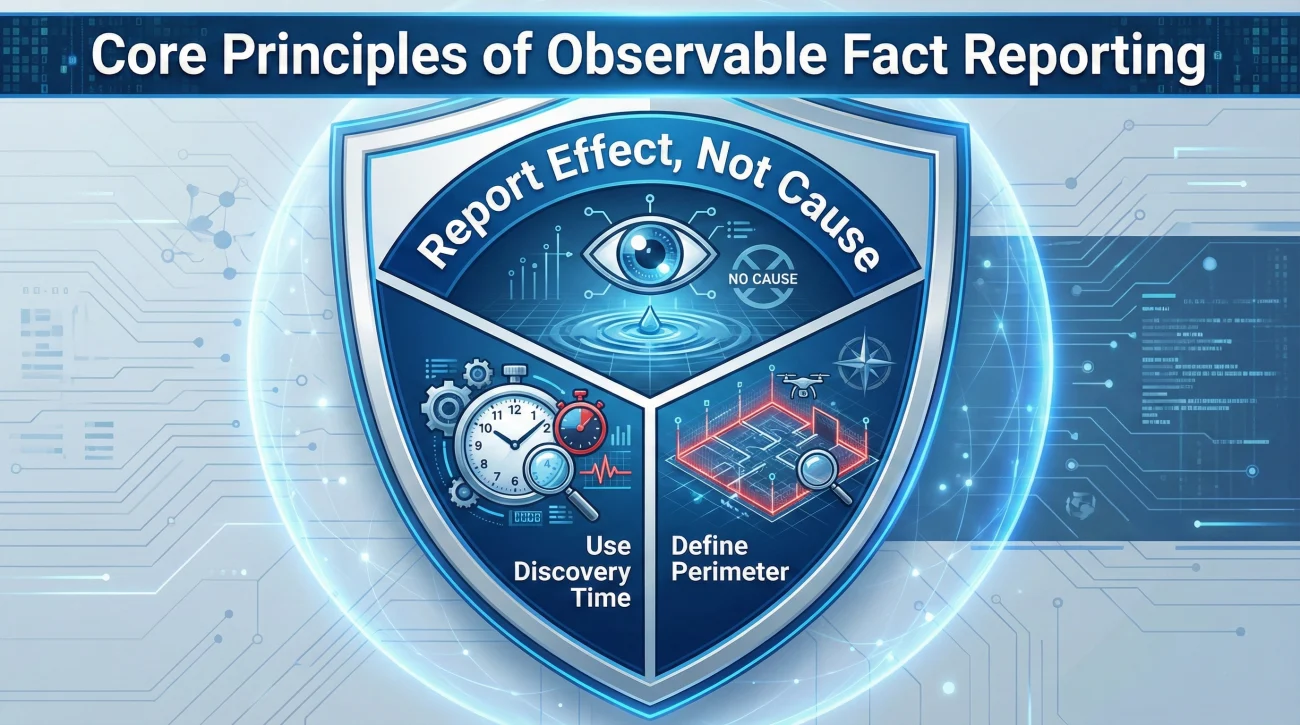
Principle 1: Report the Effect, Not the Cause
Unless you are a licensed structural engineer or a master plumber, you are rarely qualified to state the exact cause of a failure. Your job is to report the effect. If there is water on the floor, the water is the effect. The cause might be a burst pipe, a failed seal, or a backed-up sewer line. Do not guess the cause.
If they ask you what caused it, it is perfectly acceptable to say, “I am not sure yet, I just know there is active water coming from underneath the sink cabinets.” This simple sentence keeps you safe and forces the insurance company to rely on their own professional inspection to determine the cause.
Principle 2: Use Discovery Time
Intake systems require a “Date of Loss” to generate a claim number. Homeowners often panic because they do not know exactly when a pipe started leaking inside a wall. They try to be helpful and guess, saying things like, “It looks like it started a few days ago.”
Guessing timelines is incredibly dangerous. In many insurance policies, you have a duty to report damage promptly. If you guess that the damage has been sitting there for a week, the reviewer might question why you waited so long to call. Always use your discovery time. State clearly, “I discovered the damage today at 4:00 PM.” This is an undeniable, observable fact.
Principle 3: Define the Current Perimeter
Instead of talking about how the damage happened, focus on where the damage currently is. Clearly define the perimeter of the loss for the intake representative. List the specific rooms that are affected. Tell them if the water has reached the hallway, or if the smoke odor is contained to the kitchen. This helps the claims team gauge the severity of the event without requiring any diagnostic theories from you.
Safe Phrasing Comparisons
Shifting your vocabulary takes practice. It feels unnatural to speak like an auditor in your own home, but it is a vital skill. Here is a breakdown of how to convert natural, emotional statements into safe, operational facts.
| Before (Emotional or Guessing) | After (Safe and Observable) |
|---|---|
| “My old water heater completely exploded and ruined everything in the basement.” | “I discovered severe water pooling around the water heater, and the water has spread across the entire basement floor.” |
| “The wind ripped off my shingles. I always knew that roof was getting too old to handle a storm.” | “Following last night’s storm, I noticed several shingles missing from the front slope of the roof.” |
| “I think the window has been leaking slowly for a few months and I just didn’t notice it until the drywall fell apart today.” | “I discovered crumbling drywall and moisture beneath the living room window this afternoon.” |
The Danger of the “Polite” Report
While over-explaining is the most common issue, the second most common problem I see is minimizing. Many people are naturally polite and do not want to sound dramatic or demanding on the phone. They try to downplay the situation to seem reasonable.
They might say, “It is just a little water on the kitchen floor, we cleaned most of it up, but a few boards look warped.” They say this to be nice, but the intake system records “Minor water, mostly cleaned up, slight floor damage.” Based on that note, the system might assign the file to a low-priority desk.
A week later, the homeowner’s contractor realizes the water actually ran under the cabinets and ruined the subfloor. When the contractor submits a $12,000 estimate, the desk adjuster looks at the original intake note that said “minor water” and may flag the file for a scope inflation review. The contradiction between the polite intake call and the actual contractor bid often stalls a claim for weeks.
Do not minimize the damage to be polite. You do not need to exaggerate, but you must report the full observable truth. If the floor is soaked, say it is soaked. If the room smells heavily of smoke, report the heavy odor. Be factual, complete, and unapologetic about what you see.
A Practical Scenario: The Mystery Hardwood Stain
Let us look at how an organized policyholder handles an ambiguous situation without over-talking or making assumptions.
A homeowner moves a large area rug in their dining room and discovers a massive, dark, warped stain on the hardwood floor near the sliding glass doors. They have no idea how long it has been there or where the water came from. They do not see any active dripping.
A poorly handled intake call would sound like this: “I found a huge stain under my rug. I think the sliding door might be leaking when it rains, or maybe my dog spilled a large bowl of water a few weeks ago and I didn’t notice.” By offering two completely different guesses, the homeowner has just given the insurer multiple reasons to pause the claim for investigation.
Instead, they call the claims center and state: “I am reporting newly discovered damage. At 10:00 AM today, I moved my dining room rug and discovered severe warping and discoloration on the hardwood floor near the sliding doors. The affected area is roughly three feet by four feet. I cannot determine the source of the moisture at this time.”
This report is clean and highly effective. It gives the necessary parameters and refuses to diagnose the cause. The intake representative has no choice but to log the facts and schedule a professional inspection to determine the root cause. The homeowner’s file remains free of contradictory statements.
Red Flag Words to Eliminate
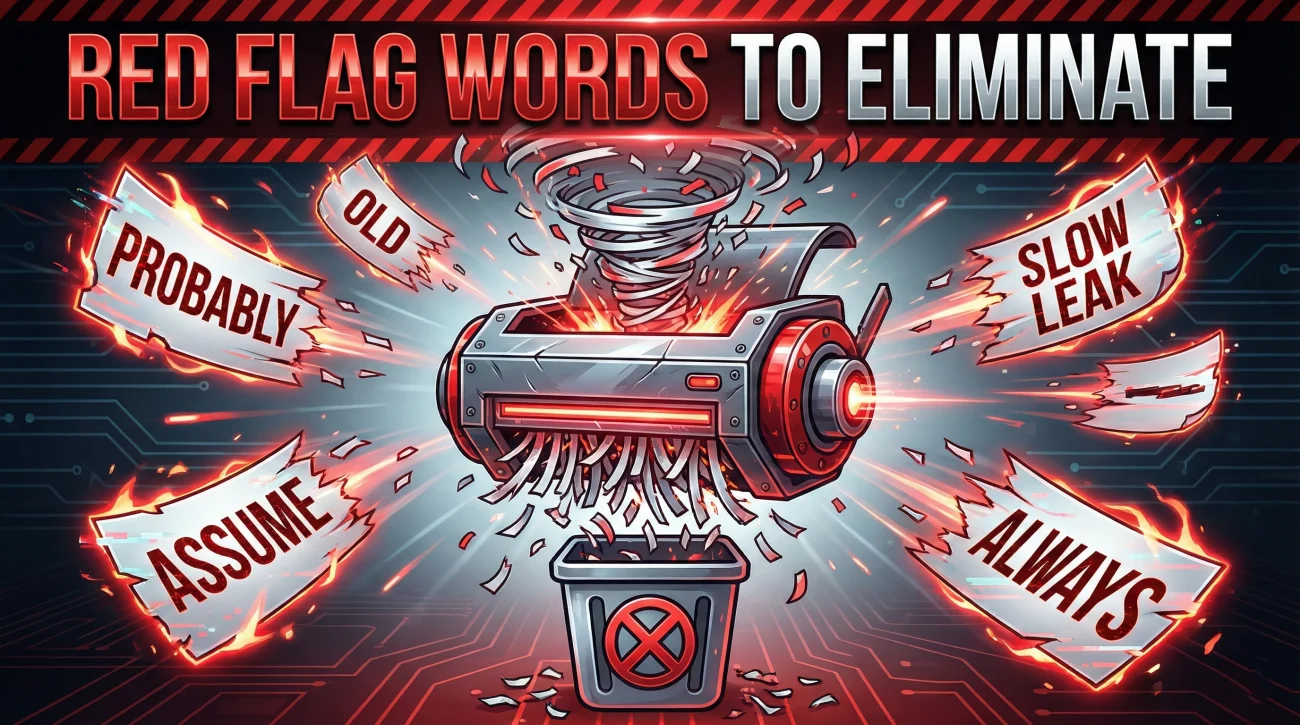
When you are describing damage, there are a few specific words that act like tripwires in an insurance database. If possible, completely remove these words from your vocabulary when speaking to any claims representative.
- ❌ “Probably” or “Assume”: If you say “I assume it was the wind,” you are guessing. Guesses are not facts. If you do not know for sure, simply state that you do not know.
- ❌ “Always”: Saying “That pipe has always rattled” or “The basement always gets a little damp” implies an ongoing condition that you accepted as normal. Insurance is generally designed for sudden and accidental losses, not ongoing accepted conditions.
- ❌ “Old” or “Rotten”: Unless a contractor has officially diagnosed dry rot, avoid using words that describe long-term decay. Describing your own property as “old and rotten” invites wear-and-tear denials.
- ❌ “Slow leak”: Similar to the word old, describing something as a slow leak implies it has been happening for a long duration. Stick to describing the active moisture you currently observe.
Building Your Master Playbook
The words you use on day one do not just sit in a vacuum. They become the opening page of your permanent claim record. When your desk adjuster eventually sits down to review the final repair estimates and your photo evidence, they will read your initial intake notes first.
If your initial description was factual and neutral, it will perfectly align with the photos and documents you submit later. This consistency is the core strategy behind building a successful proof of loss playbook. You want every piece of evidence, from the first phone call to the final contractor bid, to tell the exact same, undeniable story.
Keep It Factual, Keep It Moving
I know how difficult it is to bite your tongue when your home is damaged. You want answers, you want reassurance, and you naturally want to explain everything that is happening in your life at that moment.
However, you must treat your interactions with the insurance company as business transactions. The intake representative is there to collect data points, not to offer emotional support or diagnose your plumbing. By keeping your descriptions tight, observable, and free of personal theories, you protect the integrity of your claim.
Take a breath, write down your observable facts before you make the call, and stick to your script. Refusing to over-talk is often one of the most reliable ways to keep your claim moving smoothly from day one.
❓ FAQ
🗣️ How much detail should I give on the very first phone call?
Keep it brief. State the exact time you discovered the issue, the specific rooms affected, and the observable damage (like standing water or smoke). Save the deep details for the field inspector.
🤷♂️ What if the rep insists on asking what caused the damage?
It is perfectly fine to firmly state, “I am not a professional contractor, so I cannot confirm the exact cause. I can only confirm the damage I currently see.”
⏳ If I don’t know exactly when it happened, what do I say?
State clearly that you discovered this damage today at a specific time. Emphasize when you found it rather than guessing the exact start time.
🤐 Is it bad to tell the insurance company “I’m not sure”?
No, it is actually much safer. Admitting you are not sure about a technical detail is always better than guessing wrong and having your guess logged as an official statement.
📞 Do I need to report the claim before my contractor looks at it?
In most emergency situations, you want a mitigation contractor to stop the active damage first (like shutting off a burst pipe). Once the emergency is stable, you can call to report the facts.
📝 What if the call center rep writes down the wrong thing anyway?
This happens occasionally. Always ask for a written copy of your intake summary. If you see a guessed cause or incorrect detail, send a portal message immediately to correct the factual record.
🤔 Should I mention previous repairs I made to the same area?
Only if directly asked, and keep it factual. Offering unprompted backstory about old repairs often muddies the waters and can lead a reviewer to assume the current issue is just failed maintenance.
📸 How do I describe damage that is hidden inside a wall?
You cannot describe what you cannot see. Describe the surface indicators. Tell them the drywall is soft to the touch, peeling, or wet. Do not guess how far the hidden damage goes.
😰 What if I panicked and already guessed the cause on the phone?
Do not panic. You can send a brief, written follow-up message stating, “To clarify my initial report, I do not know the actual cause of the loss, I was simply describing the area of discovery.”
🕵️♀️ Who exactly am I talking to when I first report the claim?
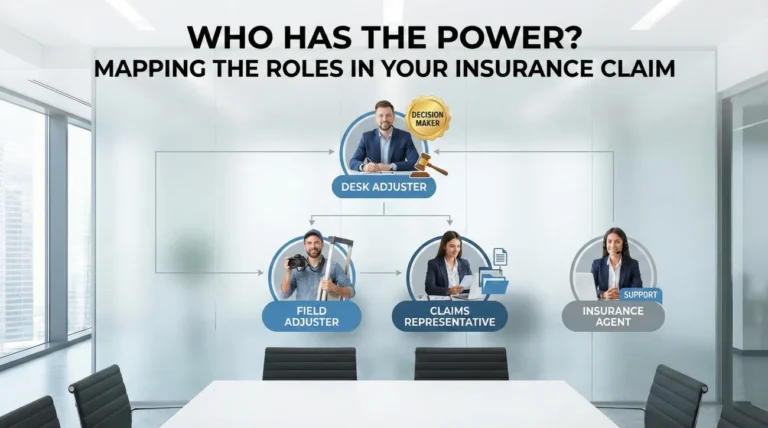
Usually, you are speaking to an intake specialist or a third-party call center. Their job is simply to capture data points and generate a claim number, not to make coverage decisions.
⚠️ Disclaimer: PropertyClaimChecklist.com provides practical guidance, process checklists, and example follow-ups to help you organize a property claim and move it forward. It is not policy language, claim documentation, legal content, or a substitute for your insurer's instructions. Always rely on your carrier's requirements and your actual policy terms for what must be submitted and how decisions are made.