- It is not your Policy Number: Your Policy Number identifies your account (who you are). Your Claim Number identifies this specific damage event (what happened). Do not mix them up.
- The Submission Rule: In claims operations, documents without a Claim Number risk getting lost in a “general correspondence” queue. Write this number on absolutely everything you submit.
- It changes per event: If you have a second, unrelated loss later this year, you will get a new Claim Number.
- Digital hygiene matters: Rename your files (PDFs, JPEGs) to include the claim number before uploading. IMG_001.jpg gets lost; Claim123_Kitchen.jpg does not.
- Share it carefully: Give it to your mitigation crew and contractor so they can bill correctly, but avoid posting it publicly on social media.
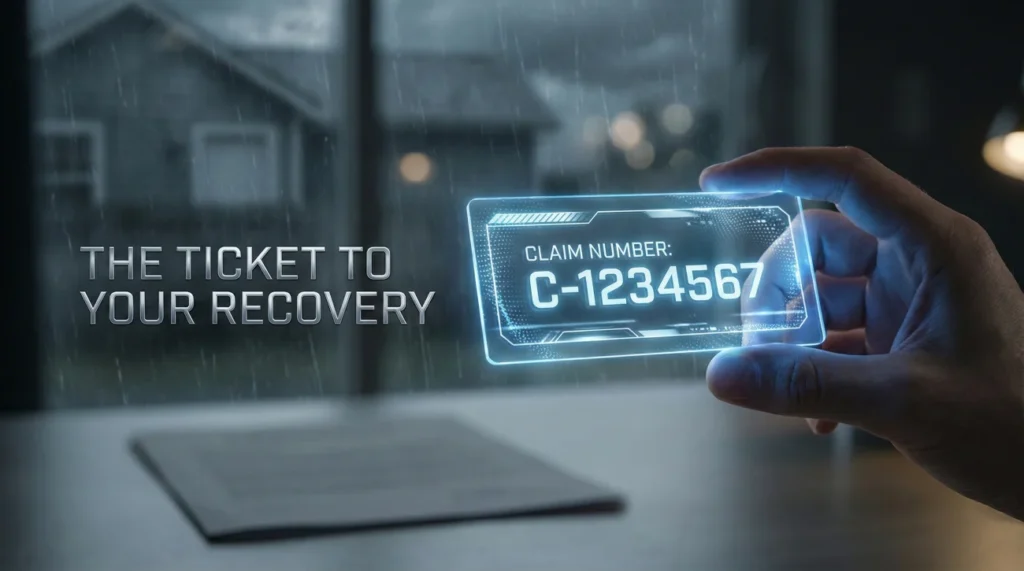
The “Ticket” to Your Recovery
Before you file a claim, you are just a “Policy Number” to the insurance carrier. You are a customer paying premiums, a row in their billing database. But the moment you report damage, you become a “Claim Number.” This shift is critical to understand because it changes how the insurance company’s system tracks you, routes your documents, and ultimately pays you.
In my 12 years working in claims operations across both regional and national carriers, I have seen a recurring pattern that causes unnecessary delays: homeowners continue to use their Policy Number when sending in receipts, photos, and emails. They assume the insurer knows who they are because “I’ve been a customer for 20 years.”
The reality is that large insurers receive thousands of documents a day. A document labeled only with a Policy Number typically requires a human clerk to manually look up your account, search for open files, match the dates, and route it. This process takes time, and human error happens. A document labeled with a Claim Number gets routed automatically to the right desk or digital folder. Understanding the insurance claim number meaning is simply about understanding how to keep your file moving without friction.
Think of your Claim Number not just as an ID, but as a VIP pass. Without it, you are waiting in the general line. With it, you go straight to the adjuster’s desk.
Policy Number vs. Claim Number: The Critical Distinction
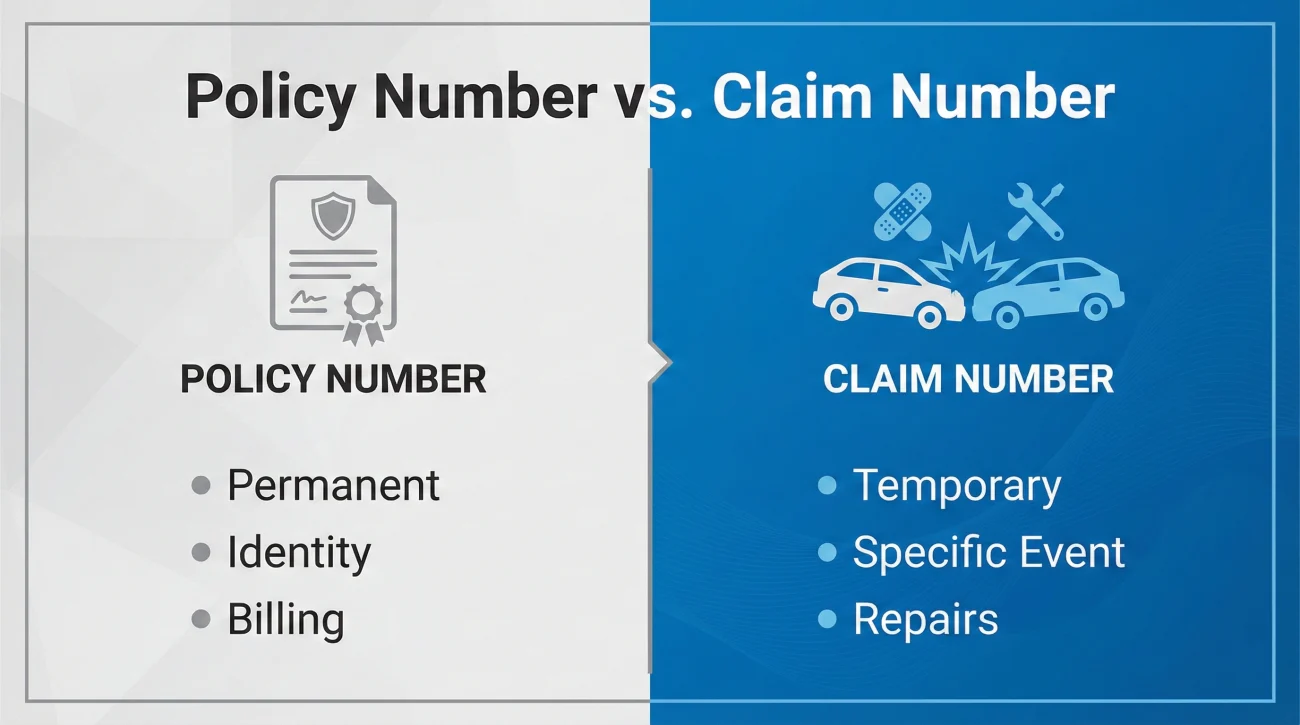
This is the most common confusion point I see on Day 1. It is vital to distinguish between these two identifiers immediately, as using the wrong one is the fastest way to get your urgent email ignored.
| Feature | Policy Number | Claim Number |
|---|---|---|
| Purpose | Identifies your contract/account | Identifies this specific accident/loss |
| Lifespan | Permanent (as long as you pay premiums) | Temporary (closes when repairs end) |
| Analogy | Your Social Security Number | A Hospital Visit ID |
| When to use | Paying bills, talking to agents, renewals | Talking to adjusters, sending evidence, emails |
| Format | Often has letters/dashes (e.g., HO-123-45) | Often a long string of digits (e.g., 0045-889-22) |
Think of it like checking into a hospital. You have a permanent medical record number (Policy Number), but for this specific broken arm, you get a unique Visit ID (Claim Number). All the X-rays, prescriptions, and doctor notes for the arm must have the Visit ID. If the lab sends your blood work with just your medical record number, it might get filed in your general history without the ER doctor ever seeing it.
Similarly, if you send an estimate with just your Policy Number, in many systems it gets routed to the “Policy Services” department (the people who handle renewals and billing) not the “Claims Department.” These two departments often use completely different software systems.
The “Ghost Document” Problem
I want to share a specific operational reality that many policyholders never see. In many claims departments, there is a digital bucket often called “Unmatched Mail,” “General Correspondence,” or simply “The Orphan Queue.”
When you email an invoice or mail a letter that only has your name or Policy Number on it, it risks landing in this bucket. It sits there until a clerk has free time to open it, read it, search your name in the database, identify which of your claims it belongs to (if you had a prior one), and manually move it. During catastrophe seasons (after big storms), this queue can have a backlog of weeks.
I once worked on a file where the homeowner sent a $15,000 mitigation invoice via email with the subject “Invoice for Smith House.” It sat in the unmatched queue for 12 days. The mitigation company, unpaid, threatened to put a lien on the house. The adjuster had no idea the invoice existed because it wasn’t in the claim file; it was floating in the “ghost” queue.
Key Point: If it leaves your hand, it must have the Claim Number on it. No exceptions. This is your insurance against the “I never got that” excuse.
The “Write It On Everything” Protocol
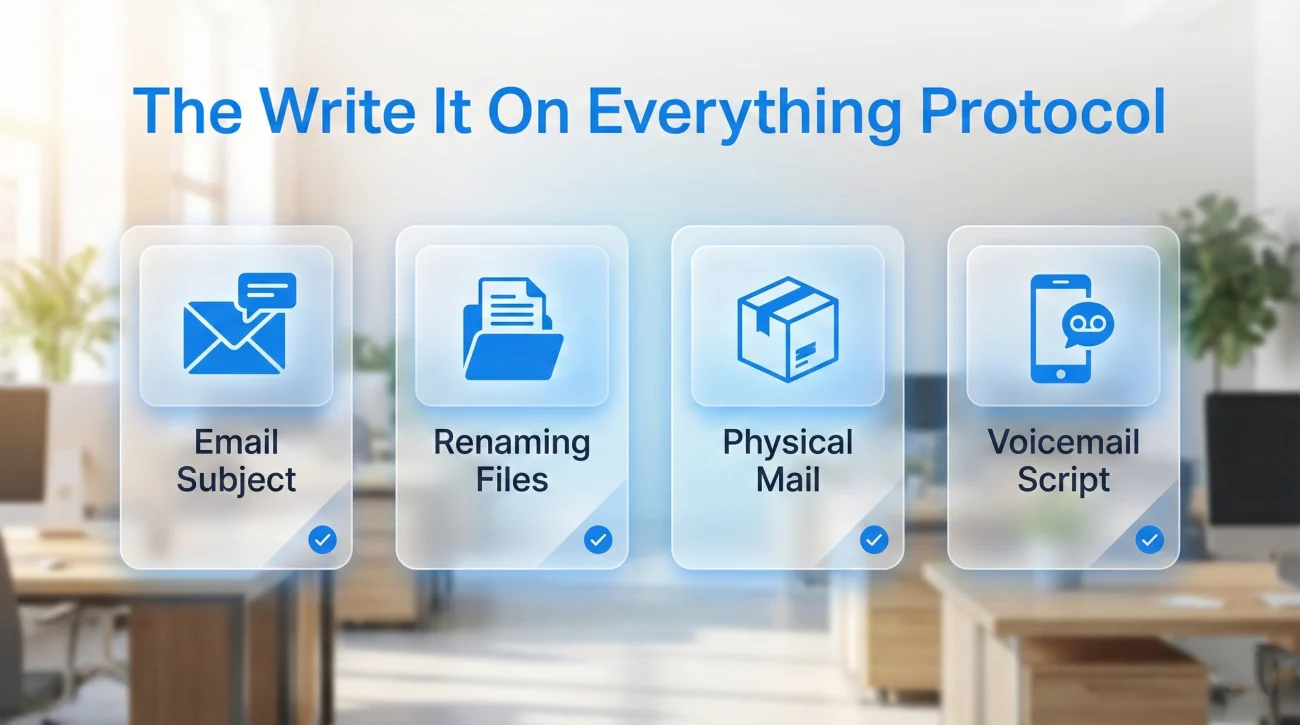
To avoid the problem above, you need to adopt a strict habit. As soon as you receive your Claim Number (usually during your first call or via an automated email), it becomes the most important data point in your life for the next few months. Here is the protocol I recommend to every policyholder:
1. Email Subject Lines
Never send an email with a vague subject like “Questions” or “Photos.” Adjusters prioritize their inbox by scanning for Claim Numbers.
Claim #12345678 – [Your Last Name] – [Topic of Email]
Example: Claim #00998877 – Johnson – Kitchen Repair Estimates
2. Digital File Naming
This is a step 90% of people miss. When you take a photo on your phone, it is automatically named something like IMG_4821.jpg. If you upload that to a portal, it is just one of a million similar files in the insurer’s cloud.
If the system glitches and the file gets separated from your folder, it is lost forever. Renaming your files is the safeguard.
Bad:
❌ Scan001.pdf
❌ IMG_055.jpg
Good:
✅ Claim123456_RepairEstimate_v1.pdf
✅ Claim123456_KitchenFloor_Damage.jpg
3. Physical Mail & Packages
If you are mailing large blueprints, a USB drive of videos, or physical receipts, the Claim Number must be on the outside of the envelope and on every page inside. Why? Because mailrooms open envelopes and scan pages. If page 1 has the number but page 5 doesn’t, and they get dropped or separated, page 5 is gone.
4. Voicemail Scripts
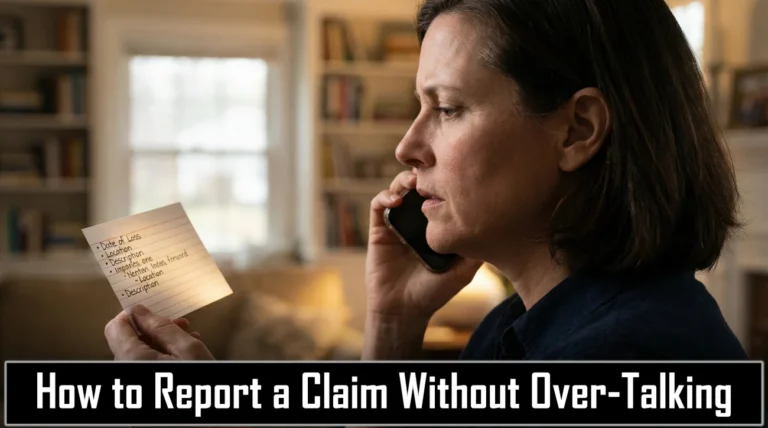
Adjusters listen to voicemails while typing into a search bar. If you start your message with a 2-minute story and only give the claim number at the end, they have wasted 2 minutes just staring at a blank screen.
The “Search-Friendly” Voicemail Script:
“Hi, this is [Name]. I am calling regarding Claim Number [Say Number Slowly]. That is Claim Number [Repeat Number]. I am calling to discuss…”
By the time you finish repeating the number, they have your file open and are ready to take notes on what you say next.
Where to Find Your Claim Number
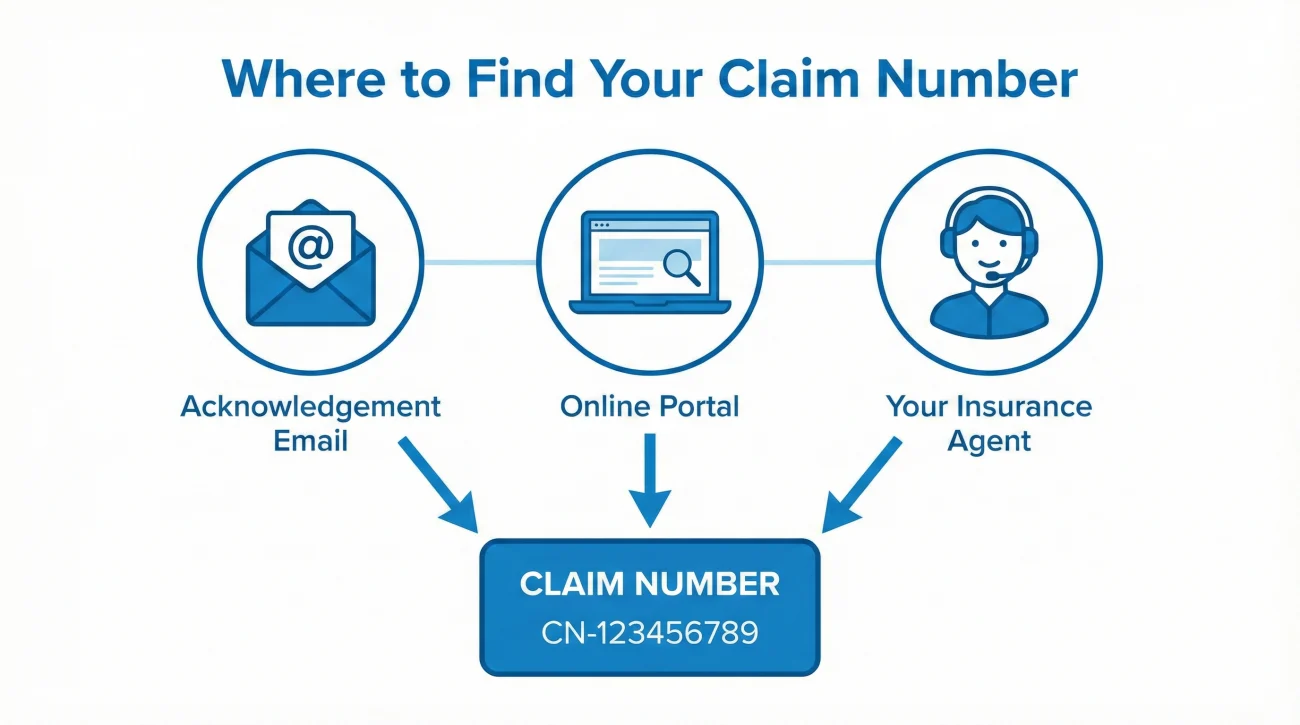
If you hung up the phone after reporting the claim and forgot to write it down, do not panic. It is not on your physical policy document (the Declarations Page) because that was printed before this damage happened.
You can usually find it in three places:
- The Acknowledgement Email: Most modern carriers send an automated “We received your claim” email within minutes of the First Notice of Loss (FNOL).
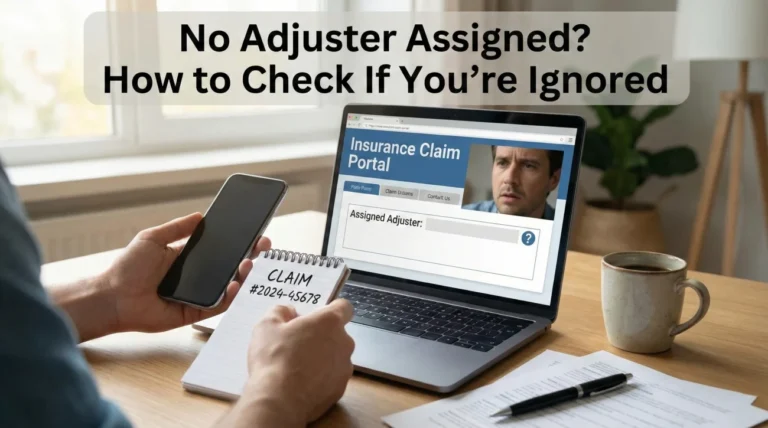
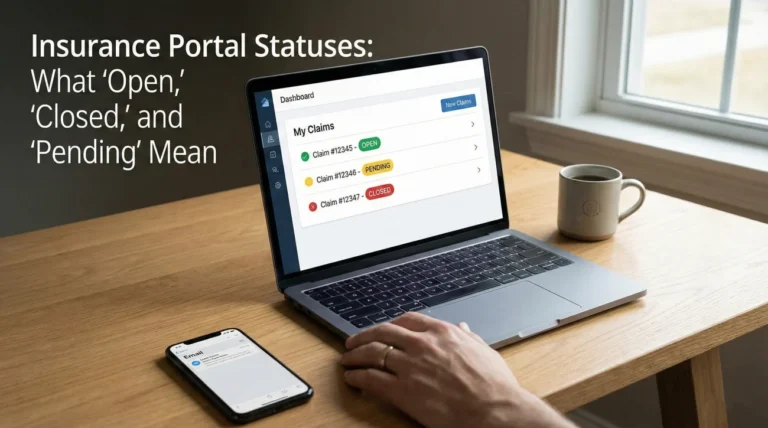
- The Online Portal: If you log in to your carrier’s website, there should be a “Claims” tab separate from “Billing.” It will be listed there as “Open Claim.”
- Your Agent: Your insurance agent can look it up in their system almost immediately. They often have a “read-only” view of the claims system.
💡 Pro Tip: Save the Claim Number in your phone as a new contact named “Claim [Number]” with the adjuster’s phone number. You will never have to hunt for a scrap of paper when they call you while you are driving.
Sharing With Contractors: The Rules
You should provide your Claim Number to your mitigation company (water dry-out crew) and your general contractor. They need it to communicate with the adjuster and to submit their estimates directly (often via software like Xactimate).
However, you need to set boundaries. Giving them the Claim Number authorizes them to discuss the scope of work with the insurer, but it does not inherently give them the right to settle the claim for you unless you sign a specific “Direction to Pay” or “Assignment of Benefits” (AOB).
⚠️ Warning: Be careful where you post this number publicly. I have seen cases where homeowners posted their Claim Number on public complaints on social media. Insurance investigators can use that public post to find your profiles and scrub them for evidence that contradicts your claim (e.g., photos of you on vacation when you claimed you were displaced due to loss of use).
Script for Contractors:
“My Claim Number is [Number]. Please ensure this is on every estimate you generate. Please copy me on any email you send to the adjuster so I can track what has been submitted.”
Troubleshooting: When the Number Doesn’t Work
Even with a number, things can go wrong. Here are three common “glitches” I see in the lifecycle of a claim number.
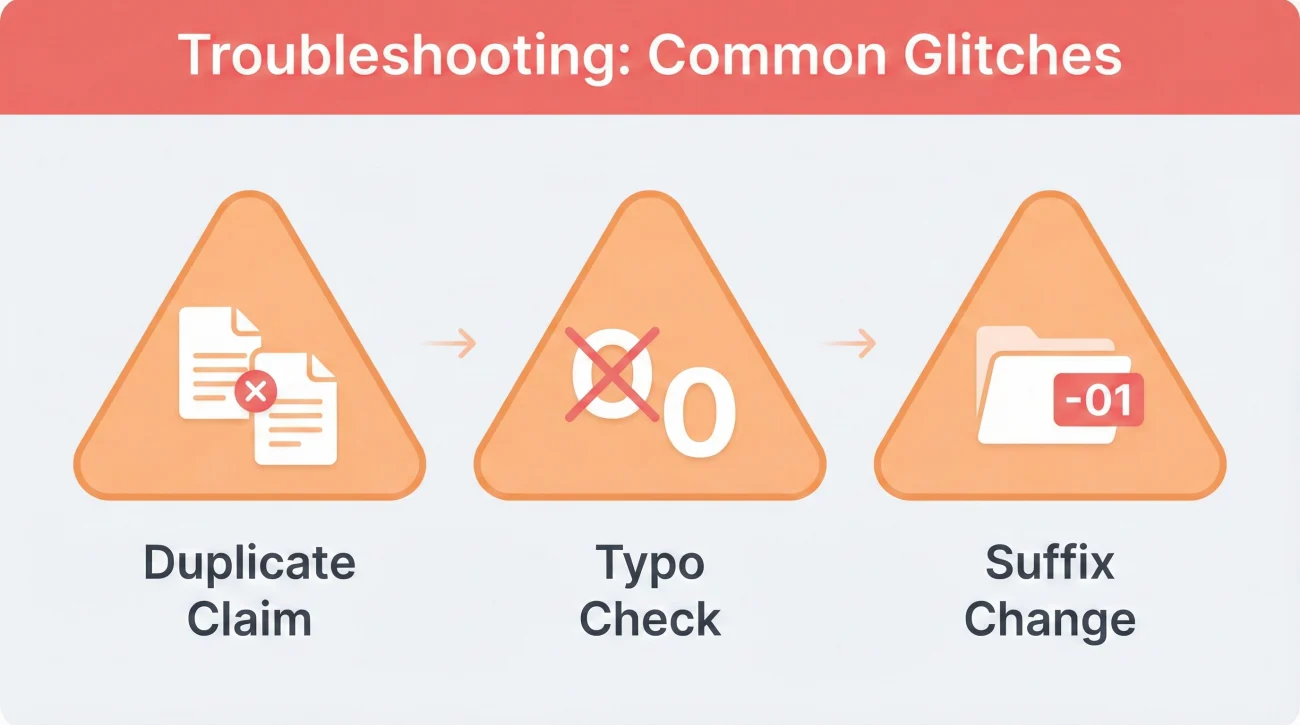
1. The Duplicate Claim
This happens when you call to report a claim, but the line disconnects, so you call back and get a different rep. Or, you report it online, but your agent also reports it for you. The system might generate two different claim numbers for the same event.
If you receive two acknowledgement letters with different numbers, you must call immediately to merge them. If you don’t, half your documents will go to Claim A and half to Claim B, and the adjuster on Claim A will deny you for “lack of documentation.”
2. The “O” vs “0” Problem
Claim numbers are alphanumeric. It is very common to mistake the letter “O” for the number “Zero”, or the letter “I” for the number “One”. If your portal login isn’t working or the adjuster says they can’t find your email, check this first. Ask the adjuster explicitly: “Is that a zero or the letter O?”
3. The “Suffix” Change
Some insurance carriers add a suffix to the claim number for different “features” of the claim. For example, 12345-01 might be for the Dwelling damage, and 12345-02 might be for the Contents. If you are sending a list of damaged furniture, make sure you are using the correct suffix if your carrier uses this system. Using the Dwelling suffix for Contents might delay the Contents adjuster from seeing it.
Final Thoughts
The Claim Number is a small string of digits, but it controls the workflow of your entire recovery. It is the single most effective tool you have to prevent administrative friction. In my experience, the files that move the fastest are the ones where the homeowner is disciplined about referencing this number.
It signals to the adjuster that you are organized, professional, and ready to do business. When an adjuster sees an email with a perfectly formatted subject line including the claim number, they breathe a sigh of relief because they know they won’t have to hunt for the file. Do not make them search for you. Hand them the key to your file every time you communicate.
❓ FAQ
🔢 What is the meaning of an insurance claim number?
An insurance claim number is a unique ID assigned to a specific damage event. It tells the insurance company’s system exactly which file to open. Unlike your policy number which tracks your account, the claim number tracks this specific accident or loss.
🔍 Where can I find my claim number if I lost it?
Check the subject line of the first email the insurance company sent you after you filed. You can also log into your insurance carrier’s online portal or mobile app under the “Claims” tab. If all else fails, call your insurance agent. They can look it up instantly.
📝 Should I give my claim number to my contractor?
Yes. Your contractor needs the claim number to submit estimates and photos to the adjuster. Without it, their paperwork may get lost in the insurance company’s general mail system. Just ensure you tell them to copy you on all submissions.
📅 Does my claim number change if the claim takes a long time?
Generally, no. The claim number stays the same from the day you file until the day the case closes. However, if your claim is transferred to a special investigation unit or a different department, some carriers might assign a suffix (like -01 or -02) or a secondary reference number.
📞 Why does the adjuster ask for my claim number every time I call?
Adjusters handle 50 to 100 claims at once. They ask for the number so they can type it into their system and pull up your specific file immediately. It ensures they are looking at your photos and notes, not someone else’s.
🆔 Is the claim number the same as the policy number?
No. Your policy number is permanent and represents your contract. Your claim number is temporary and represents one specific incident. You could have one policy number but three different claim numbers over ten years if you had three separate losses.
🏷️ How should I write the claim number on documents?
Write it clearly on the top right corner of every single page. In emails, put it at the very start of the subject line. For digital files, rename the file to include the number (e.g., Claim123_Photo.jpg). This prevents items from getting separated or ignored.
🚫 Can someone steal my identity with my claim number?
It is unlikely to lead to full identity theft on its own, but it is private information. Someone with your claim number and name could potentially call in and get details about your home’s damage or settlement. Keep it private and do not post it on public social media.
🔁 Do I get a new claim number for a supplement?
No. A supplement is just an addition to the existing claim (like finding more damage behind a wall). You continue to use the original claim number so that the new payments are tracked against the same deductible and coverage limits.
📧 What happens if I send an email without the claim number?
It often goes into a “general correspondence” queue. A clerk has to manually open it, read it, and try to find your file based on your email address or name. This can delay your document being seen by the adjuster for several days, or it may never be linked at all.
⚠️ Disclaimer: PropertyClaimChecklist.com provides practical guidance, process checklists, and example follow-ups to help you organize a property claim and move it forward. It is not policy language, claim documentation, legal content, or a substitute for your insurer's instructions. Always rely on your carrier's requirements and your actual policy terms for what must be submitted and how decisions are made.