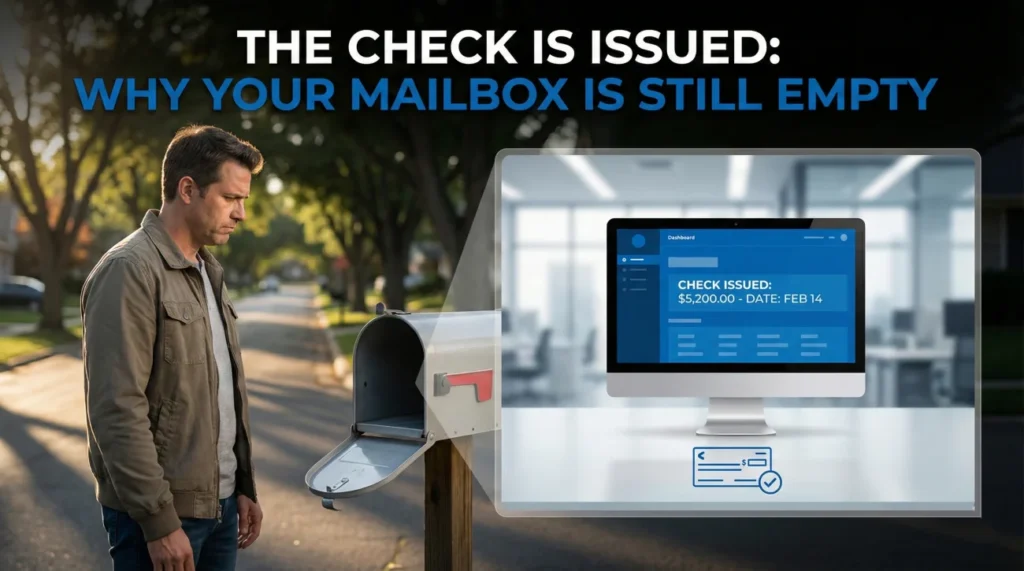
- The “Issued” Illusion: In insurance terms, “Issued” often just means “approved by accounting,” not “physically put in a mailbox.” There is often a processing lag (commonly 3 to 5 days, though it varies).
- The Mortgage Trap: If your check includes your mortgage company’s name, it might have been sent directly to them, or it requires a complex endorsement process that adds weeks to the timeline.
- Verify the Address: A surprisingly common cause of delay is a mismatch between your current temporary address (ALE) and the policy address on file.
- Tracking Data: Never just accept “it’s on the way.” Always ask for the specific check number and the date it entered the mail stream.
- Action Item: Use the “Payment Trace” questions below to locate the funds before requesting a stop-payment.
The Gap Between “Approved” and “Paid”
There is a specific kind of anxiety that comes after the victory of getting a claim approved. The adjuster calls you, confirms the amount, and says, “The check has been issued.” You feel a wave of relief. You schedule the contractor. You tell the water mitigation company they will get paid on Friday.
Then Friday comes, and the mailbox is empty. Monday comes, and it is still empty. By Wednesday, the contractor is calling you for a deposit, and you are left wondering if the adjuster lied to you.
In my experience with claims operations, the adjuster likely didn’t lie, but they did use internal jargon that misled you. An insurance claim payment delay at this stage is rarely about coverage. It is almost always about logistics. Understanding the mechanical process of how a large carrier cuts a check is the first step to finding your money without losing your mind.
What “Issued” Actually Means
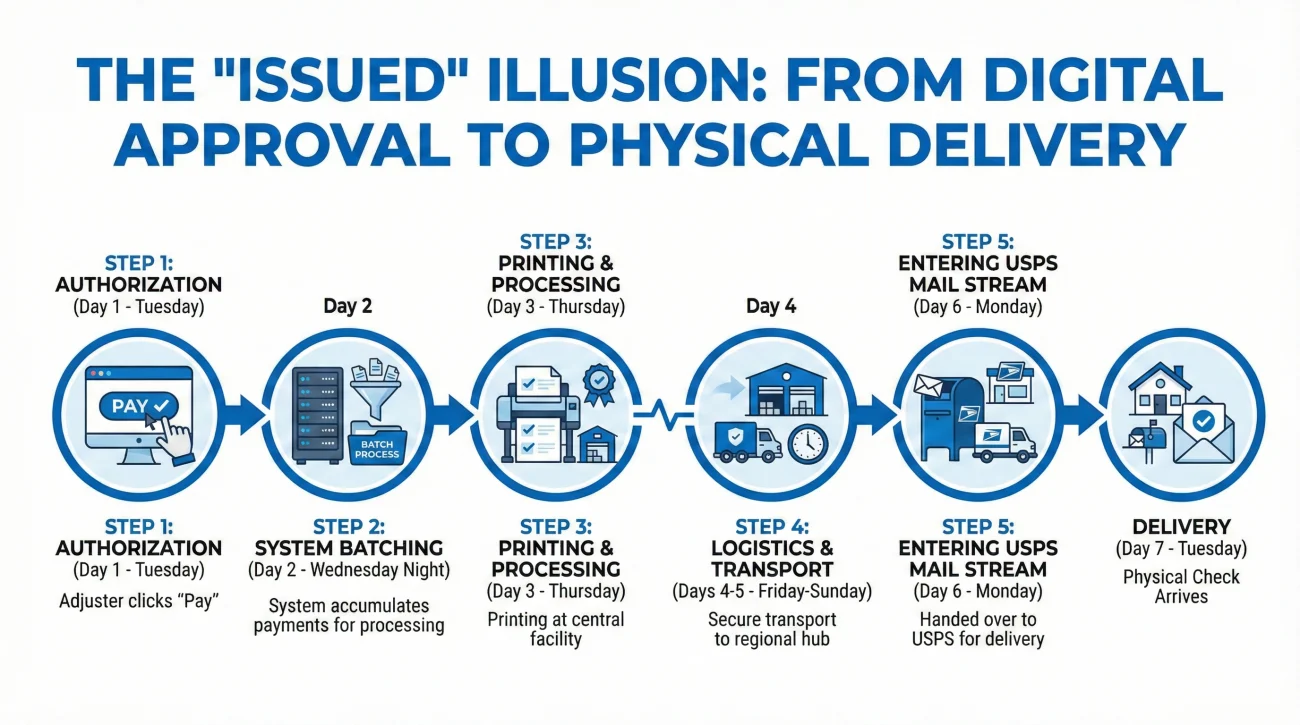
To a homeowner, “Issued” means the envelope is in the hands of the postal service. To an insurance accounting department, “Issued” means the payment was authorized in the ledger. Those are two very different states.
In many large carriers, payments go through a batch process. The adjuster clicks “Pay” on Tuesday. The system batches all payments on Wednesday night. The checks are printed at a central facility (often in a different state) on Thursday. They sit in a mailroom bin until Friday afternoon. They actually enter the USPS stream on Saturday or Monday.
While specific steps vary by carrier, the gap between approval and mailing is common. This means a check “issued” on Tuesday might not physically move until the following Monday. If you are counting on that money arriving in 2 days, you will be disappointed. I typically advise clients to add a buffer (often 5 to 7 business days) to any “issued” date provided by an adjuster before assuming the check is lost.
The Address Verification Failure
This sounds incredibly basic, yet it causes a massive percentage of lost checks. When you file a claim, you often move out of your house because it is uninhabitable. You are staying at a hotel or a rental property.
However, the insurance company’s automated system defaults to mailing checks to the “Insured Location” (your damaged house). If you do not have mail forwarding set up perfectly, or if your mailbox was damaged in the loss (common in fire or hurricane claims), the check sits in a pile of wet mail or gets returned to the carrier as undeliverable.
Whenever an adjuster says they are sending a payment, immediately verify the specific mailing address on file. Do not assume they remembered you are at the Marriott. Force them to read the street address back to you.
Field Note: The Mortgagee Clause Error
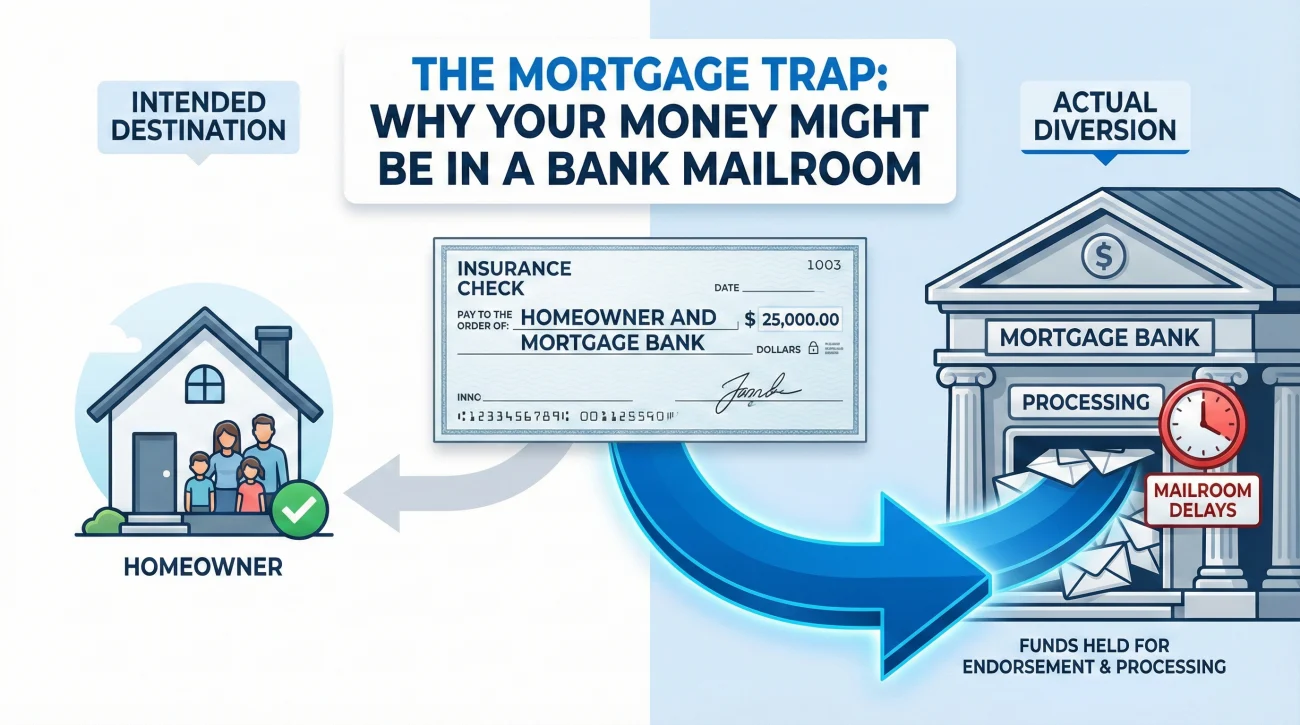
I worked on a wind claim where a $15,000 roof payment went missing for three weeks. The system showed it was mailed. The homeowner checked their mail daily. Nothing.
When we finally got a supervisor to pull the digital copy of the check, we saw the problem. The check was made out to “John Smith AND Wells Fargo.” Because of the “AND,” the carrier’s automated system sent the check directly to the mortgage company’s correspondence address, not to the homeowner. The homeowner was waiting for a check that was sitting in a bank mailroom in Texas. Nobody had bothered to tell the homeowner that the payee logic had diverted the mail. Once we knew where it was, we could call the bank to track it, but we lost 21 days simply waiting for a letter that was never coming to the house.
The Payment Trace Protocol
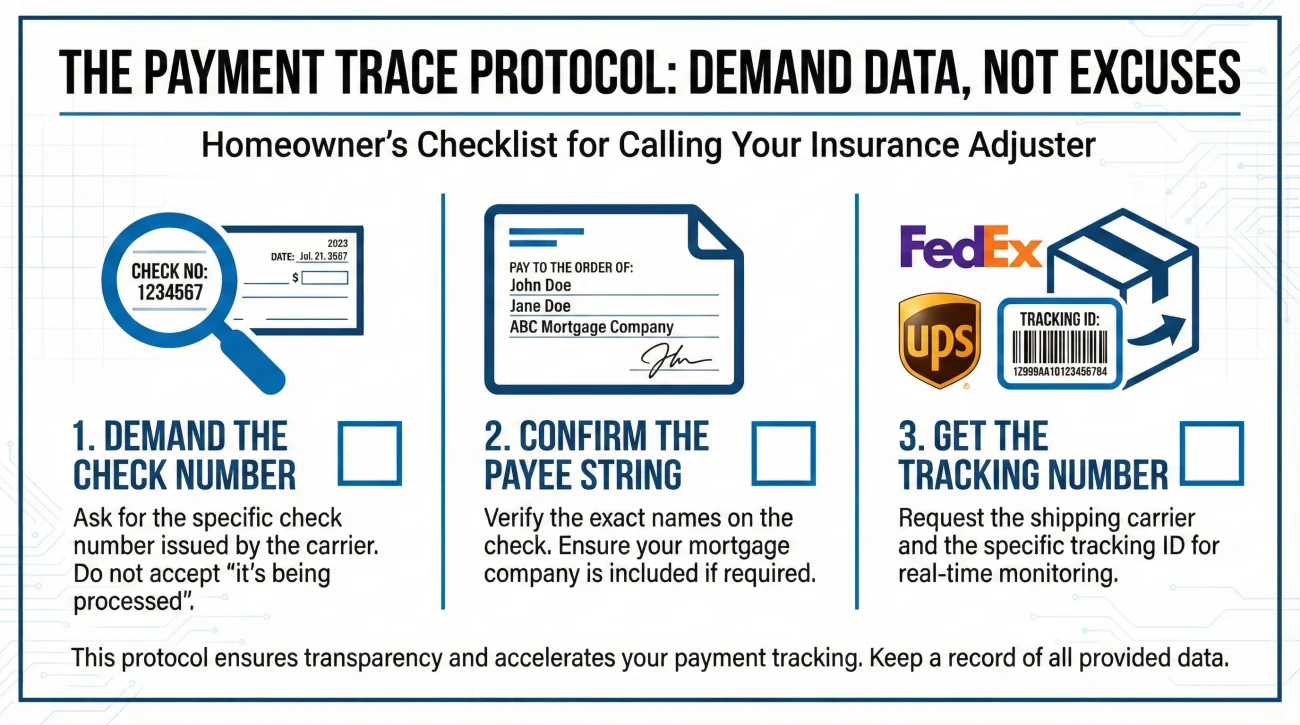
If 10 business days have passed and you have no money, you need to stop asking “Where is it?” and start asking for data. You need to verify if the check actually exists.
Send an email to your adjuster requesting three specific data points. This is part of a structured insurance claim follow up system designed to eliminate vagueness.
- 🔍 “Please provide the specific Check Number.” (If they can’t give you a number, the check hasn’t been printed yet).
- 🔍 “Please confirm the exact Payee string listed on the check.” (This reveals if your mortgage company or a contractor is listed).
- 🔍 “Please provide the Tracking Number if sent via overnight mail.” (Large checks are sometimes sent via FedEx/UPS, but adjusters forget to share the tracking).
If they reply that there is no check number yet, then the check is not “lost.” It is still stuck in the approval queue (likely waiting for a supervisor’s authority), and you need to pivot your strategy to asking about approval delays, not mail delays.
The “Stop Payment” Decision
If the check was mailed significantly long ago (often 14+ days) and hasn’t arrived, it is likely lost or stolen. You can request a “Stop Payment and Reissue.” However, you must understand the timeline consequence.
This is not an instant process. The carrier has to notify their bank to kill the first check. They often require you to sign an “Affidavit of Non-Receipt,” swearing you didn’t cash it. Then they have to re-process the new payment through the entire accounting cycle again. A reissue typically adds another 7 to 14 days to your wait.
Because of this delay, I advise clients to wait a reasonable period (often 10 full business days) before pulling the trigger on a stop payment. If the original check arrives the day after you stop it, that check is worthless paper, and you still have to wait for the new one. It creates a mess. Be patient for two weeks, then act decisively.
The Digital Fix: Pushing for EFT
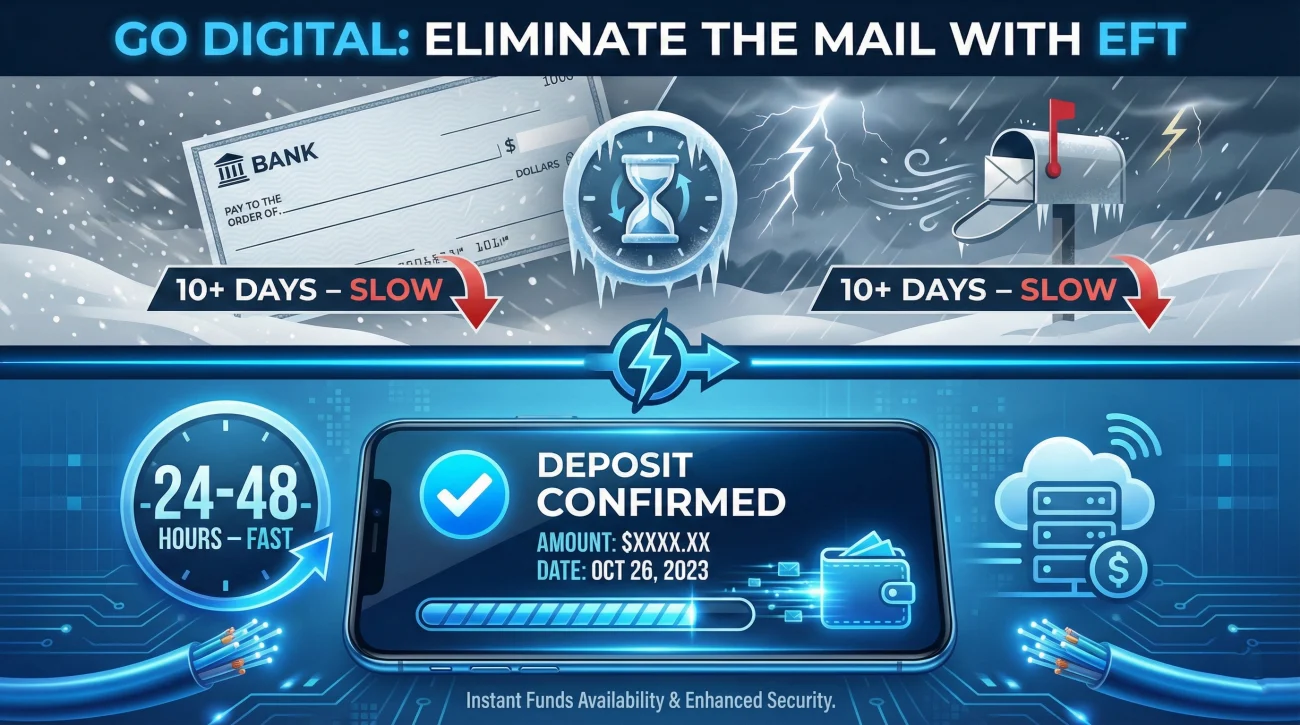
The best way to solve “check is in the mail” problems is to eliminate the mail. Many modern carriers offer Electronic Funds Transfer (EFT) or direct deposit. However, they often default to paper checks because it is their legacy standard.
At the very beginning of the payment conversation (before they say “issued”), ask explicitly: “Can this payment be released via EFT or direct deposit to expedite the repairs?”
If they agree, you will likely need to provide a voided check or fill out a digital authorization form. The 24 hours it takes to set this up is worth it. An EFT clears in 1-2 days and cannot get lost in the snow or eaten by a dog. It removes the physical variables from your payout.
The Mortgage Company Factor
If your claim is over a certain amount (often $10,000, though this depends on the lender and policy setup), your mortgage lender will almost certainly be named on the check. This is not a mistake; it is a requirement of your mortgage contract. They have a financial interest in ensuring the home is repaired.
This adds a significant delay after the check arrives. You cannot just deposit it. You have to send it to the mortgage company, they endorse it, put it in a restricted escrow account, and then release funds to you in “draws” as work is completed. If you are tracking a missing check, verify if the carrier sent it to you or directly to the lender’s specialized “Loss Drafts” department. If it went to the lender, your fight is now with the bank, not the insurance adjuster.
Final
A missing payment is usually a failure of logistics, not a denial of coverage. It is a typo in an address, a batch processing lag, or a mortgage company diversion. By treating the “Issued” status as a starting point rather than a conclusion, and by demanding specific data like check numbers and payee lists, you can pinpoint exactly where the money is stuck. Don’t sit by the mailbox hoping. Use the tracking questions to force the system to locate your funds.
❓ FAQ
📅 How long does it typically take to receive an insurance check?
Once the adjuster says “issued,” expect roughly 7 to 10 business days for mail delivery. Timelines can vary, especially during high volume events. If it has been less than 5 days, it is likely still in transit or sitting in the carrier’s mailroom.
🏦 Why is my mortgage company’s name on the check?
This is standard for claims over a certain threshold (often $10,000, varying by lender). The lender owns a stake in the property and wants to ensure the money is used for repairs, not spent elsewhere. You will need their endorsement to cash it.
🚫 Can I deposit a two-party check without the other signature?
Usually, no. Your bank will typically require all endorsements. Attempting to deposit it without the lender’s signature may result in the check being rejected or funds being frozen.
📧 Can the insurance company just wire the money to me?
Often, yes. Ask for EFT (Electronic Funds Transfer) or direct deposit. You usually have to request this specifically, as many systems default to paper checks.
🔍 How do I track a check sent by regular mail?
You generally cannot track regular USPS mail. However, you can ask your adjuster if the check hasn’t been cashed yet (they can see “cleared” status). If it hasn’t cleared after 14 days, request a reissue.
✍️ What is an Affidavit of Non-Receipt?
It is a legal form you sign stating you never received the check and promising not to cash it if it shows up later. Carriers require this before they will issue a replacement check.
📦 Will they send the check via FedEx or UPS?
For large settlements or replacement checks, adjusters can often authorize overnight shipping if you push for it. Ask for the tracking number immediately if they agree to this.
📛 What if my name is spelled wrong on the check?
Most banks will accept a check with a minor typo if the deposit account matches the person. However, if the name is completely wrong, you must return the check to the carrier for a reissue.
💸 Why did I receive multiple small checks instead of one big one?
Insurers often separate payments by coverage type (e.g., one check for structure, one for contents, one for ALE). This helps them track limits internally. Ensure the totals match your estimate.
🔄 What happens if I cash the old check after getting a new one?
Do not do this. The old check has likely been stopped. If you deposit it, it will bounce, and your bank may charge you a fee or flag your account. Destroy the old check immediately if it arrives.
⚠️ Disclaimer: PropertyClaimChecklist.com provides practical guidance, process checklists, and example follow-ups to help you organize a property claim and move it forward. It is not policy language, claim documentation, legal content, or a substitute for your insurer's instructions. Always rely on your carrier's requirements and your actual policy terms for what must be submitted and how decisions are made.