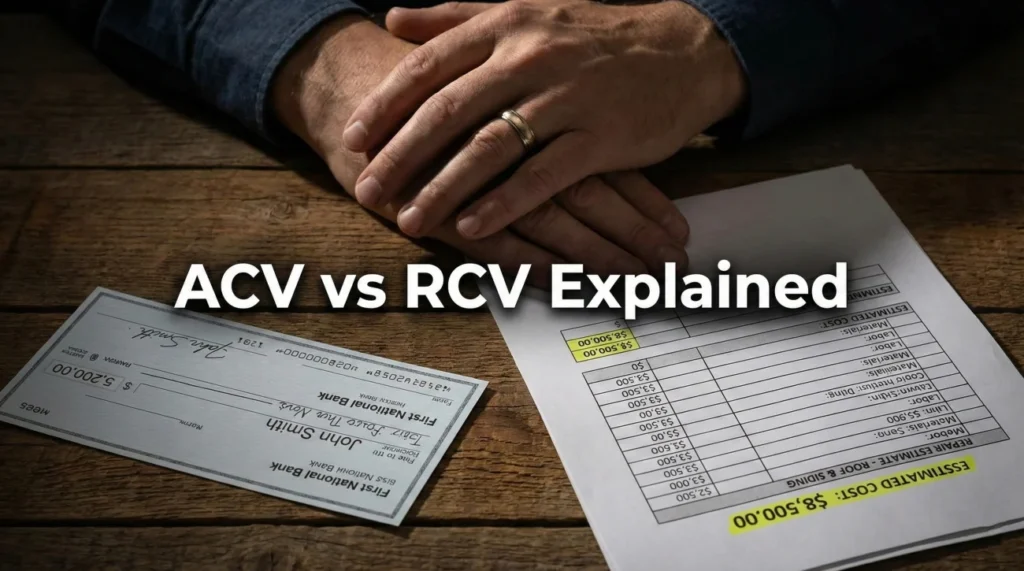
- The “Silent Check” Problem: The first check is almost always just the Actual Cash Value (ACV) and not the final amount.
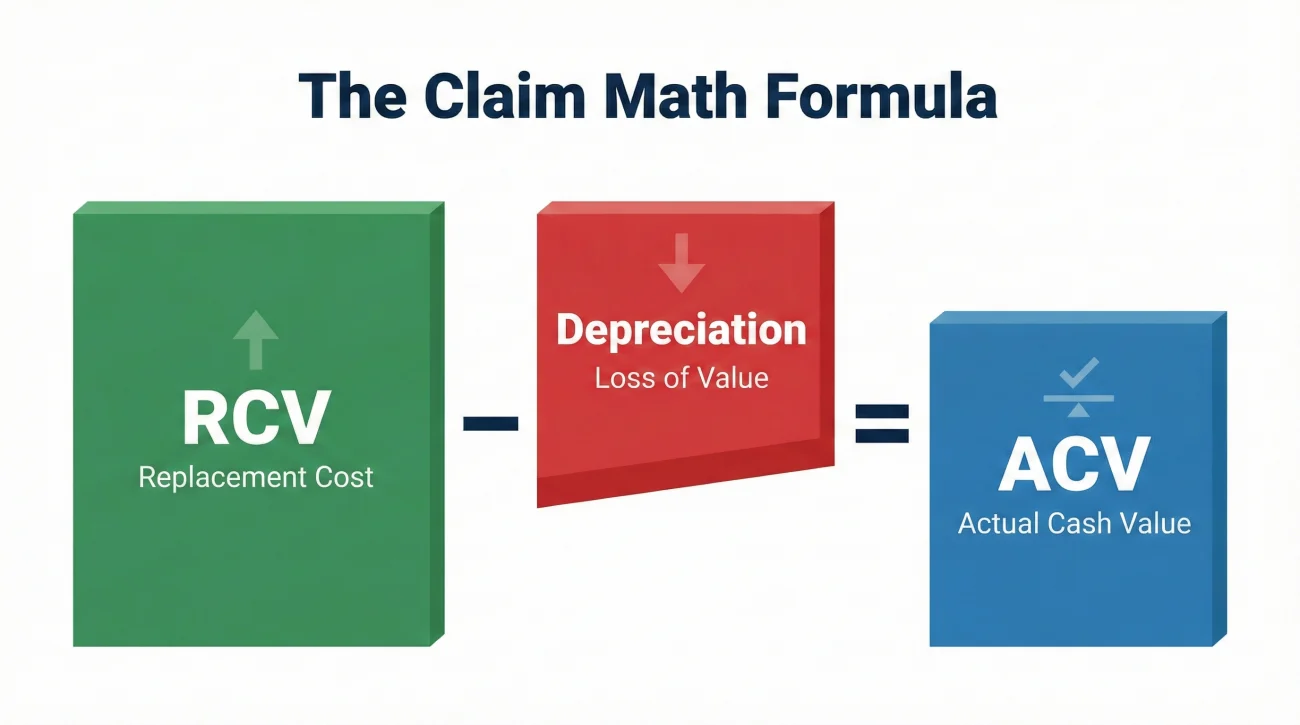
- ACV vs. RCV: RCV is the price to replace it new. ACV is the used price, which equals RCV minus depreciation.
- Recoverable Depreciation: In most replacement cost policies, the deducted money is held back and not lost. You get it after repairs.
- Action Item: Check your estimate summary page for “Non-Recoverable Depreciation” to ensure you are not losing funds permanently due to age limits.
- Process: You must usually incur the cost or do the work to unlock the holdback money.
Intro
One of the most stressful moments I see in claims operations happens right at the beginning. A homeowner opens an envelope from the insurance carrier, pulls out a check, and sees a number that is thousands of dollars lower than the estimate they just read. The immediate reaction is almost always a mix of panic and anger. Did the adjuster cut the scope? Is this the final offer? How can they possibly repair the home for this amount?
In my experience handling file documentation, this confusion stems from a lack of clarity regarding ACV vs RCV depreciation explained in plain English. The carrier is not necessarily shorting you. They are following a payment schedule dictated by the concepts of Actual Cash Value (ACV) and Replacement Cost Value (RCV).
Understanding these acronyms is not just academic. It is the key to managing your cash flow. If you do not understand where the rest of your money is hiding, you might accept the first check as the final settlement and leave thousands of dollars unclaimed. This guide will walk you through the math, the operational reality of “holdback,” and how to make sure you eventually collect the full amount.
The Three Big Numbers: RCV, Depreciation, and ACV
To manage your project budget, you need to read the insurance estimate summary page like a balance sheet. There are three core components that dictate how your money flows. Understanding the relationship between these three numbers is the first step to taking control of your claim finances.
1. RCV (Replacement Cost Value)
This is the “retail price” of your claim. RCV represents what it costs to buy new materials and pay for labor at today’s market rates, without any deduction for age or wear. When you look at your estimate, the RCV total is usually the number you expect to see on the check, but rarely do. This number should reflect the current market reality of hiring a contractor in your area.
2. Depreciation
In the insurance world, your property loses value as it ages. A ten-year-old roof is not worth the same as a brand-new roof. Depreciation is the dollar amount the adjuster deducts from the RCV to account for that loss of value due to age, wear, and tear. This is the source of the “gap” between the estimate total and your check. The older the item, the higher the depreciation deduction will be.
3. ACV (Actual Cash Value)
This is the “used price.” It is the value of your property the second before the damage happened. The formula is simple:
RCV - Depreciation = ACV
Your first check is almost always the ACV payment (minus your deductible). It is an upfront payment for the value of the damaged items “as is.” This payment is yours to keep, regardless of whether you do the repairs or not, but it is rarely enough to cover the full cost of restoration.
Key Point: The ACV check is rarely enough to pay for the full repair. That is normal. The system is designed so that the remaining funds are released after you prove the work is done.
The “Holdback”: Recoverable vs. Non-Recoverable
This is the most critical distinction in your paperwork. Not all depreciation is created equal. When reviewing your estimate summary, you need to look for specific columns that define what happens to that deducted money.
| Term | What It Means for Your Wallet |
|---|---|
| Recoverable Depreciation | This is money held back temporarily. It sits in the insurance company’s account with your name on it. Once you complete repairs and submit invoices, this money is released to you. |
| Non-Recoverable Depreciation | This is money lost forever. It is deducted because of age or policy limits (like an ACV-only endorsement on a roof) and you cannot get it back, even if you repair the item. |
In day-to-day operations, I often see homeowners fail to check this distinction. They assume all the missing money is coming later. You must verify that the depreciation listed on your summary is actually “Recoverable.” If you see a large amount in the “Non-Recoverable” column, you need to stop and ask why immediately. Finding this early allows you to adjust your scope of work or ask the adjuster for a policy explanation before you commit to expensive repairs.
Assuming the gap between the check and the estimate is an error or a low-ball offer, and arguing about the total immediately.
Checking the “Recoverable Depreciation” line item to confirm the money is available, then planning cash flow to bridge the gap until the work is done.
Field Note: The “Silent Check” Confusion
A common pattern I see involves what I call the “Silent Check.” A homeowner receives a check in the mail for $6,000, while their contractor quoted $10,000. There is no cover letter explaining the math, just the check and a 40-page estimate. The homeowner often assumes the insurance company has valued the loss at $6,000 total and starts panicking.
I worked with one file where the homeowner had already fired their contractor because they thought they could not afford the work. They believed the $6,000 check was the final verdict. Once we looked at the last page of the estimate together, we realized there was $5,500 in recoverable depreciation waiting to be unlocked. They re-hired the contractor the next day. If you are holding a check that seems light, find the Summary Page of your PDF immediately. The answer is usually sitting in the “Recoverable Depreciation” column.
The Mortgage Check Barrier
Understanding the math is only half the battle. The other half is logistics. When your ACV check arrives, you might notice it is not just made out to you. It often includes the name of your mortgage lender. This is standard procedure for claims over a certain dollar amount, usually $10,000 or more (though this threshold varies by lender and carrier), because the lender has a financial interest in ensuring the property is repaired.
This adds a layer of delay that most people do not plan for. You cannot simply deposit this check into your personal bank account. You usually have to send it to the mortgage company, who will endorse it and place the funds in a restricted escrow account. They will then release the money to you in “draws” or phases as the work is completed and inspected.
This intersects with the ACV vs RCV issue because it squeezes your cash flow even further. You are already starting with a smaller check (ACV only), and now that check is locked up in a mortgage escrow process. This makes it vital to understand exactly how much money is recoverable later so you can assure your contractor that the funds are real.
⚠️ Warning: Do not sign the check and hand it to your contractor if the mortgage company is listed as a payee. The bank will likely reject it, and you will be stuck in a bureaucratic loop to get the check re-issued.
How to Audit Your Depreciation
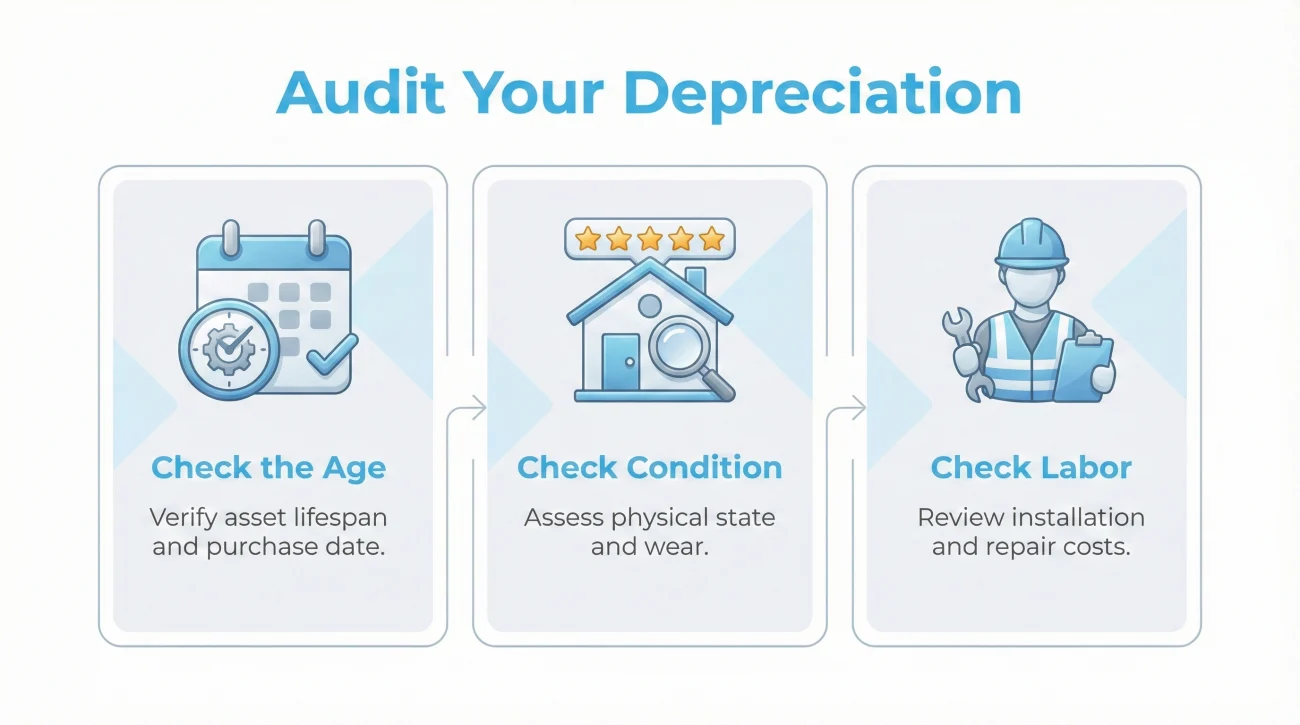
Adjusters are human, and the software they use (like Xactimate) relies on human inputs. If the input is wrong, the depreciation will be wrong. Here is how to audit the depreciation on your file to ensure you are not being shorted on your upfront ACV check.
1. Check the Age
Depreciation is calculated based on age and life expectancy. If the adjuster entered your carpet age as 15 years, but you have receipts showing it was installed 3 years ago, the depreciation is incorrect. You are losing upfront cash flow because of a data entry error. Always verify the “Date Installed” or “Age” column in the detailed breakdown of the estimate.
2. Check the Condition
Items can be depreciated based on “Average,” “Better than Average,” or “Superior” condition. If your home was meticulously maintained, but the adjuster defaulted to “Average,” the depreciation deduction will be higher than it should be. “Average” assumes normal wear and tear. If your 10-year-old cabinets look brand new because you travel 9 months out of the year, you should argue for a “Better than Average” condition rating to reduce the depreciation deduction.
3. Check Labor Depreciation
This is a specific operational nuance. In some jurisdictions, insurance companies are not allowed to apply depreciation to labor costs, only to materials. If you see depreciation applied to tasks that are purely labor, such as “tear out,” “detach and reset,” or “hauling debris,” you should flag this to confirm it aligns with local regulations. Depreciating labor artificially lowers your upfront ACV payment and pushes more money into the “Recoverable” bucket, which forces you to pay more out of pocket to get the job started.
💡 Pro Tip: If you find an error in age or condition, do not just call. Send a photo of the receipt or the item tag with a short note requesting a revision to the depreciation schedule.
Material-Specific Depreciation nuances
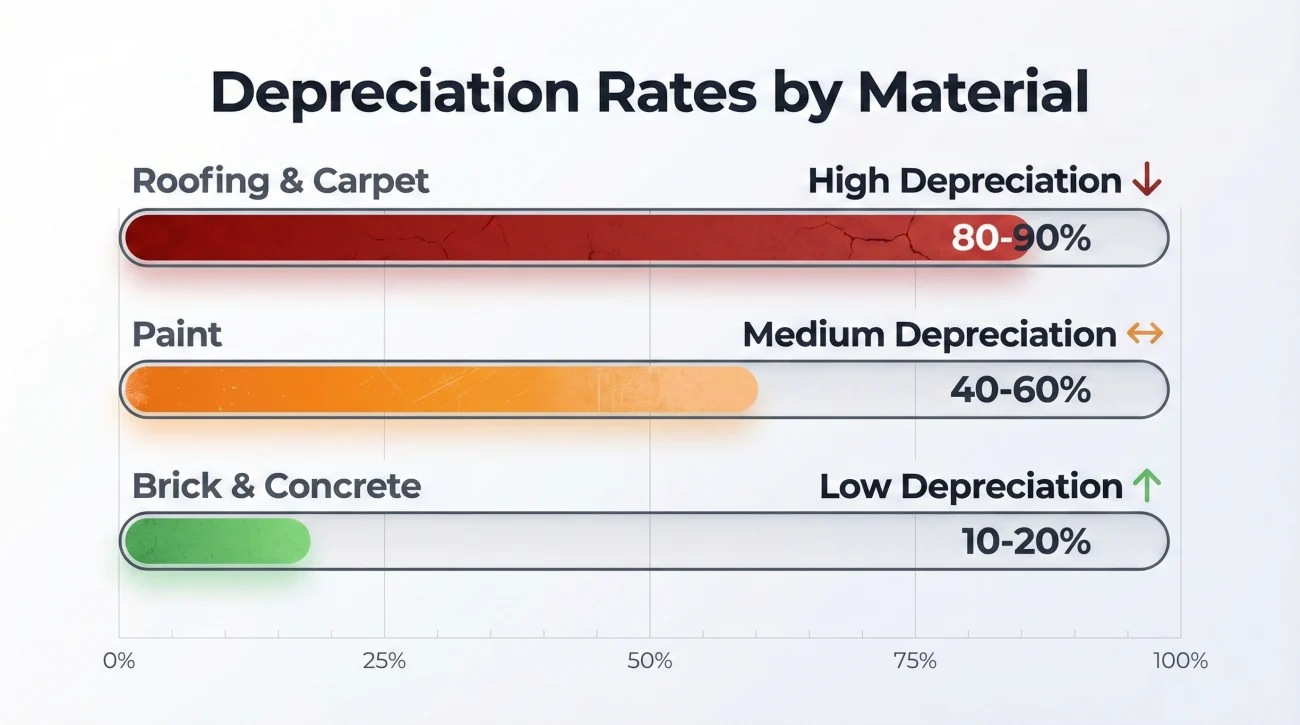
Depreciation is not a flat percentage applied to your whole house. It is applied line item by line item. Understanding which materials depreciate faster can help you spot errors.
- 📉 Roofing: This depreciates heavily. A 15-year-old shingle roof might be depreciated by 75% or more depending on the carrier’s schedule. This is where the ACV check often feels shockingly low.
- 📉 Carpeting: This has a short lifespan in insurance tables (often 5 to 7 years in many standard tables, though this varies). If your carpet is 5 years old, expect a very low ACV payment for it.
- 📉 Paint: Yes, paint depreciates. Adjusters assume paint only lasts a few years before needing a refresh.
- ✅ Solid Elements: Items like brick, concrete, or high-grade framing depreciate very slowly. If you see high depreciation on these items, question it immediately.
If the depreciation seems uniform across every single item (e.g., exactly 50% on everything from the roof to the drywall), that is a red flag. It implies the adjuster may have applied a “global depreciation” setting rather than evaluating each item’s actual condition. This is often inaccurate and worth challenging.
How to Request Partial Depreciation Releases
Many homeowners think they have to wait until the entire project is 100% complete to ask for their recoverable depreciation. This is not true. In larger claims, you can and should ask for partial releases as you complete major trades.
For example, if you have finished the roof but are still waiting on siding and windows, you do not have to wait for the windows to arrive to get paid for the roof. You can submit the roofing invoice and the “Certificate of Satisfaction” (or your carrier’s equivalent form like a Certificate of Completion) for the roof alone. This keeps cash flowing back into your account and helps you pay the roofer without dipping into your personal savings.
This strategy is essential for large losses where the timeline might stretch over months. Do not let your money sit in the carrier’s bank account while you are paying interest on credit cards to float the project.
Script: Clarifying Non-Recoverable Items
If you see funds listed as “Non-Recoverable” and you do not understand why, or if the age of your items is wrong, use this script to get a written explanation. Never rely on a phone explanation for financial deductions.
Hello [Adjuster Name],
I am reviewing the estimate summary and have two questions regarding the depreciation applied:
1. I noticed [Amount] listed under “Non-Recoverable Depreciation” for the [Item, e.g., roof]. Could you please confirm in writing the policy reason or condition that makes this portion non-recoverable?
2. The estimate lists the age of the [Item] as [Years]. I have attached a receipt showing this item was installed in [Year], making it significantly newer. Please adjust the depreciation schedule to reflect the correct age.
I want to make sure the upfront ACV payment is accurate so I can begin repairs.
Regards,
[Your Name]
Script: Requesting Partial Depreciation Release
Use this script when you have finished one major part of the job (like the roof) and want that specific money released, even if the rest of the house is not done.
Hello [Adjuster Name],
The roof replacement for the above claim has been completed as of [Date].
I have attached:
1. The roofing contractor’s final invoice.
2. Photos of the completed roof.
3. A signed Certificate of Satisfaction (or equivalent completion form) for the roofing trade.
Please release the Recoverable Depreciation associated with the roofing line items. We are still working on the [Siding/Interior] repairs and will submit a separate request for those funds once that work is complete.
Please confirm when this partial payment has been issued.
Thank you,
[Your Name]
When the RCV Itself is Too Low
Sometimes the problem is not the depreciation percentage but the starting number. If the RCV (Replacement Cost Value) listed on your estimate is not enough to hire a contractor even before depreciation is deducted, you have a different problem. In that case, no amount of unlocking depreciation will save you. You need to address the scope and pricing gap first.
If you find yourself in this situation, you need to pause and build a proper documentation response. You can refer to our guide on low estimate documentation response to learn how to correct the base RCV numbers before worrying about the depreciation math. You cannot calculate the correct ACV if the RCV is wrong to begin with.
Final
The gap between ACV and RCV is not lost money. It is just “performance-based” money. The insurance carrier wants proof that you actually fixed the home before they release the full replacement cost. Your job is to audit the depreciation for accuracy, protect your cash flow by understanding the holdback, and ensure you have a clear paper trail to unlock that second check once the work is done. By checking the age, condition, and labor depreciation settings, and by requesting partial releases as you go, you can turn a cash-flow crunch into a manageable project timeline.
❓ FAQ
💸 Why is my first insurance check so low?
Your first check usually only covers the Actual Cash Value (ACV), which is the replacement cost minus depreciation and your deductible. The rest of the money (recoverable depreciation) is paid after repairs are completed.
📉 What does recoverable depreciation mean?
Recoverable depreciation is the money the insurance company holds back until you prove you have repaired or replaced the damaged items. It bridges the gap between the “used” value and the “new” cost.
🚫 What is non-recoverable depreciation?
This is a deduction for age or wear that you will never get back, even if you do the repairs. This typically applies to old items or specific policies (like an ACV-only roof policy).
🛠️ Do I have to fix everything to get the depreciation money?
Generally, yes. You only get the recoverable depreciation for the items you actually repair or replace. If you decide not to fix something, you keep the ACV check but forfeit the holdback for that item.
⏳ Is there a time limit to claim recoverable depreciation?
Yes. Most policies have a deadline, often 180 days to 1 year from the date of loss, to complete repairs and claim the holdback. You should ask your adjuster for this specific deadline in writing.
👷 Can the insurance company depreciate labor?
It depends on state laws. Some states prohibit depreciating labor costs, while others allow it. If you see labor being depreciated, it is worth asking the adjuster to confirm if this is compliant with local regulations.
📝 How do I prove repairs are done to get the check?
You typically need to submit a “Certificate of Satisfaction” (or a Certificate of Completion/Proof of Repair) signed by you and the contractor, along with the contractor’s final invoice.
💰 Can I keep the extra money if repairs cost less than RCV?
No. If your repairs cost less than the insurance estimate, the carrier will usually lower their final payment so they do not pay more than you actually spent. You generally cannot profit from an insurance claim.
👴 What if the adjuster got the age of my roof wrong?
You should provide documentation (like a permit, receipt, or home inspection report) proving the correct age. Ask them to revise the depreciation schedule based on the actual age, which will increase your upfront check.
💵 Who does the depreciation check get made out to?
It is often made out to both you and your mortgage company (if you have one), and sometimes the contractor if you signed a direction to pay. You will need to get all parties to endorse it.
⚠️ Disclaimer: PropertyClaimChecklist.com provides practical guidance, process checklists, and example follow-ups to help you organize a property claim and move it forward. It is not policy language, claim documentation, legal content, or a substitute for your insurer's instructions. Always rely on your carrier's requirements and your actual policy terms for what must be submitted and how decisions are made.