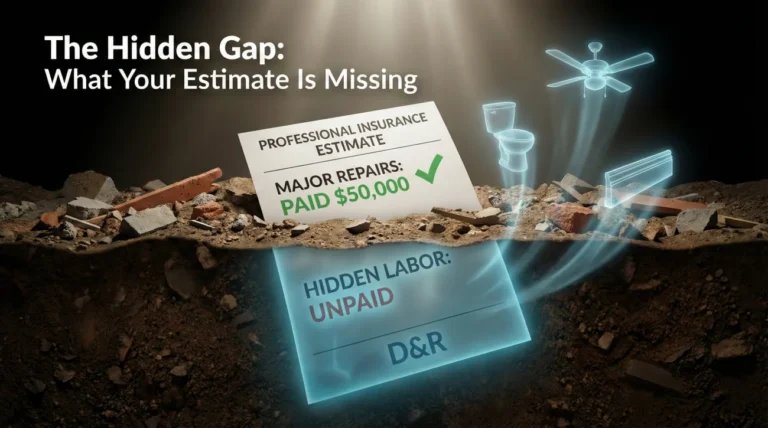
- The Core Truth: A gap between the bid and the estimate is normal. It is rarely a “take it or leave it” situation; it is the start of a reconciliation process.
- Scope vs. Price: Most gaps are caused by missing scope (items left out), not just price differences. You must fix the scope first.
- The “Apple-to-Apple” Rule: You cannot compare a one-page contractor bid to a 30-page insurance estimate. You need to line them up item by item to find the missing pieces.
- The Supplement Solution: The operational fix is not to argue, but to submit a “Supplement” request backed by photos and invoices.
- Action Item: Do not sign a contract for the difference yet. Use the “Comparison Method” below to force the insurance carrier to review the missing costs.
The Sticker Shock of the First Bid
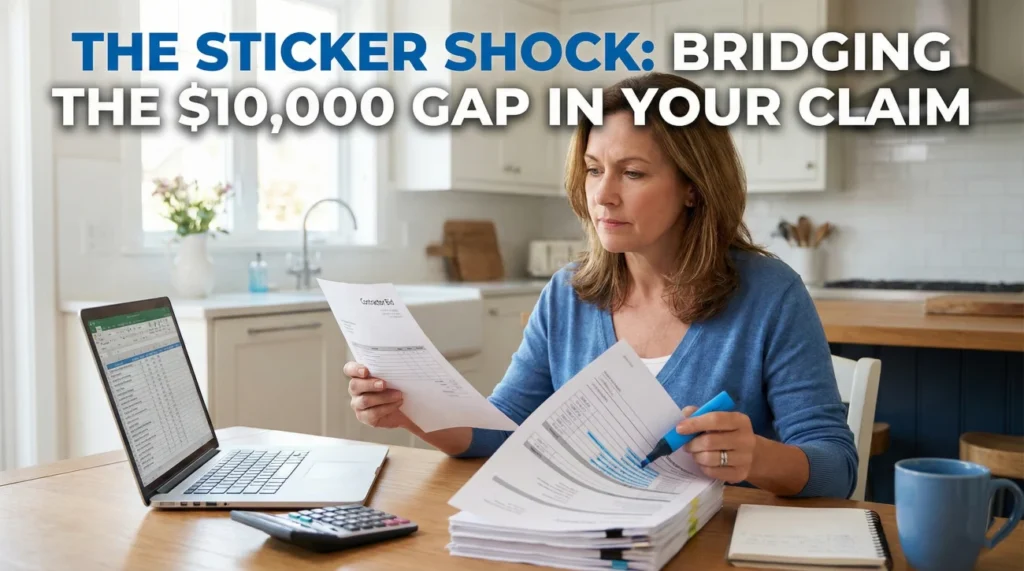
One of the most stressful moments in a property claim is receiving your contractor’s proposal. You hold the insurance estimate in one hand, showing a payout of $12,000. You hold the contractor’s bid in the other, showing a cost of $22,000. The panic sets in immediately. Do you have to pay the $10,000 difference out of pocket? Is your contractor ripping you off? Is the insurance company cheating you?
In many claims I have managed, this gap happens in almost every single significant loss. It is not necessarily a sign of fraud or bad faith. It is usually a sign of two different languages being spoken. The adjuster is often writing a theoretical estimate based on regional software averages (like Xactimate). The contractor is writing a real-world bid based on their actual labor availability and material costs.
When you see that the contractor bid higher than insurance estimate figures, do not panic. Do not fire the contractor, and do not scream at the adjuster. Instead, treat this as an administrative puzzle. Your job is to find the missing pieces that explain the $10,000 gap and present them in a way the adjuster can pay.
It Is Usually Scope, Not Price
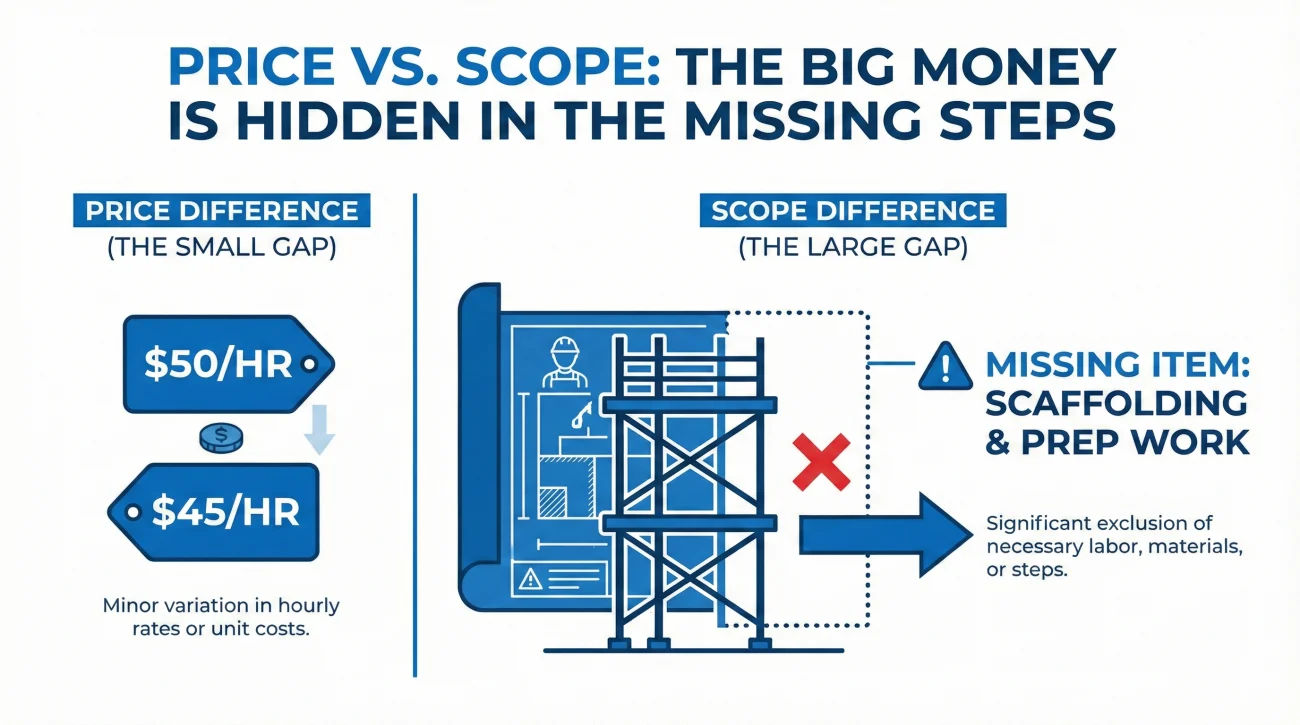
Homeowners often assume the fight is about the price of paint. “My guy charges $2.00 a foot, insurance pays $1.50.” While price differences exist, they rarely account for a $10,000 gap. The big money is usually hidden in “Missing Scope.”
Missing scope means the contractor included steps that the adjuster completely ignored. Common examples include:
Contractor wants $50/hr, Insurance pays $45/hr. Gap: Small.
Contractor charges to scrape, sand, and prime the floor. Insurance only pays to varnish. Gap: Huge.
If you argue “price,” the adjuster will likely say “we pay market rates.” If you argue “scope” (e.g., “you forgot the scaffolding”), the adjuster has to address it. Operational success comes from identifying these missing line items.
Common Scope Gaps Checklist
Before you call the adjuster, check your contractor’s bid for these items that insurance estimates frequently miss:
- ✅ Prep & Protection: Masking tape, floor covering (Ram Board), plastic sheeting (containment).
- ✅ Detach & Reset: Removing light fixtures, switch plates, or blinds to paint behind them.
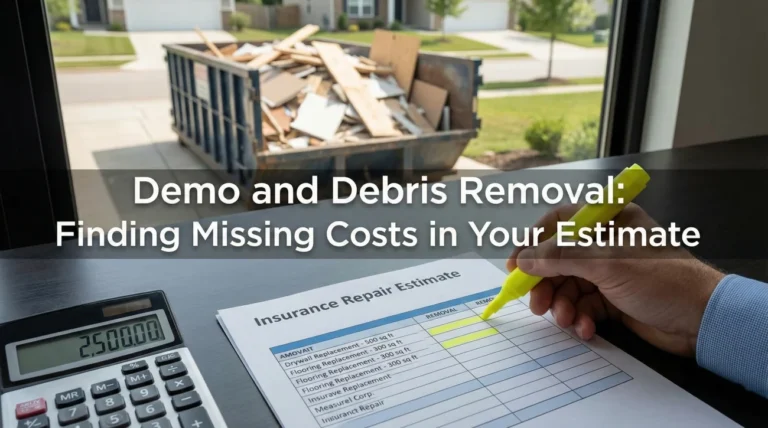
- ✅ Haul-off & Dump Fees: The cost to throw away the debris.
- ✅ Minimum Labor Charges: An electrician might charge a minimum of $250 just to show up, while the software writes $45 for “one hour.”
- ✅ Access Costs: Scaffolding for high ceilings or steep roofs.
- ✅ Texture Matching: The extra labor to make a new drywall patch match the old texture.
Field Note: The “One-Page” Bid Problem
I recall a file where the homeowner sent a contractor’s quote that simply said: “Repair Roof and Living Room: $18,500.” The insurance estimate was $9,000. The adjuster rejected the contractor’s bid immediately. Why? Because he couldn’t see what he was paying for.
Adjusters typically need itemization to justify payment. They cannot pay a lump sum without knowing if it includes upgrades. I advised the homeowner to ask their contractor to break down the bid. Once the contractor itemized it, we saw he included “code upgrade insulation” and “custom crown molding matching.” The adjuster had missed both. Once those line items were visible, the adjuster added them, and the gap closed to within $500. The money was there; it was just hidden behind a vague bid.
How to Get Your Contractor to Itemize
Many contractors hate paperwork. They give you a “napkin number.” To bridge the gap, you need to help them help you. Ask these three questions to force a better bid:
- “Can you break this lump sum into specific rooms and tasks with quantities?”
- “Which line items are for demolition versus installation versus finish work?”
- “Are there any ‘allowances’ in this price, or are these fixed costs?”
This transforms a vague number into a working document you can send to the insurance carrier.
The “Apple-to-Apple” Comparison Method
To fix the gap, you need to perform a line-item audit. Sit down with both documents and a highlighter.
| Contractor Bid Line | Insurance Estimate Line | Status |
|---|---|---|
| Replace Drywall (Whole Room) | Patch Drywall (4×4 area) | Scope Mismatch |
| Paint Ceiling (2 coats) | Paint Ceiling (1 coat) | Missing Step |
| Scaffold Rental | (Not listed) | Missing Item |
Quantity Errors: The Fastest Win
Did the adjuster measure the room as 12×12 (144 sq ft), but the contractor measured it as 14×14 (196 sq ft)? That quantity error ripples through every line item (flooring, paint, ceiling). Correcting the math is often the easiest way to close the money gap without arguing about price rates.
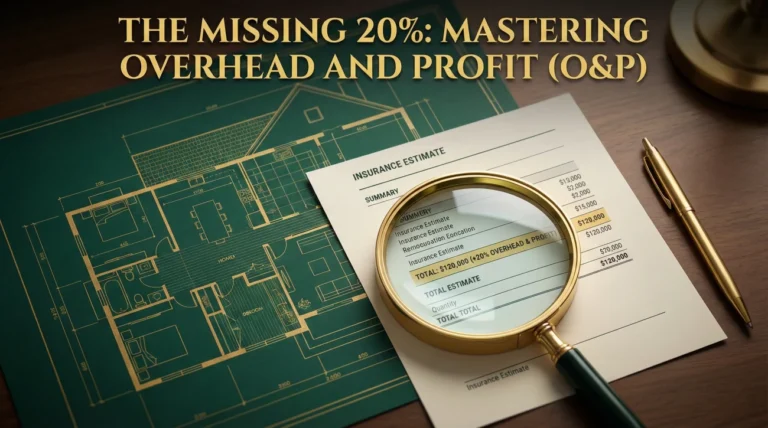
Identify the “O&P”
Did your contractor charge 20% for Overhead and Profit? Did the insurance estimate leave it off? If so, that alone could be 20% of your gap. (Refer to our guide on overhead and profit insurance estimate for details on how to trigger this payment).
The Supplement: How to Ask for More Money
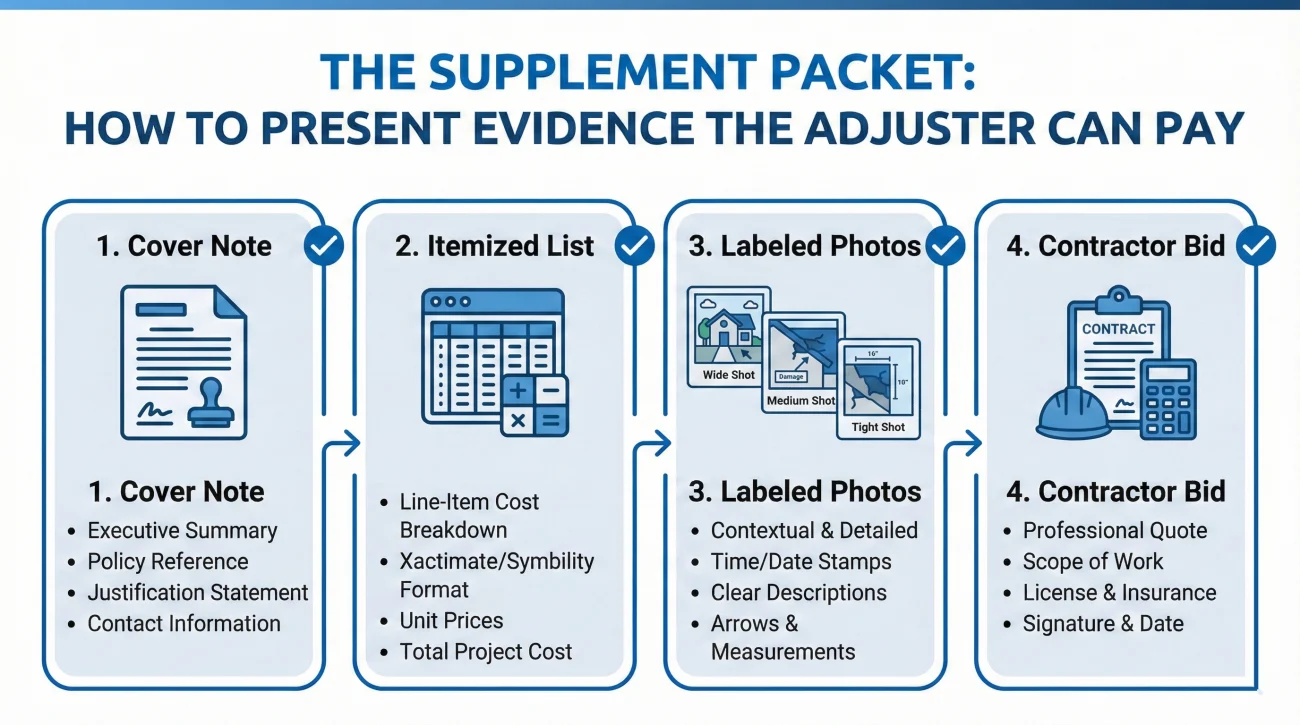
Once you have identified the missing items (the “deltas”), you do not just email the adjuster and say “pay more.” You submit a formal “Supplement Request.”
A strong supplement packet usually follows this structure:
- 📄 Cover Note: A brief summary of what changed (e.g., “Found subfloor rot after carpet removal”).
- 📄 Line-Item List: The specific missing items you identified.
- 📷 Photos Labeled: Evidence proving the condition (e.g., photo of the rot).
- 📄 Contractor Scope: The itemized page from your contractor.
- 📅 Next Step Request: “Please review by [Date].”
💡 Photo Rule: For supplement photos, take three shots: Wide (room context), Medium (the area), and Tight (the specific damage with a tape measure if possible). This prevents context questions.
Guidance: Writing the Supplement Email
If you don’t have time to write a long letter, use this short script to get the process started.
Hello [Adjuster Name],
I have reviewed the insurance estimate against my contractor’s bid. I identified 3 specific scope items missing from the insurance estimate (photos attached for reference).
Please review the attached supplement request for these items so we can proceed with repairs. Do you need a reinspection, or can you approve this from the photos?
Regards,
[Your Name]
Red Flags: Restore vs. Upgrade
Sometimes the contractor is expensive because they are upgrading you, not restoring you. Insurance pays for “Like Kind and Quality” (LKQ). If your gap is caused by these items, you will likely have to pay the difference yourself:
- 🚫 Betterment: Replacing laminate counters with granite.
- 🚫 Design Changes: Moving a wall to open up the floor plan.
- 🚫 Extra Rooms: Painting the hallway just because “it’s dirty,” even though the fire was in the kitchen.
When to Pause Work
If your contractor finds new hidden damage (like mold behind a wall) that isn’t on the estimate, they should pause work on the affected area immediately. Do not rip it out and throw it away. Take photos, send them to the adjuster, and wait for approval. If you destroy the evidence before the adjuster sees it, you might not get paid.
Final: What to Do Next in 24 Hours
A low estimate is not the final verdict; it is an opening offer based on incomplete data. To bridge the gap, follow this 24-hour action plan:
- Request an itemized breakdown from your contractor.
- Map the bid to the insurance estimate line-by-line.
- Build your supplement packet with photos of the missing items.
- Send it to the adjuster and ask for a receipt confirmation.
By meticulously comparing the scope and identifying missing steps, you can usually force the carrier to pay for the true cost of repairs without ever having to argue about the “price.”
❓ FAQ
📉 Why is the insurance estimate always lower?
Insurers often use software (like Xactimate) with standardized regional price lists. These lists can sometimes lag behind real-time inflation or labor shortages. Also, adjusters are trained to write only for visible damage, whereas contractors anticipate hidden steps.
📝 Can I just send the adjuster my contractor’s bid?
You can, but if it is a lump sum (one total number), it will likely be rejected. Ask your contractor to provide an “itemized” breakdown splitting labor and materials so the adjuster can compare it line-by-line.
🔨 What if the contractor finds more damage later?
This is standard. It is called a “Supplement.” The contractor should pause work on that area, take photos of the new damage, and send them to the adjuster for approval before proceeding.
🚫 Should I pay the difference myself?
Only if the difference is for an “upgrade” (like granite counters instead of laminate). If the difference is for restoring the property to its original condition, you should fight for the insurance to cover it.
🤝 Can my contractor talk to the adjuster directly?
Yes, and this is often the most efficient path. You may need to give verbal or written permission for them to discuss the claim details, but letting the two pros talk “construction” often solves scope disputes faster.
📐 What if the measurements are wrong?
This is the easiest win. If the adjuster says the room is 10×10 and it is actually 12×12, just send a photo of a tape measure showing the real dimension. They must correct math errors.
💸 Does the insurance company have to match my contractor’s price?
Technically, they owe the “market rate” to repair the damage. If you can prove your contractor’s price is the market rate (and you can’t find anyone cheaper), they should pay it. But they are not obligated to pay a “luxury” contractor’s premium.
📊 What is Xactimate?
It is the estimating software used by most insurance companies. It generates prices based on zip code averages. Restoration contractors often use it too, which makes alignment easier.
🔄 What if the adjuster refuses to budge?
Depending on your policy and state, you may be able to request a reinspection, invoke an “Appraisal” clause (arbitration), or hire a Public Adjuster. Check your specific policy conditions for dispute resolution options.
🏗️ Can I do the work myself and keep the money?
Yes, but you usually cannot claim the Overhead and Profit (O&P) or the full labor rate a contractor would charge. You get paid for materials and a basic labor allowance.
⚠️ Disclaimer: PropertyClaimChecklist.com provides practical guidance, process checklists, and example follow-ups to help you organize a property claim and move it forward. It is not policy language, claim documentation, legal content, or a substitute for your insurer's instructions. Always rely on your carrier's requirements and your actual policy terms for what must be submitted and how decisions are made.