

- It is Just Math: Industry data indicates roughly 1 in 20 insured homes files a claim annually. Filing a claim is a standard financial interaction, not a rare tragedy.
- Structure Beats Volume: Sending 100 random photos often slows you down. Adjusters need photos labeled by room and trade to process payments quickly.
- The “Review-Ready” Standard: The fastest files follow a specific pattern: clear chronology, room-based organization, and evidence that matches line items.
- Your Goal: Make it easy for the adjuster to say “yes” by packaging your evidence so they do not have to hunt for it.
Stop Thinking Your Claim is “Special”
In my experience, new homeowners often treat a property claim like a rare, catastrophic event. They approach it with hesitation, thinking, “I never thought this would happen to me.”
Veterans in claims operations see it differently. To us, a claim is simply a contract feature being activated. It happens every day, in every zip code. The system is designed to handle thousands of these at once. The problem is not that claims are rare; the problem is that most homeowners submit files that jam the gears of that system.
The difference between a check in 14 days and a fight lasting 4 months is rarely about “luck.” It is frequently determined by whether you provided a file that an overworked adjuster could review, verify, and approve in a single sitting.
The Reality of Risk: 5.6% is Not Zero
Let’s look at the numbers to ground this. You might feel unlucky, but the data says you are just part of the statistical norm.
According to the Insurance Information Institute (III), approximately 5.6% of insured homes filed a claim annually between 2019 and 2023. That is roughly 1 in 20 homes.
When we dig deeper into the “peril” (the cause of loss), wind and hail damage consistently top the list, followed closely by water damage and freezing. Why does this matter to you?
It matters because adjusters are specialists in these patterns. They know exactly what “wind damage” looks like versus “old roof wear and tear.” They know exactly what “frozen pipe burst” looks like versus “slow leak over 10 years.” When your evidence matches the standard patterns they see in that 5.6% of homes, the process moves. When your evidence is messy or ambiguous, the brakes slam on.
Field Note: The “Photo Dump” Problem
Here is a scene I see constantly in operations. A homeowner suffers significant water damage. They want to prove it, so they walk around taking photos of everything wet. Then, they upload 75 files to the portal with names like `IMG_0492.JPG` and `IMG_0493.JPG`.
You might think, “I sent them 75 photos! The proof is undeniable!”
The adjuster sees: A chaotic pile of close-ups. They cannot tell if that wet drywall is in the bathroom, the kitchen, or the basement. They cannot tell if `IMG_0492` is the same wall as `IMG_0420`.
Key Point: In claims, confusion is treated as a lack of evidence. If an adjuster cannot orient themselves in your photos within 30 seconds, they will likely set the file aside to “figure out later.” And later can mean weeks.
The Perfect Room Photo Map
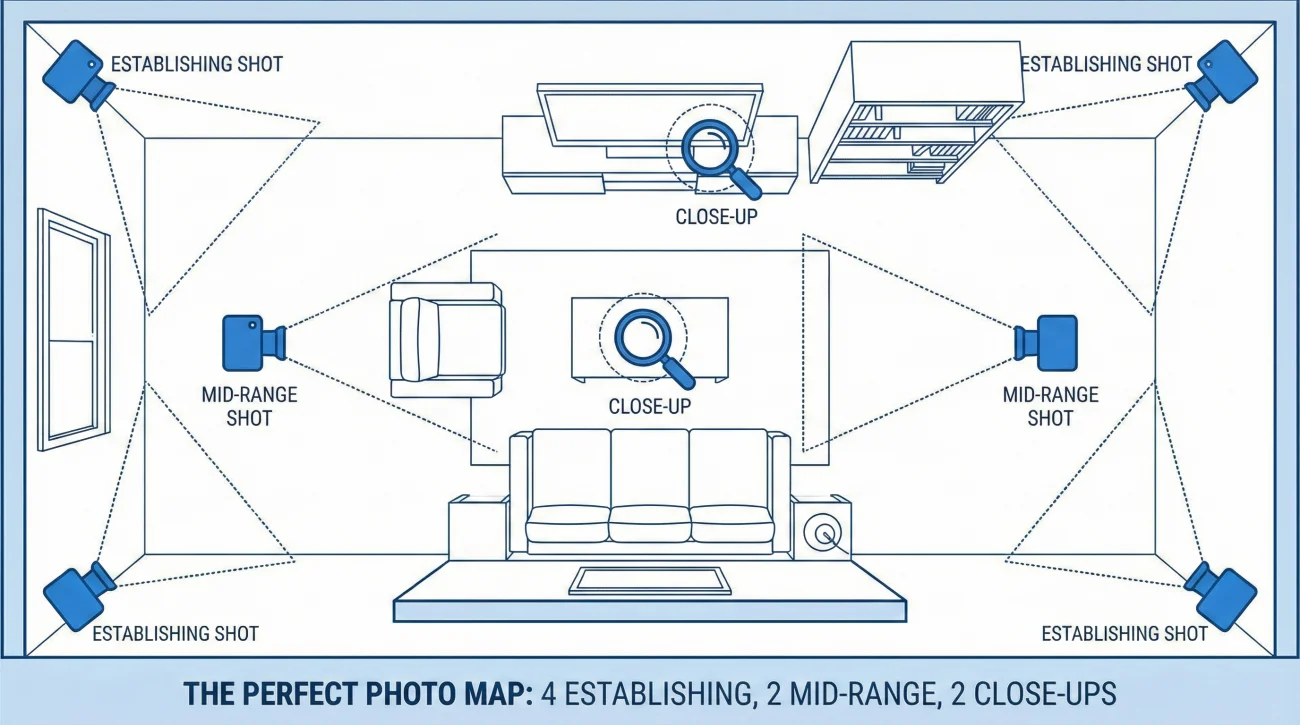
To avoid the photo dump trap, follow this simple shot list for every damaged room. This structure tells the full story without saying a word.
- 📸 4 Establishing Shots: Stand in each corner of the room and take a photo looking across to the opposite corner. This proves context.
- 📸 2 Mid-Range Shots: Step closer to the damaged area (about 4-6 feet away) to show the location of the damage relative to the room.
- 📸 2 Close-Up Shots: Get within 6-12 inches of the damage to show texture, water lines, or impact marks. Place a tape measure or coin for scale if needed.
3 Patterns of a “Review-Ready” File
The files that get approved fastest always share the same DNA. They are structured. They respect the adjuster’s need for logic. Here are the three patterns you should mimic.

1. Clear Chronology
A good file tells a time-based story without words. The photos and documents are ordered: Discovery -> Damage -> Mitigation -> Repair.
Do not mix photos of the demolition with photos of the initial leak. It creates doubt about what was pre-existing damage. Keep the “Before” clearly separated from the “During” and “After.”
2. Room and Trade Logic
Adjusters write estimates by room (e.g., “Master Bath”) and by trade (e.g., “Drywall,” “Painting”). Your evidence should mirror this.
- ✅ Good: A folder named “Kitchen” containing sub-folders for “Flooring” and “Cabinetry.”
- ❌ Bad: A single folder named “Damage” with everything mixed together.
3. The Line Item Match
This is the advanced move. If you are claiming $500 for a new vanity, you need a photo of the old vanity showing it is ruined. If you are claiming $200 for baseboard removal, you need a photo of the baseboards being removed.
Every dollar you ask for must have a corresponding “visual receipt.” If there is a line item on your spreadsheet without a photo next to it, expect that item to be cut.
The Portal Protocol
Uploading to the portal is not enough. Systems glitch, and notifications fail. Use this micro-protocol to ensure your evidence is actually received:
- Rename First: Never upload `IMG_1234.jpg`. Rename it to `Kitchen_Sink_Leak.jpg`.
- Batch by Folder: If the portal allows, upload by room. If not, upload in batches of 10 and label the batch.
- Verify the Upload: Refresh the page to ensure the files appear in the “Documents” tab.
- Send the “Ping”: Immediately email your adjuster: “Just uploaded 12 labeled photos of the kitchen damage. Please confirm you can view them.”
Mini Cases: Packaging Changes Speed
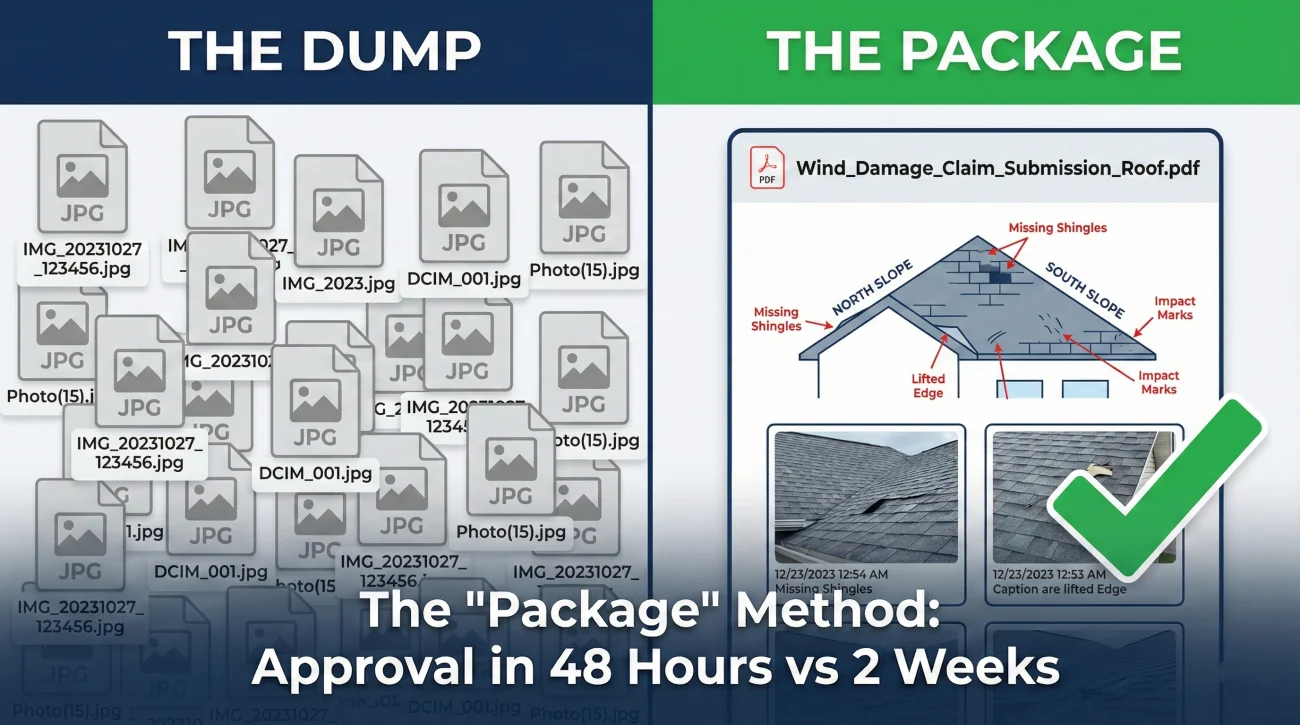
Case A: The Context Gap (Wind Damage)
Homeowner sends 40 close-ups of shingles on the grass. No context.
Result:
Adjuster cannot verify where they came from or if they are old debris. Orders a ladder assist inspection. Delay: 2 weeks.
Homeowner sends a PDF diagram of the roof labeling the slopes (North, South). Photos are annotated with circles showing missing tabs on the North slope.
Result:
Damage is verified as wind-consistent. Scope approved. Time: 48 hours.
Case B: The 14-Day Water Loss Timeline
Here is what a perfect “fast track” water claim looks like in practice:
- Day 1 (Discovery): Photo of the burst pipe and standing water. Water shut off immediately.
- Day 2 (Mitigation): Photos of wet drywall removal and dehumidifiers running. Daily moisture log started.
- Day 5 (Submission): Evidence pack sent. Includes: Timeline of events, photos labeled by room, and mitigation invoice.
- Day 10 (Review): Adjuster matches the mitigation invoice to the moisture log and photos. No questions asked.
- Day 14 (Payout): Undisputed payment issued.
Final Thoughts
Filing a claim is not just about being right; it is about being clear. The statistic that 5.6% of homes file a claim proves that this is a routine part of homeownership, not an anomaly. But the system is designed to process routine, well-ordered data.
You cannot control the weather, and you cannot control the insurance company’s internal delays. But you can control the quality of the input. Be the file that is easy to read, and you will likely be the file that gets paid.
❓ FAQ
📊 What are the most common home insurance claims?
Wind and hail are consistently the most frequent causes of loss, followed by water damage and freezing. These categories make up the vast majority of property claims filed each year.
📸 How many photos should I send for a claim?
There is no magic number, but quality beats quantity. You need enough “Establishing Shots” to show the whole room and enough close-ups to show the texture of damage. Usually, 20 organized photos are worth more than 100 random ones.
🏷️ Do I really need to label my photos?
Yes. Renaming a file from “IMG_102” to “Kitchen_UnderSink_Leak” takes you 10 seconds but saves the adjuster 10 minutes of guessing. That small courtesy often buys you goodwill and speed.
🏠 Is it bad if I have filed claims before?
A history of claims can make you higher risk in the eyes of insurers, potentially raising premiums or making renewal harder. However, when you have legitimate damage, prior claims do not invalidate your current coverage.
Sources & Data Context
To provide a realistic view of claim frequency and types, this article references data from industry-standard organizations:
- On claim frequency and perils: We cite the Insurance Information Institute (III), which tracks homeowners insurance data. Their analysis shows that about 5.6% of insured homes file a claim annually, with wind and hail being the dominant causes. See the full breakdown in their Facts + Statistics: Homeowners and Renters Insurance report.
⚠️ Disclaimer: PropertyClaimChecklist.com provides practical guidance, process checklists, and example follow-ups to help you organize a property claim and move it forward. It is not policy language, claim documentation, legal content, or a substitute for your insurer's instructions. Always rely on your carrier's requirements and your actual policy terms for what must be submitted and how decisions are made.