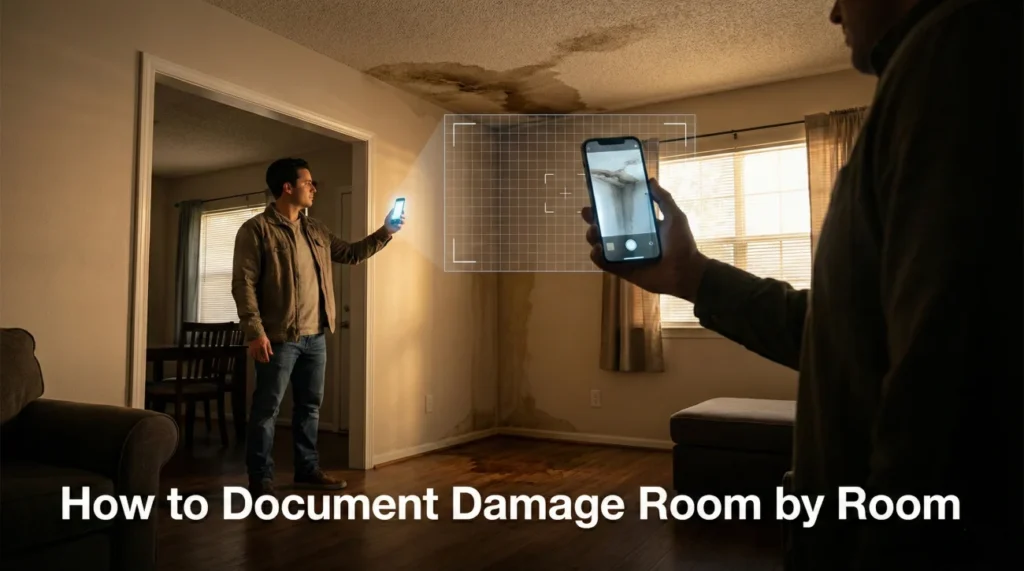
- Follow the “Clockwise Rule” to create a continuous visual map of the room so reviewers never have to guess where they are looking.
- Use the “Wide, Medium, Tight” sequence for every point of damage to provide necessary context, scale, and material detail.
- Track the vertical path of water or smoke from the floor up to the ceiling, documenting the unaffected areas in between.
- Prioritize safety and stop the source of damage first, but capture your complete room scan before throwing items away or tearing out materials.
The First Rule of a Damaged Room
Walking into a damaged room is stressful. The urge to grab a mop, throw away ruined items, and start fixing things is overwhelming. But in property claims, taking action before capturing the right evidence can unintentionally complicate your recovery.
The desk adjuster reviewing your file is not standing there with you. If your photos are scattered or zoomed in too close, they simply cannot see what you see. When a reviewer cannot map the damage to a specific location in your home, they are forced to stop and ask for more information.
You need a reliable system. This guide explains how to document damage room by room methodically. By slowing down just a bit and following a structured workflow, you will build an undeniable visual record that keeps your claim moving smoothly.
Why Claims Actually Get Delayed
To understand why room-by-room documentation matters, it helps to look at how files are processed on the other side of the screen. When a claim gets delayed, it is rarely because there are not enough photos. Usually, it is because the reviewer cannot figure out where the photos were taken.
A typical file might start with a close-up of a wet baseboard, followed immediately by a cracked ceiling. The reviewer has no spatial awareness. They do not know if these items are in the master bedroom, the hallway, or the basement. Without knowing the perimeter of the damage, they cannot accurately confirm the materials needed for repairs.
It sounds tedious when you are standing in a flooded room, but building a visual tour guide is the most reliable way to prevent pushback. It proves the starting point, the stopping point, and the severity of the damage in a logical sequence.
Field Note: This is where most people get stuck. I often see files paused because of the “floating photo” pattern. A policyholder submits 50 detailed pictures of ruined drywall, but not a single wide shot showing the whole room. Because the continuous wall measurements cannot be proven visually, the estimate gets paused. Always show the whole room first.
The Clockwise Room Scan Strategy
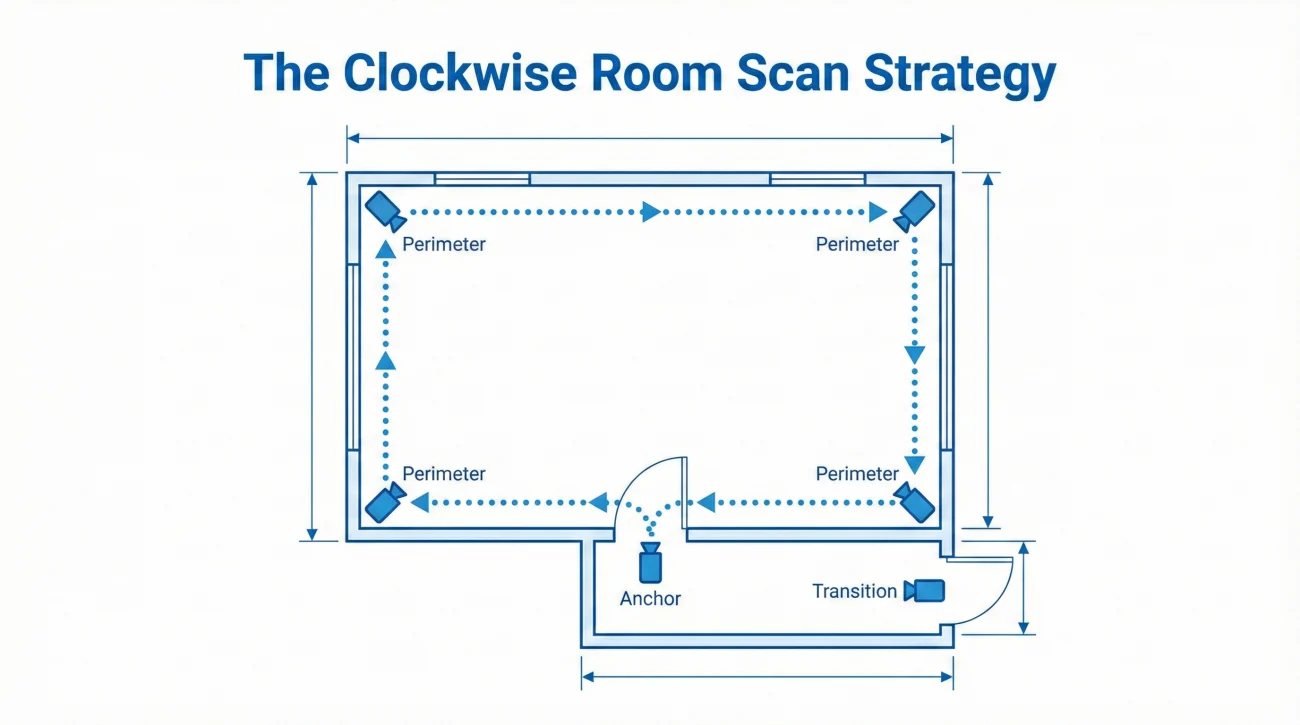
The foundation of effective room documentation is the clockwise scan. This method ensures you never miss a corner, a closet, or an undamaged wall. It creates a 360-degree perimeter that anchors all future photos.
Step 1: The Doorway Anchor
Before you step foot into the damaged room, stand squarely in the doorway. Take a wide photo looking straight into the space. This is your anchor shot. It establishes the entry point and provides a general overview of the room’s condition from the perspective of someone walking in.
Step 2: Following the Perimeter
Once you step inside, pick the wall immediately to your left. Take a wide shot of that entire wall, from floor to ceiling. Then, turn slightly to capture the corner where the left wall meets the back wall. Continue this pattern in a clockwise direction. Photograph the back wall, the next corner, the right wall, the final corner, and finally, turn around and photograph the wall with the door you just walked through.
Step 3: The Transition Shots
Do not forget the spaces between the rooms. One of the most common gaps in a file is missing the doorway or the hallway connecting two spaces. Take a transition shot looking from the hallway into the room. This links your mental map together, making it easy for the reviewer to follow the path of the damage.
Step 4: Proving the Undamaged Areas
You might wonder why you need to photograph a dry wall if a leak happened on the opposite side of the room. The answer is continuity. Photographing the undamaged areas proves exactly where the water stopped. It acts as a boundary line for the loss and shows the standard of materials originally used in your home.
The Wide, Medium, Tight Method
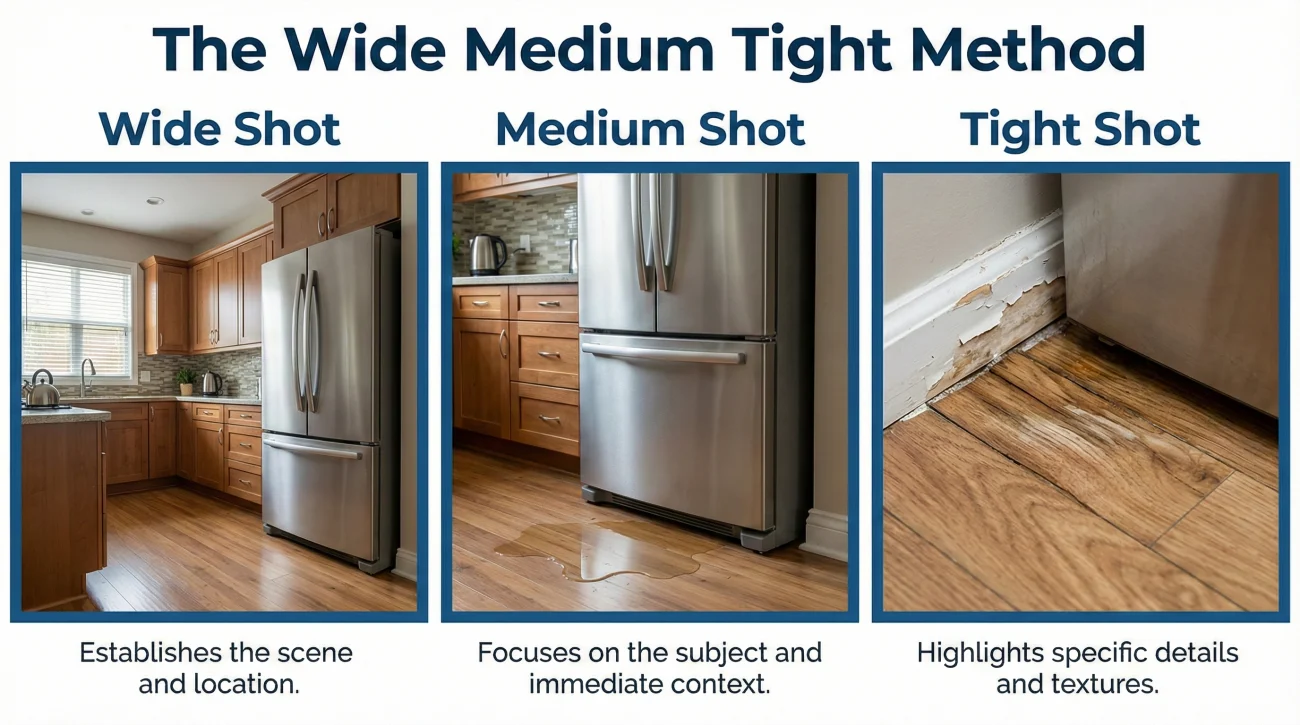
After you have completed the clockwise scan to establish the room’s perimeter, it is time to document the specific points of damage. Use the “Wide, Medium, Tight” sequence for every single damaged area to avoid getting too close too fast.
The Wide Shot for Context
The wide shot shows the damage in its natural environment. If there is a massive water stain on the ceiling, the wide shot should show the entire ceiling, the top of the walls, and a window for reference. This answers the question: “Where exactly is this damage located?”
The Medium Shot for Scope
Next, step closer. The medium shot focuses on the boundaries of the damage. Frame the photo so it shows the entire water stain and a few inches of the clean drywall surrounding it. Hold a tape measure across the damage while taking the photo. This answers the question: “How large is the affected area?”
The Tight Shot for Detail
Finally, get very close. The tight shot is designed to show the texture, the severity, and the specific material. This is where you document bubbling paint, separating carpet seams, suspected mold staining, or cracked wood. If there is a brand name or a serial number visible, capture it here.
Taking one macro photo of peeling paint. The reviewer cannot tell if this is a bathroom baseboard or a kitchen ceiling, resulting in a request for more information.
Taking three photos.
1) The whole bathroom wall showing the sink.
2) The wall beneath the sink showing the leak path.
3) A tight shot of the ruined baseboard material and peeling paint.
Documenting the Vertical Story
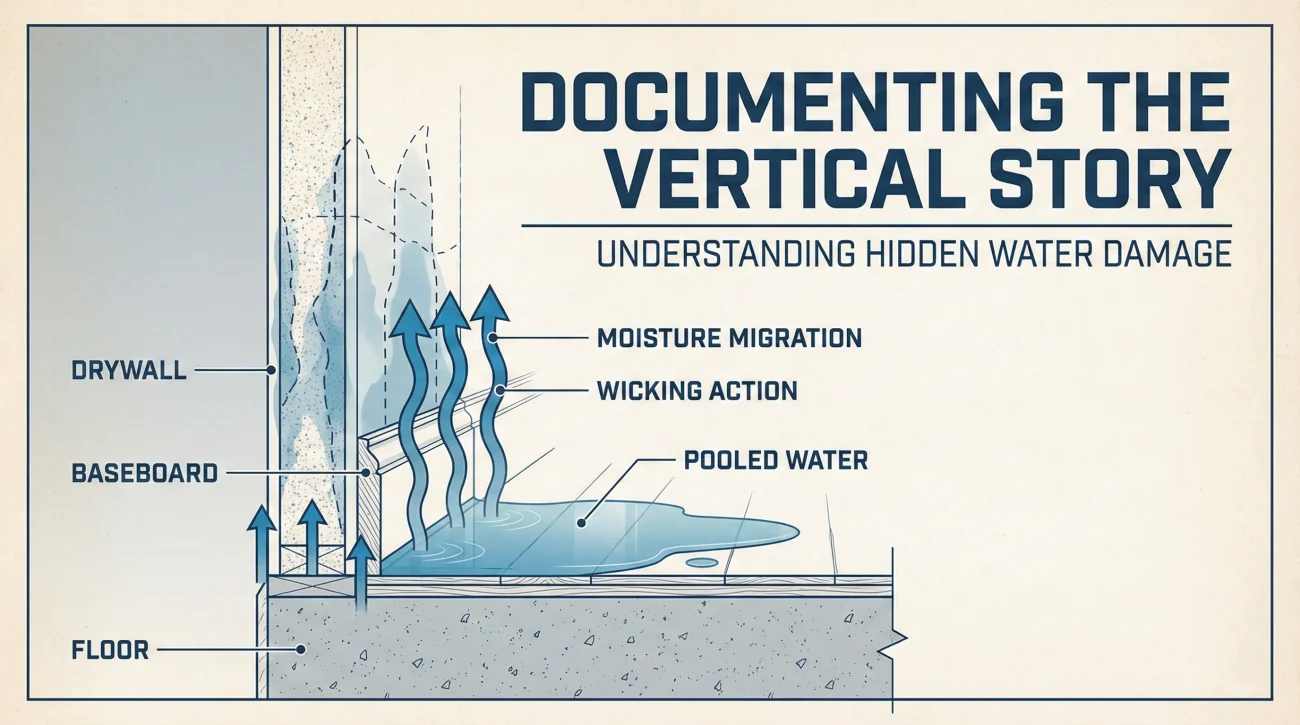
Damage rarely stays in one place. Water follows gravity, pulling downward through floors and wicking upward into drywall. Smoke rises, filling the upper portions of a room before settling. Your documentation must tell the vertical story of the event.
When scanning a room, look at the floor, the baseboards, the lower wall, the upper wall, the crown molding, and the ceiling. You must connect the dots. If there is a puddle on the floor, trace it upward. Find the origin point and photograph the entire path the water took to get there.
Never assume the adjuster will logically know the baseboards were ruined just because the floor was flooded. They can only write an estimate for what they can see. If the baseboard is wet, take a medium and tight shot of it.
⚠️ Warning: Drywall can wick water upward invisibly. The front of the paint might look dry, but the gypsum board behind it could be saturated. Document any swelling, bubbling, or discoloration, no matter how minor it seems.
Mini-Scenario: The Kitchen Leak
To see how this works in practice, let us look at a realistic documentation workflow for a common kitchen leak.
A homeowner discovers water pouring from behind their refrigerator. Instead of immediately pulling the appliance out and mopping, they stop. They stand at the kitchen entrance and take a wide shot of the entire space, showing the fridge in its original position and the water spreading across the floor.
Next, they perform a clockwise scan of the four kitchen walls. When they return to the refrigerator area, they start the Wide, Medium, Tight process. They pull the fridge out slightly and take a medium shot showing the puddle underneath it. They place a tape measure on the floor and take a tight shot of the warped floorboards directly beneath the leak source.
Crucially, they follow the vertical story. They look at the base of the drywall behind the fridge and see swelling. They take a medium shot of the lower wall, then a tight shot of the peeling baseboard. By the end of this process, the homeowner has created an undeniable record of exactly what happened before the cleanup crew arrived.
| Step | Action | Purpose |
|---|---|---|
| 1. Anchor | Photograph kitchen from doorway. | Establishes room layout. |
| 2. Perimeter | Clockwise scan of all 4 walls. | Proves context and undamaged areas. |
| 3. Wide Shot | Photograph fridge and surrounding floor. | Shows location of damage. |
| 4. Medium Shot | Photograph puddle with tape measure. | Proves scope and size. |
| 5. Tight Shot | Close-up of warped floorboards. | Identifies ruined material. |
| 6. Vertical Check | Photograph swollen baseboard behind fridge. | Catches hidden wicking damage. |
Integrating Contents into the Room Map
While documenting the physical structure of the room, you will encounter damaged personal property like furniture or rugs. It is vital to document these items in their original context before you move them.
If a rug is soaked, take a wide shot of the rug sitting on the wet floor. This proves that the rug was directly in the path of the water. If you roll the rug up, drag it to the garage, and then photograph it, the reviewer has no visual proof that the rug was actually in the flooded room. Always capture the item in the environment where the damage occurred.
Once you have captured the context, you can safely log the items. Organizing these photos and linking them to your master property claim evidence pack ensures that every structural issue and every personal item is mapped directly to a specific room.
Common Mistakes and How to Avoid Them
Under pressure, it is easy to make simple mistakes that complicate the review process. Based on files that commonly get flagged or delayed, here is what you need to avoid.
- ❌ The Flashlight Void: Taking photos in a dark room using only a phone flash. This blows out the center of the image and leaves the edges black. Always try to introduce ambient light, open blinds, or bring in temporary work lights if safely possible.
- ❌ Deleting “Bad” Photos: If you take a blurry photo, do not delete it. Take another clear one immediately after. Deleting photos can create gaps in the chronological file numbers, which may raise unnecessary questions during a file review.
- ❌ Moving Items Too Soon: Pulling up ruined carpet pad or throwing away wet towels before capturing the wide contextual shots. Once you alter the scene, you lose the ability to prove the initial severity of the event.
- ❌ Rushing the Corners: Standing in the middle of the room and simply spinning around. This often results in blurry photos that miss the crucial details where the floor meets the wall. Walk the perimeter methodically.
Communication Scripts for Documenting Damage
Maintaining clear communication is just as important as the photos themselves. In many cases, you may need to begin emergency mitigation to stop a leak or prevent safety hazards. When uncertainty exists about what you can touch, default to asking for requirements in writing, and confirming receipt in writing.
Use these neutral scripts to establish a clean paper trail regarding your documentation efforts.
[Action] + [What you need in writing] + [Confirmation request]
Subject: Request for documentation guidelines regarding [Claim Number]
Hello [Name],
I am currently documenting the damage in each room before beginning any temporary water extraction to protect the property. To ensure I meet your requirements, could you please provide a written checklist of the specific documentation or photo formats you need for this claim?
Please let me know if there are any specific areas you need me to focus on before we move any items. I look forward to your written guidance.
Thank you,
[Your Name]
Once you have compiled your photos, organized by room, you must ensure they are received and logged properly by the reviewer. Sending a massive file without a clear summary can lead to misplaced evidence.
Subject: Submission of room-by-room evidence pack – [Claim Number]
Hello [Name],
I have uploaded the initial batch of damage documentation to the portal. The photos are organized by room, beginning with the kitchen and moving clockwise through the main floor. The files include wide contextual shots and detailed images of the affected materials.
Could you please review the file log and confirm in writing that you have received the complete batch for these rooms and that the format is acceptable for your review process?
Thank you,
[Your Name]
Final
Documenting damage is a strict operational task, not an artistic endeavor. By relying on the clockwise room scan and the Wide, Medium, Tight method, you remove emotion from the process and replace it with structure. You build a visual timeline that leaves no room for guessing.
When saving these files to your computer, use a simple naming convention. Grouping your photos with names like “01_Kitchen_Anchor.jpg” and “02_Kitchen_Perimeter.jpg” forces the files to sort alphabetically. This guarantees the reviewer will see the room in the exact order you mapped it.
Once you have safely captured the entire house room by room, back up your files immediately. Save copies of the original files to a cloud drive or an external hard drive before you submit them. Protecting your original data is the final step in securing your evidence.
❓ FAQ
📸 Should I take photos before the mitigation company starts?
Absolutely. While professional crews will take their own photos, nobody cares about your claim as much as you do. Capture your own wide, medium, and tight shots before they begin tearing out drywall or setting up fans.
🧹 If my room is messy, do I need to clean first?
No, do not tidy up the damage. If books fell off a shelf or a ceiling collapsed onto your laundry, leave it exactly as it happened. Cleaning up changes the scene and hides the true severity of the event.
📤 Do I email or upload these photos, what is better?
Uploading directly to the insurer’s official portal is usually best because it preserves file sizes and links directly to your claim number. If you must email them, send a link to a cloud folder so the images do not get compressed.
🚪 What is the first thing I should photograph in a damaged room?
Always start with a wide anchor shot from the doorway looking in. This establishes the room’s location and provides a complete contextual view before you focus on specific details.
🧱 Do I need to take pictures of areas with no damage?
Yes. Photographing undamaged walls and floors establishes the perimeter of the loss, proving exactly where the damage stopped and showing the prior condition of the room.
📏 How do I show the size of a water stain in a photo?
Place a standard tape measure across the stain or next to the damaged area when taking your “Medium” shot. This provides undeniable scale for the reviewer.
🛋️ What if the damage is hidden behind furniture?
Take a photo of the furniture in its original position first. Then, carefully move the item and immediately photograph the damage revealed behind or beneath it.
📂 How many photos are too many for one room?
There is no strict limit, but focus on quality and sequence over sheer volume. A structured set of 20 clear, logically ordered photos is far better than 100 random close-ups.
🗓️ What do I do if I find more damage days later?
Document it immediately using the same Wide, Medium, Tight method. Keep a written log noting the date you discovered the hidden damage, and submit it as a supplement to your initial evidence.
🗂️ How should I organize these photos once I take them?
Create a master digital folder for your claim. Inside, create subfolders for every room (e.g., “Kitchen,” “Master Bedroom”). Save the respective photos into these folders before submitting.
⚠️ Disclaimer: PropertyClaimChecklist.com provides practical guidance, process checklists, and example follow-ups to help you organize a property claim and move it forward. It is not policy language, claim documentation, legal content, or a substitute for your insurer's instructions. Always rely on your carrier's requirements and your actual policy terms for what must be submitted and how decisions are made.