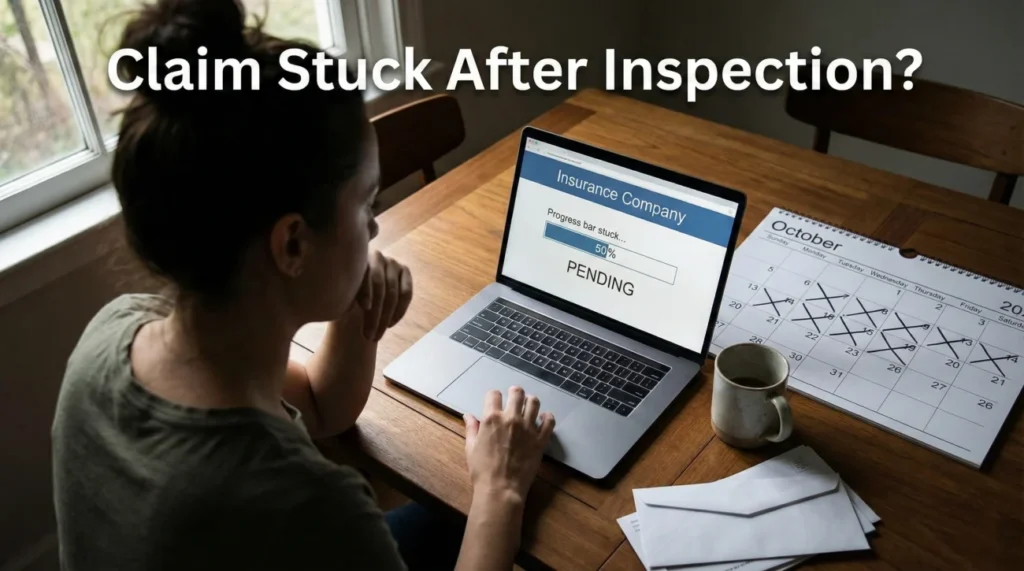
- The Core Problem: Silence after an inspection often means the report is stuck in a “handoff gap” between the field inspector and the desk adjuster.
- The Diagnosis: You need to identify if the report was uploaded, if it passed quality assurance (QA), or if the desk adjuster is just sitting on it.
- The Fix: Stop waiting for the estimate to appear. Use specific “trigger questions” to locate the file and request a timeline.
The “Black Hole” After the Inspection
There is a very specific, uncomfortable silence that happens about ten days after an insurance adjuster visits your property. You felt good when they left. They took photos, measured the rooms, and maybe even told you that things “looked covered” or that they would “write it up tonight.”
Then, nothing happens.
You check your email. You check the online portal. The status just says “Pending” or “In Progress.” This silence is often where the momentum dies. It is frustrating because you feel powerless. The physical part is done, so you assume the paperwork is automatic.
Here is the reality: the paperwork is rarely automatic. The path from a field inspection to a finalized estimate in your inbox is not a straight line. It is a series of handoffs between different people, different software systems, and different approval queues. If your insurance claim is stuck after inspection, it usually means the file has been dropped at one of these handoff points.
Waiting longer rarely fixes this. If two weeks have passed and you have zero communication, you need to stop waiting and start diagnosing where the file is physically sitting. You do not need to be aggressive, but you do need to ask the right questions to trigger the next step.
Why Claims Stall Here: The Field vs. Desk Gap
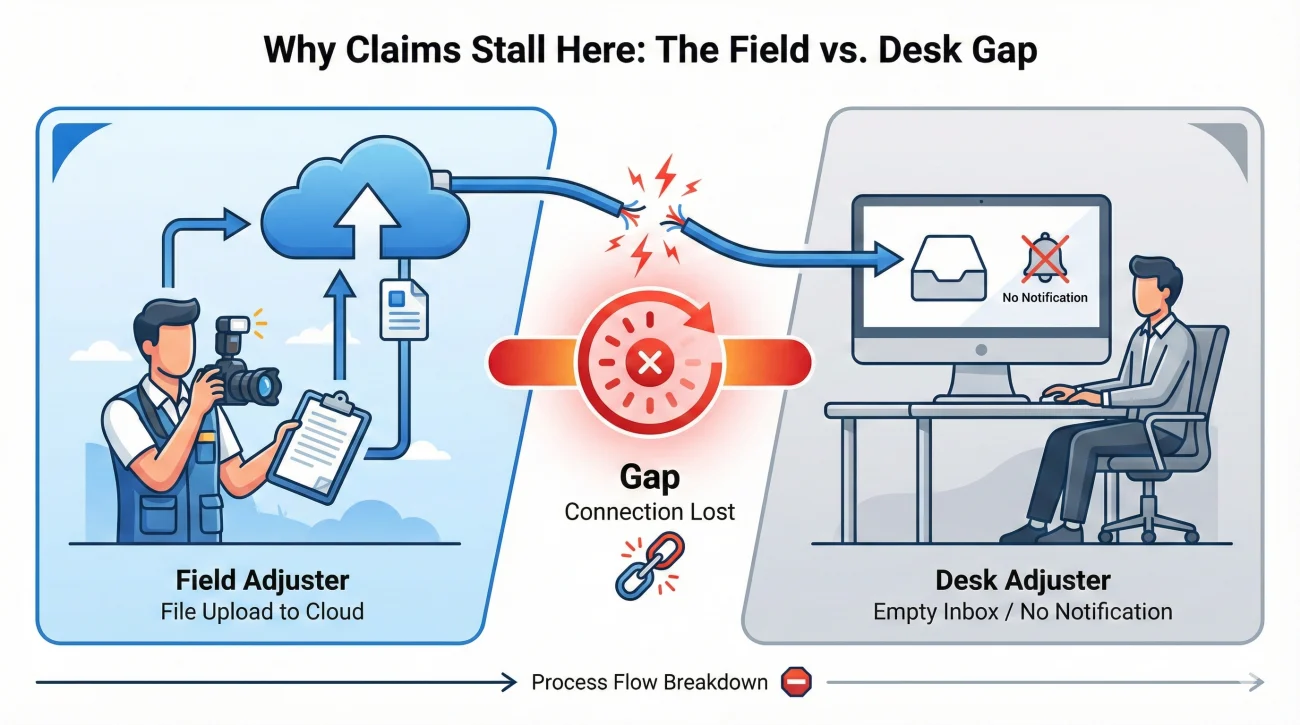
To unstuck your claim, you first need to understand who actually visited your house. In many property claims, the person who came to your door is not the person who has the authority to write your check.
Often, the person you met was a “Field Adjuster” (or sometimes an independent contractor). Their job is to gather data: photos, measurements, and notes. They upload this data to a system. Then, a “Desk Adjuster” (the person sitting in a corporate office) reviews that data, applies the policy coverage, and issues the official estimate and payment.
🗝️ Key Point: The delay usually happens in the gap between the Field Adjuster uploading the report and the Desk Adjuster opening it.
Claims often sit stagnant for weeks simply because the Field Adjuster forgot to hit “submit” on a specific form, or because the Desk Adjuster never received the notification that the report was ready. It wasn’t malice; it was just a broken notification loop.
In other cases, specifically with independent adjusting firms, there is a hidden step called “QA” (Quality Assurance). The Field Adjuster writes the estimate, but before it goes to the insurance company, it must pass their internal manager’s review. Files can sit in this QA queue for days or weeks if the firm is overwhelmed, and the insurance company doesn’t even know they have it yet.
💡 Pro Tip: If you met an “Independent Adjuster,” assume there is a middle layer of management reviewing their work before your insurance carrier ever sees it. This is a prime location for delays.
Step 1: Check the “Upload” Status
Before you call the main customer service line, you should try to contact the person who physically inspected your property. You likely have their cell phone number or email from when they scheduled the appointment.
Your goal here is simple: confirm the data has left their hands.
Do not ask: “When will I get paid?” (They probably don’t know).
Do not ask: “Is it approved?” (They might not have the authority to say).
Instead, ask a purely logistical question about the file transfer. This is non-threatening and gets you a factual answer.
Subject: Status of inspection report for Claim [Number] – [Your Address]
Hello [Name of Field Adjuster],
Thanks again for coming out to inspect the property on [Date].
I am checking to see if you have completed your report and uploaded it to the desk adjuster yet?
I haven’t received an update from the carrier, so I want to make sure the file isn’t waiting on anything else from my end before it moves to the next stage.
Thanks,
[Your Name]
If they reply, “Yes, I uploaded it three days ago,” you have valuable information. You now know the ball is in the Desk Adjuster’s court. If they reply, “I’m still working on it,” you know exactly why it’s stuck. It hasn’t even left the field yet.
Step 2: Triggering the Desk Adjuster
If the field adjuster confirms they have sent the report, but you still have silence from the insurance company, the problem is likely at the “Desk” level. The file might be sitting in a digital pile marked “Pending Review.”
Adjusters handle hundreds of files. When a new inspection report comes in, it doesn’t always flash a red light on their screen. It might just drop into a folder. If they are busy, they might not open that folder for a week unless something, or someone, prompts them.
You need to be that prompt. But you must be specific. Calling and shouting “Where is my money?” is less effective than asking a specific process question that forces them to look at the file status.
For a robust strategy on maintaining this rhythm without being annoying, you can refer to our guide on the claim follow-up system. It breaks down the exact timing for these interactions.
Here is how to ask:
Subject: Confirmation of inspection report receipt – Claim [Number]
Hello [Desk Adjuster Name],
The field inspection was completed on [Date]. The field adjuster mentioned the report has been uploaded to your system.
Can you please confirm that you have received the inspection report and photos?
If the file is currently in queue for review, can you provide a rough ETA on when you expect to review it?
Thank you,
[Your Name]
This script does two things:
- It forces them to check if the file is actually there (sometimes it’s missing, and they didn’t know).
- It asks for a timeline (ETA) rather than a result. Adjusters are more comfortable giving an ETA on a task than promising a payment amount before they’ve reviewed the damage.
Field Note: The “Correction” Loop
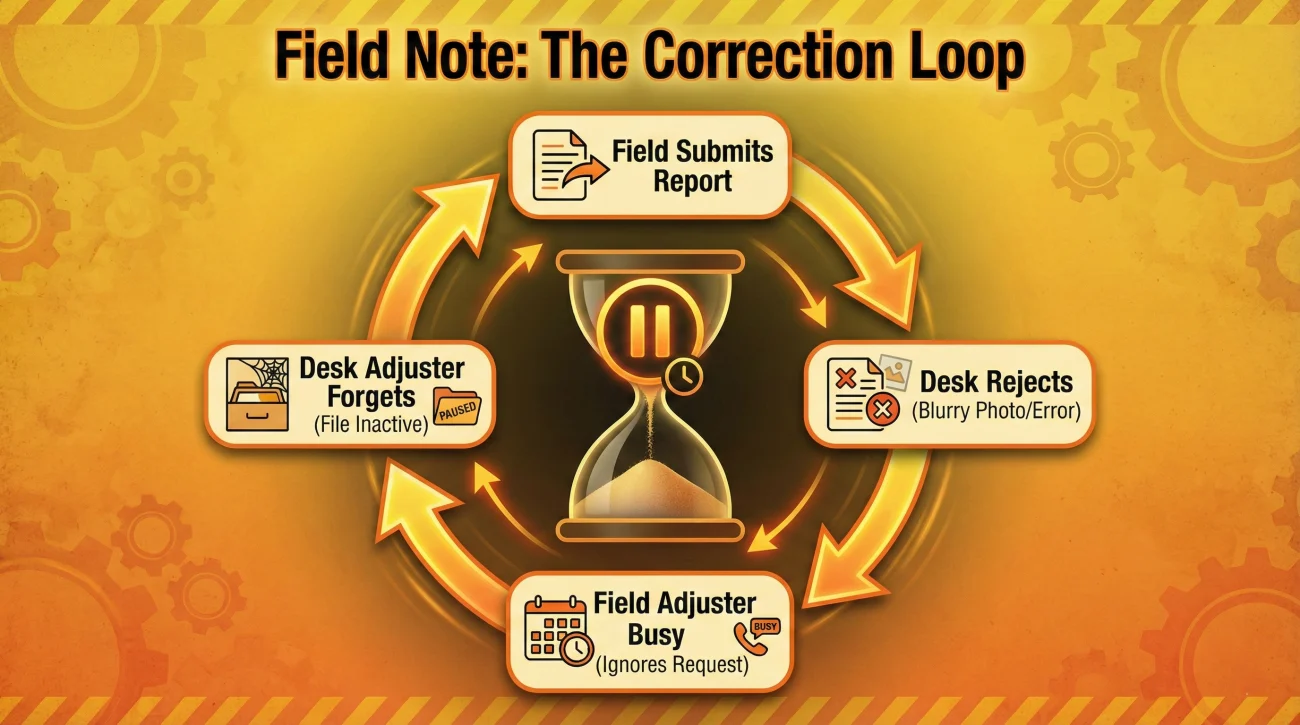
In my time working in claims operations, I noticed a pattern that causes massive, silent delays: the “Correction Loop.”
Here is what happens: The Field Adjuster submits a report. The Desk Adjuster opens it and sees a mistake. Maybe a photo is blurry, or a room dimension is missing. The Desk Adjuster rejects the report and sends it back to the Field Adjuster for corrections.
To you, the homeowner, this is invisible. The status just stays “Pending.”
The Field Adjuster is busy inspecting new houses and might ignore the correction request for days. The Desk Adjuster forgets about it because it’s technically “off their desk.” The claim enters a zombie state where nobody is working on it.
If you have been waiting more than 14 days post-inspection, this is a common possibility worth checking. You must ask explicitly about this.
“Are we waiting on any revisions or corrections from the field adjuster, or is the report fully accepted and ready for your review?”
Asking this specific question signals that you understand the process. It often prompts the Desk Adjuster to realize, “Oh wait, I sent that back 10 days ago and never got a reply,” which triggers them to call the field adjuster immediately.
Common Mistakes That Extend the Wait
When you are anxious to get your repairs started, it is easy to make tactical errors that don’t speed things up. Here are the most common ones I see.
| Mistake | Why it causes delays |
|---|---|
| Assuming silence means progress | Silence usually means the file is sitting in a queue, not being actively worked on. |
| Calling the wrong person repeatedly | Calling the field adjuster about the check won’t help; they don’t print checks. Calling the desk adjuster about the inspection time won’t help; they aren’t in the field. |
| Starting repairs before the estimate< | If you fix everything before they write the estimate, it can create coverage disputes because they cannot verify the full “scope” of damage. |
| Not asking for an ETA in writing | A verbal promise on the phone (“I’ll get to it soon”) vanishes. An email ETA creates a deadline you can follow up on. |
A Realistic Scenario: The Missing Photos
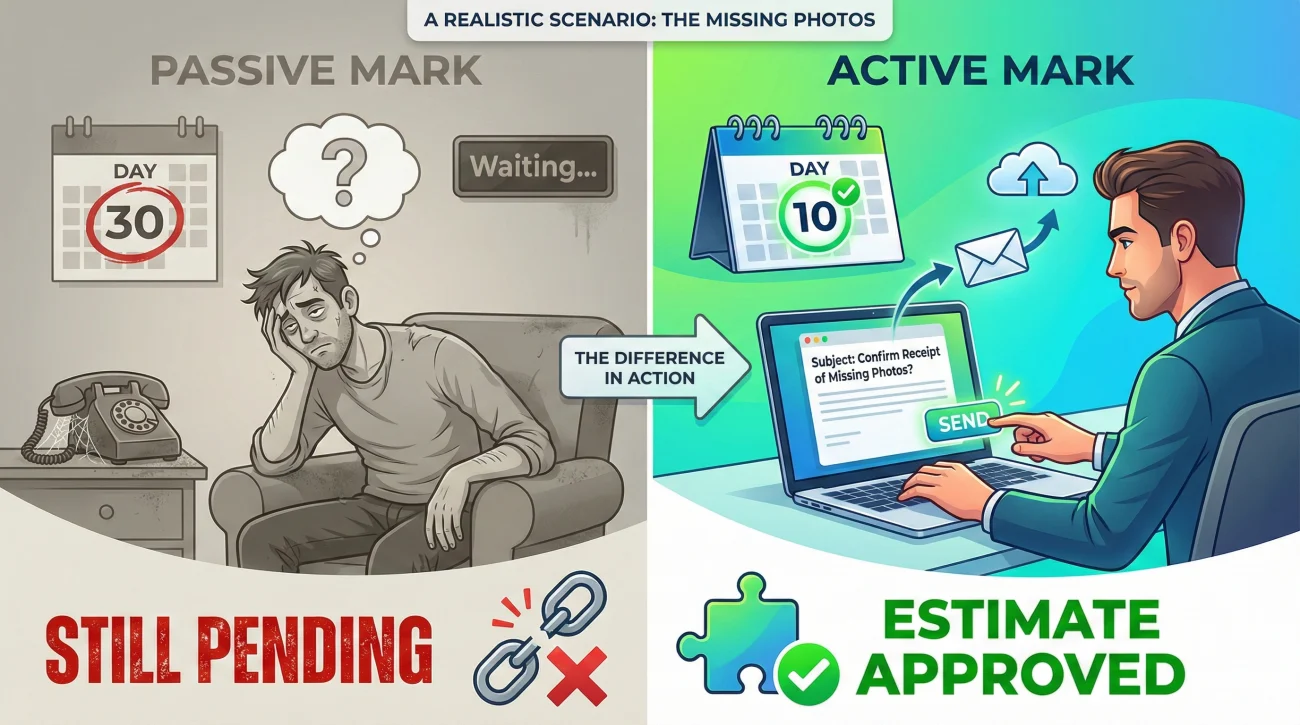
Let’s look at a typical situation to see how proactive follow-up changes the outcome.
The Situation: An adjuster inspects a roof leak on the 1st of the month. The homeowner, let’s call him Mark, waits patiently. By the 15th, the portal still says “Pending.” Mark assumes the insurance company is just analyzing the cost of shingles.
The Reality: The field adjuster tried to upload dozens of photos on the 2nd, but the internet connection cut out. Only a small batch uploaded. The system didn’t flag an error, but the Desk Adjuster can’t write the estimate with missing photos. The file is just sitting there.
He waits another week. Then he calls the main 1-800 number. The call center rep sees “Pending” and tells Mark to keep waiting. Mark waits another week. Now it is day 30.
On day 10, Mark emails the desk adjuster: “Can you confirm you received the full photo report?” The desk adjuster checks, sees the missing photos, and realizes the error. They call the field adjuster that same day. The photos are re-uploaded. The estimate is written shortly after.
In this scenario, a single specific question saved Mark almost three weeks of waiting. You cannot rely on their internal systems to catch every error.
Final Thoughts
The period after the inspection is not a time to be passive. While you do not want to nag your adjuster every single day, you do need to manage the handoff.
Remember that you are dealing with a process involving human beings and imperfect software. Files get dropped. Uploads fail. People go on vacation. By asking simple, logistical questions about where the report is located, you help the insurance company help you.
Confirm the upload. Confirm the receipt. Ask for an ETA. If you do those three things, you will prevent the vast majority of post-inspection delays.
❓ FAQ
⏳ How long does it take to get an estimate after the insurance adjuster comes out?
In most routine claims, you should expect an estimate within 7 to 14 days after the inspection. If it takes longer than two weeks without an update, you should actively follow up to confirm the report was received.
📞 Why hasn’t my adjuster called me back after the inspection?
Adjusters typically do not call until the estimate is finished. Silence usually means they are still working on the file, waiting for the report upload, or the file is sitting in a review queue.
📝 What if the field adjuster says they sent the report but the company says they don’t have it?
This suggests a “handoff failure.” Ask the field adjuster for the “upload confirmation number” or date, and then provide that specific information to the desk adjuster to help them locate the file in their system.
🚫 Should I start repairs while waiting for the estimate?
Generally, no. You should only do emergency mitigation (like stopping a leak) to prevent further damage. If you start permanent repairs before the estimate is approved, you risk denial for items the adjuster hasn’t verified yet.
🧐 Can I ask for a copy of the field adjuster’s report?
Yes, you can request it, but the insurance company is not always required to give you the raw field notes. They are required to give you the final estimate that outlines what they are paying for.
🛑 What does “pending review” mean on the insurance portal?
This usually means the field data has been received but a desk adjuster has not yet opened the file to finalize the coverage and dollar amounts. It is a digital waiting room.
📧 What is the best way to contact my adjuster for an update?
Email is almost always better than a phone call for status checks. It creates a paper trail, allows the adjuster to check the file on their own time, and prevents “phone tag.”
🤝 Is the person who inspected my house the same one who pays me?
Rarely. The field adjuster usually just gathers facts. The desk adjuster (inside the office) reviews those facts and issues the payment. You need to know which one is holding up the process.
📋 Do I need to send my contractor’s estimate to the adjuster?
If you have one, yes. Sending your contractor’s estimate can sometimes speed up the process because it gives the desk adjuster a reference point to compare against the field report.
🚩 How do I know if my claim is denied if they won’t talk to me?
Insurers must send a denial in writing. If they are silent, the claim is likely not denied yet; it is just stalled. A written denial letter is a legal requirement in almost every jurisdiction.
⚠️ Disclaimer: PropertyClaimChecklist.com provides practical guidance, process checklists, and example follow-ups to help you organize a property claim and move it forward. It is not policy language, claim documentation, legal content, or a substitute for your insurer's instructions. Always rely on your carrier's requirements and your actual policy terms for what must be submitted and how decisions are made.