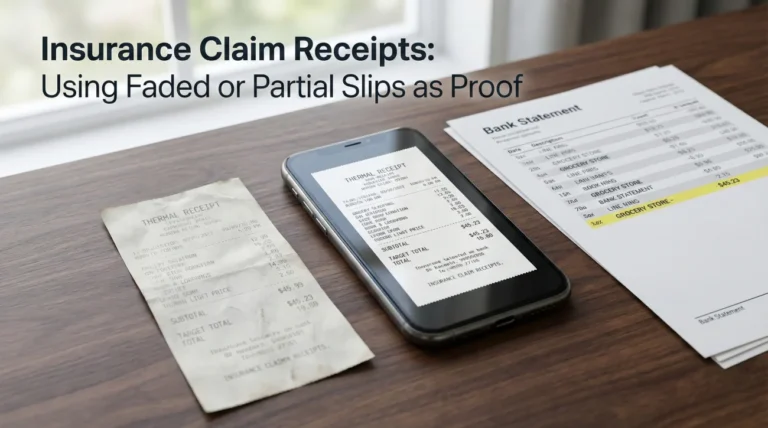
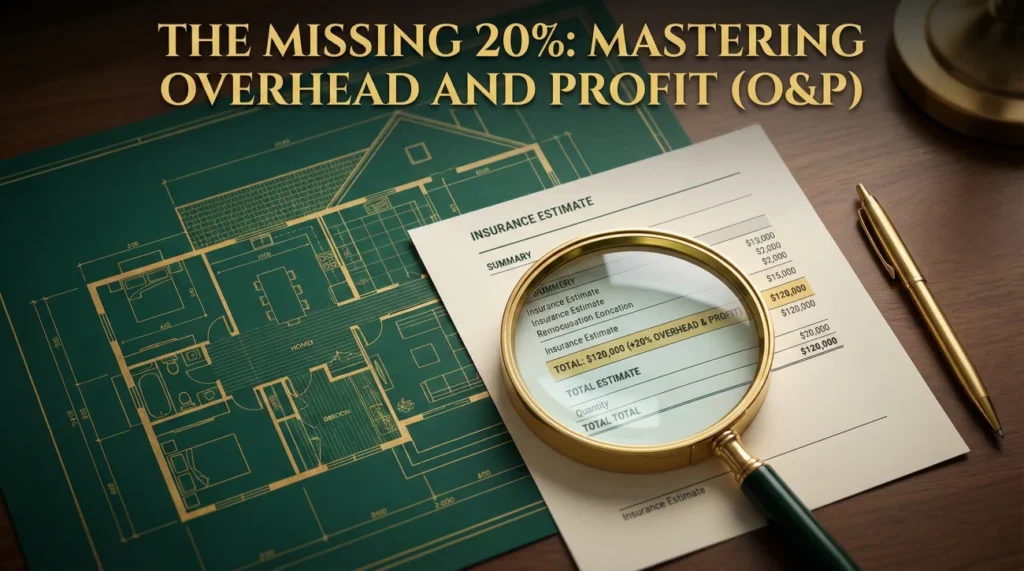
- The “Hidden” 20%: Overhead and Profit (O&P) is a surcharge paid when a General Contractor is needed to coordinate the job, typically adding ~20% to the total.
- The Trigger: It is not automatic. It is usually triggered by the complexity of the repair, not just the cost.
- The “Three Trade” Myth: Many adjusters use a rule of thumb that you need 3+ trades (e.g., drywall, paint, floor) to qualify, but this is an operational guideline, not always a policy rule.
- Where to Look: O&P is often found at the very bottom of the estimate summary, labeled as “O&P” or “General Contractor Fees.”
- Action Item: If you are hiring a GC to manage multiple trades and O&P is missing, you need to document the coordination tasks involved to justify the cost.
The Missing 20 Percent of Your Claim
In the world of insurance estimates, there is a line item that causes more arguments than almost anything else. It is not the price of drywall or the grade of carpet. It is a pair of numbers usually found at the very bottom of the last page, often referred to as “O&P” or “10 and 10.”
This stands for Overhead and Profit. In simple terms, it is the money paid to a General Contractor (GC) to manage a complex project. If your claim involves gutting a kitchen, you are likely hiring a GC to schedule the plumber, the electrician, the cabinet installer, and the painter. That GC doesn’t work for free. Their fee is covered by O&P.
However, in my experience handling claim files, I frequently see this line item omitted from initial estimates. Adjusters often write the estimate assuming you will act as your own project manager, hiring individual handymen for each task. In fact, some carriers have internal guidelines to only add O&P once you submit a signed contract with a General Contractor. If you are actually hiring a professional GC, missing overhead and profit insurance estimate line items can leave you underfunded by thousands of dollars. Understanding when this applies is critical to closing the gap between your contractor’s bid and the insurance offer.
What Is O&P, Really?
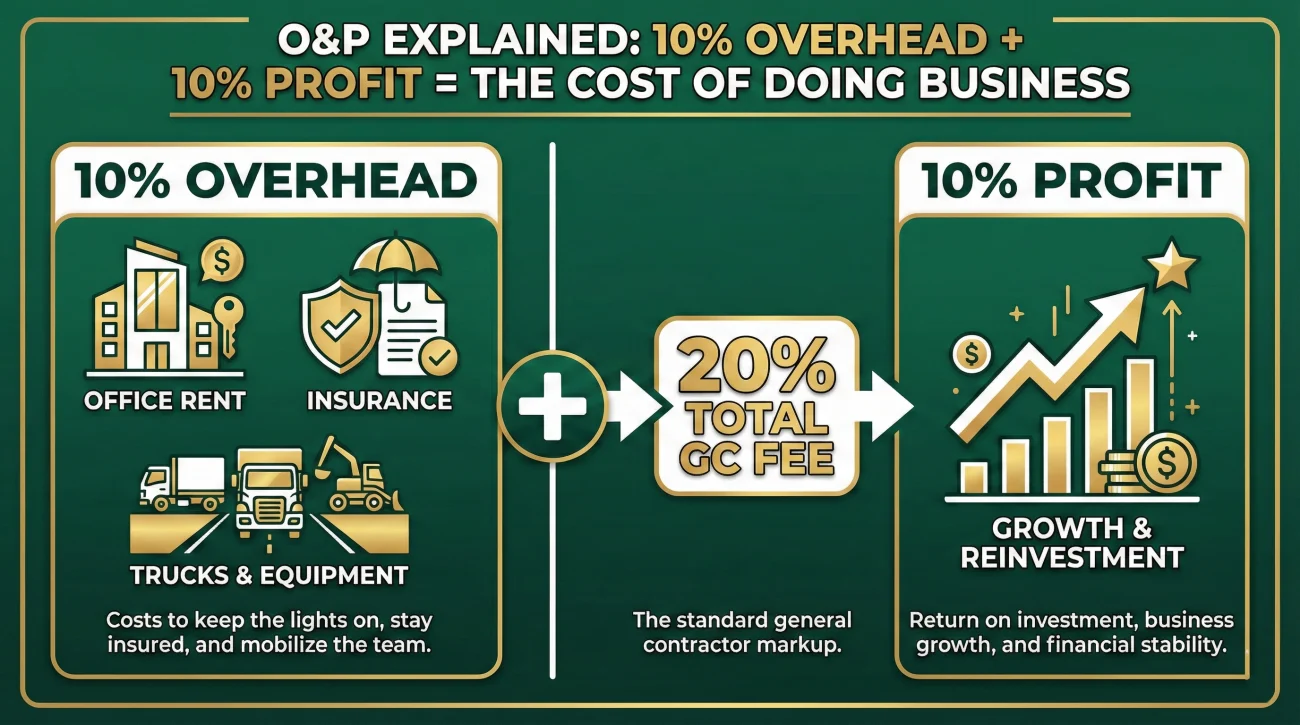
To discuss this effectively with an adjuster, you need to use the right terminology. O&P is not a “bonus” for the contractor. It is a reimbursement for the cost of doing business. It typically consists of two parts:
- 🏢 Overhead (10%): This covers the fixed costs of running a construction business, such as office rent, insurance, truck fleets, administrative staff, and software licenses.
- 📈 Profit (10%): This is the margin that keeps the business viable.
Together, they commonly add about 20% on top of the “subtotal” (the cost of labor and materials). If your repair subtotal is $50,000, missing O&P means you are short $10,000. That is a massive gap that cannot be closed by haggling over the price of paint.
The estimate only pays for the wood, the nails, and the carpenter’s hourly wage.
The estimate pays for the wood, the carpenter, AND the person who schedules the carpenter, pulls the permits, and guarantees the work.
The “Three Trade Rule” Myth
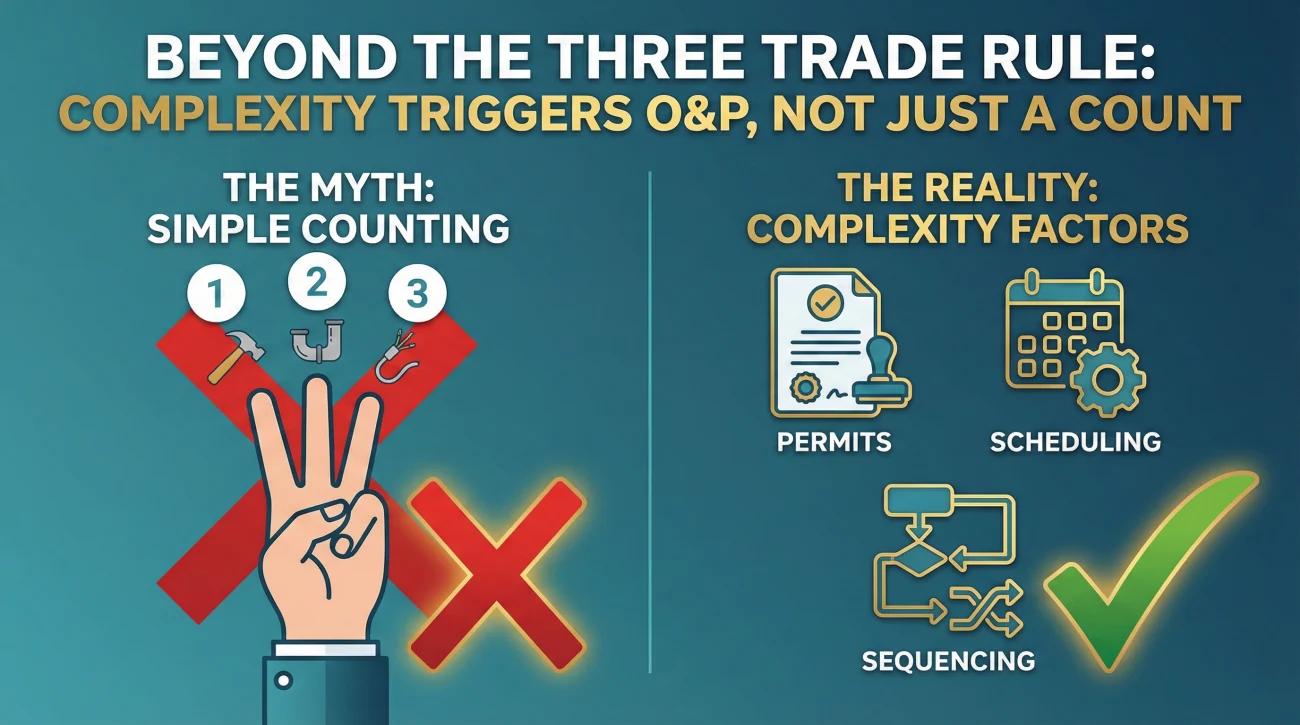
If you ask an adjuster why O&P was left off, you will often hear a standard response: “This job doesn’t meet the three trade rule.”
This is a common operational guideline used by many carriers. The logic is that if a job only involves one or two trades (e.g., just replacing a carpet), a homeowner can coordinate that themselves without a General Contractor. Therefore, no GC fee is owed. They argue that a GC is only needed when there are three or more distinct trades involved (e.g., drywall + paint + electric).
However, this “rule” is rarely written in the insurance policy itself. It is a rule of thumb for adjusters, not a law. The real trigger for O&P is usually complexity and coordination. I have seen claims with only two trades (e.g., custom cabinetry and specialized flooring) that were so complex and high-end that a GC was absolutely required, and O&P was eventually paid. Do not let the “three trade” counting game stop you from explaining the actual complexity of the restoration.
Field Note: The “Simple” Water Loss
I worked on a file involving a water leak in a bathroom. The adjuster wrote it as a “simple” repair: replace vanity, paint walls, replace tile. Three trades. But the adjuster argued that “painting is just finishing,” so it didn’t count as a trade. He refused O&P.
The operational reality was much messier. The bathroom was on the second floor. The tile removal required a specialized crew to prevent dust from ruining the master bedroom. The vanity was custom and required a 6-week lead time, meaning the plumbing rough-in had to be coordinated precisely with the cabinet delivery to avoid leaving the family without water. The homeowner, who worked full-time, physically could not coordinate these moving parts.
We documented the coordination timeline—the calls, the scheduling, the specialized dust containment setup. By showing that this wasn’t just “plug and play” but a logistical project, the carrier eventually agreed to add O&P. The lesson is that you must demonstrate the management effort, not just list the materials.
Where to Look for O&P
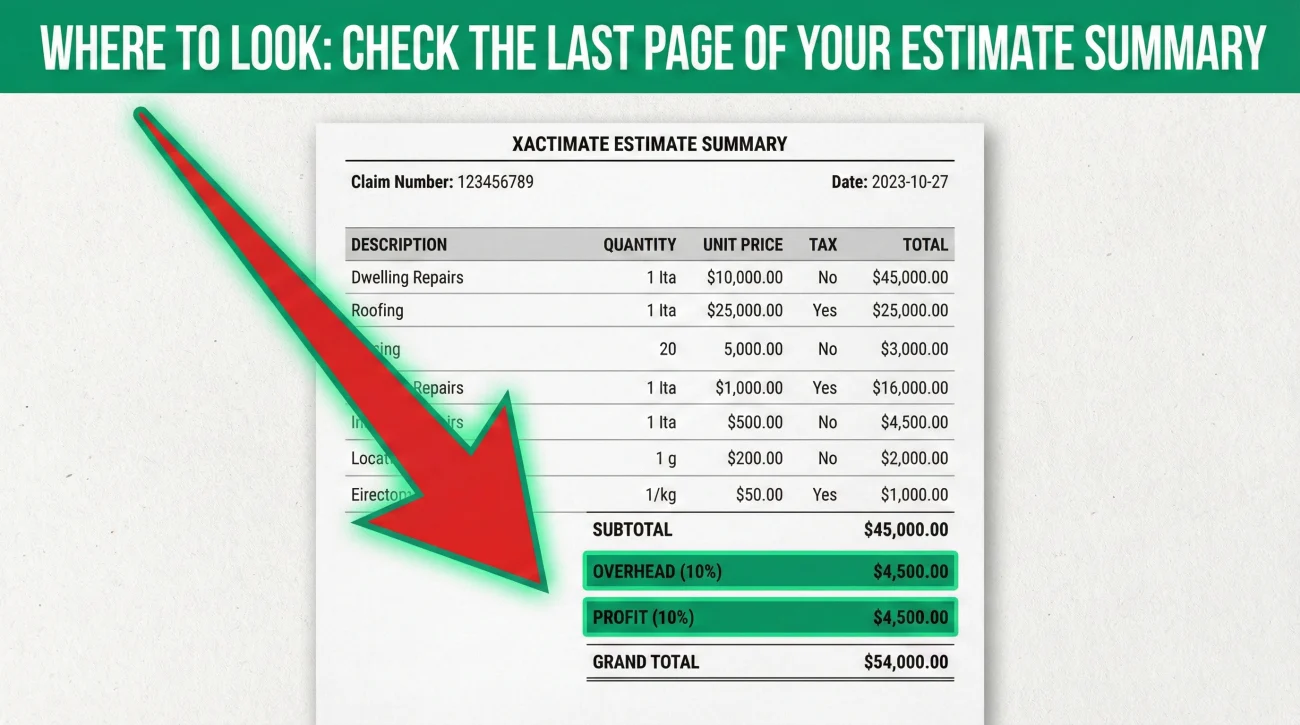
Before you argue for it, verify it isn’t already there. Insurance estimates (like those from Xactimate) can hide O&P in different places.
1. The Summary Page
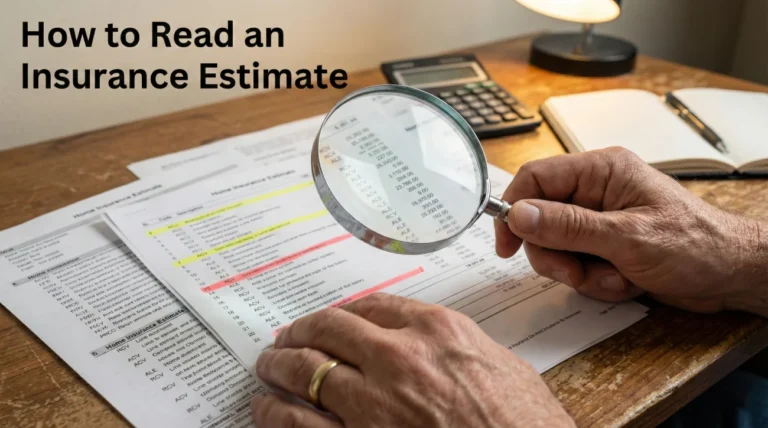
Go to the very last page of your estimate PDF. Look for the “Recap” or “Summary” section. I often see adjusters leave these fields blank or set to ‘0’ by default in their software settings until explicitly asked to trigger them. You should see a subtotal, then tax, and then look for:
- Overhead (10%)
- Profit (10%)
- Cumulative O&P
If these lines show “$0.00” or are missing entirely, O&P has not been applied.
2. Line Item O&P
Occasionally, adjusters apply O&P only to specific items rather than the whole job. Look at the detailed line items. Sometimes you will see a column labeled “O&P” with small dollar amounts next to specific tasks. This is less common but happens.
3. “Bid Item” Estimates
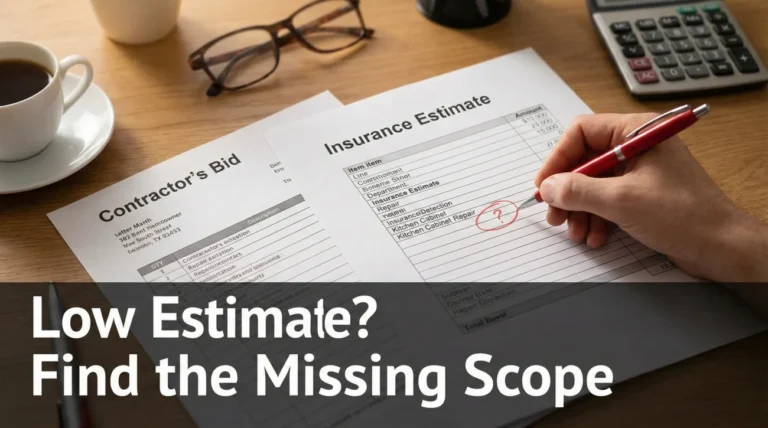
If your estimate is just a single number from a contractor (a “bid”), O&P is usually baked into that number. Contractors rarely break it out separately in a simple bid. Insurance adjusters, however, always break it out. If you are comparing a contractor’s bid to an insurance estimate, make sure you are comparing “Total vs. Total,” not “Bid vs. Insurance Subtotal.”
The Complexity Argument
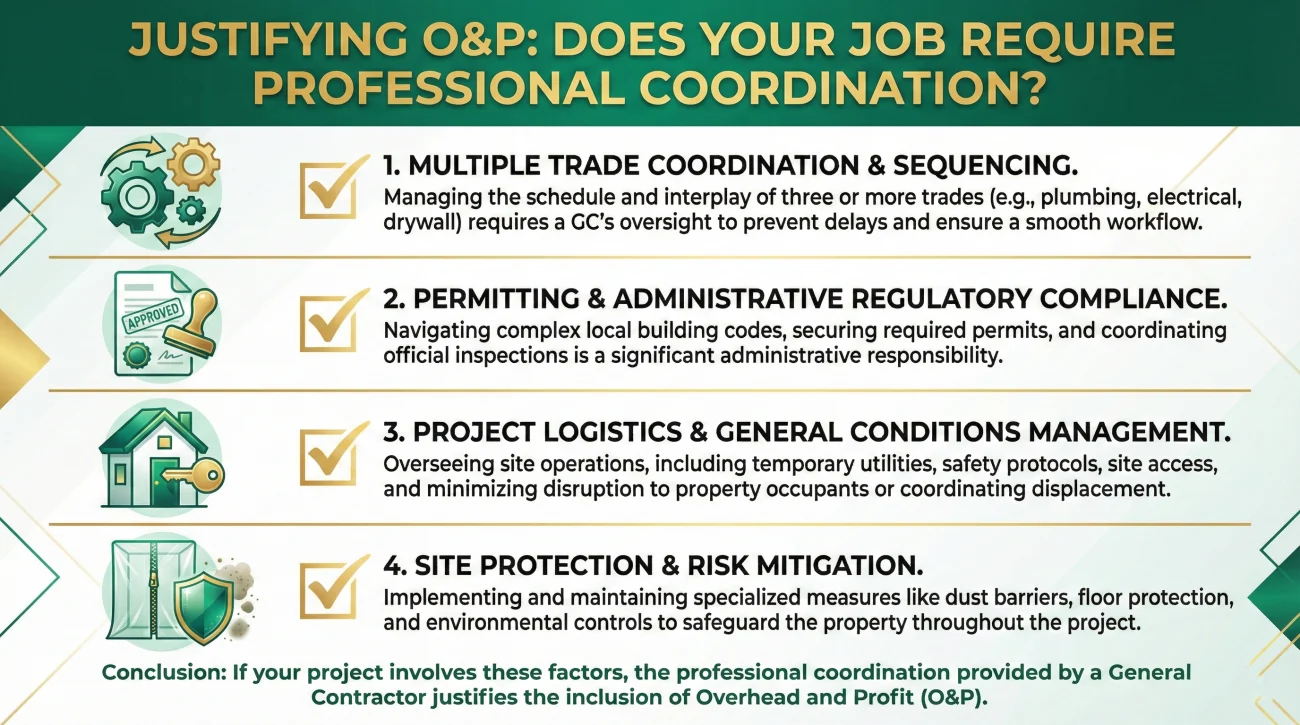
If O&P is missing and you believe it is warranted, your argument should focus on the “Project Management” necessity. You need to prove that the job is too big for a layperson to coordinate.
Factors that support an O&P request include:
- ✅ Sequencing Needs: Does Trade A have to finish before Trade B starts? (e.g., floors must be done before baseboards, which must be done before paint).
- ✅ Permits and Inspections: Does the job require city permits? A GC is usually required to pull permits for structural or mechanical work.
- ✅ Temporary Housing: If you are moved out of the house, the timeline pressure requires professional management to get you back in.
- ✅ Specialized Protection: Does the job require negative air pressure, dust barriers, or protecting high-value contents?
If your project has these elements, you are effectively hiring a manager, not just laborers. That management cost is what O&P pays for.
Guidance: Asking for O&P
When requesting this funding, avoid saying “I want more profit.” That triggers a negative reaction. Instead, frame it as “Covering the cost of the General Contractor.”
A constructive approach involves listing the trades and the coordination steps. You might write something like: “The current estimate outlines repairs for drywall, electric, flooring, and finish carpentry. Due to the scope, we have engaged a General Contractor to coordinate the permitting, sequencing, and quality control of these four distinct trades. Please modify the estimate to include the standard General Contractor Overhead and Profit to reflect the operational reality of this restoration.”
This request ties the money to a specific role (the GC) and a specific need (coordination). It is harder to dismiss than a simple demand for more money.
If the adjuster refuses because the base estimate is fundamentally missing items, you may need to address the scope gaps first. Refer to our guide on low estimate documentation response to build a supplement packet that fixes the underlying scope before layering O&P on top of it.
Common O&P Mistakes
There are times when asking for O&P will hurt your credibility because it simply doesn’t apply.
1. The “Do It Yourself” Claim
If you are fixing the damage yourself (DIY), you generally cannot claim O&P. You cannot pay yourself a “management fee” for working on your own house. O&P is incurred expense coverage. You have to actually incur the cost of hiring a pro to get paid for it.
2. Single Trade Jobs
If your roof was damaged and you are hiring a roofing company to fix it, you usually do not get O&P. The roofer’s overhead and profit are already baked into the unit price of the shingles (the “per square” price). Adding 20% on top of that would be double-dipping. O&P applies when a General Contractor manages sub-contractors (like a roofer).
3. Confusing Sales Tax with O&P
Sales tax is a government mandate. O&P is a business charge. They are separate lines. Do not mix them up. You are owed both if the situation warrants it.
Final
Overhead and Profit is not free money. It is a specific funding bucket for a specific role: the General Contractor. If your claim is large, complex, and requires coordinating multiple trades, that GC role is essential to getting your home back to normal. By identifying the need for coordination and checking your estimate summary for those key lines, you can ensure that the “management” of your repair is paid for, just like the materials.
❓ FAQ
📊 What is the “10 and 10” rule in insurance?
“10 and 10” refers to the standard breakdown of General Contractor fees: 10% for Overhead (business expenses) and 10% for Profit. It is added on top of the repair subtotal.
🏗️ Do I always get Overhead and Profit?
No. It is typically only paid when the repair is complex enough to require a General Contractor to coordinate multiple trades. Simple, single-trade repairs (like just replacing a fence) usually do not qualify.
🔢 How many trades do I need to qualify for O&P?
A common insurer guideline is “three trades or more,” but this is not a hard law. Complex two-trade jobs can sometimes qualify if you can prove significant coordination or permitting is required.
💰 Can I keep the O&P money if I manage the job myself?
Generally, no. O&P is coverage for an incurred expense. If you act as your own GC, you didn’t incur the fee, so the insurer usually won’t pay it. They pay it to reimburse you for paying a pro.
📉 Where do I find O&P on my Xactimate estimate?
Look at the very end of the document, on the “Summary” or “Recap” page. It will be listed below the subtotal and sales tax. If those lines are zero, it wasn’t applied.
🏠 Does a roofing claim get Overhead and Profit?
Usually no, because a roofing job is considered a “single trade.” The roofer’s profit is already built into the price per square foot of the shingles. Unless the job also involves gutters, painting, and AC repair, O&P is rarely added.
👷 What if my contractor charges 25% O&P?
Insurance standards (like Xactimate) typically stick to 10&10 (20%). If your contractor charges more, you will have to negotiate with the adjuster. You typically need to provide itemized GC fee justification or documentation showing that 25% is the prevailing market rate in your specific location.
📝 Should O&P be applied to sales tax?
This varies by state. In some states, O&P is calculated on the pre-tax amount. In others, it is calculated on the post-tax amount. Ask your contractor or adjuster how your estimate is calculated in your area to ensure compliance with local rules.
🚫 Why did the adjuster deny O&P?
The most common reason is they believe the job is simple enough for you to manage without a General Contractor. They view a GC as an unnecessary luxury for that specific scope of work.
🛠️ Can I add O&P later if the job gets complicated?
Yes. If you start a job and realize you need to hire a GC to manage unexpected complexity, you can submit a supplement request asking to add O&P, provided you have a signed contract with the GC.
⚠️ Disclaimer: PropertyClaimChecklist.com provides practical guidance, process checklists, and example follow-ups to help you organize a property claim and move it forward. It is not policy language, claim documentation, legal content, or a substitute for your insurer's instructions. Always rely on your carrier's requirements and your actual policy terms for what must be submitted and how decisions are made.