

- The “First Notice” Sets the File: What you say in the first 10 minutes often shapes how the claim gets routed and reviewed. Accuracy matters more than speed.
- Don’t Guess the Cause: If you see water, say “water.” Avoid labeling it “flood” or “roof leak” unless you are truly sure. Wrong terminology can complicate coverage or slow the process.
- Get Your Claim Number Immediately: This number is your key identifier. Most actions in the system attach to it. Write it down and keep it easy to find.
- Set Up the “Intake File” Before You Hang Up: Do not wait for the adjuster to organize you. Create your folders and call log immediately.
The First 24 Hours Determine the Next 3 Months
In claims operations, we have a saying: “A claim well-opened is half-closed.” Conversely, a claim opened with panic, guessing, and disorganized data is a claim that can get stuck in extra review loops for weeks.
Most homeowners file a claim in a state of adrenaline. Water is pouring through the ceiling, or the smoke alarm is still chirping. In that chaos, you call a 1-800 number and start talking. This is where the mistakes happen. You might use a word like “flood” when you meant “pipe burst,” which can confuse how the loss is categorized. You might agree to a “preferred vendor” without understanding the arrangement. You might mention that something had been happening “for weeks,” which can raise maintenance questions you did not mean to raise.
This guide is your operational slowdown button. Before you make that call, or immediately after you hang up, use this blueprint to stabilize the situation. We will cover the Intake System, the specific steps to take on Day 1 so your file is set up for a clean review. We will walk through the decision to file, how to describe the loss clearly during the First Notice of Loss, and how to build a file structure that keeps you in control.
Phase 1: The Decision (Stop Before You Call)
The moment you call your insurer and describe damage, a “claim record” is often created, even if they pay you zero dollars. This is called a “zero-pay claim,” and it can still increase your premiums or affect your CLUE report (the insurance credit score).
Before you file, you need to pause and evaluate the situation calmly. Do not file out of panic. Treat this as a business decision.
1. The Deductible Math
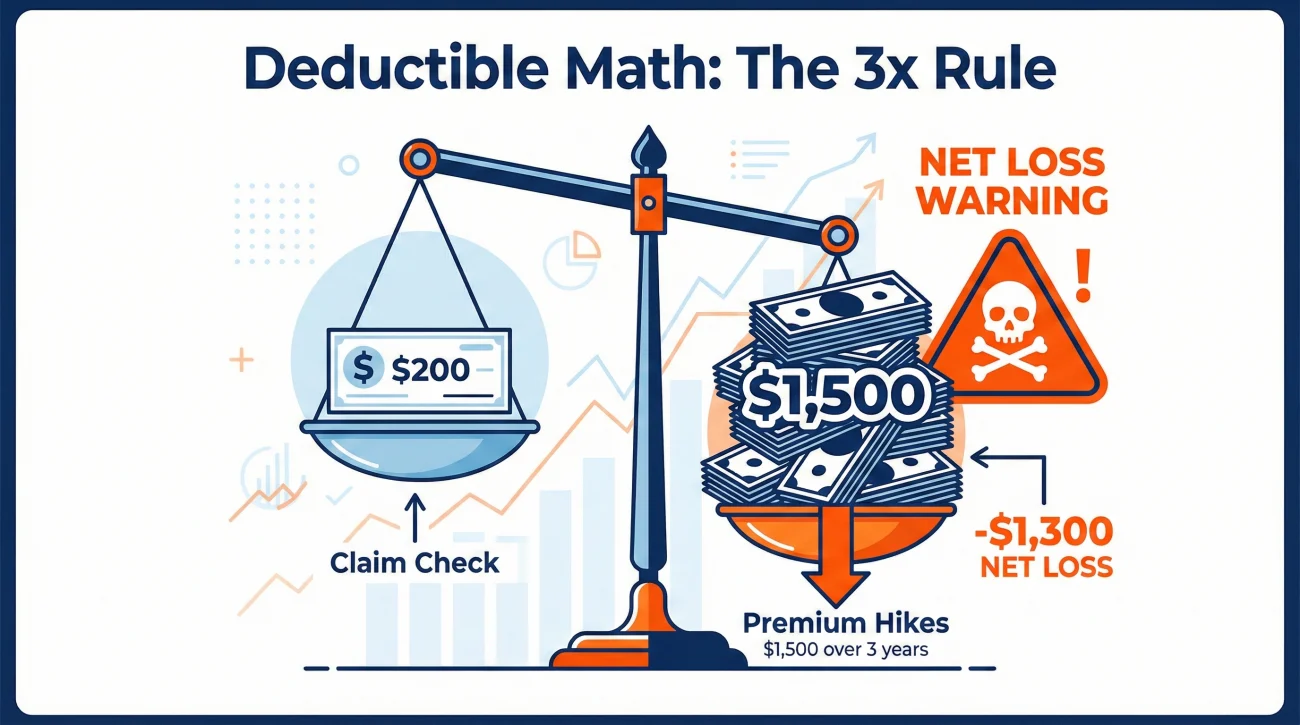
Insurance is designed for catastrophic losses, not maintenance. If your deductible is $1,000 and the repair estimate is $1,200, filing a claim is a financial loss for you. You will get a check for $200, but you will likely face a premium hike that costs you $500 a year for the next three years. That is a net loss of $1,300.
Rule of Thumb: Often, unless the damage is at least 2x or 3x your deductible, think carefully before filing. This can vary by state, carrier rules, and your claim history, so treat it as a quick filter, not a law. Get a rough estimate from a contractor first if you can. If the repair is $8,000 and your deductible is $1,000, filing makes sense.
2. The “Inquiry” Trap (CLUE Report)
Your insurance history is tracked in a database called CLUE (Comprehensive Loss Underwriting Exchange). Every claim is logged there. Sometimes, even calling to ask “is this covered?” can result in an “inquiry” being logged on your report. Too many inquiries can make you look high-risk to future insurers.
If you have filed another claim in the last 3-5 years, you are in the “frequency danger zone.” Two claims in a short period (e.g., 3 years) can label you as “high risk,” leading to non-renewal notices or major rate increases. If you have a recent prior claim, it can be smart to save claims for truly significant losses (like a fire or major storm) when possible.
3. The Maintenance vs. Sudden Question
Insurance covers “sudden and accidental” damage (storm, burst pipe, fire). It generally does not cover maintenance issues (old roof leaking, slow drip under sink, rotting wood, termites).
If you file a claim for a “slow leak under the sink that rotted the cabinet over 6 months,” it is often denied. However, you may still end up with a claim record. Try to tie what you are reporting to a specific, sudden event or a clear discovery moment, and stick to what you can honestly verify.
Phase 2: The First Notice of Loss (FNOL) Call
When you decide to file, you will call the claims department. This conversation is the “First Notice of Loss” (FNOL). The person on the other end is likely a call center representative, not a licensed adjuster. Their job is to data-entry what you say into a form.
This is where precision is vital. Your goal is to be brief, factual, and neutral. What you say here creates the first impression of the claim.
The 3 Dangerous Words to Avoid
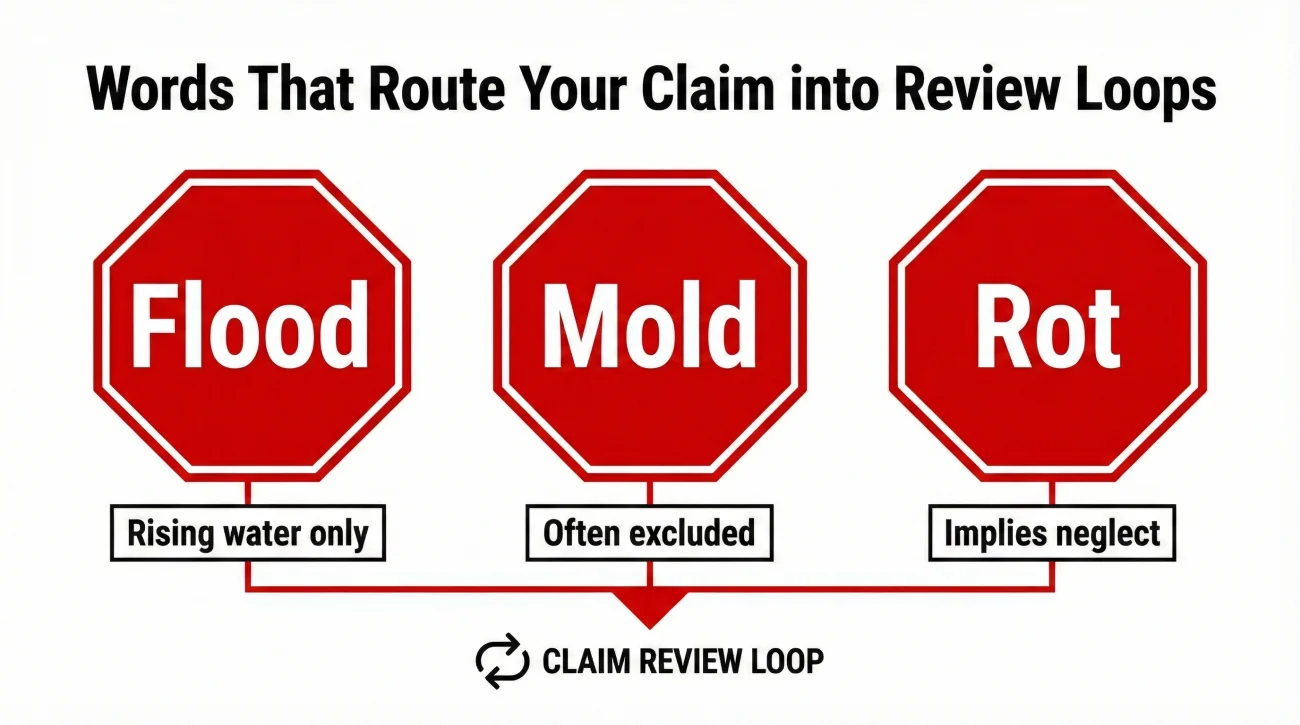
In claims operations, certain words have very specific technical meanings. Using them casually can route the file into a different review path than you expect. Use them only if you are confident they apply.
- 🛑 “Flood”: In insurance, “flood” specifically means rising water from the ground (rivers, lakes, storm surge). Standard homeowner policies often do not cover this without a separate flood policy. If a pipe bursts, do not label it “flood.” Say “I have standing water in the basement from a pipe.”
- 🛑 “Mold”: Many policies have limited or excluded mold coverage. Leading with “mold” can trigger extra questions. Focus on the water source and current conditions first. Mold is often the result, not the cause.
- 🛑 “Rot”: Rot implies long-term decay (maintenance). Insurance covers sudden damage. If you mention rot, you are signaling the issue may have been developing over time.
The “Safe Reporting” Strategy
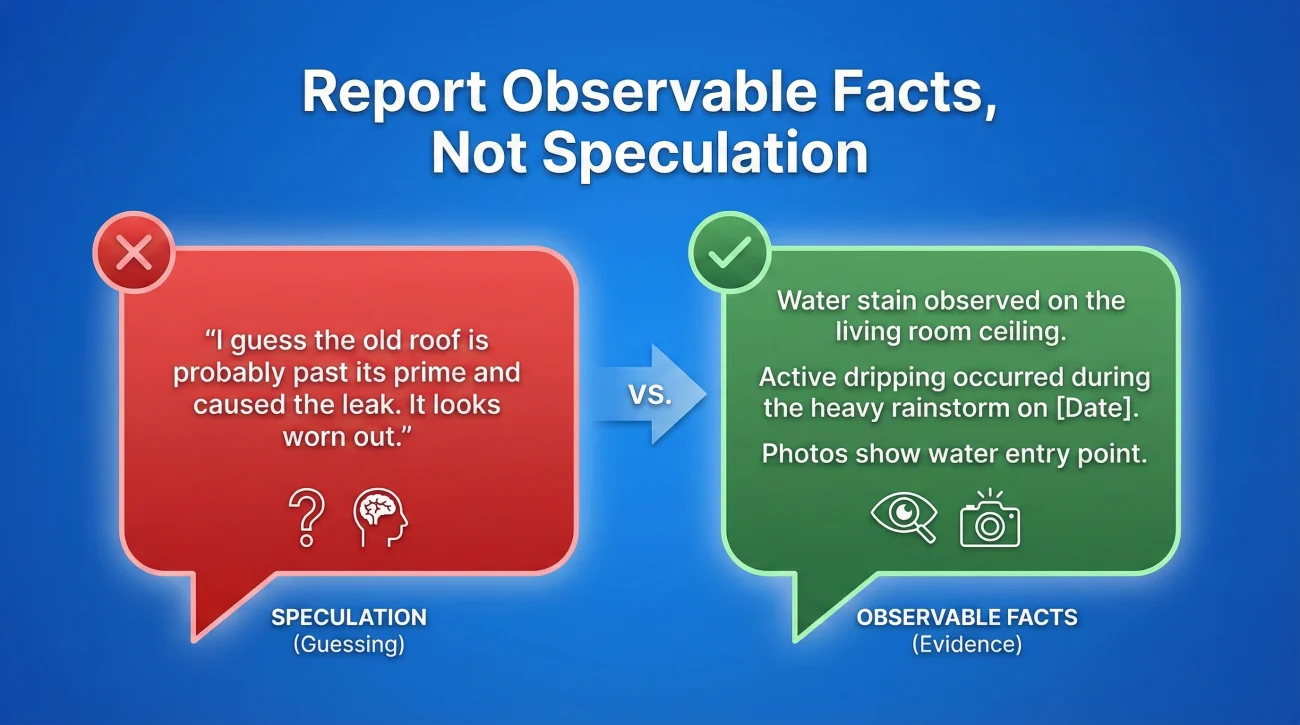
Do not speculate on why it happened. Report what you observed and what you did to prevent further damage. If you guess the cause and guess wrong, you can create unnecessary confusion in the initial record.
“I think my roof is old and leaking, or maybe the flood waters got in.” (Mixes multiple causes and uses terminology with technical meaning).
“I discovered water dripping from the living room ceiling at 2:00 PM today during the rainstorm. I am reporting water damage to the interior.” (Sticks to timing and observation).
Key Facts to Have Ready Before Dialing
Write these down on a piece of paper so you don’t stutter or guess during the call:
- Date of Loss: When did it happen? If you just found it, when did you discover it? (Discovery date is crucial for hidden damage). Be specific. “Sometime last week” is bad. “Tuesday the 12th” is good.
- Location: Which rooms are affected? Be specific but don’t overstate. “Kitchen and living room” is better than “the whole house” if the bedrooms are fine.
- Source: If you know it (e.g., “pipe under sink”), say it. If you don’t, say “investigating source.” Never guess “flood” or “seepage.”
- Mitigation Steps: “I have called a plumber to stop the leak” or “I have placed buckets.” This shows you are a responsible homeowner fulfilling your duty to prevent further damage.
Phase 3: The Claim Number & Role Assignment
By the end of the call, the representative will give you a Claim Number. This is your new identity in the insurance system. From this moment on, your policy number is secondary. Every document, photo, email, and receipt must have this Claim Number on it.
Write this number down on a sticky note and put it on your fridge. Put it in your phone notes. You will need it every time you call.
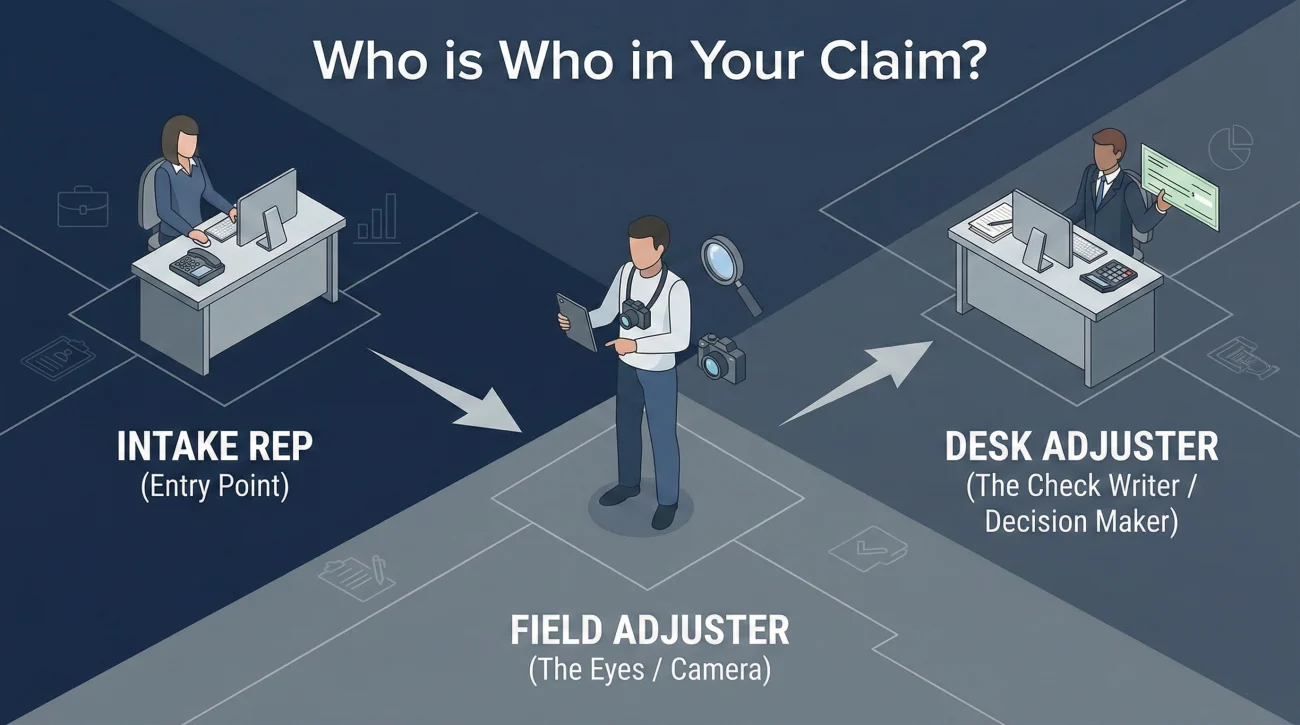
Who Are These People?
You will be introduced to several job titles. Knowing who does what prevents you from wasting time calling the wrong person.
| Role | Function | When to Contact |
|---|---|---|
| Claims Representative | Intake staff. Opens the file. | Day 1 only. Usually hands off the file after the call. They cannot approve payments. |
| Desk Adjuster (Inside) | The Decision Maker. Writes the check. | This is your main point of contact for coverage questions, approval, and payment release. |
| Field Adjuster (Inspector) | The Eyes. Visits the house. | Comes once to measure and photograph. They submit a report to the Desk Adjuster. Note: They often do NOT have authority to confirm coverage on site. |
| Independent Adjuster (IA) | Contractor hired by insurer. | Common in major storms. They work for the insurance company, not you. They are paid to handle the claim volume. |
💡 Insight: Don’t ask the Field Adjuster “Is this covered?” while they are measuring. They will usually say “I have to submit my report to the desk.” This isn’t them being difficult; it’s their job limitation. Save your coverage questions for the Desk Adjuster.
Phase 4: The “Day 1” Intake File Setup
The biggest operational error homeowners make is waiting for the adjuster to organize them. You must organize yourself. If you rely on the insurer’s portal, you only see what they choose to show you. You need your own “Command Center.”
Before you go to bed on Day 1, create a simple 4-folder digital structure on your computer or a cloud drive (Google Drive/Dropbox):
The 4-Folder System

- 📂 01_Intake_Notes: Save your call log, the claim number, policy copy, and adjuster contact info here. This is your admin folder.
- 📂 02_Photos_Evidence: Dump your “Day 1” photos here immediately so they are safe. Do not just leave them on your phone where they can get lost or deleted. Label them by room if you can.
- 📂 03_Receipts_Expenses: If you bought tarps, tape, or stayed in a hotel tonight, save the receipts here immediately. These are “Additional Living Expenses” (ALE) or mitigation costs. Losing these receipts means losing cash reimbursement.
- 📂 04_Communications: A place to save PDFs of the emails you will start receiving tomorrow. Do not rely on your inbox search bar. Save every letter they send you here.
The Communication Log
Start a simple text document or spreadsheet called “Claim Log.” Make your first entry immediately after the FNOL call. Do not trust your memory.
Log Entry Example:
Date/Time: Oct 12, 4:30 PM
Spoke to: Sarah (Intake Rep)
Summary: Reported water damage in kitchen. Received Claim #123-456. Sarah stated an adjuster would call within 24 hours. I asked for the adjuster's email but she didn't have it yet.
This log will be your best weapon if delays happen later. It proves who said what and when.
Phase 5: Scheduling the Inspection
Usually within 24-48 hours, an adjuster will call to schedule the inspection. This is not a casual visit; it is a data collection event. The adjuster is coming to verify coverage and scope the damage.
⚠️ Warning: Do not just say “come whenever.” Confirm the details to avoid a wasted trip.
Script: Inspection Confirmation
“I can meet you on [Day/Time]. Please confirm: Will you be inspecting the roof and the interior? Do I need to have a ladder available, or will you bring one? I want to make sure you have full access to all damaged areas.”
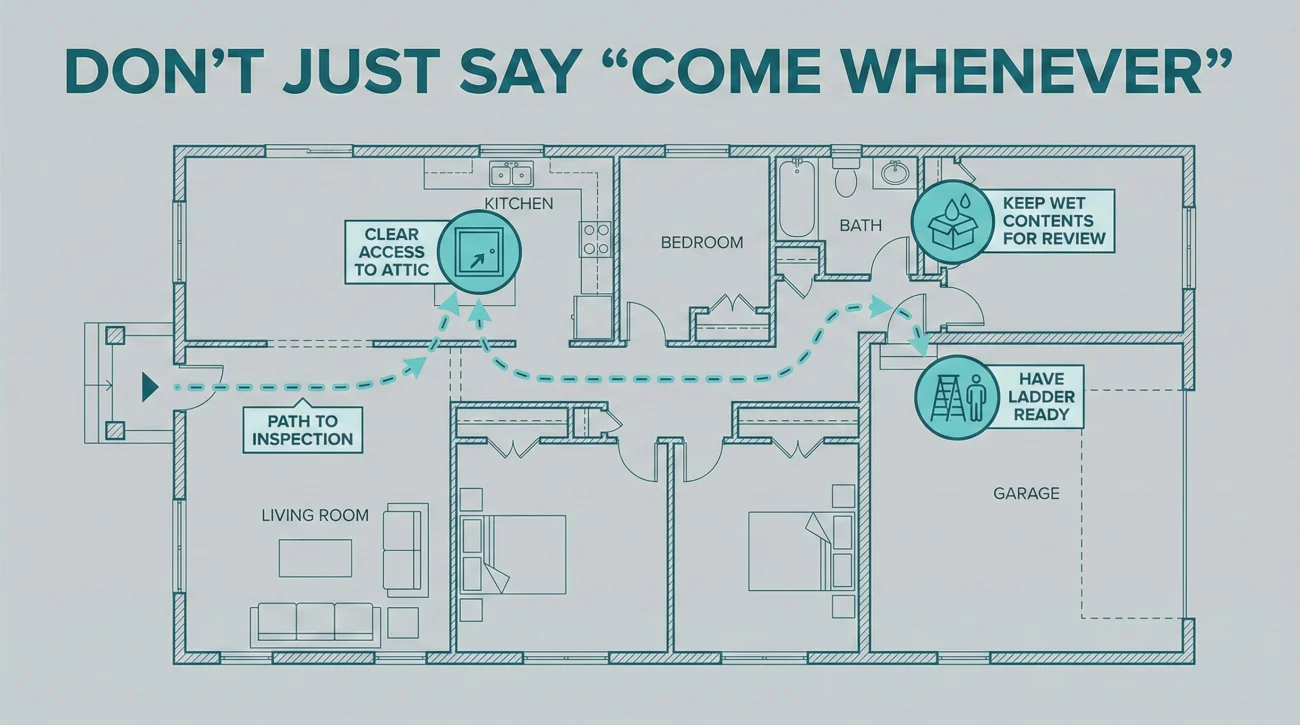
Preparing the Battlefield (Your Home):
Before they arrive, make sure the damage is accessible. If you have a pile of wet contents, don’t throw them away! Keep them for the adjuster to see. If you must bag them due to smell, keep the bags on site or take extensive photos. If the adjuster cannot see the damaged item, they cannot pay for it.
If you have emergency repairs that need to happen before they arrive (like extracting water to prevent mold), tell them explicitly: “I have mitigation crews working now to stabilize the home. I am taking photos of the damage before they remove anything. Is there anything specific you need me to preserve?” This prevents them from later claiming you destroyed evidence (spoliation).
Phase 6: The “Radio Silence” Period (Days 3-10)
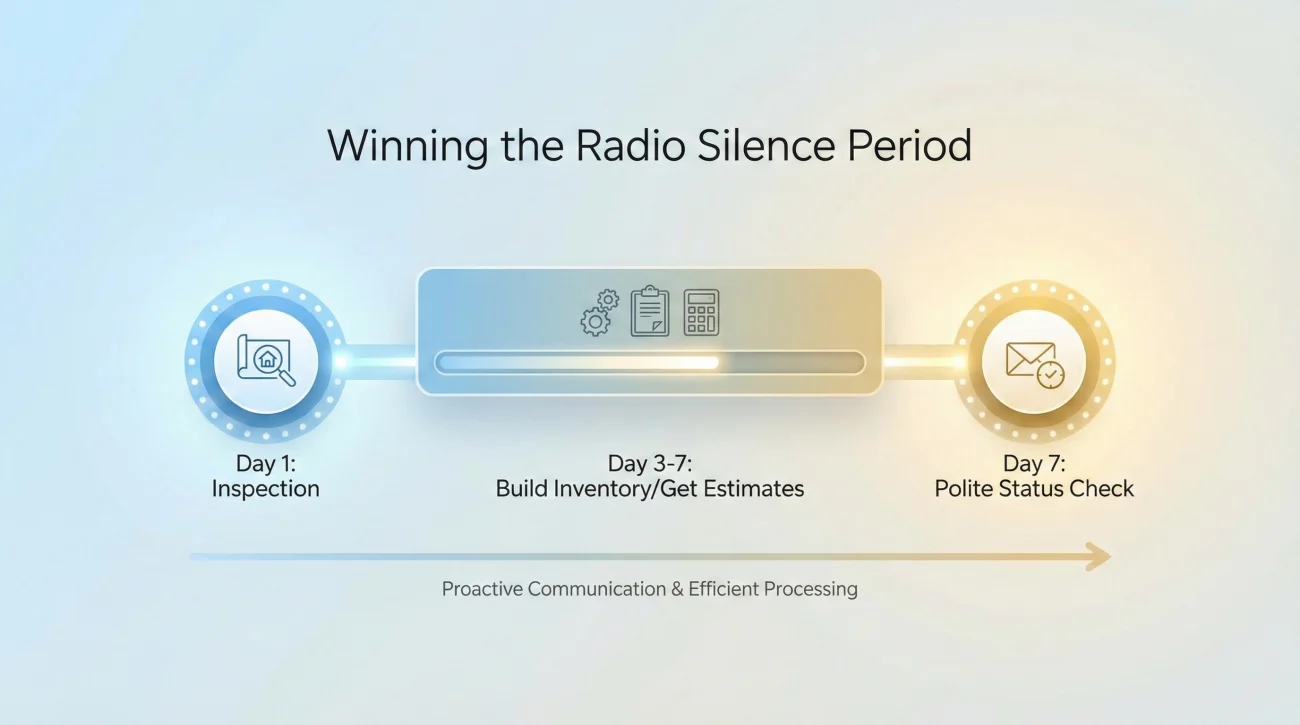
After the inspection, there is often a gap. The field adjuster goes home to write the report. The desk adjuster waits for the report. You sit at home wondering what is happening. This is the “Radio Silence” zone.
Do not just wait. Use this time to build your evidence packet.
- Build Your Inventory: Start listing every damaged item in a spreadsheet (Description, Age, Cost).
- Get Your Own Estimates: Call a trusted contractor to give you a repair estimate. Do not wait for the insurance number to be the first number you see. You need a comparison.
- Follow Up on Day 7: If you haven’t heard back one week after inspection, send a polite status check email.
“Hello [Adjuster Name], checking on the status of the estimate following the inspection on [Date]. Please let me know if you need any further information from me to finalize the report.”
Common Day 1 Mistakes That Cause Day 90 Problems
In claims operations, we see files break not because of coverage issues, but because of procedural errors in the first hour. Avoid these traps.
1. Cleaning Up Evidence Too Fast
It is natural to want to throw away ruined wet carpet or burnt furniture. Don’t. Or at least, not until you photograph it extensively. If you throw it away before documenting it, the adjuster cannot verify the quality (was it expensive wool or cheap synthetic?) and may pay you for the cheapest builder-grade replacement. Keep a sample of the carpet pad and the carpet itself if you must dispose of the bulk.
2. Signing “Assignment of Benefits” (AOB) Blindly
A restoration contractor might show up at your door (sometimes uninvited) and ask you to sign a form to start work. Read it carefully. If it assigns your entire claim rights to them (Assignment of Benefits), it can reduce your control over the process and who communicates with the insurer. A standard “Work Authorization” is often fine; a full “Assignment of Benefits” requires extra caution. You want to stay in charge of your claim.
3. Assuming the Adjuster Knows Everything
The intake rep might type “kitchen leak” into the system. If the water actually went into the dining room and the basement, you must tell them. If it is not on the report, the field adjuster might not even look at the basement, and you will have to request a supplemental inspection later. Be comprehensive in your description of the affected areas.
The Complete Claim Filing Ecosystem
Filing a claim is not a single action; it is a series of decisions. To help you navigate the specific nuances of your situation, we have broken down the process into specialized guides.
🤔 Decision & Coverage (Read Before Filing)
Not every damage requires a claim. Sometimes, filing a small claim costs you more in long-term premiums. These guides help you run the math and understand your policy buckets.
| Guide | Why it matters |
|---|---|
| Should You File a Claim or Pay Out of Pocket: A Decision Checklist | A decision checklist to weigh deductibles vs. rate hikes so you don’t file a “zero-pay” claim. |
| Call Your Agent First: What to Ask Before You File | Why an “off-the-record” chat with your agent can save you from a bad filing decision. |
| Coverage Buckets in Plain English: The Questions to Ask Before You File | Understanding Dwelling vs. Contents vs. ALE buckets before you call so you know what to ask for. |
| Water Damage vs. Flood: The One Difference That Changes Everything | The critical terminology difference (rising water vs. pipe burst) that usually determines coverage. |
| Wear and Tear vs. Sudden Damage: How to Describe the Loss at Intake | How to describe damage using neutral, observable facts to avoid accidentally admitting neglect. |
| Mold Coverage Reality: The Questions That Determine the Bucket | Helps you understand if your mold issue is a covered “result of damage” or an excluded “long-term leak.” |
| Roof Leak Coverage Buckets: The Intake Questions That Keep You Consistent | Distinguishes between storm damage (covered) and maintenance issues (not covered) before you report it. |
📞 The Filing Call (Reporting the Loss)
The “First Notice of Loss” (FNOL) call is where the official record begins. What you say here becomes the foundation of the investigation.
| Guide | Why it matters |
|---|---|
| First Notice of Loss Checklist: The Facts You Need Before You Call | The exact facts (date, time, source) you need ready before you dial the 1-800 number. |
| Reporting a Claim: How to Describe the Loss Without Overexplaining | Safe phrasing principles to avoid “over-talking” or guessing causes you can’t verify. |
| Day 1 Questions: What to Ask So You Get a Real Next Step | A script of questions to ask the rep before you hang up to ensure you get a real timeline. |
| Claim Call Notes: What to Write Down on Day 1 | A template for what to write down during the intake call so you have a record of promises made. |
| Recorded Statements: What to Clarify Before You Agree to One | How to handle the request for a recorded interview without trapping yourself. |
🗂️ Setup & Logistics (The First 24 Hours)
Once the claim is open, you need to set up your side of the desk. Organization now prevents “lost file” syndrome later.
| Guide | Why it matters |
|---|---|
| Set Up Your Intake File: The Four Folders You Need on Day 1 | The 4 specific digital folders you need to create immediately to manage the paper trail. |
| Claim Number Basics: What It Is, Where It Appears, and How to Use It | Why this number matters more than your policy number and how to use it to track every interaction. |
| Who Does What in a Claim: Agent, Claims Rep, Desk Adjuster, Field Adjuster | Who is who, and when to contact each role so you don’t waste time calling the wrong person. |
| Choose a Communication Channel: Portal, Email, or Phone (Intake Decision) | Deciding how you will communicate for the record to ensure nothing gets “lost in translation.” |
| Forms Arrive Immediately: How to Identify and Track Them Without Filling Them Yet | How to catch and organize the wave of automated paperwork that arrives on Day 2. |
🚧 Immediate Next Steps & Troubleshooting
After the call, the process moves to inspection. Use these guides if you hit early roadblocks, need to do emergency repairs, or need to fix a mistake.
| Guide | Why it matters |
|---|---|
| What Happens After You File: A Simple Claim Timeline Overview | A high-level map of the stages and triggers so you know what comes next. |
| Scheduling the Inspection: What to Confirm Before the Adjuster Comes | What to confirm about access, ladders, and timing so the adjuster can actually see the damage. |
| Emergency Repairs Before Inspection: What to Confirm So You Don’t Create a Problem | How to fix immediate issues (like a tarp or water extraction) without voiding coverage. |
| Wrong Claim Details: How to Correct Date, Address, or Policy Info Cleanly | How to fix a wrong date of loss or address cleanly before it triggers a fraud flag. |
| No Adjuster Assigned Yet: What to Check Before You Assume You’re Ignored | What to do if radio silence hits on Day 3 and you still don’t have a contact person. |
Final Thoughts
Filing a property insurance claim is a business transaction, not a request for help. By treating Day 1 with operational discipline, sticking to facts, generating a claim number, and setting up your file, you remove the friction that causes delays.
You have started the process correctly. You have your claim number, your file structure, and your initial log. Now, your job is to feed the system the evidence it needs to pay you. The next step is usually documenting the damage in detail before the adjuster arrives.
❓ FAQ
⏱️ “How long do I have to file a claim after damage?”
Most policies say you must file “promptly” or “as soon as reasonably possible.” This usually means days, not months. Waiting months can cause a denial because “late reporting” prevents the insurer from investigating the fresh damage. If you wait, you must have a very good reason (like being out of town).
🛑 “Can I cancel a claim if I decide not to pursue it?”
You can withdraw a claim (ask to close it without payment), but the “record” of the claim usually remains on your CLUE report (the insurance history database) as a “zero-pay claim.” It acts like a mark on your record, even if you got no money. This is why calling your agent first is smart.
💰 “Will my rates go up if I file?”
Often, yes. Losing your “claims-free discount” is common. In some states, they cannot raise rates for “Acts of God” (weather), but for negligence or pipe bursts, a rate hike is standard risk management. Ask your agent for the specific rules in your state.
👷 “Should I call a contractor before filing?”
Yes, getting an opinion from a trusted contractor can confirm if the damage is actually worth more than your deductible. It helps you avoid filing small claims that net you zero dollars. Just don’t let them start permanent repairs yet.
🏠 “What if I have two different damages at once?”
If a storm damaged the roof AND a pipe burst in the kitchen, these are likely two separate “occurrences.” You will likely need to file two separate claims with two separate deductibles. Discuss this with your agent to be clear on how to report it so they don’t get conflated.
⚠️ Disclaimer: PropertyClaimChecklist.com provides practical guidance, process checklists, and example follow-ups to help you organize a property claim and move it forward. It is not policy language, claim documentation, legal content, or a substitute for your insurer's instructions. Always rely on your carrier's requirements and your actual policy terms for what must be submitted and how decisions are made.