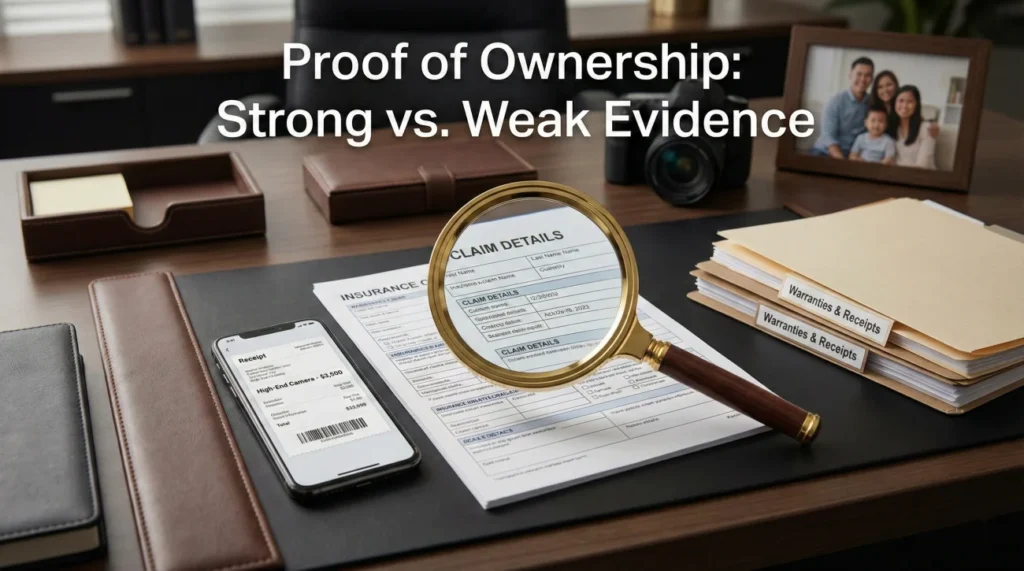
- When you lose your belongings in a disaster, proving that you actually owned them is often one of the most stressful parts of the recovery process.
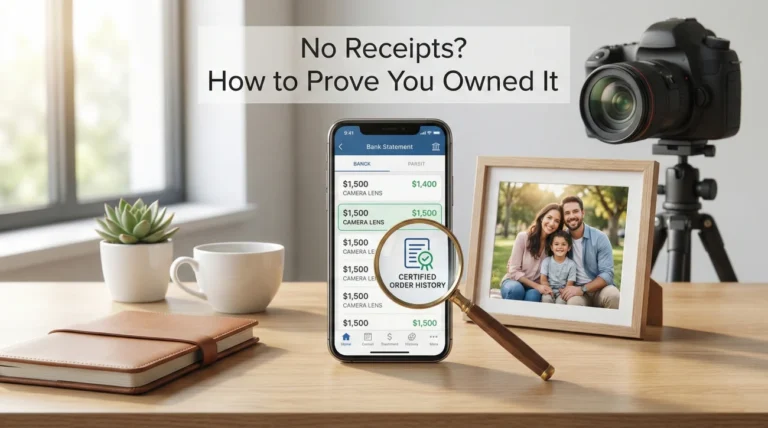
- I frequently see adjusters categorize proof into three levels. Strong evidence includes itemized receipts or appraisals. Medium evidence includes personal photos showing the item in your home. Weak evidence includes empty boxes or generic bank statements.
- If you do not have a receipt, you are not out of luck. In many cases, combining two pieces of medium or weak evidence can create a strong proof package.
- Context is everything. A photo of a television sitting in your living room is excellent proof, but a screenshot of a television from an online store is commonly rejected.
- Before you send anything to the insurance company, I highly recommend organizing your files into a clear index so the reviewer does not have to guess what they are looking at.
The Reality of Proving What You Lost
I have sat at the operations desk and watched countless property claims stall out over a single, frustrating question from the insurance company. The adjuster looks at your inventory list and says they need proof of ownership for your items. If you have just survived a fire, a flood, or a major theft, this request can feel incredibly insulting. You are already dealing with a massive loss, and now it feels like the insurance company thinks you are making things up.
In my experience, adjusting teams are not usually trying to accuse you of anything malicious. They are simply bound by strict auditing guidelines. The person reviewing your file has a supervisor, and that supervisor has an auditor. They cannot release thousands of dollars based solely on a spreadsheet you typed up. They need something tangible to put in the file to justify the payout.
This is where understanding the system gives you a massive advantage. Over the years, I have noticed that reviewers mentally sort evidence into distinct categories of strength. Some documents get stamped with instant approval, while others trigger endless follow up questions. If you know how they evaluate these documents, you can save yourself weeks of delays.
I want to walk you through practical proof of ownership examples. We will look at what constitutes strong evidence, what falls into the medium category, and what weak evidence looks like. More importantly, I will share the operational strategies I use to help people combine weak pieces of proof into a package that gets accepted.
The Reviewer’s Mindset: What They Are Looking For
Before we look at specific examples, it helps to understand exactly what the adjuster is trying to verify when they look at your documents. In daily claims operations, a perfect piece of evidence answers four distinct questions for the reviewer.
- ✅ Who bought it? They want to see your name or your address tied to the item.
- ✅ What exactly is it? They need the brand, the model number, and the specific features to determine its replacement value.
- ✅ When was it purchased? This helps them calculate depreciation based on the age of the item.
- ✅ How much did it cost? They need to know the baseline financial value before taxes and shipping.
A single receipt often answers all four of these questions easily. However, when you do not have the receipt, you have to build a bridge of alternative evidence to answer those same four questions. The more questions a document leaves unanswered, the weaker the evidence becomes.
Tier 1: Strong Proof of Ownership Examples
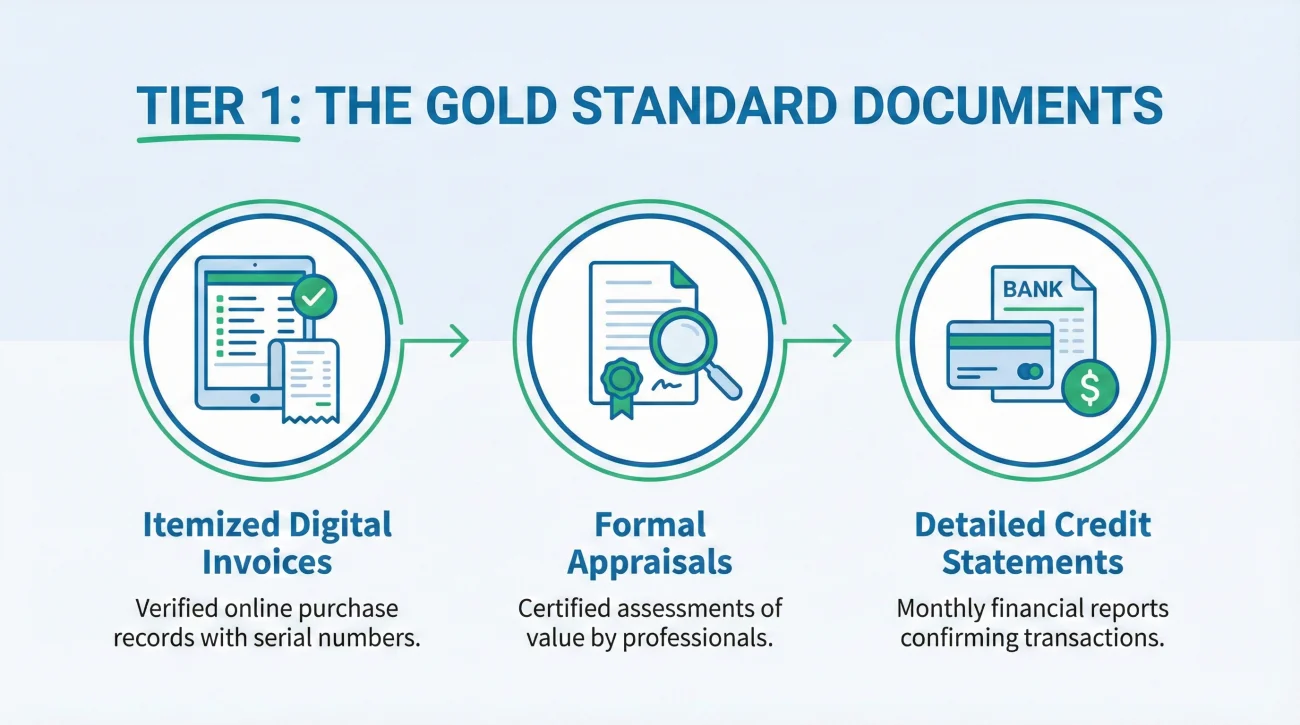
These are the gold standard documents. When you submit these items, the review process is usually rapid because the adjuster does not have to guess. If you have these documents, put them at the very top of your evidence file.
Original Itemized Receipts and Digital Invoices
The strongest possible proof is a clear, itemized receipt. In today’s digital age, this is frequently easier to find than you might think. A digital invoice from an online retailer like Amazon, Best Buy, or Wayfair is perfect. It shows your shipping address, the exact date of purchase, the exact model number, and the price paid. I often advise people to comb through their email archives using search terms like “Order Confirmation” or “Receipt” to pull these digital goldmines.
Formal Appraisals and Scheduled Item Policies
For high-value items like jewelry, fine art, or specialized electronics, a formal appraisal is excellent proof. Even better is if you had the item specifically scheduled on your insurance policy before the loss. If an item is officially scheduled on your declarations page, you have already proven ownership to the insurer during the underwriting process.
Detailed Credit Card Statements
Not all bank statements are created equal. A strong bank statement is one where the vendor provides line-item details to the credit card company. For example, if you buy a computer directly from Apple, your credit card statement might actually list the specific Macbook model in the transaction details. This is incredibly strong evidence because it is a third-party financial record.
Tier 2: Medium Proof of Ownership Examples
In many cases, you will not have the original receipt. Perhaps you bought the item with cash, or maybe the receipt burned in the fire. This is where medium-tier evidence comes into play. These are items that prove the item existed in your home, even if they do not perfectly prove how much you paid for it or when exactly you bought it.
Contextual Home Photographs
A photograph of the item inside your house is one of the most common and effective forms of alternative proof. I call this “contextual” because the background matters immensely. A photo of your expensive espresso machine sitting on your kitchen counter proves it was in your house. If the adjuster can match the kitchen countertops in the photo to the damaged countertops in the claim file, you have undeniably proven ownership.
Owner’s Manuals and Warranty Registrations
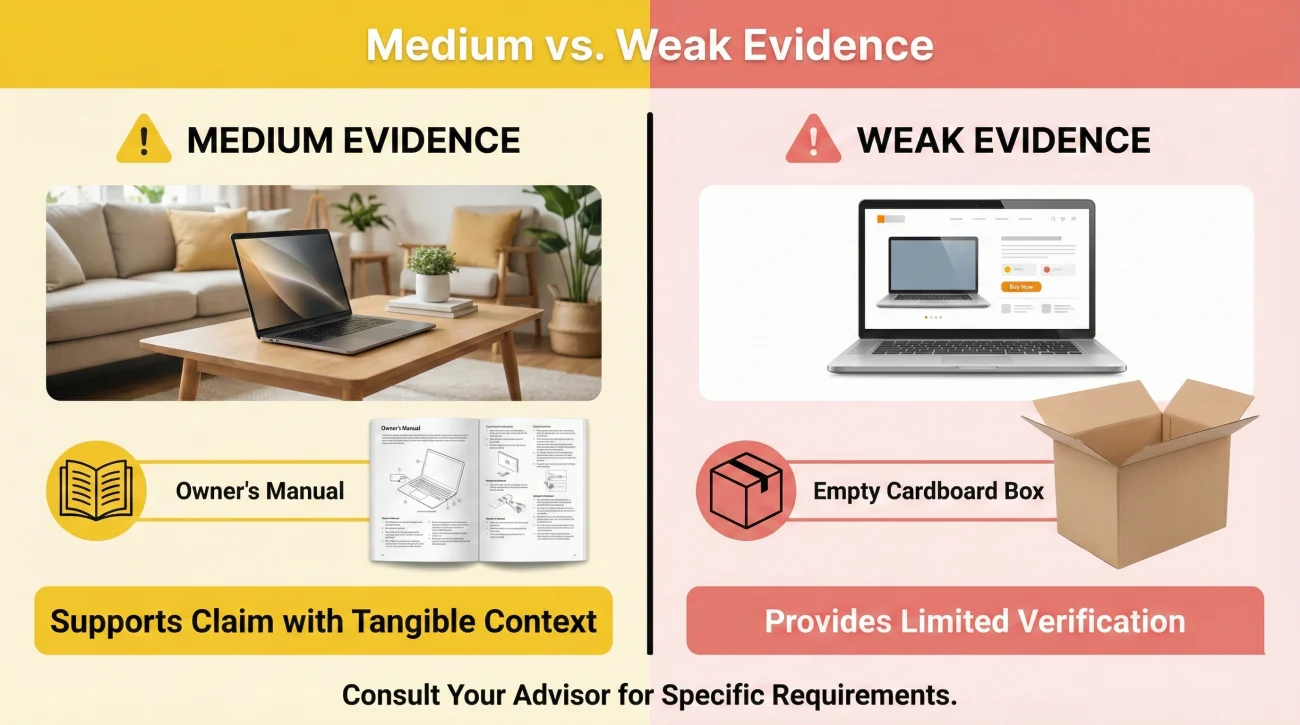
When you buy a lawnmower or a television, you often keep the manual in a drawer while the receipt gets thrown away. Submitting a photo of the physical owner’s manual is decent proof that you owned the item. Warranty registration emails are even better. If you filled out a warranty card online and received a confirmation email, that email usually contains the date and the model number, making it fantastic medium-tier evidence.
Repair or Maintenance Invoices
If you have an invoice from a local mechanic showing they repaired your specific brand of riding lawnmower, that proves you own the lawnmower. If you have an email from a tech support agent troubleshooting your specific brand of smart TV, that creates a paper trail showing the item was in your possession.
Telling the adjuster you owned a $2,000 leather sofa but having no receipt, leading to them pricing out a generic $500 fabric sofa instead.
Submitting a family holiday photograph showing the distinct leather sofa in the background, proving the specific quality and style of the furniture you actually owned.
Tier 3: Weak Proof of Ownership Examples
This is where claims often get bogged down. Weak evidence is documentation that leaves too many questions unanswered. While you might occasionally get a lenient reviewer who accepts these, relying on them is a massive operational risk that usually leads to frustrating email chains and reduced payouts.
Generic Bank Line Items
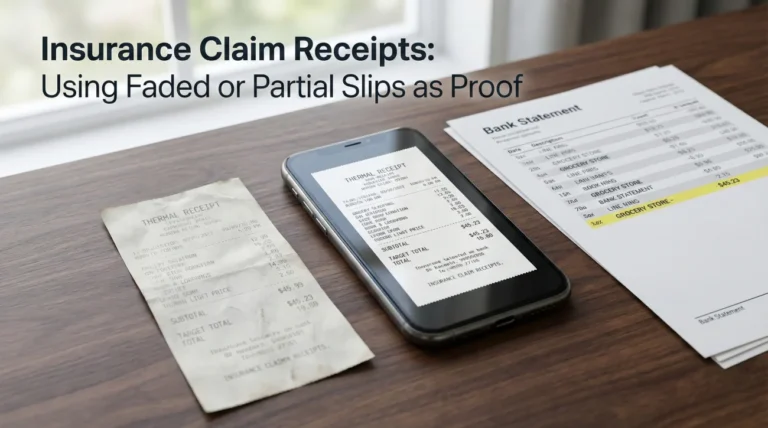
A bank statement that simply says “Target $450.00” is weak evidence for a specific television. The adjuster knows you spent money at Target, but they have no way of knowing if you bought a television, groceries, or clothing. Without additional context, they frequently reject this as proof for a specific high-value item.
Empty Boxes Without Context
I often see people submit photos of an empty box in their garage as proof they owned the expensive tool that came inside it. While this is better than nothing, it is weak. Adjusters are trained to be cautious of empty boxes, as people often keep boxes for items they sold years ago, or they might have brought a box home from a workplace. An empty box proves you have a box, not that you currently own the item.
Stock Photos from the Internet
Sending a screenshot of a product page from a website is not proof of ownership. It is simply proof that the item exists in the world. Adjusters use product links to verify the current replacement price of an item, but a product link does absolutely nothing to prove that the item was sitting in your living room on the day of the loss.
The Combination Strategy: Turning Weak Evidence into Strong Proof
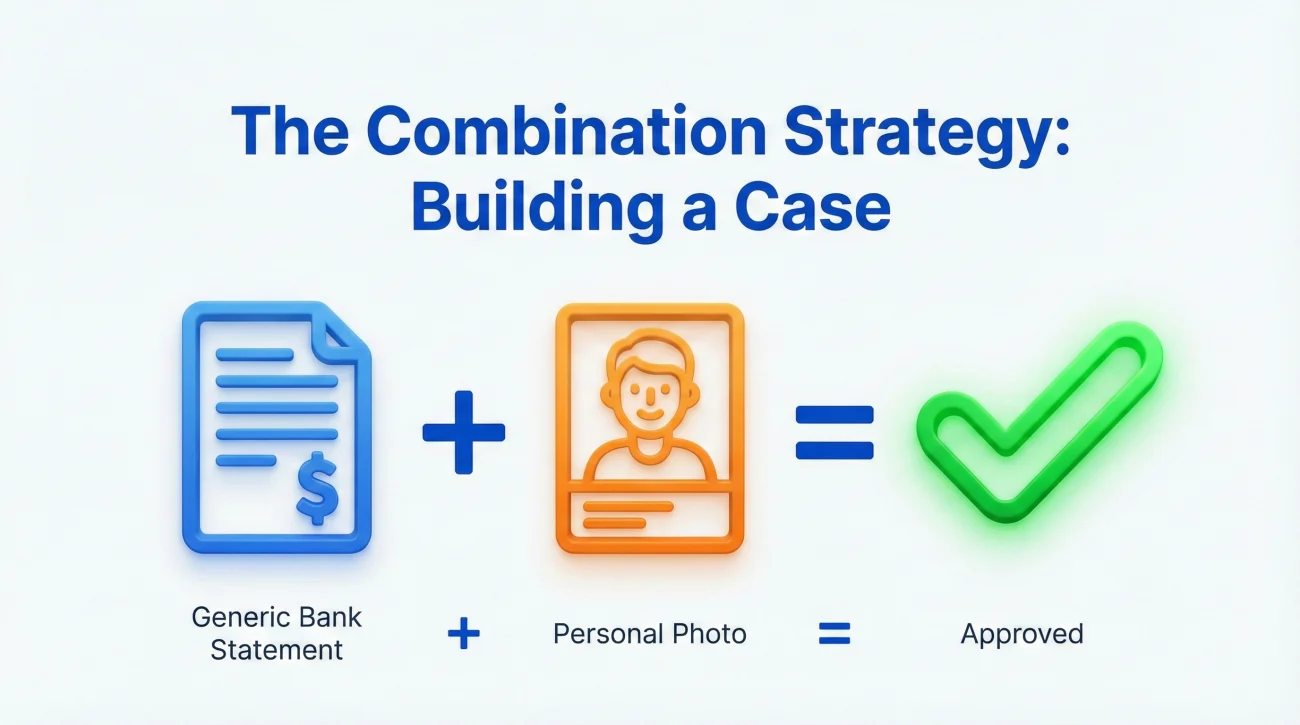
One of the most valuable lessons I try to share with people navigating a complex claim is that evidence is cumulative. If you do not have a Tier 1 receipt, you can often satisfy the adjuster by combining multiple pieces of Tier 2 and Tier 3 evidence.
Think of it as building a story that leaves no room for reasonable doubt. If a generic bank statement is weak on its own, and a physical owner’s manual is medium on its own, putting them together creates a highly compelling case.
| Missing Item | Piece of Evidence A | Piece of Evidence B | The Result for the Reviewer |
|---|---|---|---|
| Laptop Computer | Generic Best Buy Charge for $1,200 | Photo of laptop on your desk | The photo proves existence. The bank charge aligns with the price and date. Approved. |
| Gas Grill | Owner’s Manual found in a drawer | Family BBQ photo showing the grill | The manual provides the exact model number. The photo proves it was at your house. Approved. |
| Designer Jacket | Social media photo wearing the jacket | Email from dry cleaner mentioning the brand | The photo establishes possession. The dry cleaning receipt establishes authenticity. Approved. |
When you use this combination strategy, you have to explain it clearly. Do not just attach three random files to an email and hope the adjuster pieces the puzzle together. You have to write a clean, polite explanation of how the documents connect.
Subject: Proof of Ownership for Item #45 (Samsung Television)
Hello [Adjuster Name],
I am attaching documentation to verify ownership of the Samsung Television listed as Item #45 on my inventory.
While the original paper receipt was lost in the incident, I have attached two files to verify this item:
1. A photograph from last December showing the television mounted in my living room.
2. A copy of my credit card statement from July 2021 showing a transaction at Best Buy for $850.00, which corresponds to the purchase of this television.
Please let me know if this satisfies the verification requirement for this item, or if you need me to request a duplicate receipt directly from the retailer.
Thank you,
[Your Name]
Common Failure Patterns When Submitting Proof
Even when people have excellent proof of ownership examples, I commonly see files get delayed because of how the evidence is presented. The person reviewing your file might be looking at fifty different claims that day. If your submission is confusing, they will set it aside.
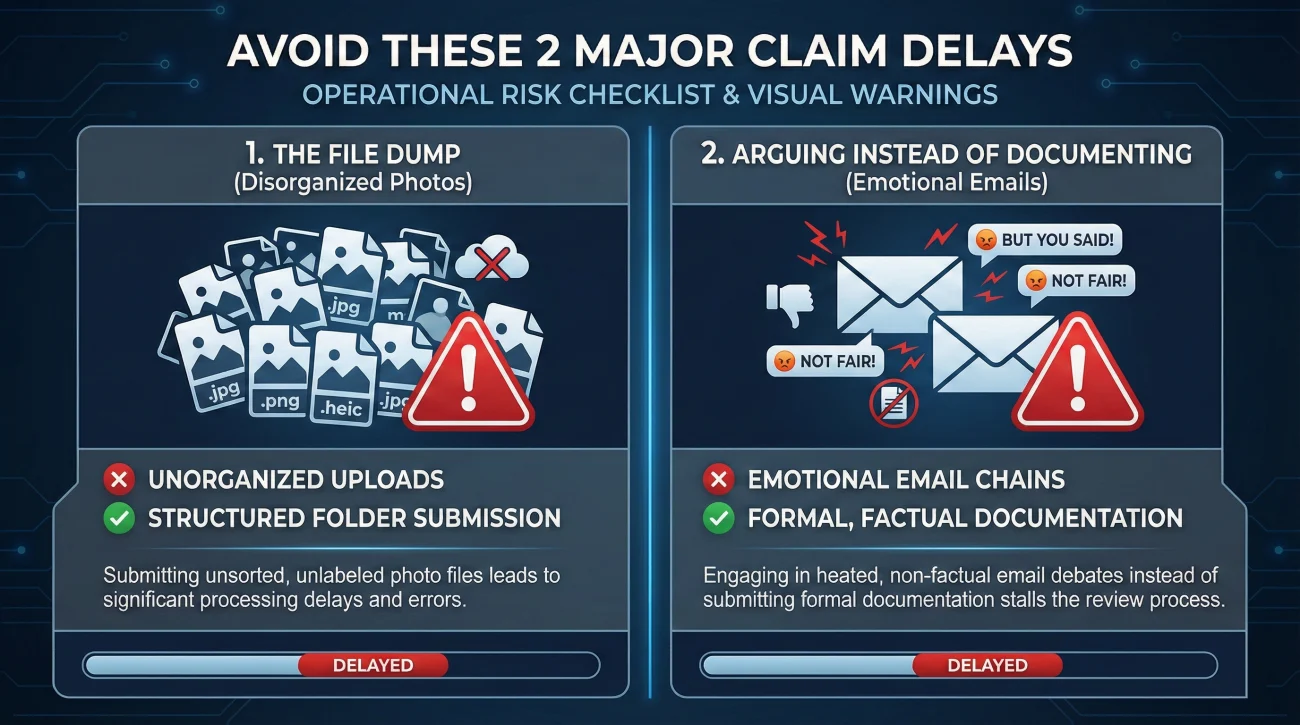
The File Dump
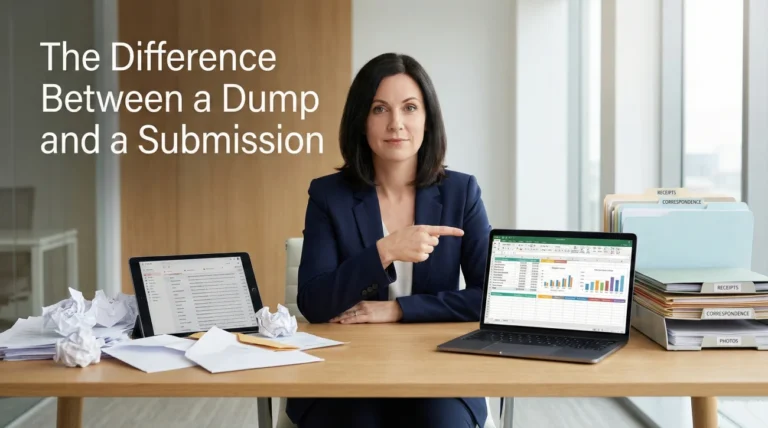
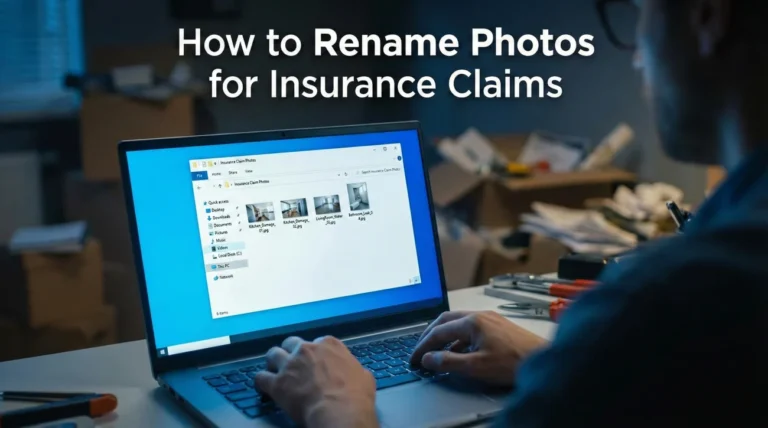
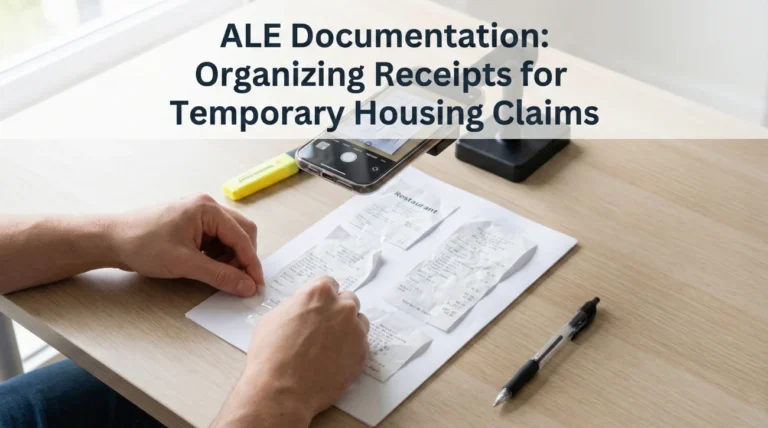
The single biggest mistake you can make is sending an email with twenty attachments named “IMG_4092.jpg” and no explanation. The adjuster does not have the time to open every photo and try to guess which item on your spreadsheet it corresponds to. You must label your files clearly. If the photo proves ownership for item number twelve on your list, name the file “Item_12_Proof_LivingRoomTV.jpg”.
Arguing Instead of Documenting
When an adjuster asks for proof, a frequent reaction is to get defensive. People write long emails explaining that they are honest and that the insurer should just trust them. In operations, I can tell you that these emails accomplish absolutely nothing. The reviewer cannot put your “word” into their auditing software. Shift your energy away from arguing and put it into finding alternative documentation, like older photographs or credit card histories.
Key Point: Do not take requests for proof personally. Treat the claim like a business transaction. If they ask for data, provide data in the cleanest, most organized format possible.
Organizing Your Evidence for the Adjuster
Gathering all these receipts, photos, and manuals is only the first step. To ensure your claim moves quickly, you need to tie everything together into a cohesive package. You want the adjuster to look at your inventory list, see an item, and instantly know where to find the proof for that item.
I highly advise creating a master folder on your computer. Inside that folder, keep your spreadsheet, and keep all your labeled photographs and PDF receipts. By utilizing a structured property claim evidence pack, you eliminate the friction that causes delays. You take control of the narrative, showing the insurance company that you are highly organized and meticulously documented.
Final
Being asked to prove that you owned your own belongings is a uniquely frustrating experience, especially after a traumatic event. However, by understanding the mechanics of how insurance companies review files, you can remove the emotion from the task.
Start by hunting down the Tier 1 evidence, like digital receipts and order confirmations. When those are missing, do not panic. Dig into your phone’s photo albums, search your email for warranty registrations, and look at your bank history to build strong combination proofs. By treating the documentation process calmly and systematically, you provide the exact artifacts the adjuster needs to approve your inventory and issue your settlement.
❓ FAQ
🧾 What if I paid cash for my items and have no receipts?
If you paid cash, you will need to rely heavily on alternative evidence. Look for personal photos showing the item in your home, owner’s manuals, or warranty registration emails to establish that the item was in your possession.
📸 Does a picture of the item count as proof of ownership?
Yes, a contextual photograph showing the item inside your home is widely accepted as strong alternative proof. It is significantly better than a stock image from the internet, which only proves the item exists generally.
💳 Are credit card statements enough for insurance claims?
They can be, but it depends on the detail. A statement showing a specific item purchased directly from a brand is excellent. A generic store charge usually needs to be combined with a photo or manual to be considered strong proof.
📦 Does an empty box prove I owned the item?
On its own, an empty box is often considered weak evidence because people frequently keep boxes for items they no longer own. You should combine the photo of the box with a manual or a bank statement to build a stronger case.
🎁 How do I prove ownership of a gift?
Gifts can be tricky. You can ask the person who gave it to you if they have an email receipt. If not, rely on photographs of you using the item, or written appraisals if it is a high-value item like jewelry.
📱 Can I use my phone’s location history as proof?
In some unique cases, yes. If you do not have a receipt for an expensive bicycle, but you have location data, photos, and maintenance logs showing you consistently used a bike path, that data can serve as supporting medium-tier evidence.
📑 Do I need proof for every single spoon and towel?
In many cases, insurers do not demand rigid proof for standard, low-value household items like basic utensils or everyday clothing. They typically focus their strict proof requirements on high-value items, electronics, and specialty goods.
🔍 What happens if the adjuster rejects my proof?
If they reject a piece of evidence, calmly ask them in writing what specific detail is missing. Once you know if they are questioning the age, the price, or the existence of the item, you can look for the exact document needed to fill that gap.
💻 Can I use online order histories from years ago?
Absolutely. Digital order histories from retailers like Amazon, Wayfair, or Home Depot are considered excellent Tier 1 evidence because they show the date, price, and your shipping address perfectly.
🛑 Will the insurance company accept a sworn statement?
A sworn statement or an affidavit can sometimes be used as a last resort, but it is rarely accepted on its own for high-value items without any supporting physical or digital evidence to back up your claim.
⚠️ Disclaimer: PropertyClaimChecklist.com provides practical guidance, process checklists, and example follow-ups to help you organize a property claim and move it forward. It is not policy language, claim documentation, legal content, or a substitute for your insurer's instructions. Always rely on your carrier's requirements and your actual policy terms for what must be submitted and how decisions are made.