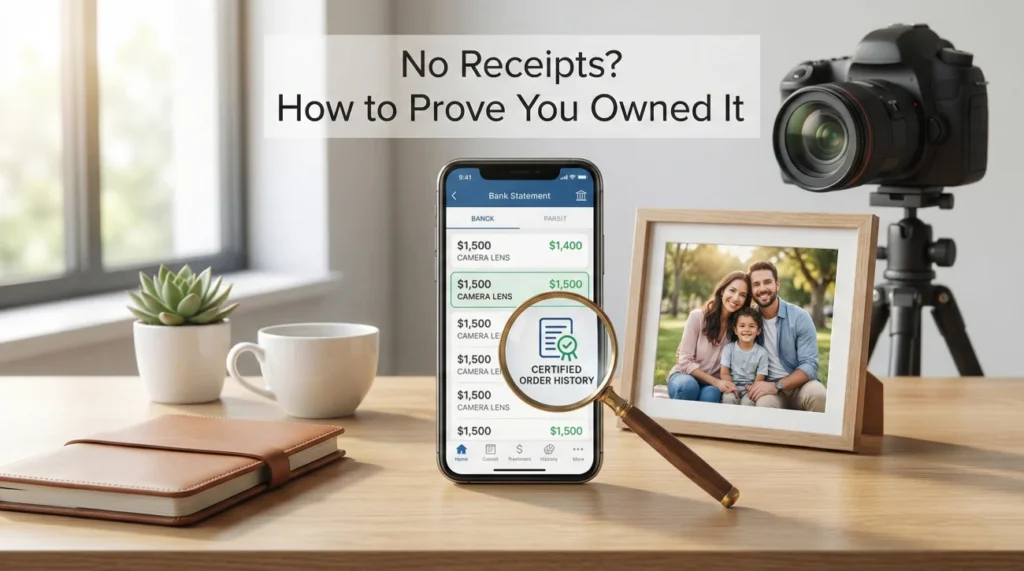
- Losing paper receipts is incredibly common in property claims. Insurance companies process claims without original store receipts every single day.
- You can establish ownership through alternative financial trails, such as credit card statements, bank records, and digital purchase histories.
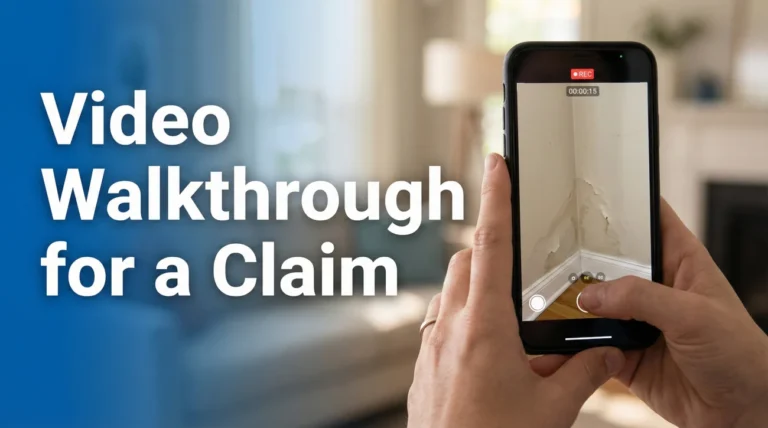
- Visual evidence is highly effective. Background elements in old family photos or video walkthroughs often serve as perfectly acceptable proof of ownership.
- Digital footprints, like warranty registrations, user manuals, and smart home app connections, create a verifiable record that an item was in your home.
- When submitting alternative proof, clearly label it and explain what it represents to remove the guesswork for the person reviewing your file.
The Panic of Missing Receipts: An Operational Reality
When a disaster strikes (whether it is a fire, a flooded basement, or a severe storm), people often lose more than just their furniture and electronics. They lose the filing cabinet that held the physical proof they owned those items. One of the first questions I hear from stressed property owners is, “How can I prove I owned a $2,000 television if the receipt burned in the fire?”
In my years of working in claims operations, I have seen this exact scenario cause massive amounts of unnecessary panic. Many people assume that without a neatly printed store receipt, the insurance company will simply delete the item from their claim. I want to reassure you: processing claims without original store receipts is a standard, daily occurrence in the insurance industry.
The goal of the adjuster is not to force you into an impossible corner. Their job is simply to verify that a claimed item actually existed in the property before authorizing payment. When I review a contents file, I am not looking specifically for a paper receipt; I am looking for a reasonable, verifiable trail of ownership. If you can provide a logical alternative that proves you possessed the item, that is often perfectly sufficient to keep the claim moving forward.
Key Point: You do not need to invent details or panic if a receipt is gone. You just need to shift your focus from finding a specific piece of paper to reconstructing a digital or visual trail that points to the same conclusion.
Alternative 1: Reconstructing the Financial Trail
If you do not have the piece of paper the cashier handed you, your first step is to follow the money. In our modern economy, very few high-value items are purchased with untraceable cash. Almost every significant purchase leaves a financial footprint.
When I coach people on how to build their property claim evidence pack, I always start with digital financial records because they are the easiest to retrieve, even if your physical home is inaccessible.
Credit Card and Bank Statements
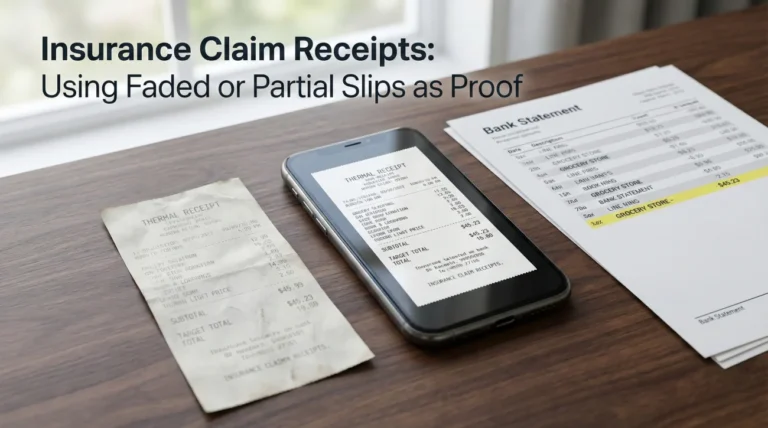
A line item on a credit card statement showing a charge at Best Buy, Home Depot, or a local furniture store is incredibly strong alternative evidence. While it may not list the exact model number of the refrigerator you bought, it proves a transaction occurred at a specific store for a specific dollar amount.
When using a bank statement, you must do the administrative work for the adjuster. Do not just send a 12-page PDF of your monthly spending and expect the reviewer to hunt for the right charge.
Attaching a raw, unedited PDF of a credit card statement with no context, forcing the adjuster to guess which $800 charge applies to the couch.
Highlighting the specific transaction, adding a text box next to it that says “Purchase of Sectional Sofa – Item #42 on Inventory List,” and blacking out unrelated personal purchases.
Digital Purchase Histories
Online retailers maintain robust order histories that can often be accessed years after the purchase. Amazon, Wayfair, Target, and Walmart all have online dashboards where you can pull up past orders. An order confirmation email or a screenshot of a “Delivered” status from an online retailer is often treated with the exact same weight as a physical receipt because it contains the date, the price, and the exact item description.
Alternative 2: Mining Your Visual Evidence
If there is no financial trail, perhaps because the item was a gift, a cash purchase from a decade ago, or an inheritance, your next best option is visual proof. In many cases, a clear photograph showing the item sitting in your living room is actually better evidence than a receipt. A receipt only proves you bought something; a photograph proves it was actually in the house.
I frequently review claim files where the policyholder cannot find a receipt for an expensive dining table. However, they are able to provide a photograph from a family Thanksgiving dinner where the table is clearly visible in the foreground. For claims operations, that is excellent evidence.
💡 Pro Tip: Do not just look for photos of the items themselves. Search your phone for holiday photos, birthday videos, or pictures of your pets. The background of these images is often a goldmine of evidence for furniture, electronics, artwork, and rugs.
Using Metadata to Support Your Claim
When you submit a photograph as proof of ownership, the digital metadata attached to that image can be incredibly helpful. Metadata often includes the date the photo was taken and the location coordinates. If an adjuster is looking at a photo of a high-end espresso machine, and the metadata confirms the photo was taken at your home address six months before the loss, you have established a very strong case for ownership. However, be cautious and always redact or hide private location data if it is not strictly necessary for verification.
Alternative 3: Digital and Administrative Footprints
Sometimes, items leave a trail just by existing and operating in your home. These administrative footprints are often overlooked by policyholders, but they are highly respected in the claims review process.
| Proof Type | How It Helps Establish Ownership |
|---|---|
| Warranty Registrations | When you buy an appliance or a piece of electronics, you often register it with the manufacturer via an online form or a mailed card. A confirmation email from the manufacturer proving the warranty is registered in your name is fantastic alternative proof. |
| User Manuals and Boxes | While not as strong as a receipt, providing the original user manual, the remote control, or a photograph of the empty packaging box helps build a circumstantial case that the item was present. |
| Smart Home App Data | Modern homes are connected. If you are claiming a lost smart TV, a robotic vacuum, or a Wi-Fi-enabled thermostat, open the companion app on your phone. Taking a screenshot showing the device registered to your account and connected to your home network is a brilliant way to verify its existence. |
| Repair and Maintenance Invoices | If you had a local shop repair your lawnmower or a technician service your HVAC system last year, the invoice from that service call proves you owned the item. |
Proof Type by Category: A Quick Reference
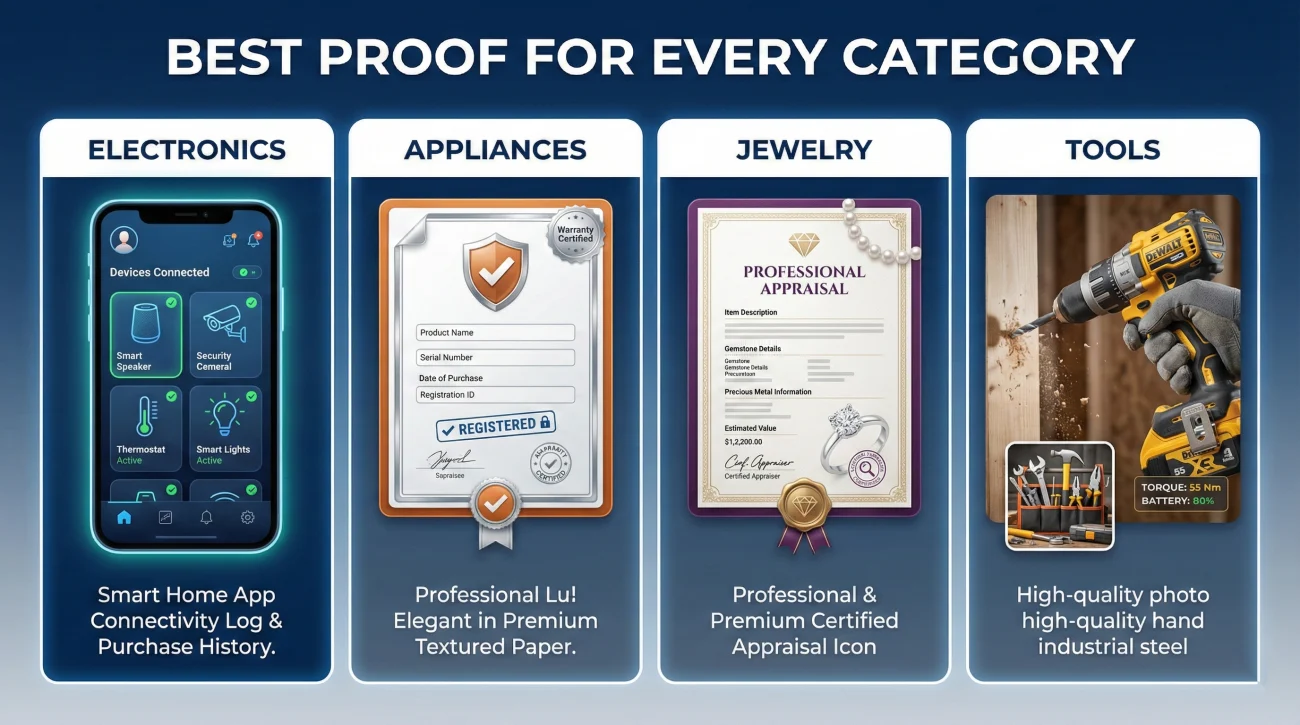
Different types of property leave different footprints. Here is a quick guide I share to help people locate the best alternative proof for common household categories.
| Item Category | Strongest Alternative Proof |
|---|---|
| Electronics & IT | Smart home app registration screenshots, digital software licenses, or photos of the serial number plate on the damaged unit. |
| Major Appliances | Manufacturer warranty registrations paired with past service, delivery, or maintenance invoices. |
| Jewelry & Valuables | Previous professional appraisals, high-resolution family photos showing the item worn, or past insurance riders. |
| Tools & Equipment | Credit card receipts paired with job invoices or photos of the tools actively being used on a project. |
The Proof Ladder: Ranking Your Evidence
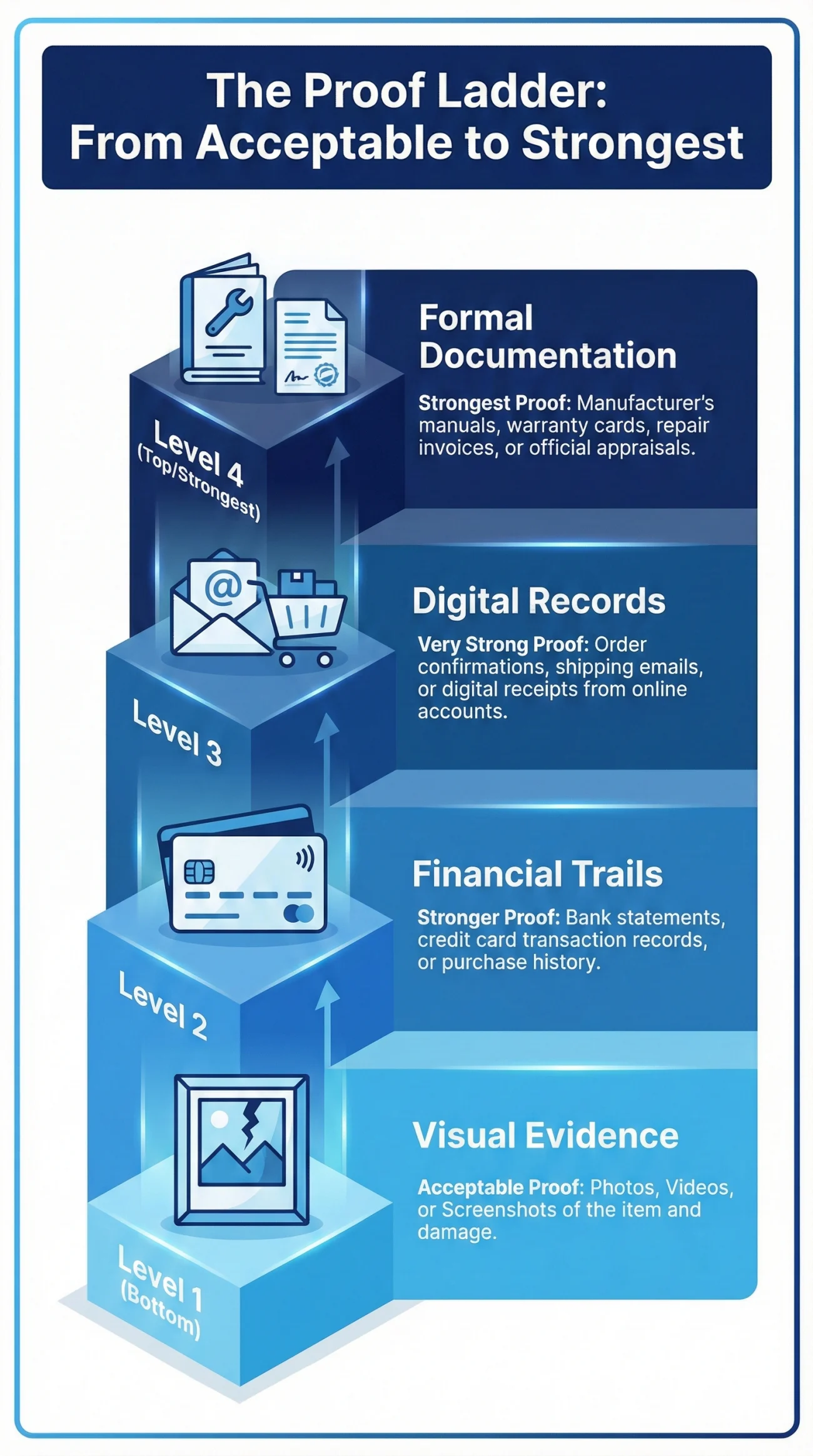
Not all alternative proof is created equal. To help you decide what to submit and avoid over-submitting unnecessary files, I recommend using this simple proof ladder, ranked from acceptable to strongest:
- Level 1: Background items in old family photos or video walkthroughs.
- Level 2: Credit card or bank statements with highlighted transactions.
- Level 3: Order confirmations, shipping invoices, or warranty registrations.
- Level 4: Formal repair invoices or dedicated photos showing the serial number and brand plate.
If you have Level 4 evidence, you rarely need to provide anything else. Always submit the highest level you can find.
Field Note: Rebuilding Proof for a High-Value Item
To show you how this works in practice, let me share a typical pattern I see when people successfully document high-value items without a single physical receipt. Let’s use a specialized mountain bike as an example.
The policyholder’s garage was severely damaged, and their $3,000 mountain bike was destroyed. The original receipt from the local bike shop was lost in the same event. Instead of panicking or simply writing “$3,000 Bike” on a blank sheet of paper, the homeowner systematically rebuilt the proof.
Here is what they submitted in their evidence packet:
- ✅ Item 1: A screenshot of a credit card statement from three years ago showing a $3,150 charge at “Downtown Cycle Shop.”
- ✅ Item 2: Two photographs from their smartphone showing them riding the exact bike, with metadata confirming the photos were taken a year before the loss.
- ✅ Item 3: A PDF download from their fitness tracking app (like Strava or Garmin) showing hundreds of miles logged on a “Trek Fuel EX 8” profile.
This is a great example of usage-data proof; other categories have similar footprints, like smart home network logs for electronics or service history for appliances. When an adjuster receives a package like this, there is virtually zero administrative friction. The financial trail is established, the visual evidence matches the claim, and the usage data confirms ongoing ownership. It completely eliminates the need for the original piece of paper.
The High-Value Items Protocol
If you are claiming an expensive item without a receipt, the administrative burden is naturally higher. Follow this strict protocol for every high-value item on your list:
- List the item clearly on its own dedicated line in your inventory.
- Record the exact brand and model number.
- Photograph the serial number or manufacturer tag if the damaged item is still onsite.
- Map your alternative proof file directly to the inventory item ID.
- Keep the physical damaged item securely onsite until the adjuster formally clears it.
Attach vs. Keep: How to Submit Alternative Proof
Having the alternative proof is only half the battle; how you present it to the insurance company determines how quickly your claim moves. If you dump fifty random photos and ten unedited bank statements into an email, the adjuster will likely send it back and ask for clarification.
You must actively organize the alternatives. For every item missing a receipt, you should decide whether the alternative proof needs to be proactively attached or simply kept in your records just in case.
Rule of Thumb:
- ✅ Always attach: High-value electronics, jewelry, specialized gear, and major appliances.
- 📂 Usually keep on standby: Everyday clothing, basic kitchenware, and low-value standard items.
When to Attach Proactively:
Link the proof directly to your inventory sheet. For example, if your television is Item #12 on your inventory, name your bank statement file Item12-BankStatement-Proof.pdf. This creates a clean, undeniable map for the reviewer.
When to Keep on Standby:
For standard, low-value everyday items (like clothing, basic kitchen utensils, or common books), you typically do not need to attach alternative proof proactively unless the adjuster specifically requests it. Keep your background photos and credit card statements in a backup folder. In many cases, a well-written inventory list is accepted for standard household goods without requiring a paper trail for every single pair of socks.
Communication Script for Alternative Proof
When you are sending in an inventory list that relies heavily on alternative documentation, use a cover email to set the right expectations. Here is a neutral, professional way to explain your documentation.
Subject: Personal Property Inventory & Evidence Files – Claim #[Your Claim Number]
Hello [Name or Claims Department],
Attached is the initial inventory list for the damaged contents in the living room.
Because some original paper receipts were lost in the event or discarded over time, I have provided alternative proof of ownership for the high-value items. You will find highlighted bank statements, order confirmations, and dated photographs clearly mapped to the corresponding item numbers on the inventory sheet.
Please let me know if you need any additional context for these specific files so we can keep the review process moving.
Thank you,
[Your Name]
This script is effective because it is confident and highly organized. It tells the reviewer exactly what they are looking at and frames alternative proof not as a failure to produce a receipt, but as a deliberate, organized solution.
The Privacy-Safe Submission Checklist
When you are stressed and rushing to prove your claim, it is dangerously easy to overshare. Always sanitize your alternative evidence before sending it to an adjuster to build trust safely.
- Redact account numbers: Black out full credit card and bank account numbers, leaving only the last four digits if needed for verification.
- Redact unrelated purchases: Use a digital marker to hide personal purchases on your bank statement that have nothing to do with the claim.
- Avoid sharing exact location data unless necessary: Strip GPS metadata from photos if it is not explicitly required to prove the item was at the insured address.
Common Mistakes When Dealing with Missing Receipts
When people realize their receipts are gone, anxiety often leads to poor administrative decisions. Avoiding these common errors will save you from triggering unnecessary delays or scrutiny.
Mistake 1: Guessing specific dates and prices.
If you do not have a receipt and cannot find a bank statement, do not invent an exact purchase date or an exact dollar amount. If you guess that you bought a couch for exactly $1,250 on May 14th, and the adjuster later finds the model only cost $800, it creates a credibility issue for your entire file. Instead, use practical ranges: “Purchased approximately Summer 2020, estimated replacement cost based on current similar models.”
Mistake 2: Sending unedited financial statements.
I mentioned this earlier, but it is worth repeating. Never send a full, unredacted bank statement. Black out your account numbers and any personal purchases that have nothing to do with the claim. You only want to provide the specific data point that proves your purchase. Supplying too much unrelated data confuses the file and creates privacy risks.
Mistake 3: Throwing away the damaged item too soon.
If you do not have a receipt, the physical damaged item itself is your absolute best proof of ownership. A common trap is throwing away a ruined, waterlogged mattress or a burnt laptop before the adjuster has inspected it or before you have taken extensive photos of the brand and serial number. Until the claim is settled, the damaged debris is your evidence.
Final Takeaway
Missing a receipt does not mean you have lost the right to claim an item you owned. In practical claims review, insurance claims are built on a reasonable, verifiable trail, meaning you just need to provide enough documentation to show the item existed.
By shifting your focus to digital purchase histories, credit card statements, background photographs, and smart app data, you can build a highly credible evidence packet. The key to success is not having perfect paperwork; it is taking the alternative proof you do have, organizing it clearly, and mapping it directly to your inventory list so the adjuster can verify it without guessing.
❓ FAQ
📝 Can I claim items on my home insurance without receipts?
Yes. Insurance companies process claims without original receipts routinely. You will need to provide alternative forms of proof, such as photographs, bank statements, or digital order histories, to establish that you owned the items.
📸 Does a photograph count as proof of ownership?
A photograph is often excellent proof of ownership, especially if it clearly shows the item inside your home. Background elements in old family photos or holiday videos are widely accepted as evidence in property claims.
💳 Can I use a credit card statement instead of a receipt?
Yes. A credit card or bank statement showing a transaction at a specific retailer is a strong alternative. Make sure to highlight the specific purchase and black out any unrelated personal information before submitting it.
📦 What if an item was a gift and I have no proof of purchase?
For gifted items, rely on visual evidence. Look for photos of the item in your home, keep the original packaging or user manuals if you still have them, or check if the item is registered to you via a manufacturer’s warranty.
📱 Can smart home data prove I owned electronics?
Absolutely. Screenshots from companion apps showing a smart TV, thermostat, or speaker registered to your account and connected to your home network are fantastic administrative proof that the item existed.
🗑️ Should I keep damaged items if I don’t have receipts?
Yes. If you are missing paperwork, the damaged item itself becomes your primary proof of ownership. Do not throw it away until the adjuster has inspected it or you have taken extensive photos of the model and serial numbers.
🏷️ Do I need to prove ownership for every single small item?
In most cases, adjusters do not require alternative proof for every basic household item like socks or utensils. However, you should proactively provide proof for high-value items like electronics, jewelry, and major furniture.
💻 Are Amazon order histories accepted as receipts?
Yes. A digital invoice or order confirmation from online retailers like Amazon, Walmart, or Wayfair is generally treated with the same weight as a physical store receipt because it lists the date, price, and item description.
🤔 What happens if I guess the price of an item wrong?
Guessing specific dates or exact prices can hurt your credibility if the adjuster finds conflicting data. If you are unsure, provide a practical range and estimate the replacement cost based on current, similar models.
📂 How should I organize my alternative proof for the adjuster?
Rename your digital files to match your inventory list. For example, if your sofa is item #4, name the corresponding bank statement file “Item4-Proof.pdf”. This removes guesswork and speeds up the review process.
⚠️ Disclaimer: PropertyClaimChecklist.com provides practical guidance, process checklists, and example follow-ups to help you organize a property claim and move it forward. It is not policy language, claim documentation, legal content, or a substitute for your insurer's instructions. Always rely on your carrier's requirements and your actual policy terms for what must be submitted and how decisions are made.