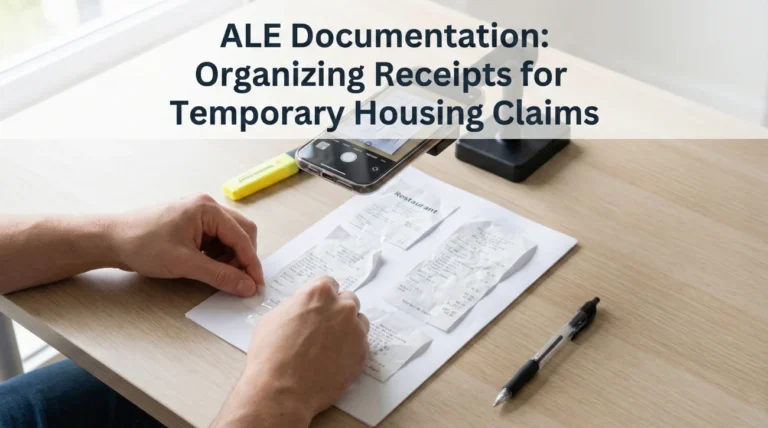
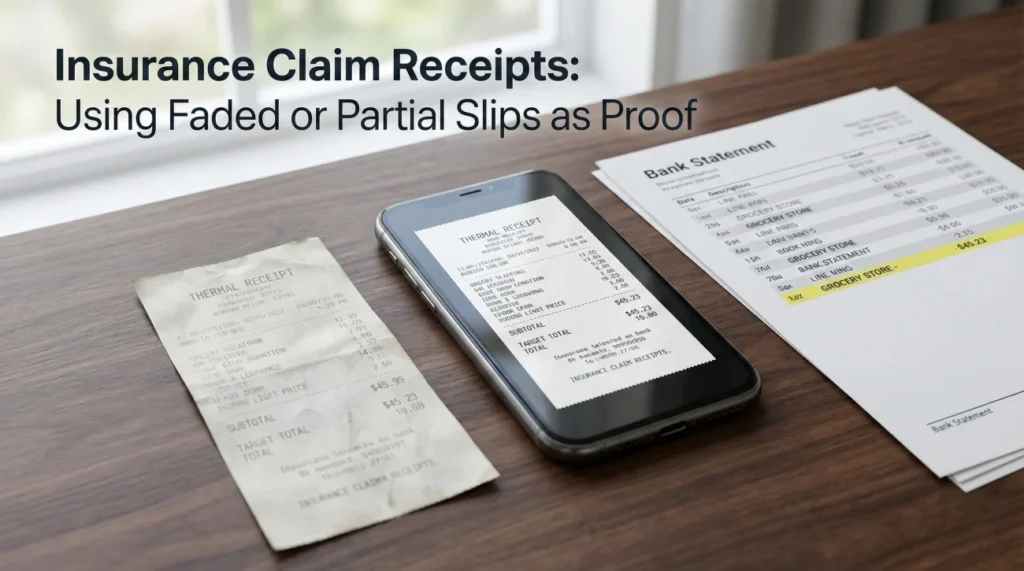
- Faded, ripped, or partial receipts can still be used as valid proof if you contextualize them correctly before submitting.
- It is best to avoid writing over the faded ink of an original receipt. Write your notes on a separate piece of paper and scan them together instead.
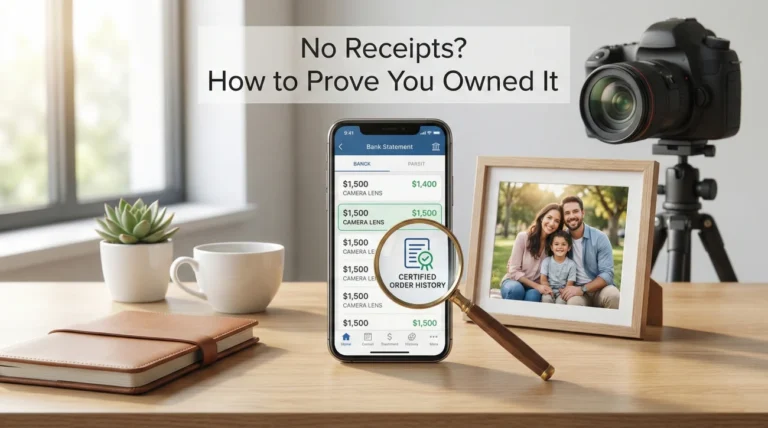
- A credit card statement alone is not a receipt, but it becomes powerful evidence when paired with a partially faded physical slip.
- Store your original paper receipts in a cool, dark place because thermal paper can turn completely black if exposed to high heat.
The Reality of Fragile Paper Evidence
When you suffer a property loss, you are expected to prove what you owned. In a perfect world, you would have a crisp and highly detailed receipt for every single item in your home. In reality, physical receipts are incredibly fragile. They are often printed on cheap thermal paper that fades in the sunlight, turns completely black in a hot car, or disintegrates the moment it touches water.
In my daily work within claims operations, I constantly see the panic that sets in when a homeowner realizes their most valuable proof has faded into a blank white slip of paper. I want to reassure you right now. A damaged or faded receipt is not automatically useless. Reviewers understand that paper degrades over time. The problem usually arises when a homeowner submits a blurry, half-torn piece of paper with zero context, expecting the reviewer to somehow guess what it proves.
I am going to walk you through exactly how to handle weak, faded, or partial receipts. We will look at what details actually matter to the person reviewing your file and how you can combine weak paper evidence with other records to build an undeniable case for your belongings. As you build your broader property claim evidence pack, mastering receipt quality will save you from endless back-and-forth arguments.
The Anatomy of a Strong Receipt
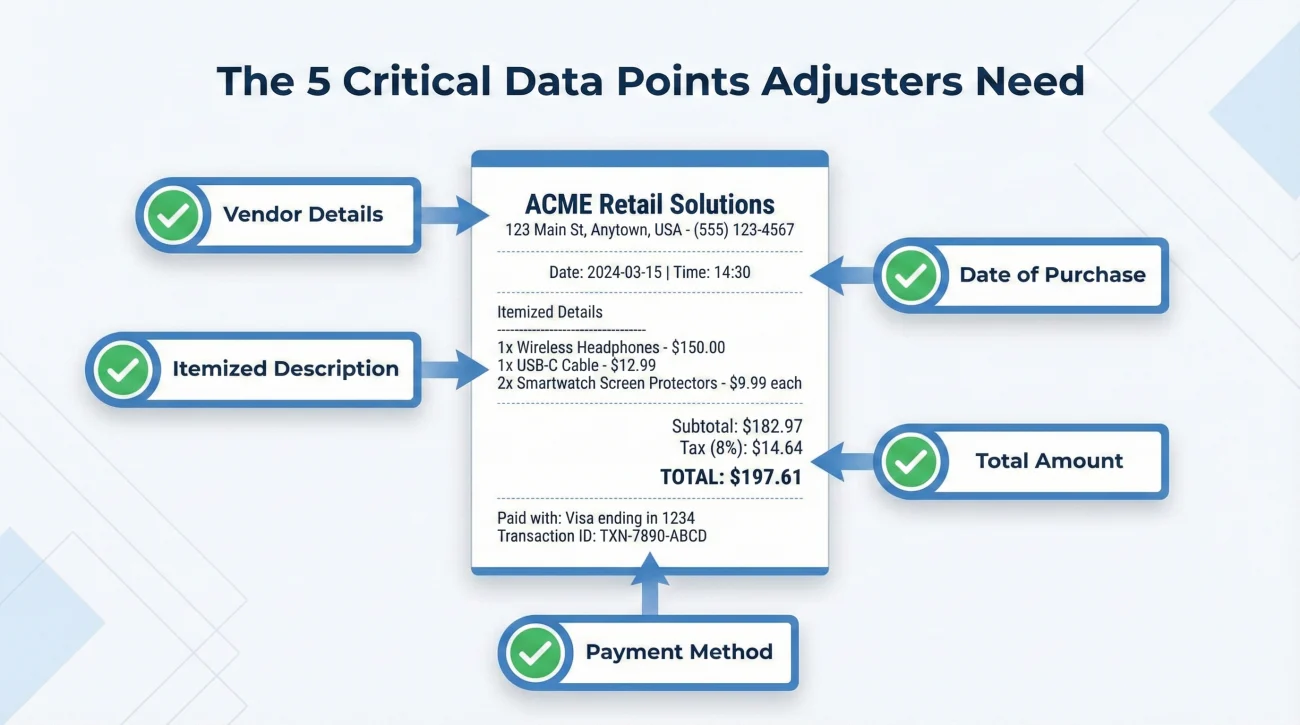
Before we can fix a bad receipt, we need to understand what makes a good one. When a desk adjuster looks at a piece of paper, they are not just looking for a dollar amount. They are looking to verify five specific data points. If a receipt has all five, it is considered strong. If it is missing a few, we classify it as weak or partial.
The Five Critical Data Points
- ✅ Vendor Details: The name of the store, the address, and the phone number.
- ✅ Date of Purchase: The exact day the transaction occurred to prove you owned it before the incident.
- ✅ Itemized Description: A clear line item showing the actual product (e.g., “Samsung 65-inch TV” instead of just “Electronics”).
- ✅ Total Amount Paid: The final cost including taxes.
- ✅ Payment Method: The last four digits of the credit card used or a cash indicator.
If your receipt clearly displays all five points, you simply scan it and log it. However, if your receipt has been sitting in a shoebox for four years, chances are the ink has degraded. This is where you need to step in and manage the narrative.
Key Point: You do not need a perfect receipt to get paid. You need a verifiable record. If the paper itself is weak, your job is to supplement it with supporting evidence so the reviewer has no room for doubt.
The Rescue Protocol for Faded and Partial Slips
When you discover a receipt that is barely legible, your first instinct might be to grab a pen and trace over the faded numbers. Do not do this. Altering the original document in any way can raise immediate questions and cause the reviewer to treat it as tampered evidence. The reviewer needs to see the original state of the document, no matter how poor it is.
Here is the exact step-by-step protocol I recommend when dealing with poor receipt quality.
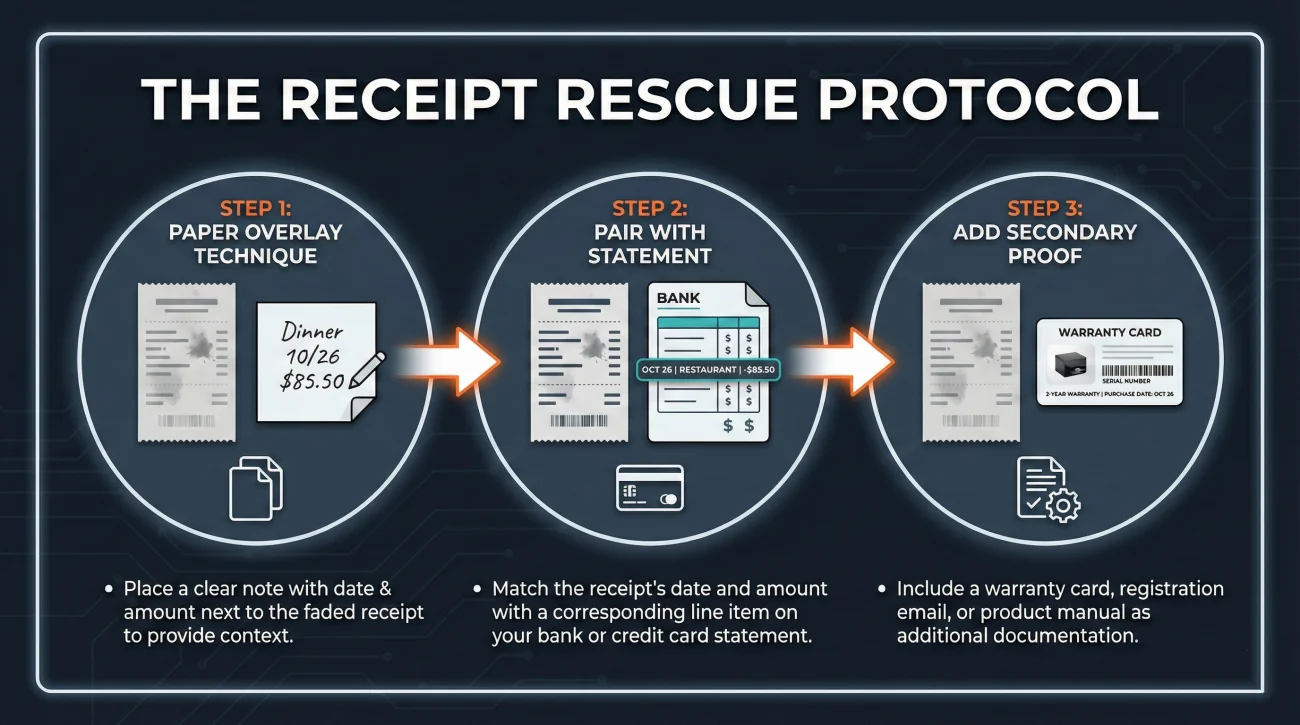
Step 1: The Paper Overlay Technique
Take your faded or torn receipt and place it flat on a clean table. Take a standard piece of lined paper or a sticky note and place it right next to the receipt. On this new piece of paper, neatly write out the missing context. State what the item was, the approximate date of purchase if you remember it, and the amount.
Take a clear, well-lit photograph of both items together in the same frame. By doing this, you are providing the context the reviewer needs without altering the physical evidence itself.
Step 2: Pairing with Bank Statements
A partial receipt often shows the date and the total amount but the itemized ink has faded away. This is incredibly common. To rescue this, log into your online banking and pull the statement from that exact date. Print the statement page, highlight the matching charge from the vendor, and scan it together with the faded physical receipt.
💡 Pro Tip: Before scanning your statement, use a digital highlighter or a black marker to redact your full account number and cross out any transactions that are entirely unrelated to the claim. This protects your privacy while still providing the exact proof the adjuster needs.
Step 3: Leveraging Secondary Proof
If the receipt is completely illegible, look for secondary artifacts. Did you save the owner’s manual? Is there a warranty registration card? Do you have an email confirmation of the delivery? Gather these secondary items and group them with the blank receipt. The presence of the blank thermal paper supports your timeline and suggests contemporaneous recordkeeping, while the secondary items provide the actual data.
The Weak Evidence Pairing Matrix
If you are unsure how to supplement a weak receipt, use this quick reference guide to find the best pairing document to build a complete proof loop.
| Receipt Issue | Best Pairing Action |
|---|---|
| Faded item description line | Pair with the product warranty card or owner’s manual |
| Missing vendor info (header ripped) | Pair with a bank statement and a store loyalty account record |
| Paper turned completely black | Request a store reprint and pair with an email order confirmation |
Real World Scenario: Handling Water Damaged Evidence
To see how this works in practice, let us look at a common situation involving water damage. Suppose a pipe bursts and floods a home office. Inside a filing cabinet was the receipt for a high-end laptop. The paper is soaked, dried out, and the ink has bled so badly that only the store logo and the final price are readable. The item description is a blue smudge.
If the homeowner simply uploads a photo of this blue smudge to the portal, the reviewer will reject it. They will send a message stating that the item cannot be verified. This delays the file by weeks.
Scanning the smeared, unreadable receipt alone and hoping the adjuster will just trust that it was for a laptop.
The homeowner takes a photo of the smeared receipt. They also take a photo of the laptop’s original box showing the barcode. They print out their credit card statement showing the matching charge. They combine all three images into one single PDF file.
By taking ten extra minutes to bundle the weak receipt with the box barcode and the bank statement, the homeowner removes all friction. The reviewer can check off the requirement and move the file forward immediately.
Simple Scan Settings for Weak Paper
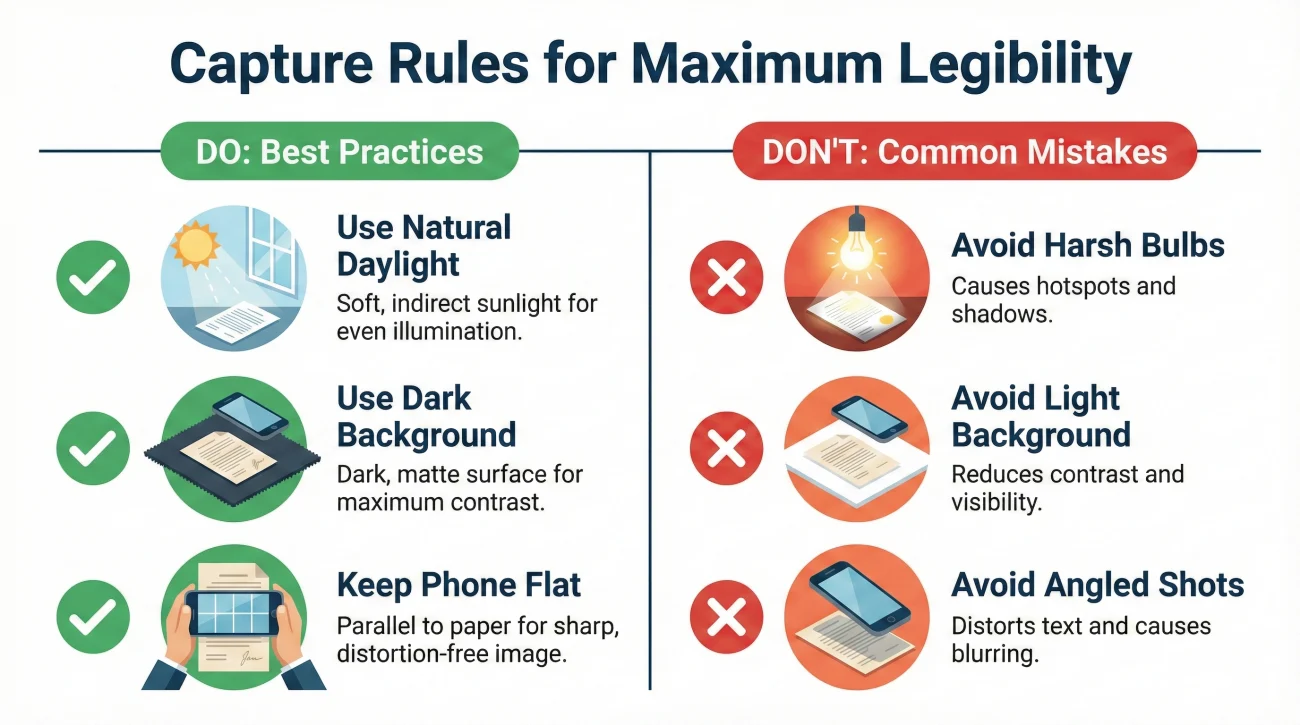
When digitizing weak evidence, a bad photo makes it completely useless. You do not need professional equipment, but you do need to follow these four basic capture rules to ensure your faded receipts remain as legible as possible:
- ✅ Shoot under natural daylight rather than harsh yellow indoor bulbs.
- ✅ Place the receipt on a solid, dark background to create high contrast.
- ✅ Turn your camera flash off to prevent a blinding white glare on the glossy thermal paper.
- ✅ Hold your phone completely flat and parallel to the table, not at an angle.
Labeling Rules for Weak Evidence
When you are submitting high quality receipts, the file naming does not have to be perfect because the document speaks for itself. But when you are dealing with partial or faded proof, your file names must do the heavy lifting. You have to tell the reviewer exactly what they are looking at before they even open the file.
The File Naming Formula
Do not use default names like “IMG_4921.jpg” or “Scan_Document_2.pdf”. Rename every file using a clear, descriptive convention without unnecessary spaces.
[ItemName]_[Vendor]_PartialReceipt_PlusStatement.pdf
For example, if you are submitting the documentation for a sofa where the receipt is torn in half, name the file: LivingRoomSofa_FurnitureMart_TornReceipt_WithDeliveryLog.pdf. This immediate transparency builds tremendous trust with the person auditing your file.
The Physical Storage Protocol for Originals
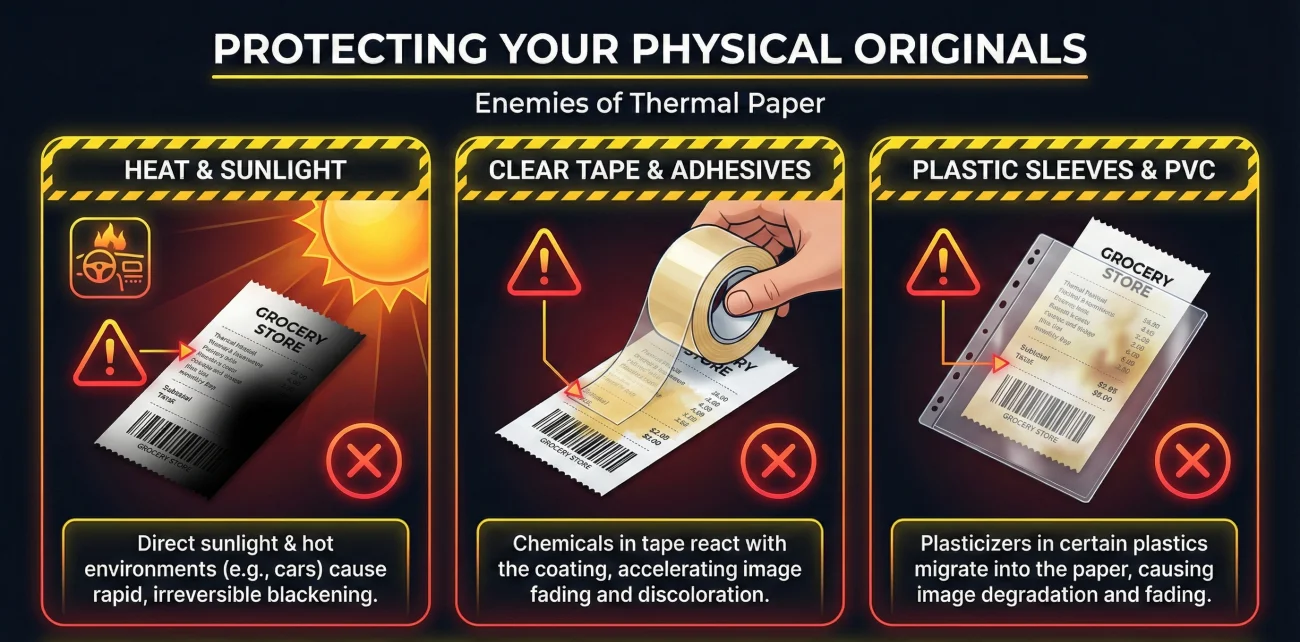
Even after you have photographed and digitized your receipts, you must protect the physical originals. I have seen cases where a digital file is corrupted or flagged in the system, and the adjuster requests to view the physical paper during a field visit.
The Enemies of Thermal Paper
Most retail receipts are printed on thermal paper. This paper does not use traditional ink. It uses chemicals that react to heat. Because of this, it is highly unstable. If you leave a thermal receipt on a sunny windowsill, the text will vanish. If you leave it in a hot car during the summer, the entire paper can turn completely black, obscuring everything.
Safe Storage Habits
- ✅ Store all physical receipts in a cool and dark environment immediately after scanning them.
- ✅ Use paper envelopes or acid-free folders rather than plastic sleeves. Cheap plastic can sometimes stick to the thermal chemicals and pull the text right off the paper.
- ✅ Never use clear tape over the printed text of a thermal receipt. The adhesive will cause the text to fade rapidly within a few weeks.
- ✅ Keep them flat. Avoid folding them heavily along the lines of text, as the friction can wear away the numbers.
⚠️ Warning: Do not use a high-heat laminator to protect your receipts. Running thermal paper through a hot laminating machine will turn the entire document solid black instantly, destroying your evidence forever.
Communication Scripts for Weak Documentation
When you know you are submitting poor quality receipts, it is always better to address the issue upfront rather than waiting for the reviewer to complain. Writing a short, professional note explaining the condition of the evidence shows that you are organized and operating in good faith.
Script: Submitting a Faded Receipt with Context
Use this script when you are attaching a digital file that contains a weak receipt paired with secondary proof.
Hello [Adjuster Name],
Please find attached the proof of purchase for the [Item Name].
You will notice that the original retail receipt has faded significantly over time. To ensure you have all the necessary verification data, I have scanned the faded physical receipt alongside the corresponding bank statement showing the exact date and purchase amount.
I have also included a photo of the owner’s manual that was kept with the receipt. Please let me know if this bundled documentation fulfills the verification requirement for this item.
Thank you,
[Your Name]
Script: Requesting a Reprint from a Retailer
If the receipt is completely gone and you cannot find a bank statement, your last resort is to contact the store. Many large retailers can pull up old transactions if you provide the exact credit card number used. Use this script when contacting customer service.
Hello Customer Service Team,
I am currently organizing documents for an insurance property claim and I urgently need a reprint of an old receipt from your store. The original thermal paper has faded completely.
The purchase was made around [Approximate Month and Year]. The total amount was [Amount] and it was paid using a Visa card ending in [Last 4 Digits].
Could you please search your system for this transaction and email me a digital copy or PDF invoice? Your assistance is greatly appreciated during this recovery process.
Thank you,
[Your Name]
[Your Phone Number]
Final Thoughts on Protecting Your Proof
Dealing with faded or damaged receipts can be frustrating, especially when you know you kept them safely in a drawer for years. Just remember that the paper itself is only one part of the equation. Your goal is to establish the facts of the purchase.
By learning how to layer your evidence, pairing weak slips with bank statements, using clear file names, and communicating proactively with your adjuster, you can turn questionable paperwork into solid proof. Audit your receipts early, digitize them immediately, and never alter the original ink. If you follow this protocol, you will prevent endless delays in your claim review process.
❓ FAQ
🧾 Can I use a credit card statement if my receipt is completely faded?
A credit card statement alone is rarely accepted as full proof because it does not show what items were purchased. However, if you pair the statement with the faded physical receipt and a photo of the damaged item, reviewers will often accept the combination.
☀️ What do I do if my thermal receipt turned completely black in the sun?
Once thermal paper turns black from heat exposure, the text cannot be recovered. You will need to rely entirely on secondary evidence. Request a digital reprint from the store, or provide your bank statement along with the product’s warranty registration card.
🔍 Will the insurance company accept a ripped or torn receipt?
Yes, ripped receipts are generally accepted as long as the critical data points are visible. Place all the torn pieces together on a dark background, take a high quality photograph, and submit that image along with a brief note explaining the damage.
📸 Is a digital photo of a receipt as good as the physical original?
For the standard submission process, a clear digital photo or PDF scan is perfectly acceptable and preferred by most reviewers. However, you must keep the physical original safely stored until the claim is completely closed just in case a field inspection requires it.
🏦 Do I need to show my bank statement if I have the original receipt?
If your original receipt is clear, legible, and shows the date, items, and total paid, you do not need to provide a bank statement. Bank statements are only needed to supplement the file when the primary receipt is too faded to read.
📱 Can the adjuster accept a screenshot from my retailer account purchase history?
Yes. A screenshot of your order history from an app or website (like Amazon or Target) is excellent proof. Ensure the screenshot captures the order date, the specific itemized product, the vendor name, and the total amount paid.
🏪 How can I get a reprint of an old receipt from a retail store?
Many large retailers track purchases via your customer loyalty phone number or the credit card used. Call their customer service line, provide the approximate date of purchase and the last four digits of your card, and ask them to email you a PDF invoice.
📦 Does a warranty registration card count if the receipt is unreadable?
A warranty card is excellent secondary evidence. While it does not prove the exact price you paid, it strongly proves ownership. Submit the warranty card alongside the unreadable receipt and a comparable current price estimate.
🗑️ Should I throw away the paper receipt after I scan it?
No. Keep all physical receipts in a designated claim envelope until your final settlement check clears. Digital files can sometimes be corrupted or flagged, so having the physical backup is a necessary safety net.
📧 Are email receipts from online purchases acceptable proof?
Yes, email order confirmations and digital invoices from online retailers are excellent proof. They are often better than paper receipts because they never fade and contain highly detailed item descriptions. Save them as PDF files for your submission packet.
⚠️ Disclaimer: PropertyClaimChecklist.com provides practical guidance, process checklists, and example follow-ups to help you organize a property claim and move it forward. It is not policy language, claim documentation, legal content, or a substitute for your insurer's instructions. Always rely on your carrier's requirements and your actual policy terms for what must be submitted and how decisions are made.