
- The Big Risk: Standard homeowners policies almost never cover “flood.” If you use the wrong word to describe your loss, you might accidentally trigger a denial.
- The Cost is Real: FEMA data shows the average NFIP claim payment has exceeded $66,000. This is not a minor repair issue; it is a financial disaster if coverage is denied.
- Top-Down vs. Bottom-Up: In claims ops, water usually covers “falling” water (pipes, rain through roof), while flood is “rising” water. Your evidence must prove the direction.
- Precision Matters: To get paid, your file must clearly distinguish the source of the water, not just show wet furniture.
Don’t Call It “Flood” If It Isn’t
In the chaos of a storm, water is water. It ruins your carpet, soaks your drywall, and destroys your memories just the same. But in the world of insurance contracts, “Water Damage” and “Flood” are two completely different legal concepts. Mixing them up is one of the most expensive mistakes a homeowner can make.
I have seen countless claims denied simply because a homeowner called into the hotline and said, “My basement flooded,” when what actually happened was a pipe burst or a sump pump failure. That one word, “flood”, triggers a specific exclusion in almost every standard policy.
To navigate this, you need to understand the definitions the way adjusters do, and you need to build your evidence to prove exactly how the water entered your home.
The $66,000 Reality Check
Why am I so emphatic about this distinction? Because the financial stakes are massive. Flood damage is catastrophic, and without specific flood insurance (like NFIP), you are on your own.
According to FEMA data, the average National Flood Insurance Program (NFIP) claim payment has exceeded $66,000 in recent reporting periods. That is not just a wet rug; that is the cost of rebuilding an entire floor of your home.
Furthermore, statistics from the Insurance Information Institute (III) reveal that 90% of all natural disasters in the U.S. involve flooding. Despite this, reporting from the Associated Press highlights a massive “coverage gap,” where millions of properties are exposed to flood risk but lack specific coverage. If you fall into this gap where you think you are covered but actually aren’t, the financial impact is devastating.
Field Note: The “Rising” vs. “Falling” Rule
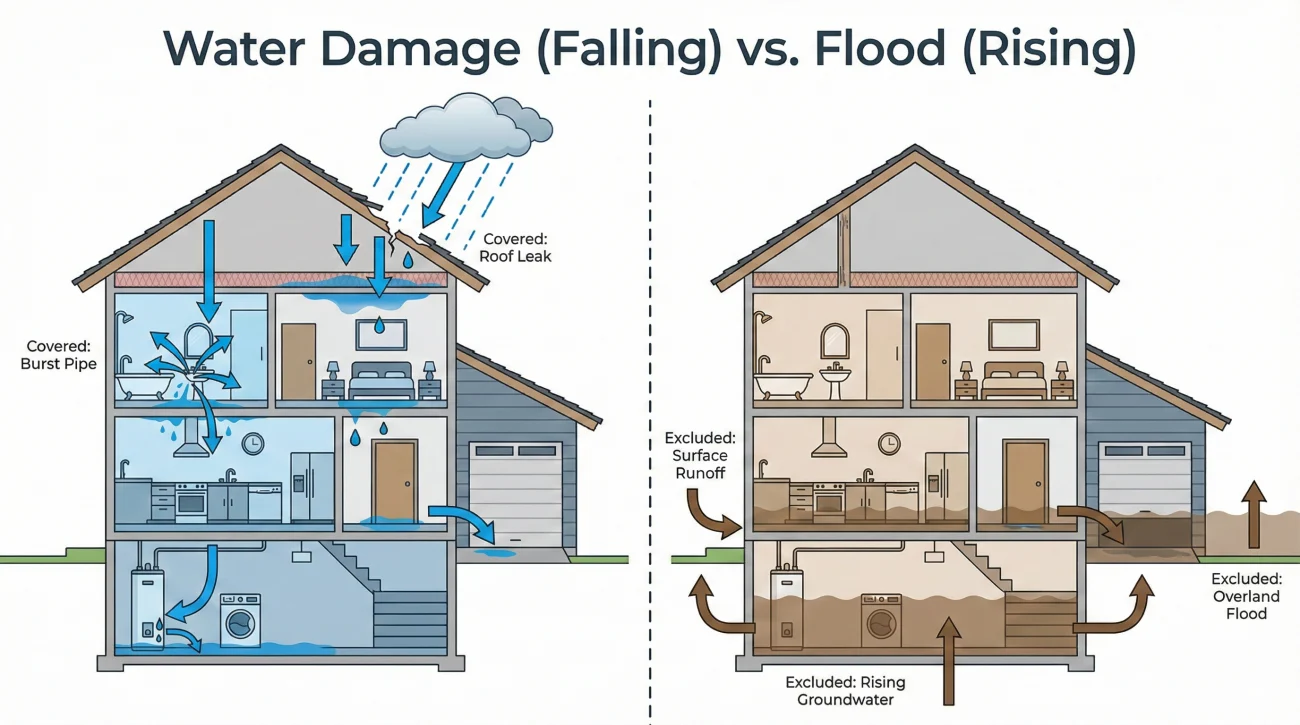
When an adjuster walks onto a wet property, they are immediately trying to solve a physics puzzle: Did the water fall down, or did it rise up?
This is the general rule of thumb we use in operations:
- ⬇️ Water Damage (Likely Covered): Water that escapes from a system (pipe, appliance) or enters from above due to wind opening a hole in the roof. It is “sudden and accidental.”
- ⬆️ Flood (Excluded on Standard Policy): Water that rises from the ground, overflows from a body of water, or is surface runoff that accumulates and enters under the door.
⚠️ Warning: Even if a storm caused the water, if that water hit the ground before entering your house, it is often classified as flood/surface water, which is excluded. This is where the fight happens.
Evidence That Proves the Source
Since the coverage depends on the source, your camera must focus on the entry point, not just the damage. A photo of a wet sofa proves nothing about coverage. A photo of a hole in the roof proves everything.
Use this checklist to gather “Source Evidence”:
If It Is Water Damage (Covered)
- The Source Photo: The burst pipe, the disconnected hose, or the missing shingles where rain entered.
- The Clean Water Line: Photos showing water dripping from the ceiling or running down walls (proving top-down entry).
- Plumber’s Report: A professional invoice stating “Repaired burst supply line.”
If It Is Flood (Requires Flood Policy)
- The Water Line: Mud lines on the exterior siding showing how high the water rose.
- Debris Lines: Debris piled up against doors or fences.
- Community Context: Photos of the street submerged (required for the “2 properties or 2 acres” definition of flood).
Mini Case: One Storm, Two Outcomes
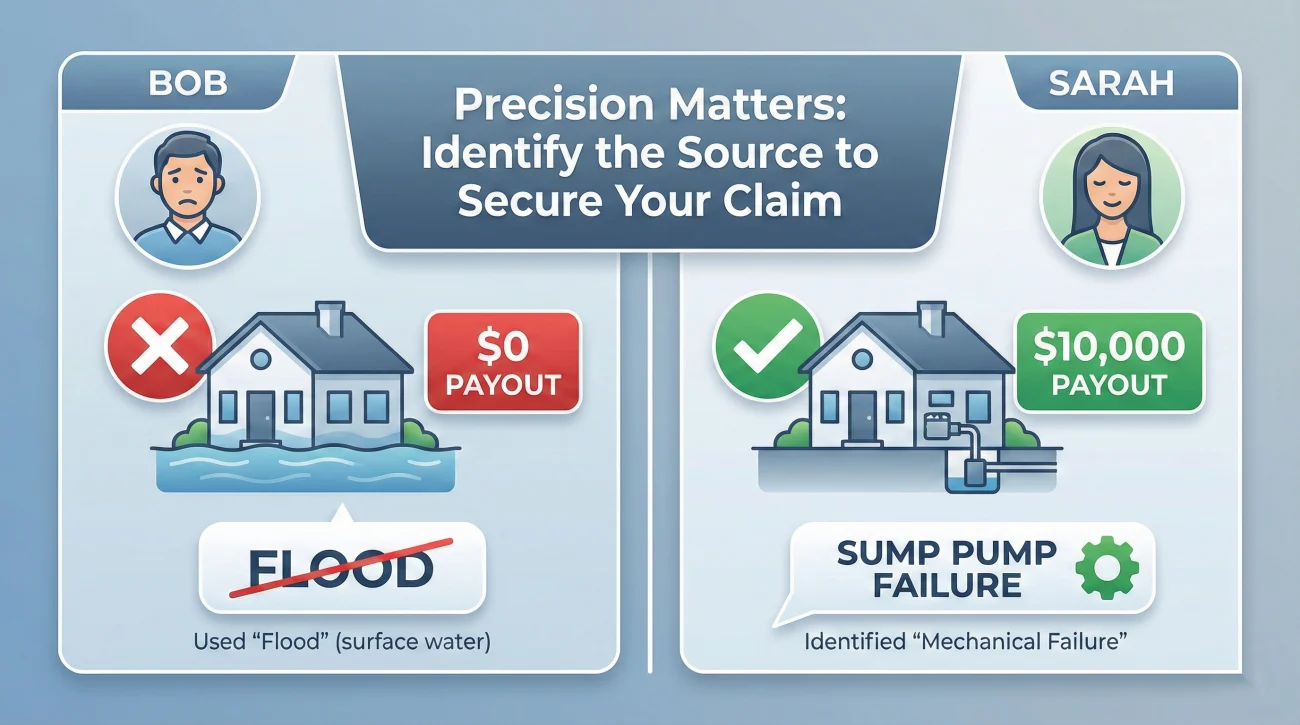
Consider two neighbors, Bob and Sarah, who both have water in their basements after a heavy storm. Neither has flood insurance.
Bob calls and says, “The heavy rain flooded my basement.” The adjuster finds water entered through the window well after pooling in the yard.
Verdict: Surface water / Flood.
Result: Denial. $0 paid.
Sarah finds water too, but she traces it. She finds her sump pump failed due to a mechanical jam. She reports, “My sump pump failed, causing backup.” She has a “Water Backup” endorsement on her policy.
Verdict: Covered peril.
Result: Paid limit (e.g., $10,000).
The lesson? Bob described a general event (“rain”). Sarah identified the specific failure mechanism (“pump failure”). Accuracy pays.
The “Peril Proof” Paper Trail
To avoid getting stuck in the argument of “is it flood or is it water,” prepare these documents immediately if you have a water event.
- ✅ The “First Discovery” Photo: Take a picture the second you see water. If it is spurting from a pipe, capture that action. It is undeniable proof of source.
- ✅ Weather Report: Save a screenshot of the local weather. Was it a storm? Wind? This helps support “wind-driven rain” claims.
- ✅ Contractor’s Causation Statement: Ask your repair pro to write one sentence on the invoice: “Water damage caused by [Specific Mechanical Failure] or [Specific Roof Damage].”
- ✅ Policy Declarations Page: Check immediately if you have endorsements like “Water Backup of Sewers or Drains.” This is often a lifesaver when standard coverage fails.
Final Thoughts
Water claims are technical. The distinction between “flood” and “water damage” is not just semantics; it is the difference between a check and a rejection letter. Understanding this does not mean lying about your claim. It means doing the investigation to find the true source of the water before you pick up the phone.
If the water came from a pipe, a roof leak, or a pump failure, make sure your evidence screams that story loud and clear. Do not let a sloppy description cost you your coverage.
❓ FAQ
🌊 What is the official definition of a flood?
The NFIP defines a flood as a general and temporary condition of partial or complete inundation of two or more acres of normally dry land, or of two or more properties (one of which is yours), from overflow of inland/tidal waters or rapid accumulation of surface runoff.
🚽 Is sewer backup covered by standard insurance?
Usually, no. Standard policies exclude water that backs up through sewers or drains. However, you can often buy a specific “Water Backup” endorsement for a small additional cost. Check your policy declarations page.
🌧️ Is rain entering through a window covered?
It depends. If the wind broke the window first and rain entered, it is often covered. If the window was left open or leaked due to old rotting seals (maintenance issue), it is likely denied. The “proximate cause” (wind vs. rot) matters.
🗣️ What should I say when reporting a water claim?
Be factual and specific about the source. Instead of saying “there is water everywhere,” say “a pipe burst in the kitchen” or “wind tore off shingles and rain came through the ceiling.” Identify the mechanism of entry.
Sources & Data Context
The statistics and definitions in this article are drawn from official federal programs and major news reporting to ensure you have the correct terminology:
- On the $66,000 claim average: We reference FEMA’s reported data on NFIP payments. See the FEMA/NFIP Claims Data.
- On the definition of flood and claims trends: We cite FloodSmart.gov Historical NFIP Claims Information.
- On the coverage gap: The Associated Press (AP) reports on the millions of properties at risk without coverage. Read the article: Millions of properties at risk of flooding are not covered.
- On flood statistics: The Insurance Information Institute (III) notes that 90% of natural disasters involve flooding. See their Facts + Statistics: Flood Insurance page.
⚠️ Disclaimer: PropertyClaimChecklist.com provides practical guidance, process checklists, and example follow-ups to help you organize a property claim and move it forward. It is not policy language, claim documentation, legal content, or a substitute for your insurer's instructions. Always rely on your carrier's requirements and your actual policy terms for what must be submitted and how decisions are made.