- The “Specifics” Rule: “Toaster” gets you $20. “Breville Die-Cast 2-Slice Smart Toaster” gets you $180. Specificity is the difference between a partial payment and a full replacement.
- Digital Forensics: You don’t need memory alone. Use your Amazon order history, old credit card statements, and even photos in the background of your phone to reconstruct your life.
- The “Invisible” Thousands: The most value is often hidden in the “boring” drawers: spices, vitamins, batteries, cables, and holiday decorations. Do not skip the small stuff.
- Grouping Saves Sanity: Do not list every fork. Use the “Cluster Method” for clothes, kitchenware, and books to finish the list weeks faster.
The $10,000 Guessing Game
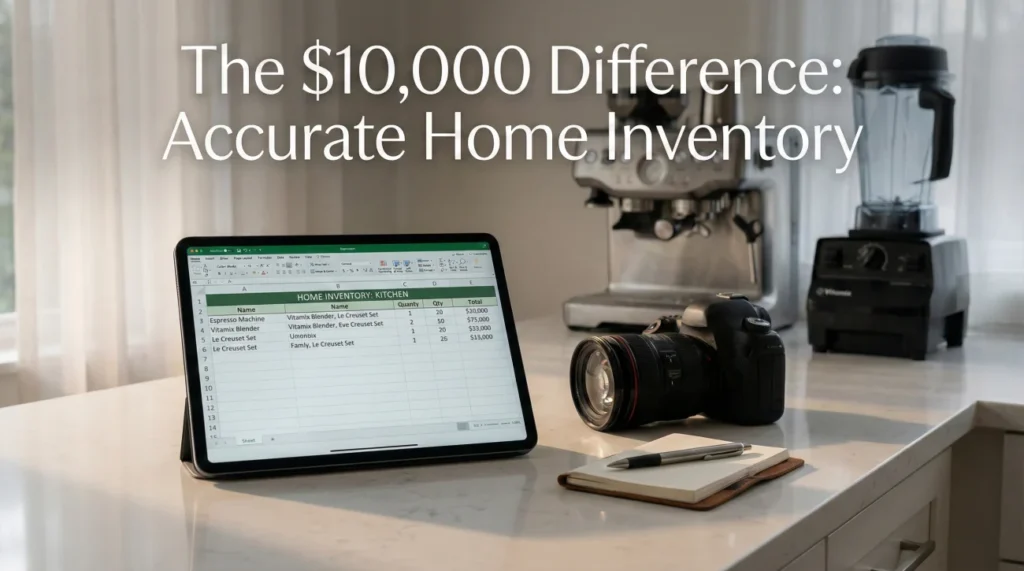
I want to start with a reality check. A few years ago, I helped a homeowner named Sarah who had lost her kitchen in a fire. She was exhausted. When it came time to submit her contents inventory, she just wanted it done. She wrote down “Coffee Maker” and “Blender” and “Pots and Pans Set.”
The insurance adjuster, using their pricing software, assigned standard “average grade” values to those generic descriptions. She got about $400 for those items.
Later, when we dug up her actual receipts and photos, we realized she didn’t own “average” gear. She owned a high-end Technivorm coffee brewer and a Vitamix blender. The real replacement cost was over $1,200. By being vague, she had voluntarily walked away from $800 in just three lines of text. Now multiply that error across an entire house.
Creating a home inventory for an insurance claim is not just paperwork. It is a valuation negotiation. If you do not tell the insurance company exactly what you lost, they are financially incentivized to guess low. This guide is written from my perspective in claims operations to help you extract the full value of your policy, room by room, without losing your mind in the process.
Why “Brand Name” is Your Most Powerful Asset
To understand how to write this list, you need to understand how the person on the other side reads it. Adjusters use pricing databases (like XactContents) that are essentially massive catalogs. When you type a description, they have to search for a matching item in that catalog to assign a price.
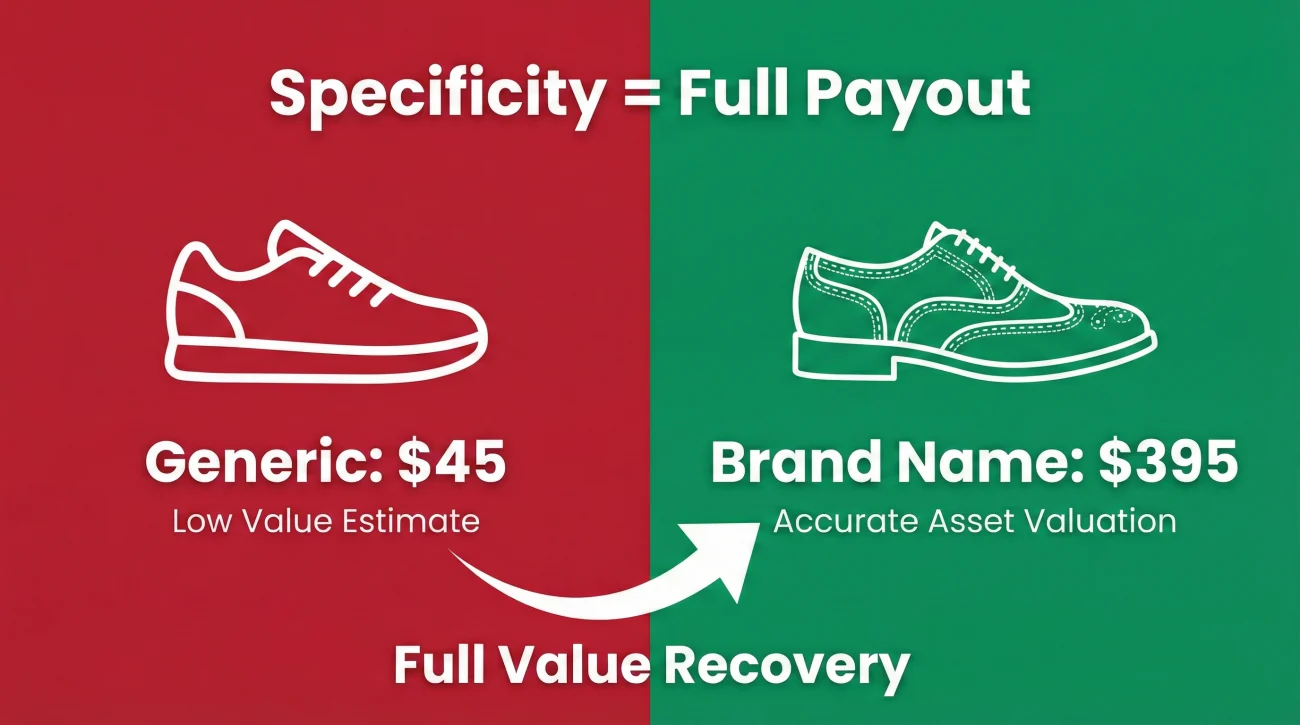
If you give them a generic description, they select the generic (base) model. If you give them a brand and model, they are forced to select that specific item (or its closest price equivalent).
Item: Men’s Dress Shoes
Adjuster Selects: “Shoes, Men’s, Synthetic/Leather Blend”
Payout: $45.00
Item: Allen Edmonds Park Avenue Oxford Shoes
Adjuster Selects: “Shoes, Men’s, High End, Calfskin”
Payout: $395.00
You do not need to do this for every pair of socks. But for anything that cost you more than $100 to buy, the Brand Name is mandatory. If you cannot remember the model, list the brand and a key feature (e.g., “Sony 55-inch TV” is better than “TV”, but “Sony 55-inch 4K OLED” is best).
Digital Forensics: How to Remember What You Forgot
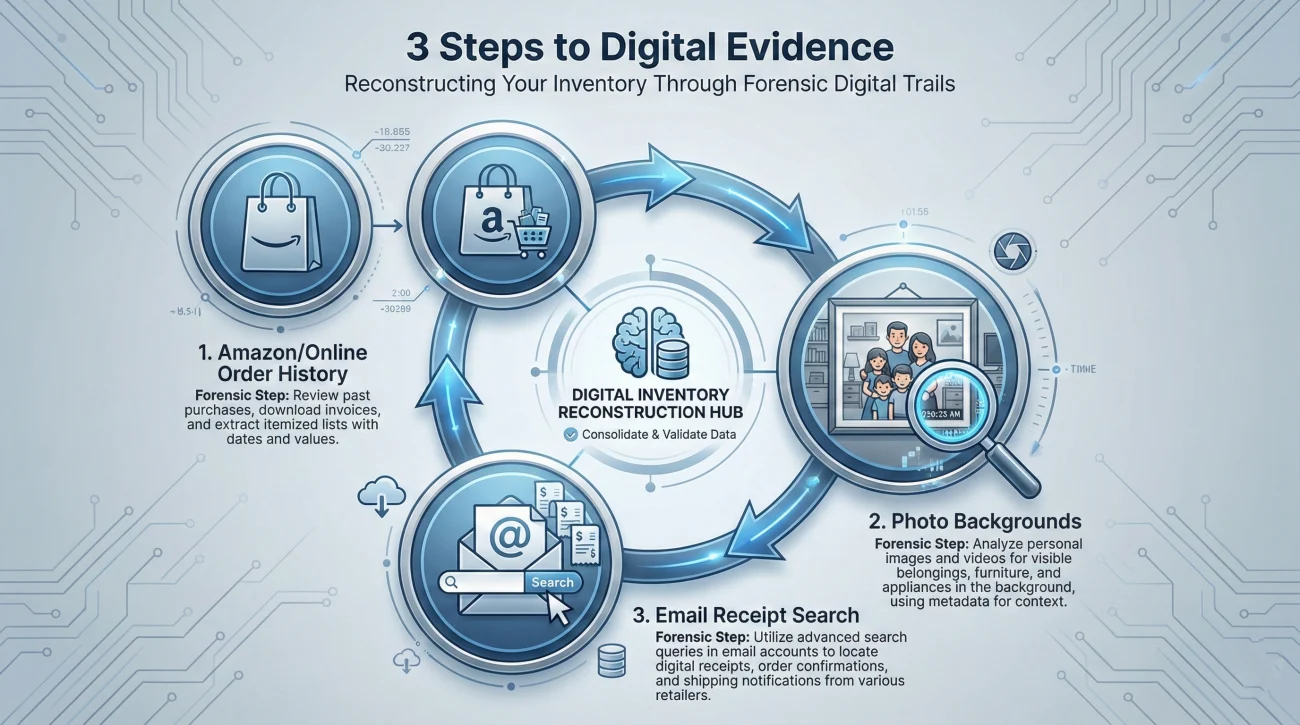
The biggest hurdle my clients face is “Post-Loss Amnesia.” You are standing in a burnt or flooded room, and your mind goes blank. You simply cannot recall what was in the drawers.
Do not rely on your brain. Use your digital footprint. Before you open your spreadsheet, spend one hour doing “Digital Forensics.”
1. The Amazon/Online Order History
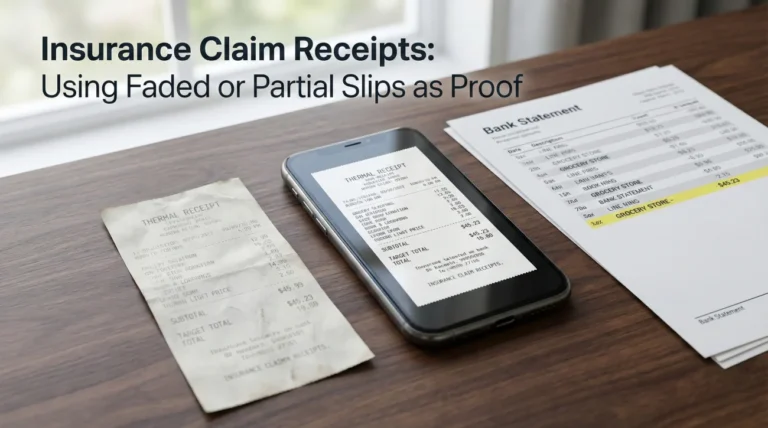
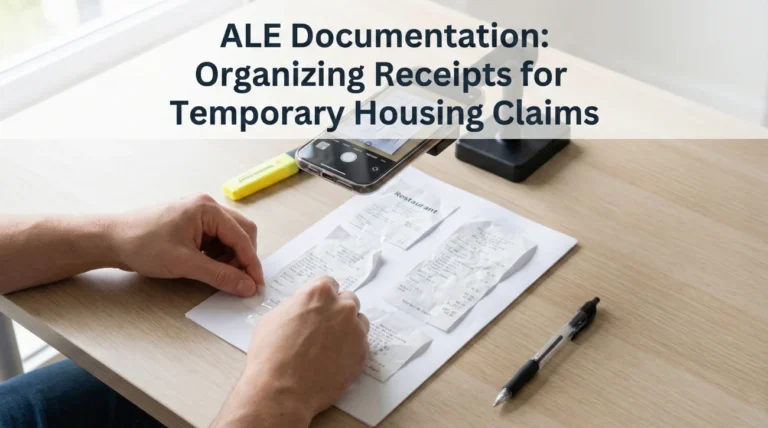
This is the gold standard. Go back 5 to 7 years in your Amazon, Wayfair, Target, or Best Buy order history. You will find exact brands, models, and purchase dates for things you completely forgot you bought. Download these reports if possible. They serve as both the inventory description and the proof of ownership.
2. The “Background Check” on Photos
Scroll through your phone’s camera roll for the last few years. Do not look for photos of the house. Look for photos of your kids opening Christmas presents, or your dog sleeping on the rug, or a dinner party. Look in the background. Is that a Dyson vacuum in the corner? Is there a specific blender on the counter? Zoom in. These background details are indisputable proof of ownership.
3. The Email Receipt Search
Search your email inbox for keywords like “Order Confirmed,” “Receipt,” “Shipped,” “Thank you for your purchase.” You will likely find receipts for electronics, furniture, and appliances that you ordered online years ago.
The Room-by-Room “Invisible Value” Tour
Most people remember the furniture. They forget the life clutter. And the life clutter is where the money is. Let’s walk through the house, and I will point out the specific “invisible” categories that often add up to thousands of dollars in missed claims.
The Kitchen: The Junk Drawer Economy
The kitchen is usually the most dense room in the house for value-per-square-foot. Do not just list the fridge and stove.
- The “Junk” Drawer: Open a drawer. Batteries, tape, glue, scissors, screwdrivers, charging cables, birthday candles, pens. In my experience, this drawer is often valued at $150 to $200 when fully inventoried. List it as a “Office/Utility Supply Bundle.”
- The Spice Rack: A single jar of good spices is $5 to $10. A collection of 30 jars can easily range from $150 to $300. Do not write “Spices.” Write “Gourmet Spice Collection, approx 40 jars.”
- Tupperware/Storage: High-quality storage containers (like Pyrex or Oxo) are expensive. A full cabinet of matching glass containers can cost $400 to replace.
- Cleaning Under-Sink: Specialized cleaners, dishwasher pods, sponges, trash bags. This is easily $100 of consumables.
The Bathroom: The Most Undervalued Room
I see men, in particular, underestimate bathrooms constantly. They see a toothbrush and soap. They miss the fortune in the cabinets.
- Cosmetics and Skincare: This is huge. A makeup bag with foundation, contour palettes, brushes, and specialized creams can be worth $500 to $1,000 in many cases. Be specific about brands (MAC, Sephora, Clinique).
- Hair Tools: A generic hair dryer is $20. A Dyson Supersonic is $400. Straighteners, curling irons, and trimmers add up fast.
- First Aid & Meds: Bandages, ointments, prescription copays, vitamins. Group these as “Medical/First Aid Supply.”
The Closet: The Volume Trap
You have more clothes than you think. Homeowners often estimate they have 10 pairs of pants. They usually have 25.
- Hangers: Yes, claim the hangers. If you have 500 wooden hangers, that is a substantial replacement cost.
- Accessories: Belts, scarves, ties, handbags, hats. These are often forgotten because they are tucked away on shelves.
- Shoes: Do not just count the ones by the door. Count the ones in the back of the closet, the boots for winter, the sandals for summer.
The Garage: The Black Hole of Value
The garage is where you store things you use once a year, which means they are the hardest to remember.
- Holiday Decorations: Artificial trees, wreaths, thousands of lights, ornaments. This is a massive category. List “Holiday Decor” by holiday (Christmas, Halloween, Easter).
- Camping/Sports Gear: Tents, sleeping bags, coolers, chairs.
- Specialized Fluids: Oil, antifreeze, car wash supplies, paints, stains. These are hazardous materials you have to pay to dispose of, and then pay to replace.
The Strategy of “Cluster Listing”
Now that you know what to list, how do you type it all without developing carpal tunnel syndrome? You use Cluster Listing.
Insurance carriers generally accept grouped items for low-value, high-volume categories. This is the only way to survive the process.
💡 The Rule of Thumb: If an individual item costs less than $50, try to group it. If it costs more than $100, list it individually.
How to write a Cluster Entry:
| Category | Bad Entry | Good Cluster Entry |
|---|---|---|
| Books | (Listing 200 individual titles) | Hardcover Novels, various authors, Qty: 50 Paperback Novels, various authors, Qty: 150 Coffee Table Art Books, large format, Qty: 10 |
| Clothes | (Listing 20 pairs of socks) | Men’s Athletic Socks, Nike/Under Armour, Qty: 20 pairs Women’s Business Casual Blouses, Ann Taylor/Loft, Qty: 15 |
| Office | (Listing every pen) | Desk Supply Bundle: Pens, Stapler, Tape, Paper, Notebooks, Qty: 1 Lot |
The Ideal Inventory Spreadsheet Structure
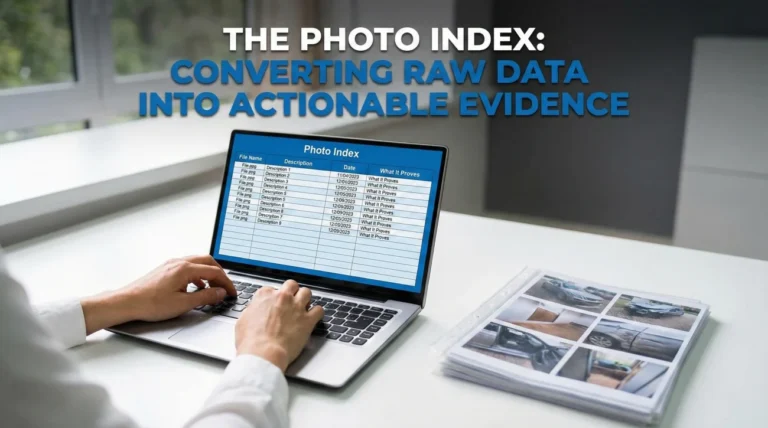
A good spreadsheet acts as a roadmap for the adjuster. It answers their questions before they ask them. I recommend setting up your columns exactly like this:
| Room | Item Description (Brand/Model) | Key Features | Qty | Age (Approx) | Condition | Proof Link | Notes |
|---|---|---|---|---|---|---|---|
| Kitchen | Vitamix 5200 Blender | Professional grade, high-speed | 1 | 3 yrs | Avg | IMG_2022_Xmas.jpg | Was on counter in background of photo |
| Living Rm | Area Rug (Wool) | 8×10, Hand-knotted, Persian style | 1 | 5 yrs | Good | Receipt_Wayfair.pdf | Purchased 2018 |
| Master Bed | Men’s Suits (Cluster) | Wool, various brands (Hugo Boss/SuitSupply) | 5 | Var | Avg | Closet_Overview.jpg | Counted from hangers |
| Garage | Dewalt Cordless Drill Set | 20V Max, with 2 batteries & case | 1 | 2 yrs | Good | Receipt_HomeDepot.pdf | Gift from wife |
| Office | Book Collection (Cluster) | Hardcover, Business/Finance titles | 40 | Var | Avg | Office_Shelf_01.jpg | – |
Insurance Claim Contents List Example (Kitchen & Bedroom)
To give you a better idea of the level of detail needed, here is what a submitted list looks like for two common rooms.
Kitchen Example List
- Major Appliances: Samsung French Door Fridge (Stainless), KitchenAid Artisan Stand Mixer (Red).
- Cookware: All-Clad Stainless Steel Set (10 piece), Le Creuset Dutch Oven (5.5 qt).
- Small Electrics: Keurig K-Elite Coffee Maker, Cuisinart 4-Slice Toaster.
- Consumables (Cluster): Baking Supply Bundle (Flour, Sugar, Spices, Oils), approx 40 items.
- Dining: Crate & Barrel White Dinnerware Set (Service for 8), Flatware Set (Stainless).
Master Bedroom Example List
- Furniture: King Size Upholstered Headboard (West Elm), 6-Drawer Dresser (Solid Wood), Nightstands (x2).
- Bedding: King Mattress (Tempur-Pedic), Sheet Sets (Egyptian Cotton, x3 sets), Down Comforter (Heavyweight).
- Electronics: 42-inch Samsung Smart TV, Apple TV 4K Box.
- Clothing (Cluster): Women’s Dresses (Work/Casual mix, approx 20), Men’s Button-Downs (Cotton, approx 15).
Replacement Cost vs. ACV: Why Age Matters
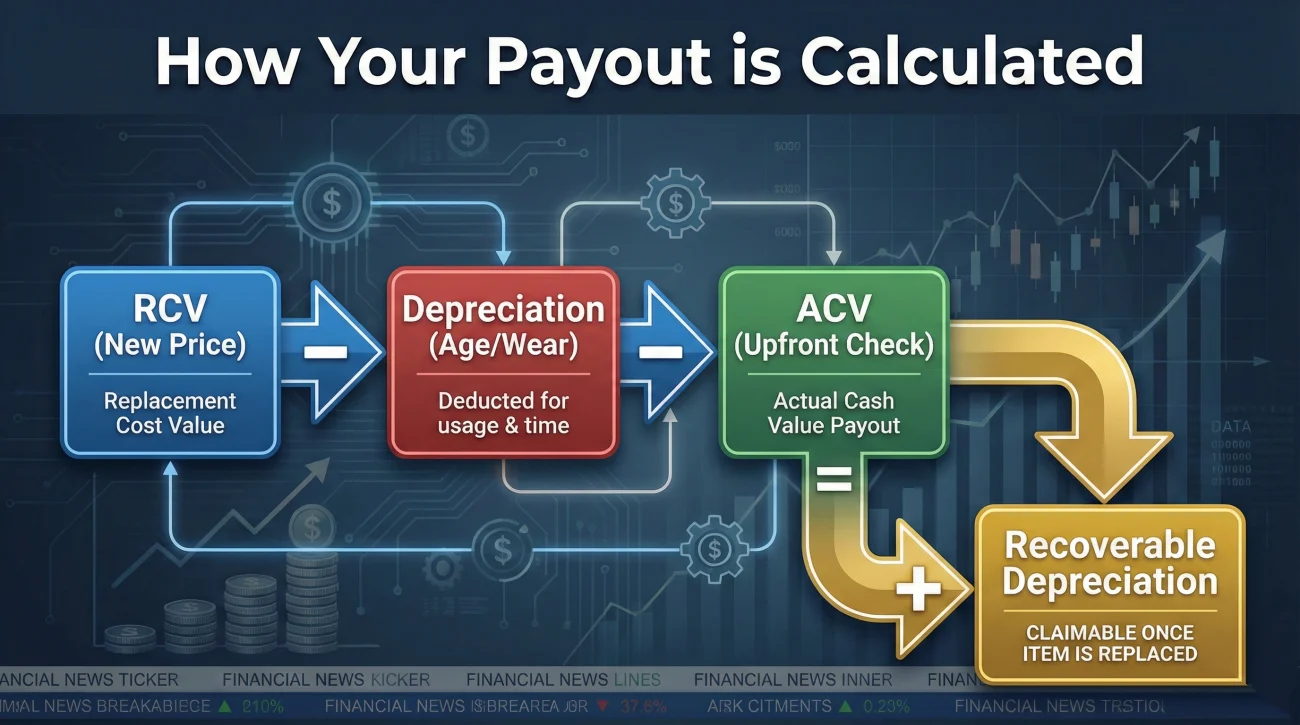
When you fill out the inventory, one of the columns will ask for “Age” or “Year Purchased.” This scares people. They think, “If I say it’s 5 years old, they won’t pay me anything.”
That is incorrect (assuming your policy includes Replacement Cost coverage – check your Declarations Page to be sure). Here is how the math actually works:
- Replacement Cost Value (RCV): What it costs to buy the item new today. (e.g., $1,000 for a new sofa).
- Depreciation: The value lost due to age. (e.g., The adjuster says a 5-year-old sofa loses 50% value = -$500).
- Actual Cash Value (ACV): What they pay you upfront. ($1,000 – $500 = $500 check).
The Critical Step: Once you actually buy the new sofa and send the receipt, they release the “Recoverable Depreciation” (the other $500).
So, be honest about the age. If you lie and say everything is “1 year old,” you destroy your credibility. If you say “5 years old,” they will depreciate it, but you get that money back later when you replace the item. Accuracy builds trust; lying builds audits.
Submission Strategy: The “Essentials First” Approach
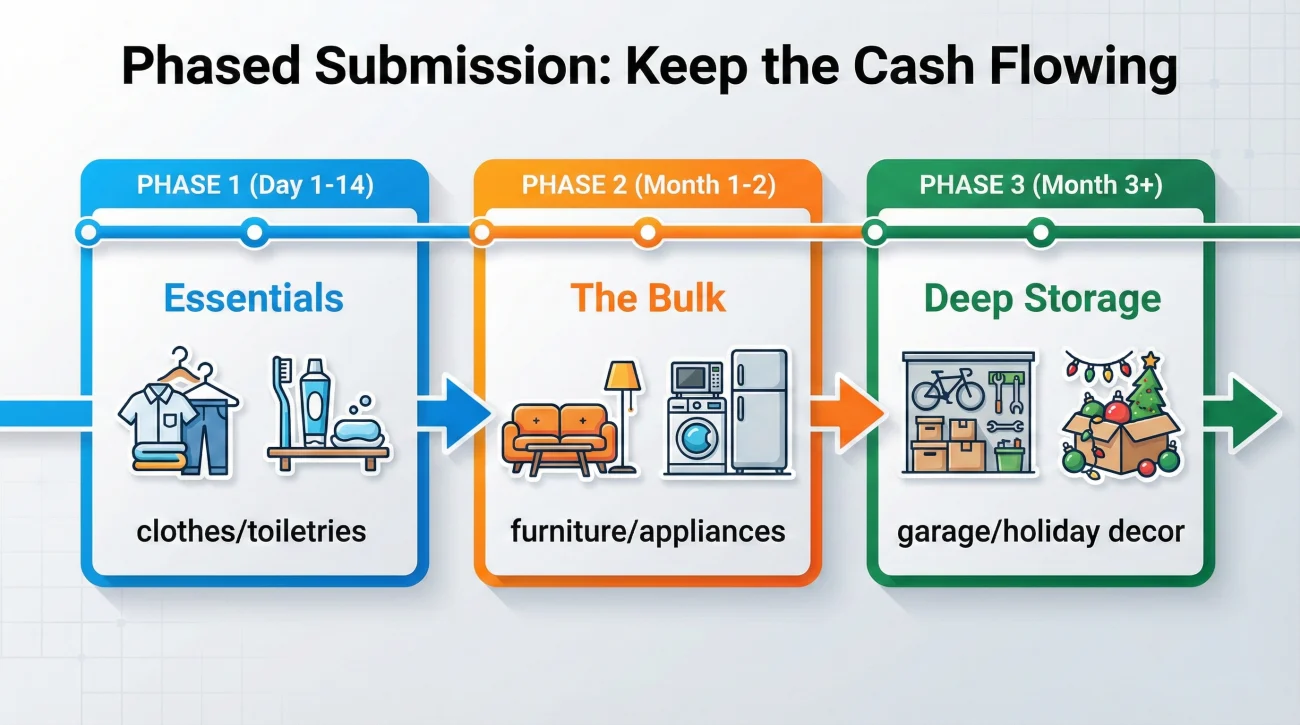
You do not need to submit the entire house at once. In fact, trying to do so often delays your first check by months. I recommend a “Phased Submission” strategy.
- ✅ Phase 1: The Essentials (Day 1-14). Focus on the items you need immediately: clothes, toiletries, kids’ school supplies, basic electronics. Submit this list quickly to get cash flowing.
- ✅ Phase 2: The Bulk (Month 1-2). Furniture, major appliances, main room contents.
- ✅ Phase 3: The Deep Storage (Month 3+). Garage, attic, holiday decor, hobby gear. Submit this as a “Supplemental Inventory.”
Proof Pack Mini-Guide
When you send your spreadsheet, you need a system for the evidence. Do not just attach 500 random photos to an email.
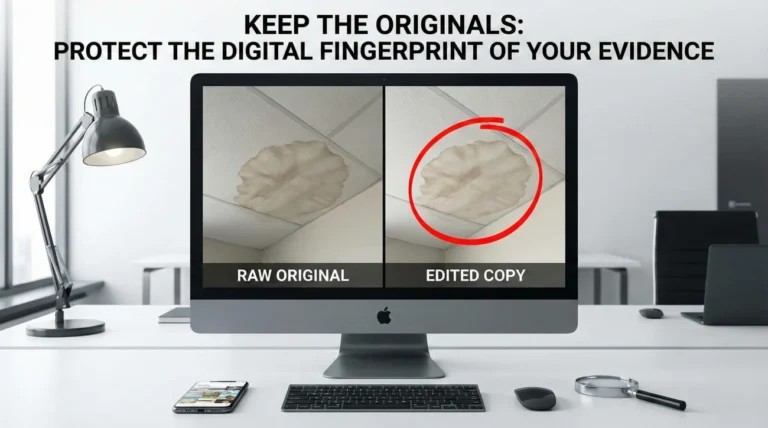
1. Naming Convention: Rename your proof files to match the spreadsheet.
Room_Item_Description.jpg (e.g., Kitchen_Blender_Vitamix.jpg).
2. Group by Room: Create folders on your computer for each room (Kitchen, Living Room, etc.) and sort the photos into them. This mirrors your spreadsheet structure. For a complete guide on organizing these folders, see our Property Claim Evidence Checklist.
3. The “Link” Column: In your spreadsheet, list the exact filename of the photo in the “Proof Link” column. This allows the adjuster to verify the item in seconds, not hours.
What NOT To Do: 7 Common Inventory Mistakes
Avoid these common traps to keep your claim moving smoothly:
- Being Vague: Writing “TV” instead of “Sony 55-inch 4K” costs you money.
- Ignoring Features: For furniture, mention “Solid Wood,” “Leather,” or “Marble Top.” Materials drive value.
- Emotional Descriptions: Adjusters can’t pay for “My favorite sweater.” They can pay for “Cashmere Cardigan.”
- Bundling High-Value Items: Don’t put a $2,000 laptop in a generic “Office Supplies” cluster. List it separately.
- Sending the List Without Proof: If you list 50 high-end items but have zero photos to back them up, you will trigger an audit.
- Guessing “New” for Everything: Listing every item as “1 year old” looks suspicious. Be realistic about age.
- Forgetting Consumables: Shampoos, spices, and detergents add up. Don’t leave them off the list.
Pacing Yourself: The 2-Hour Rule
Do not try to do this in one weekend. You will burn out, get angry, and then get sloppy. When you get sloppy, you start skipping items like the spice rack or the holiday decor. That sloppiness costs you real money.
I recommend the “2-Hour Rule.” Work on the inventory for two hours. Then stop. Do something else. Come back tomorrow. Treat it like a part-time job. If you spend 20 hours total on this list, and it increases your payout significantly – I have seen increases of $10,000 or more in large claims – you effectively earned a high hourly wage. Keep that perspective when the task feels tedious.
Final Words: It is Your Money
The insurance company is not going to come to your house and help you remember that you owned a high-end blender. They are not going to remind you about the $500 worth of shampoo in the bathroom. That is entirely on you.
The inventory is the single most important document for your financial recovery. It is tedious, yes. But it is also the mechanism that converts your premium payments into a settlement check. Take the time. Check the background of your photos. Open the junk drawer in your mind. The difference is worth thousands.
❓ FAQ: Real-World Inventory Questions
💸 I bought things on sale. Do I list the sale price or full price?
List the Replacement Cost. That means the replacement cost for an equivalent item today, not what you paid for it in 2018. If you got a great deal on a TV for $500 but it costs $1,000 to buy it now, your loss is calculated on the current replacement cost.
📦 What do I do with “mystery boxes” in the garage/attic?
If you cannot safely access them or they are destroyed, look for context clues (labels on boxes like “Xmas Decor” or “Old Tax Records”). List them as “Contents of 5 medium boxes, likely holiday decor/books” and assign a conservative estimated value. Note it as “Estimate – contents verified by box label.”
🖼️ How do I value artwork or sentimental items?
This is tricky. Sentimental value is not covered. Market value is. For original art, you need an appraisal or a record of what you paid. If it’s a generic print from Target, list the replacement cost of a framed print. For family photos, you may be able to claim the cost of scanning/restoration services – check your specific policy limits.
🛠️ I used the garage for a hobby business. Is that covered?
Be careful. Standard homeowner policies often have a “Business Personal Property” limit (often capped, for example at $2,500, though this varies). If you list $20,000 of woodworking tools and say “I use these for my business,” you might hit that cap. If they are hobby tools, make sure you clarify they are for personal use.
📄 Do I need to attach a receipt for every single line item?
No. That would crash their system. Typically, adjusters only ask for hard proof (receipts/photos) for high-value items (often over $500 or $1,000 depending on the carrier). For the small stuff (socks, forks), your list is usually accepted on the honor system unless it looks suspicious.
📱 Can I just use an app to scan barcodes?
You can, but often the barcodes on your 5-year-old items won’t scan, or the item is discontinued. I often find that “manual entry + grouping” is faster than trying to scan 500 individual barcodes. Use apps if you like tech, but don’t let the tech slow you down.
📅 What if I honestly don’t know the age of an item?
Use “Unknown” or “Average.” Do not guess “New” if it’s not, because that triggers skepticism. It is perfectly acceptable to list “Various ages, avg 5 years” for a group of books or clothes.
🥕 What about food in the fridge and freezer?
Claim it! A fully stocked freezer of meat and ready-meals is expensive. List “Contents of Refrigerator” and “Contents of Freezer” as two line items. Estimate the replacement cost (usually $200-$500 per unit depending on family size). Don’t list every ketchup bottle.
👗 My clothes are vintage/thrifted. How do I value them?
You are entitled to “Like Kind and Quality.” If you have a vintage wool coat, the replacement is a new wool coat of similar quality, not a thrift store price. Price the item based on what it costs to buy a new equivalent at a retail store today.
🤷♂️ What happens if I find more stuff later?
You can submit a “Supplemental Inventory.” You do not have to get it 100% right on day one. Submit the bulk of it to get the process moving, and tell the adjuster “I am still working on the garage/attic list.”
⚠️ Disclaimer: PropertyClaimChecklist.com provides practical guidance, process checklists, and example follow-ups to help you organize a property claim and move it forward. It is not policy language, claim documentation, legal content, or a substitute for your insurer's instructions. Always rely on your carrier's requirements and your actual policy terms for what must be submitted and how decisions are made.