- The Trap: Insurance estimates usually pay to replace “Like Kind and Quality” (what you had). But local laws often mandate better, safer, and more expensive materials (what you need).
- The Gap: If your estimate covers the old standard but the city inspector demands the new standard, you pay the difference out of pocket unless you trigger “Ordinance and Law” coverage.
- The Fix: Do not guess. Ask specific operational questions and provide the right level of proof to force the adjuster to address code compliance.
The “Like Kind and Quality” Trap
In claims operations, I see a specific frustration happen over and over. A homeowner gets their estimate, hires a contractor, and applies for a permit. The city inspector arrives and says, “You cannot put that old wiring back. Current code requires an upgraded panel.”
The contractor says it will cost an extra $2,000. The homeowner calls the adjuster, who says, “We only owe for what you had.”
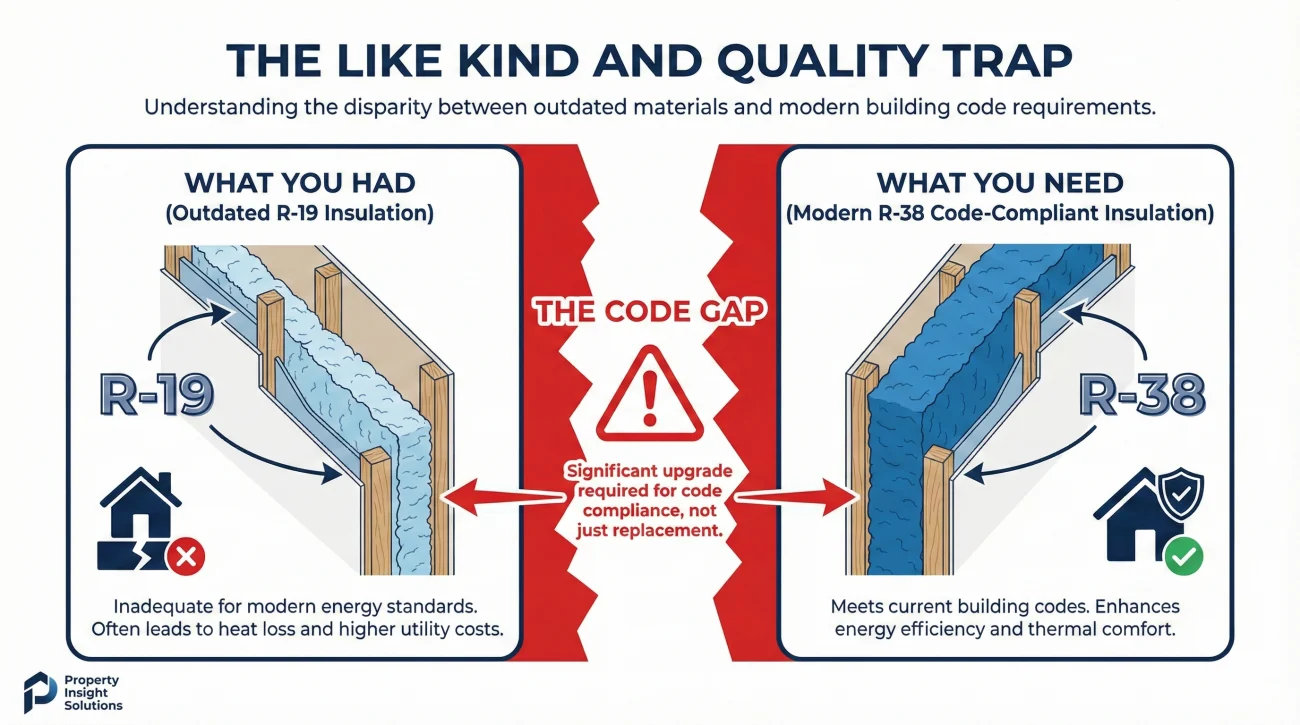
This is the “Code Gap.” Most standard policies cover the replacement of what existed. However, if your home is older than 10 or 15 years (depending on the area), building codes have likely changed. “Ordinance and Law” (or Code Upgrade) coverage exists to bridge this gap, but it is rarely automatic. You typically have to ask the right ordinance and law coverage questions to trigger it. If you don’t ask, the estimate stays at the old standard, and the upgrade cost falls on you.
How to Find This Coverage on Your Policy
Before you fight for it, verify you have it. Ordinance and Law coverage is not always included in the main dwelling limit. It is often a “sub-limit” or an endorsement.
Check your Declarations Page (the front page with all the numbers) for these keywords:
- 🔹 Ord Law or Ordinance or Law
- 🔹 Building Ordinance
- 🔹 Code Upgrade
Common Limits: You will often see a percentage like “10% of Cov A”, “25% of Cov A”, or sometimes a flat dollar amount like “$10,000”. This represents the maximum extra amount the insurer will pay for code-related upgrades. If your Coverage A is $300,000 and you have a 10% limit, you have $30,000 specifically for these mandated upgrades.
The “Grandfather” Myth vs. Operational Reality
Many homeowners assume their old house is “grandfathered in” and doesn’t need upgrades. In my experience, this is only true until you touch it. Once you open a wall, replace a roof, or touch the electrical panel to repair damage, you may lose that grandfather status depending on the scope of work. The city can force you to bring that specific area up to current code.
Your goal is not to argue the law yourself. Your goal is to get the adjuster to acknowledge that the repair cannot be performed legally without these extra costs.
Operational Field Note: The Insulation Surprise
I frequently see this with attic insulation after water damage. The old insulation was R-19 thickness (standard in 1990). The adjuster writes to replace R-19. But the local energy code now mandates R-38 or R-49. The price difference is substantial. If the policyholder doesn’t flag this mismatch, they end up paying for the extra bags of insulation themselves to pass the final inspection.
Where Code Gaps Hit Hardest
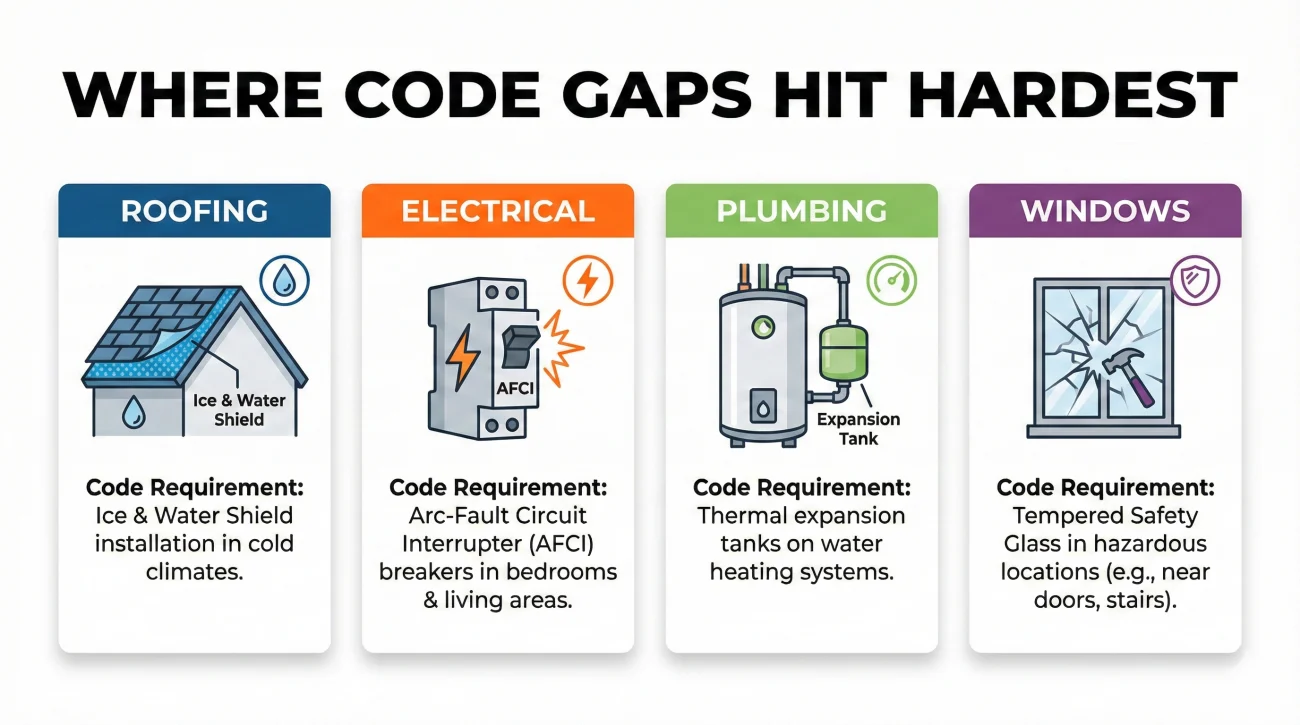
Code upgrades are not random; they hide in specific trades. Use this table to spot gaps in your estimate.
| Trade | Why It Is Missed | What to Look For | Best Proof |
|---|---|---|---|
| Roofing | Old roofs didn’t require extra barriers. | Ice & Water Shield, Drip Edge, Ventilation upgrades. | Roofer’s code citation or City Checklist. |
| Electrical | Safety standards increased drastically. | AFCI Breakers, GFI Outlets, Panel grounding. | Electrical Inspector fail note. |
| Plumbing | Water heaters now require safety catches. | Expansion tanks, Drip pans, Pressure valves. | Plumber’s permit requirement. |
| Windows | Safety glass required near doors/floors. | Tempered Glass (Safety Glazing). | Glazier’s measurement + Code section. |
| Smoke Detectors | New rules for interconnection. | Hardwired detectors vs. Battery-operated. | Fire Marshall requirement. |
The Operational Questions to Ask
You do not need to be a lawyer to ask these. You just need to be a diligent project manager. Use these questions to verify if your insurance estimate is too low due to code omissions.
1. The “Permit” Question
This is the soft opener. It forces them to look at compliance.
“Does this estimate account for all materials required to pass the current city inspection, or is it based strictly on the visual match of what was there?”
2. The “Incurred” Question
Many policies only pay for code upgrades after you actually pay for them (incur the cost). Clarify this upfront.
“I see we have Ordinance and Law coverage. Do you need me to pay for the upgrade first and submit receipts, or can we add the expected code costs to the estimate now so I have the funds to start?”
3. The “Trigger” Question
If you know a specific code is triggered, be direct.
“My contractor states that to pull the permit for the ceiling repair, the city requires R-38 insulation. Your estimate lists R-19. What documentation do you need from the city to approve the cost difference?”
What Counts as Proof? (The Hierarchy)
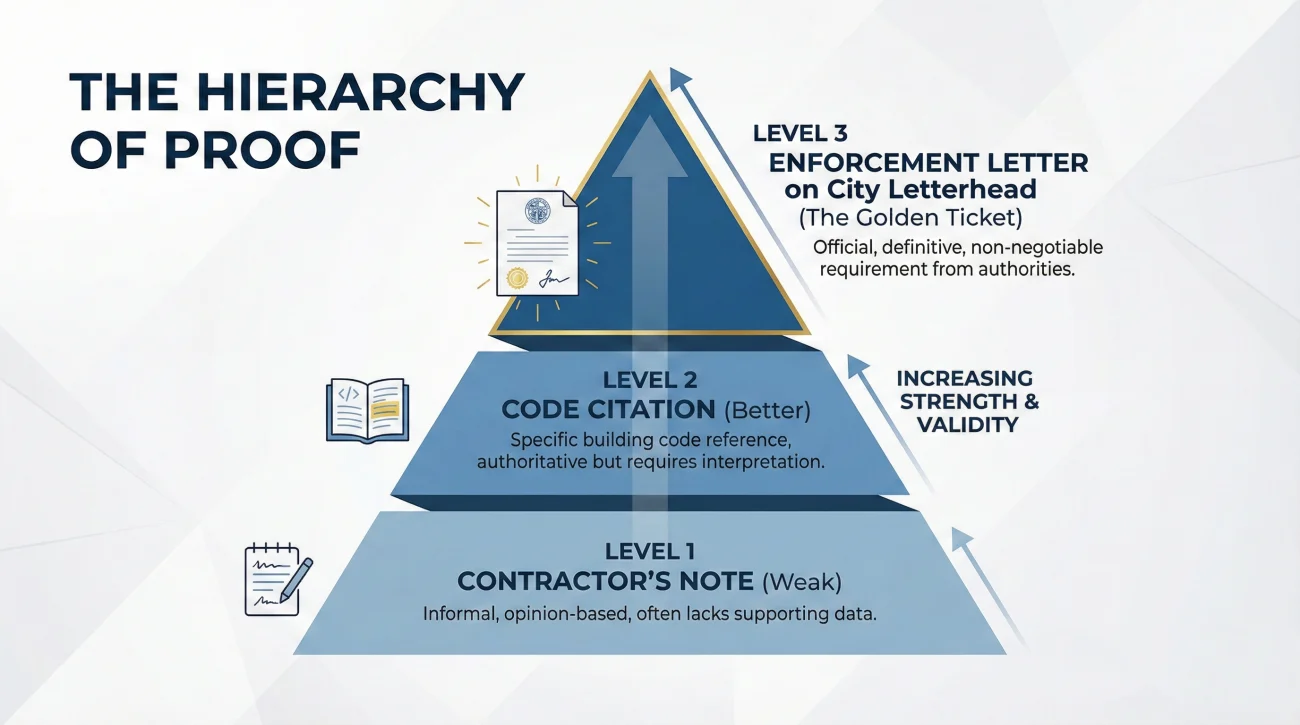
Not all “proof” is created equal. Adjusters need specific triggers to release funds. Understand the hierarchy of evidence to stop wasting time.
Level 1: The Contractor’s Note (Weakest)
“My contractor said we need to upgrade the panel.”
Adjuster Reaction: Skeptical. Contractors often want to upsell. The adjuster will likely say, “Show me the code.”
Level 2: The Code Citation (Better)
You send a PDF of the 2021 NEC Electrical Code, highlighting Section 210.12 regarding AFCI protection.
Adjuster Reaction: Listening. But they might argue, “Does your local city actually enforce this specific section?”
Level 3: The Enforcement Letter (Golden Ticket)
A letter on city letterhead signed by the Building Official: “Due to repairs at [Address], upgrading the electrical panel to current code is mandatory.”
Adjuster Reaction: Approved. They cannot argue with the authority that issues the permit.
Email Template: Requesting Code Coverage
Once you have your Level 2 or Level 3 proof, use this template to formally request the funds.
Hi [Adjuster Name],
My contractor has identified three specific areas where the current estimate conflicts with local building codes. We cannot pull a permit or pass final inspection without these upgrades:
1. Roofing: Ice and Water Shield required on eaves (Code Citation Attached).
2. Electrical: AFCI Breakers required for new circuits (Enforcement Letter Attached).
3. Insulation: Energy code requires R-38 (currently estimated at R-19).
I have attached the supporting documents from the Building Department.
Please review and advise if you can add these to the estimate now, or if I need to submit “incurred” receipts after the work is done to trigger the Ordinance and Law payment.
Thanks,
[Your Name]
Common Code Coverage Mistakes
I see policyholders lose money in this category simply because of the order of operations.
1. Doing the Work Before Approval
If you upgrade the electrical panel without telling the adjuster, they might deny the extra cost later, claiming “it wasn’t necessary.” Always get the “Enforcement Letter” and send it to the adjuster before the work starts if possible.
2. Assuming “Full Replacement Cost” Includes Code
Standard “Replacement Cost” often only covers the price to buy the same item new today. It does not automatically cover the price to buy a better item required by law. Ordinance and Law is usually a separate bucket. Check your policy specifically for this limit.
3. Ignoring the “Undamaged Portion” Rule
In some jurisdictions (like Florida or certain cities), if you damage more than 50% of a roof, you must replace the entire roof to meet code. This is a massive cost swing. Ask specifically: “If the code requires me to replace the undamaged portion to achieve compliance, how does the policy handle that?”
Final
Code upgrades are not “improvements” you are choosing to make; they are legal requirements you are forced to make. When you frame it this way – using questions about permits, inspections, and enforcement letters – you move the conversation from “I want this” to “The law requires this.” That is the language that gets estimates updated.
❓ FAQ
📜 What is an Ordinance and Law endorsement?
It is extra coverage that pays for increased repair costs due to building code enforcement. Standard policies typically only pay to put back what you had. This endorsement bridges the gap when the law says you must put back something better.
🚧 Does insurance pay for permit fees?
Yes, permit fees are a required cost of construction. If your estimate does not list “Permits” as a line item, ask the adjuster to add it or to reimburse you once you submit the permit receipt.
📄 What proof does the adjuster need for code upgrades?
They usually need a written citation or letter from a local Code Enforcement Officer stating that the specific upgrade is mandatory for your specific project. A contractor’s word is often not enough.
💰 Is there a limit on code upgrade coverage?
Yes. Common ranges are 10%, 25%, or 50% of your Coverage A (Dwelling) limit. Check your specific policy declarations. If the upgrades cost more than this limit, you typically pay the difference.
⚡ Do I have to upgrade my whole house?
Usually, no. You typically only have to upgrade the area being repaired. However, some codes say if you touch more than 50% of a system (like wiring), you must upgrade the whole system. This varies by city.
🧱 Does Ordinance and Law apply to “Matching” requirements?
Generally, no. “Matching” (making the new siding look like the old siding) is an aesthetic issue. Ordinance and Law is a safety/legal issue. However, if a code requires replacing the whole slope for mechanical reasons, that falls under O&L.
💸 What if the city requires upgrades but my O&L limit is too small?
If the mandatory upgrades cost $20,000 but your O&L limit is only $10,000, you are responsible for the remaining $10,000. This is why checking your limits annually before a loss occurs is critical.
🥶 What is the most common missed code item?
In my experience, insulation thickness and “Ice and Water Shield” on roofs are missed most often. Adjusters often write for what is visible (the old stuff) rather than what is legally required today.
🙅 Can the adjuster refuse to pay for code upgrades?
If you do not have Ordinance and Law coverage, yes. Or, if the upgrade is not actually mandatory (just “recommended”), they can refuse. This is why the Enforcement Letter is critical.
🔄 When do I get paid for code upgrades?
Often, these funds are paid on an “incurred” basis, meaning they release the money only after you prove the work is done and paid for. Ask your adjuster specifically about their release triggers.
⚠️ Disclaimer: PropertyClaimChecklist.com provides practical guidance, process checklists, and example follow-ups to help you organize a property claim and move it forward. It is not policy language, claim documentation, legal content, or a substitute for your insurer's instructions. Always rely on your carrier's requirements and your actual policy terms for what must be submitted and how decisions are made.