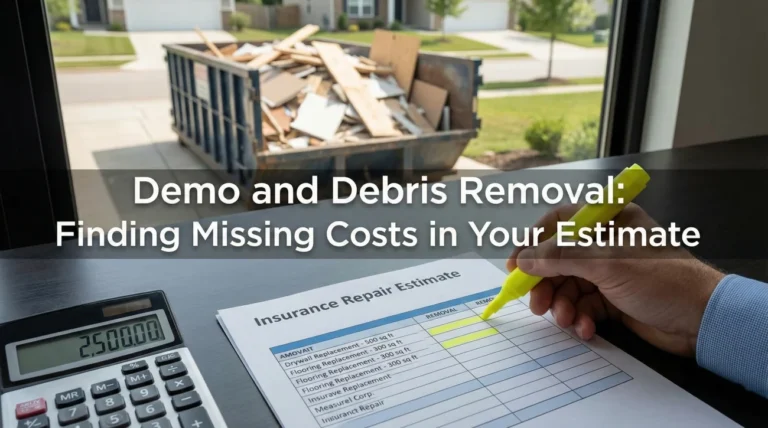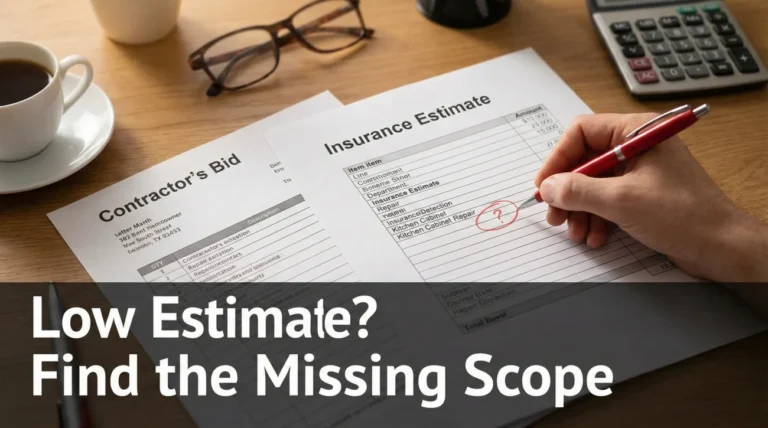
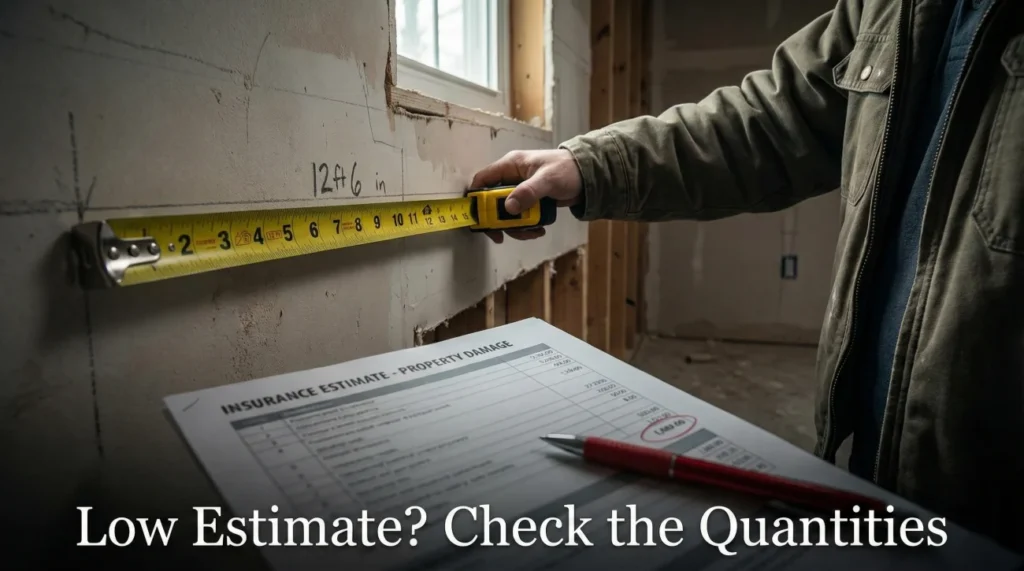
- The Core Strategy: Correcting “quantity errors” (missing square footage, missed waste factor) is often the fastest way to increase a low estimate because it relies on objective measurements.
- What to Look For: The most frequent errors are “Net vs. Gross” calculations (forgetting material waste), “phantom rooms” (missing closets), and ignored “labor minimums.”
- Action Step: Audit the measurements with a tape measure and use our “Correction Log” to submit a factual fix before debating unit prices.
Why “Quantity” is Your Best Leverage
When an insurance estimate comes in low, most people immediately look at the unit prices. They see that the insurer is paying too little per foot for painting or flooring, and they start an argument about market rates. This is an uphill battle because insurers stick rigidly to their price lists.
However, there is a back door to increasing the estimate that is much easier to open: Quantity Errors.
In my experience, adjusters often approve a “quantity correction” fairly quickly, whereas they might fight a “price increase” for weeks. Why? Because math is objective. If your room is 12 feet wide and they wrote 10 feet, there is usually no good reason for the mismatch once you show a tape measure photo. You just show the evidence, and it is often harder for them to dispute. Before you fight about the price of the paint, make sure they are paying you for the entire wall.
The “Net vs. Gross” Trap (And Why You Run Out of Material)
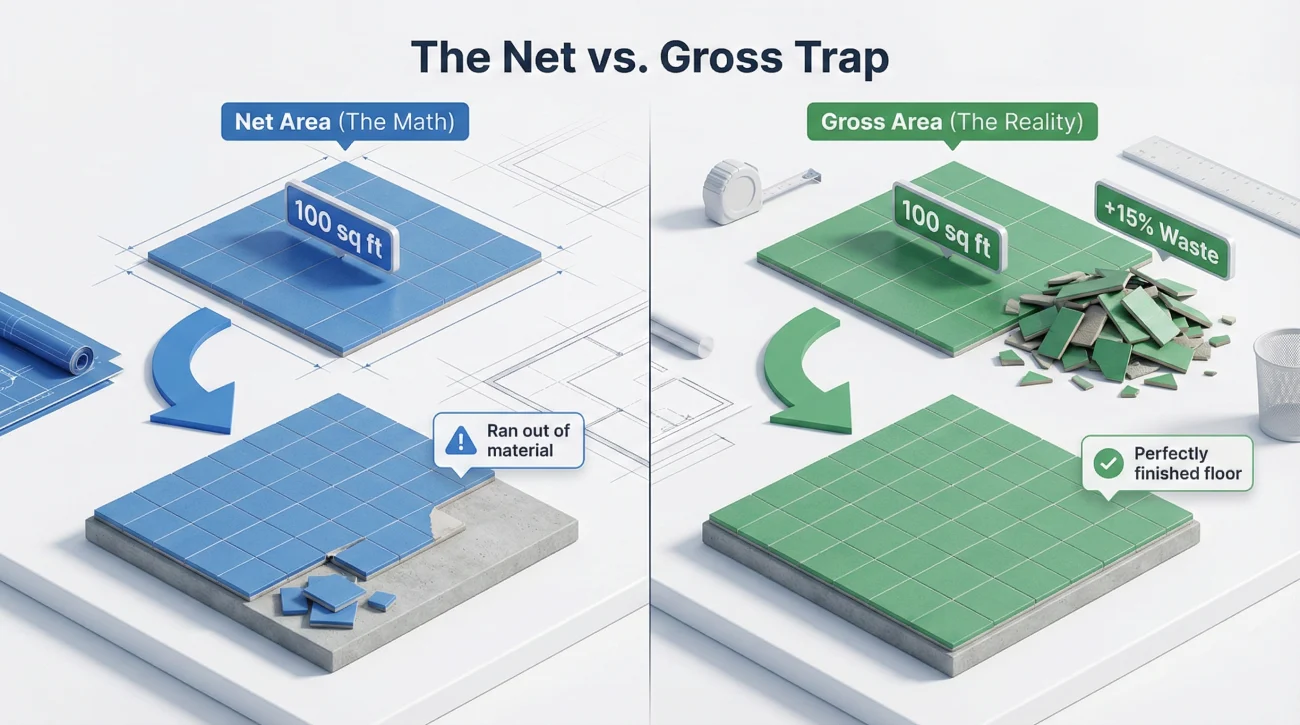
The most common hidden error in estimates is the difference between “Net” area (the exact floor size) and “Gross” usage (what you actually need to buy).
Adjuster software, like Xactimate, calculates the exact net square footage. If a room is 100 sq ft, the estimate says 100 sq ft. But you cannot buy materials this way. You need “Waste” factor to account for cutting, fitting around corners, and breakage.
Common Waste Factors That Should Be Included:
- Flooring (Laminate/Wood/Tile): Typically 10% to 15%, but higher if the room is diagonal or has many corners.
- Roofing: Typically 10% to 15% for gable roofs, and higher for hip roofs with many valleys.
- Drywall & Carpet: Waste percentage varies by material width and room layout, but should always be higher than the net square footage.
A Real-World Example:
I recall a situation where a homeowner received an estimate for exactly 200 sq ft of laminate flooring for their kitchen. Trusting the adjuster’s math, they bought exactly 200 sq ft. They ran out of planks with three rows left to finish. The adjuster hadn’t made a mistake in measuring the room; they had simply forgotten to add the standard waste factor for cutting. The homeowner didn’t need to fight about the price of the wood; they just needed to point out that “Net-only” quantities often don’t match real install needs.
Key Point: Always check your material lines. If the “Quantity” column matches your room’s exact floor area, you are effectively underpaid because you are missing the material needed for cuts.
The Domino Effect: How One Error Costs You Triple

Homeowners often ignore small measurement errors because they think, “It’s just 6 inches, it doesn’t matter.” This is a mistake. In construction estimating, one dimension affects multiple trades.
Let’s say a bedroom is actually 12×12, but the adjuster recorded it as 12×11. You lost 12 square feet of floor, which seems small. But look at the chain reaction:
- Flooring: You are short 12 sq ft of carpet + waste.
- Pad: You are short 12 sq ft of carpet pad.
- Baseboards: You are short 2 linear feet of baseboards (two 1-foot sections on parallel walls).
- Paint (Baseboards): You are short on painting those baseboards.
- Paint (Walls): You are short 8 square feet of wall painting (1 foot length x 8 foot height).
- Drywall: You are short 8 square feet of drywall if walls are replaced.
That single “one foot” error triggered shortages in six different line items. When you audit your estimate, correct every dimension, no matter how small. The math adds up.
The Tape Measure Audit (What Gets Missed)
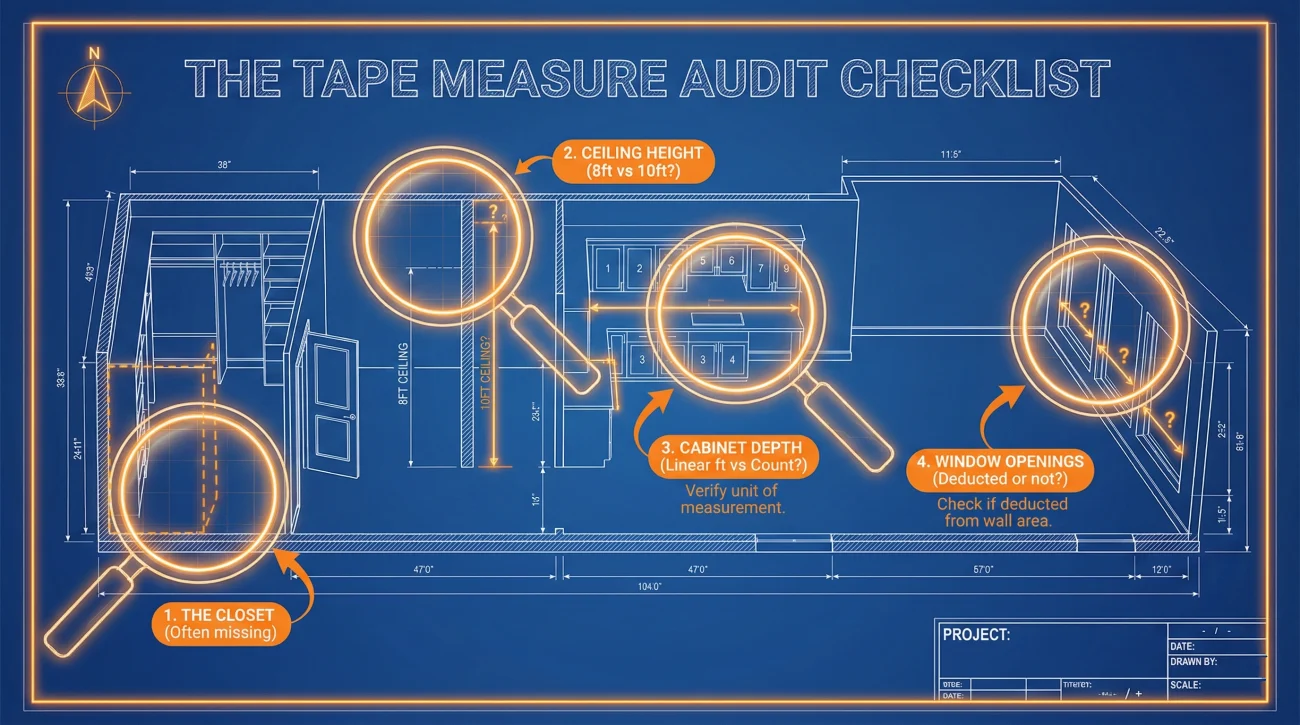
You do not need to be a professional estimator to catch these errors. You just need 20 minutes and a tape measure. When you audit your estimate, focus on these specific blind spots that adjusters often miss when they are rushing.
1. The “Missing Closet” Effect
This is a classic operational error. Field adjusters often use laser measures to shoot the four main walls of a bedroom but forget to open the closet door. In the software, that closet simply ceases to exist. It sounds small, maybe just 10 or 15 square feet. But remember: a missing closet means missing flooring, missing baseboards, missing drywall, missing paint, and missing door trim. That one oversight can cost you hundreds of dollars in scope.
2. Vertical Space (Ceiling Height)
Check the ceiling height listed in the “Room Dimensions” block. If you have 9-foot ceilings but the adjuster defaulted to 8-foot, you are losing 12.5% of your drywall and paint allowance on every single wall. This is one of the most common errors in new homes.
3. Opening Deductions
Look at the painting line items. Did they subtract the square footage for windows and doors? Whether this is correct depends on the size of the opening and the carrier’s guidelines. However, if they deducted for standard windows, you can ask: “What guideline are you applying for opening deductions? It takes more labor to cut in around a window than to roll a blank wall.”
4. Cabinetry (Linear Feet vs. Units)
If you have a gap in your kitchen cabinets, check how they measured. Did they measure along the back wall (Linear Feet) or count the boxes? Sometimes, measuring the linear footage shortchanges you on finished end panels or fillers that are required to make the cabinets fit.
Hidden Quantity: Labor Minimums
Quantities aren’t just about feet and inches; they are also about time. Insurance software often overlooks “Minimum Labor Charges.”
If a plumber has to come out to disconnect one sink, the software might calculate it as “0.5 hours” of labor, paying you $40. But no plumber will drive to your house for $40. They have a “minimum call-out” or “service call” fee, often 2 hours or a flat rate of $150-$200.
If your estimate pays for fractions of an hour that are unrealistic for a tradesperson to accept, this is a Quantity Dispute. You are arguing that the “quantity of hours” is insufficient to procure the service.
How to Present the Math
When you find these discrepancies, the way you present them matters. Do not send an angry email saying “you measured wrong.” That puts the adjuster on the defensive.
Instead, present a clean, data-driven list. Use a simple “Estimate vs. Actual” format. This makes it easy for the adjuster to simply copy-paste your numbers into their software.
Subject: Correction of quantities for Claim [Number] – Room Dimensions
Hello [Adjuster Name],
I walked the property to verify the measurements against the estimate and found a few discrepancies in the quantities. I have listed them below for correction:
1. Living Room Carpet (Line Item #42)
Estimate: 240 SF (Net only)
Actual Required: 276 SF (240 SF Net + 15% Waste for diagonal lay)
Action: Please update quantity to include standard waste factor.
2. Master Bedroom Ceiling Height
Estimate: 8’0″
Actual: 10’0″ (See attached photo with tape measure)
Action: Please update drywall and paint SF to reflect 10′ walls.
3. Hallway Baseboards
Estimate: 12 LF
Actual: 24 LF (Closet interior was missed)
Action: Please add closet perimeter.
I have attached photos of the tape measure for verification.
Thanks,
[Your Name]
Common Mistakes When Disputing Quantities
To keep your credibility high, avoid these common errors.
| Mistake | Why it fails |
|---|---|
| Guessing (“It looks bigger”) | “Looks” is an opinion. “12 feet 4 inches” is a fact. Always use a tape measure and a photo. |
| Mixing up Price and Quantity | Don’t complain about the price of the carpet when the issue is the amount of carpet. Fix the quantity first. |
| Ignoring Minimum Charges | If a trade has a minimum call-out fee (e.g., a plumber needs 2 hours minimum) and the estimate only pays for 15 minutes, that is a quantity dispute (labor hours), not a price dispute. |
Final Thoughts
Correcting wrong quantities is the least confrontational way to improve your claim outcome. It does not require you to be a negotiation expert or to know complex policy codes. It just requires you to be observant.
Before you accept the final total, walk your home with the estimate in hand. Spot-check the room sizes. Look for the word “Waste” on material lines. If the quantities are off, the total will be too. Fix the measurements first, and the value often corrects itself.
For more on how to document these gaps, see our guide on the low estimate documentation system.
❓ FAQ
📏 Why is the square footage on my insurance estimate smaller than my house size?
Insurance estimates often use “Net” square footage (actual floor space) rather than “Gross.” Also, they deduct walls and partitions that real estate listings might include. However, they must add a “waste factor” for materials.
🗑️ Does insurance cover waste factor for flooring and roofing?
Yes. You cannot buy materials in exact net amounts. Standard industry waste factors should typically be included. If missing, ask for them to be added.
🖼️ Should painting deduct for windows and doors?
It depends. Standard practice allows for “opening deductions” if the opening is large. For standard windows, it’s worth asking what guideline they are using, as cutting in often takes more labor than rolling.
📷 How do I prove the adjuster’s measurements are wrong?
Photos are best. Take a photo of a tape measure stretched across the room or up the wall. Ensure the numbers are readable. This is strong evidence.
🪜 My ceilings are vaulted, but the estimate says flat. Does this matter?
Yes, significantly. Vaulted ceilings have more drywall and paint surface area, and they often trigger “high ceiling” labor charges for scaffolding or extra difficulty. You should request a correction.
🚪 They missed my closet. Is it worth disputing?
Yes. A closet involves flooring, baseboards, door trim, painting (walls + ceiling + door), and possibly shelving. Even a small closet can add up to a significant amount of missing scope.
🧱 What is “O&P” and is it a quantity error?
O&P (Overhead and Profit) is often calculated as percentage fees added to the total. If it is missing from a complex job, it is a calculation error, not just a pricing dispute.
📉 Can I use my real estate appraisal square footage?
Adjusters rarely accept real estate appraisals because they measure “living area” differently than “repair area.” It is better to re-measure the specific damaged rooms yourself.
📧 How do I ask the adjuster to fix the math?
Send a written list (email) comparing “Estimate Quantity” vs. “Actual Quantity.” Attach photos of the tape measure. Keep it factual and unemotional.
🛑 What if the adjuster refuses to change the measurements?
Ask for a “reinspection” or ask them to meet your contractor onsite to measure together. It is generally difficult for them to refuse a joint measurement if the evidence is clear.
⚠️ Disclaimer: PropertyClaimChecklist.com provides practical guidance, process checklists, and example follow-ups to help you organize a property claim and move it forward. It is not policy language, claim documentation, legal content, or a substitute for your insurer's instructions. Always rely on your carrier's requirements and your actual policy terms for what must be submitted and how decisions are made.