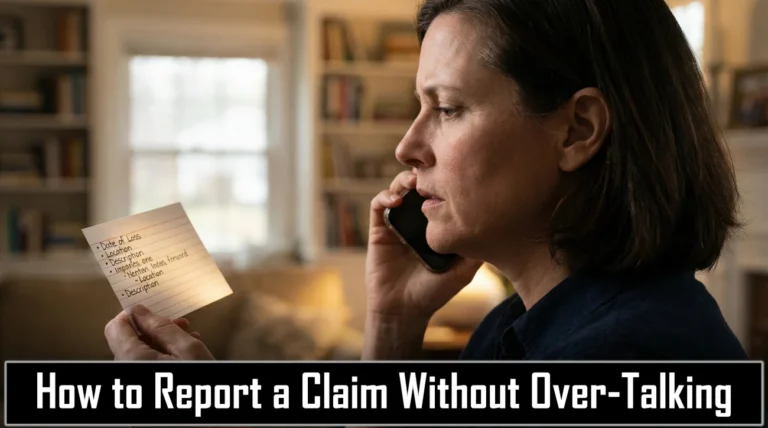

- The “Golden 5”: I never consider a call complete until I have the Date, Time, Rep Name, Claim Number, and Next Step written down.
- The “Scrap Paper” Risk: Information written on envelopes gets thrown away. I urge you to use one dedicated notebook or digital note from minute one.
- Verbal is not valid: If a rep says “go ahead and fix it,” you must write down exactly who said it and when, or it didn’t happen.
The “Day 1” Fog: Why I Force Myself to Take Notes
There is a specific type of brain fog that hits you immediately after you discover damage to your home. I have seen it countless times in my career handling claims operations. You are standing in water, or looking at a hole in your roof, and your brain shifts into survival mode.
In this state, you make the phone call. You talk for twenty minutes. You hang up. And then, ten days later, when nothing has happened, you realize you have absolutely no idea who you spoke to.
In my experience reviewing stalled files, the “Day 1” call is often where the first crack in the foundation appears. I often hear homeowners say, “But the lady on the phone said it would be covered,” or “The guy promised an adjuster would be here yesterday.” When I ask for the name of that representative or the timestamp of that promise, the room goes silent.
Without claim call notes what to write down is not just an administrative question; it is a question of protecting your timeline. From an operational perspective, if it isn’t written down with a timestamp, it effectively didn’t happen. This guide covers the exact data points I look for to ensure a claim starts and stays on track.
The 5 Non-Negotiable Facts to Capture Instantly
When you pick up the phone to report your claim (First Notice of Loss), you need a pen and paper ready before the dialing tone rings. Do not trust your memory. The adrenaline of the event will wipe your short-term memory faster than you expect.
Every single intake call must result in these five specific data points. I call these the “Golden 5” because they are the keys that unlock the door when you need to escalate later.
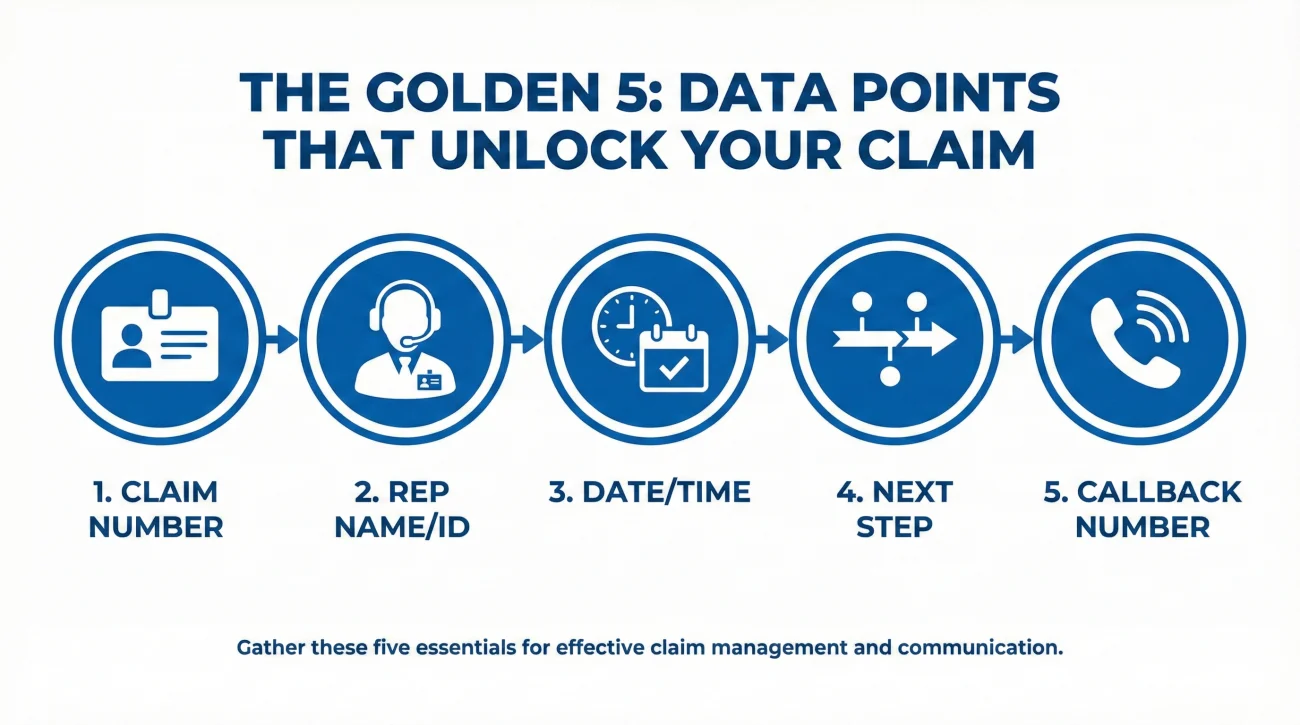
1. The Claim Number (The ID Card)
This sounds obvious, but I cannot tell you how many times I have seen this scribbled incorrectly. The claim number is the social security number of your disaster. Without it, you do not exist in the insurer’s system.
My Personal Rule: I always ask the rep to repeat the number. Then, I read it back to them using phonetic words (like “A as in Alpha, B as in Bravo”) or simply ask them to spell it out slowly while I read it back. This takes ten seconds but prevents days of confusion later.
2. The Representative’s Name & Call ID (The Accountability)
You are likely speaking to a call center representative, not your assigned adjuster yet. However, this person is inputting the initial facts that will define your claim. You need to know who entered that data.
Call centers have high turnover. If you can say, “I spoke to Agent [Name], Operator ID #442,” your notes carry significantly more weight. If they cannot provide a name or ID, ask for the Call Reference Number. Every call creates a unique log ID in their system—ask for it.
3. Exact Date and Time (The Timestamp)
“I called sometime Tuesday morning” is not evidence. “I called Tuesday, February 14th at 9:14 AM” is evidence. Claims are timeline-sensitive processes. Establishing exactly when you reported the loss can be critical if there are questions later about reporting delays.
4. The “Next Step” Promise (The Trigger)
Before you hang up, you must write down exactly what is supposed to happen next. Vague assurances are the enemy of speed.
❌ What I often see:
The homeowner notes “They will call back.” This is too vague to enforce.
✅ What you need:
“Adjuster will contact me within 24 to 48 business hours to schedule inspection.” Now you have a deadline you can track.
📌 Note: During high-volume events (like hurricanes or freezes), this timeline may be longer. Always ask for the specific “catastrophe timeline” if applicable.
5. The Direct Callback Number (The Lifeline)
Do not assume the number you called is the number you should use to follow up. Intake lines are often different from adjuster desk lines. I always advise asking: “If we get disconnected, or if I find more damage in an hour, what is the direct number to update this file?”
The 3 Things You Must NOT Say on Day 1
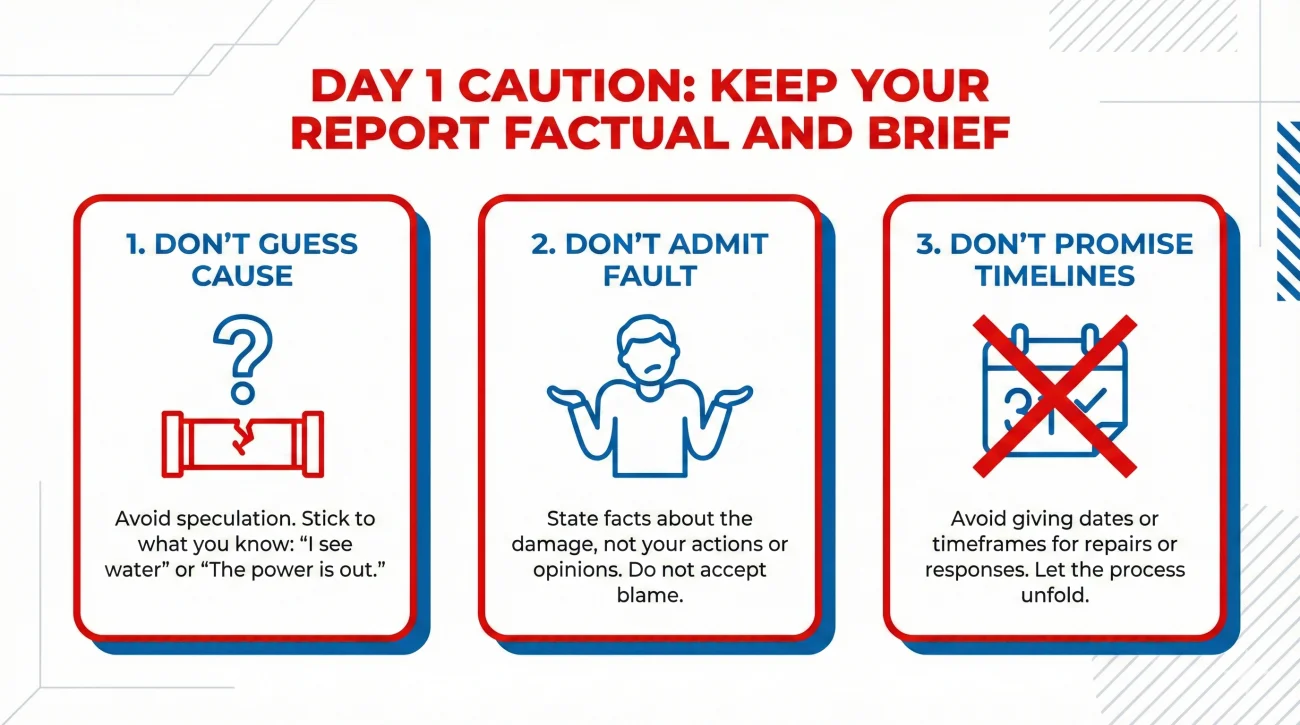
While you are taking notes, be careful about what you dictate into the record. I have seen innocent comments turn into coverage disputes later. Keep your report factual and brief.
- 🛑 Don’t Guess the Cause: Never say “I think it’s just old pipes” or “Maybe the roof was already bad.” If you don’t know, say “I discovered water in the kitchen.” Let the adjuster determine the cause.
- 🛑 Don’t Admit Fault: Avoid phrases like “I should have checked this sooner.” Just state when you found it.
- 🛑 Don’t Promise Repair Timelines: Do not tell them “I’ll have it fixed by Friday.” You don’t know the extent of the damage yet.
Field Note: The “Scrap Paper” Tragedy
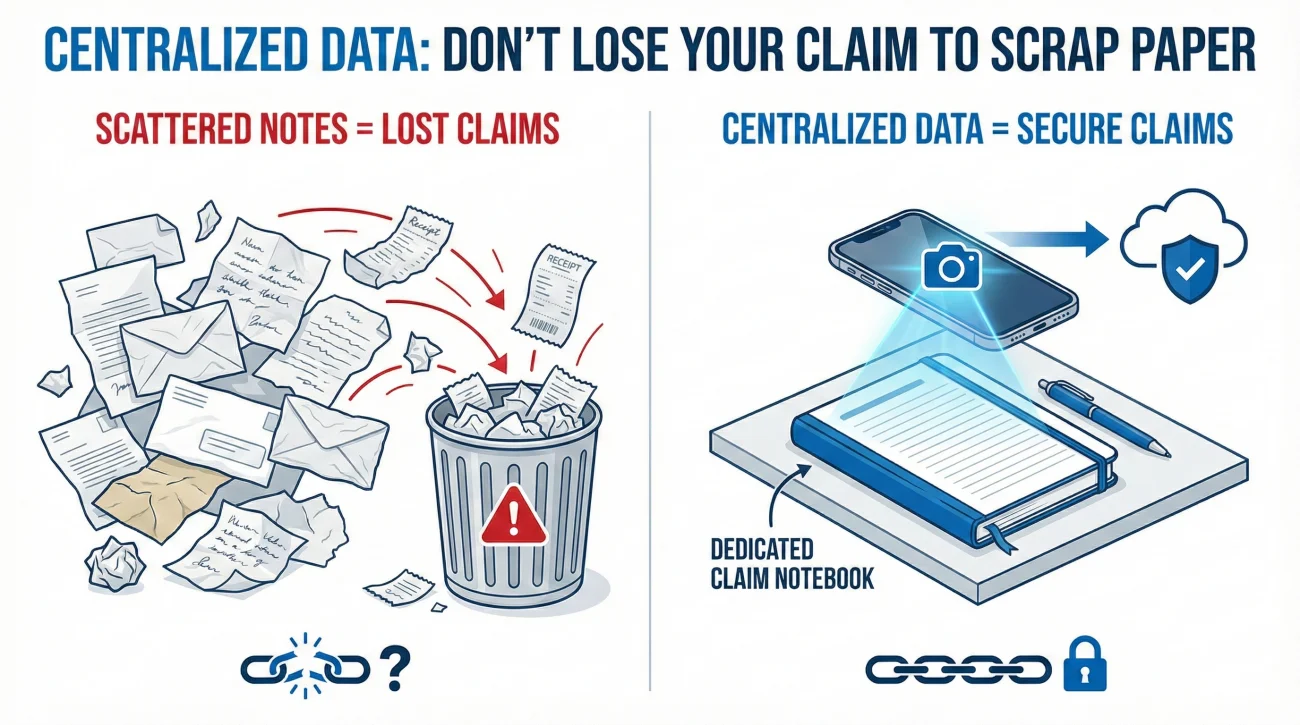
Key Point: Information scattered on three different envelopes is as good as lost. I beg you to centralize immediately.
One of the most frustrating operational failures I see doesn’t happen in the software; it happens on the kitchen counter. I recall a specific case where a homeowner had written the field adjuster’s mobile number on the back of a utility bill envelope. Two days later, during the chaos of cleanup, that envelope went out with the recycling.
That homeowner spent the next week calling the main 1-800 number, sitting on hold for 45 minutes each time, trying to get back in touch with the specific person who could help them. They lost seven days of progress because of a piece of scrap paper.
My Recommendation: Dedicate one notebook, one legal pad, or one specific app on your phone to this claim. Nothing else goes in there. If you write a note on a napkin, take a photo of it immediately and upload it to your digital folder.
The “Verbal Permission” Trap
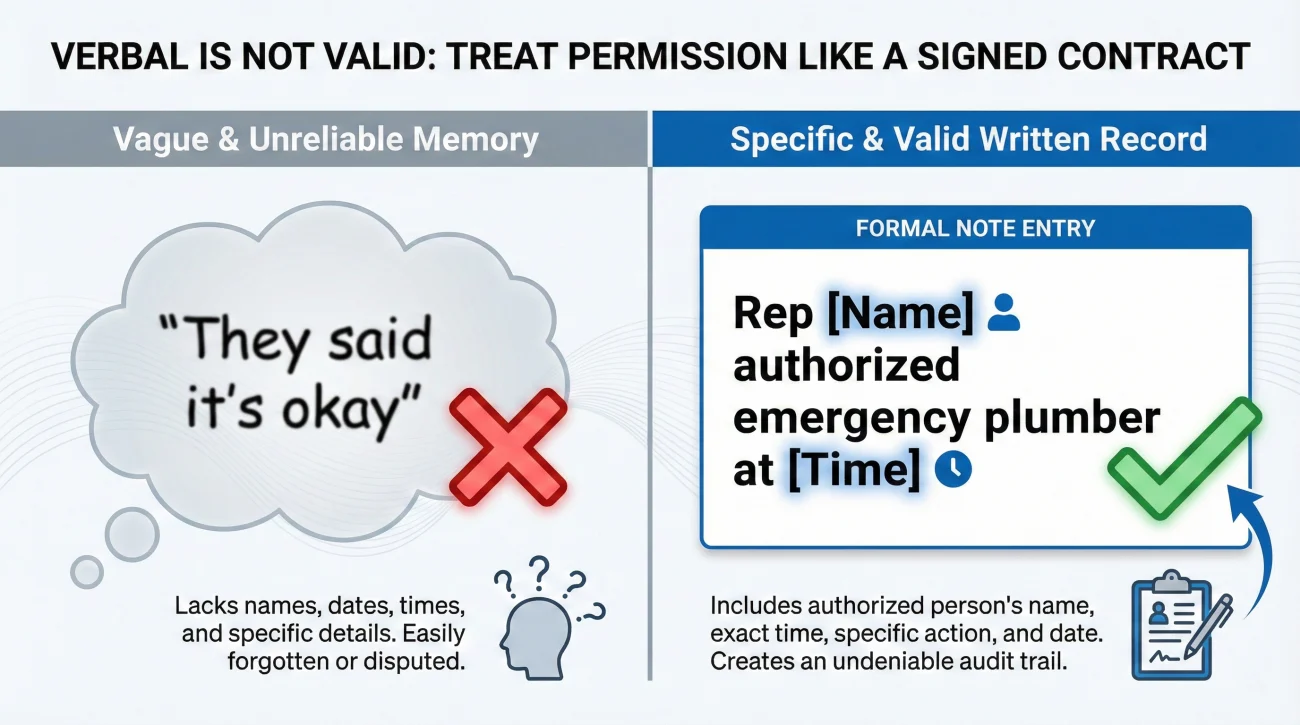
In my opinion, this is the most dangerous part of the Day 1 call. You might ask, “Can I call a plumber to stop the leak?” The rep says, “Yes, go ahead.”
Two months later, the adjuster might say, “We didn’t authorize that specific emergency plumbing rate.” If you don’t have a record of who authorized it, you might be paying that bill yourself.
“At 10:45 AM, Rep [Name] gave verbal authorization to hire emergency mitigation services to stop the leak. She stated this is standard procedure.”
I always tell people: if they give you permission to spend money, you treat that verbal sentence like a signed contract. Write it down verbatim.
Closing Scripts: How to End the Call
The last thirty seconds of the call are where you solidify your timeline. Do not just say “Okay, thanks, bye.” Use one of these scripts to lock in the next step.
Option 1: The Confirmation Loop
“Just to confirm my notes: my next step is to wait for the adjuster, and your next step is to have one assigned by Tuesday at noon, correct?”
Option 2: The Digital Paper Trail
“If I don’t receive an automatic email recap of this claim, what is the specific Call Reference ID for this conversation so I can prove we spoke?”
How Proof Changes the Outcome
Let’s look at how a proper note-taking process changes the outcome of a claim. I’ve seen both of these scenarios play out hundreds of times.
Calls in a panic. Explains the water is everywhere. The rep says, “Okay, we have that logged. Someone will be in touch.” The caller hangs up, relieved. Writes nothing down. Monday comes, nobody calls. The caller calls back but has no claim number. The new rep can’t find the record immediately because of a typo in the last name. The claim is now three days behind.
Grabs a notebook. Asks the rep, “Can I get the claim number?” Writes: Claim #445-992-K. Asks, “What happens next?” The rep says an adjuster will call by Monday noon. Writes: Next: Adjuster call by Mon 12PM. When Monday passes, this caller calls back, quotes the claim number, and says “I was promised a call by noon.” They get escalated immediately.
The difference here isn’t the policy; it’s the proof. The organized caller proved they were paying attention.
My Template for “Day 1” Notes
You do not need a fancy spreadsheet for this initial call. In fact, complex systems often fail when you are stressed. I use a simple “Block Format” that you can copy into a blank document or write on the first page of your notebook.
This block becomes the foundation of your proof of loss playbook later on.
| Field | Why I require this |
|---|---|
| Date/Time | Establishes the “Start Clock” for the claim. |
| Phone Number Called | Proves which department you reached. |
| Rep Name / ID | Creates personal accountability. |
| CLAIM NUMBER | The single most important identifier. |
| Instructions Given | Protects you from “we didn’t tell you to do that” disputes. |
| Next Deadline | Tells you exactly when to follow up. |
Where to store this: Once you write this down, do not leave it on a loose leaf. Take a photo or scan it immediately. Save it as a PDF named [Claim Number] - Initial Call Notes and move it into your “Correspondence” folder. This is now permanent evidence.
The Recovery Move: “I Forgot to Write It Down”
It happens. You were panicked, you hung up, and realized you wrote nothing down. Don’t wait three days to fix it. Fix it now.
- Call back immediately (Same Day).
- Say: “I just filed a claim but didn’t write down the details. Can you please read the Claim Number and the notes you just entered back to me?”
- Write it down this time.
- Ask for the Call Reference ID of that previous call if possible.
- Send yourself an email immediately recap: “Just confirmed Claim #XYZ with Rep [Name].”
Final Thoughts: Your Notes Are Your Shield
The insurance process is moved by paper and logs. By treating your very first phone call as a formal transaction, you signal to the insurer that you are organized and paying attention. I have found that adjusters tend to treat well-documented files with more respect because they know the homeowner is keeping score.
Take the thirty seconds to write these five facts down. Put them in a permanent place. It is the single highest-value administrative task you will do on day one.
❓ FAQ
📝 What if I forgot to write down the claim number?
Call the main claims line immediately. Provide your policy number, full name, and property address. They can look up the recent file and give you the claim number. Write it down this time.
📱 Should I record the phone call with the insurance company?
This depends on state laws (one-party vs. two-party consent). In my experience, it is often safer and more practical to take detailed written notes and confirm key points via email immediately after the call.
🗣️ What if the representative refuses to give their last name?
This is common in call centers for privacy. Ask for their Operator ID or Employee ID number instead. If they provide neither, note their first name and the exact time of the call.
📄 Do I need to transcribe the whole conversation?
No. Focus on facts: numbers, dates, names, and specific instructions (like “you can rip out the carpet”). Do not worry about word-for-word small talk.
📩 Is it better to file online or by phone for record keeping?
Filing online often automatically generates an email confirmation with the claim number, which is great for records. However, I prefer a phone call if you have immediate questions about emergency repairs.
⏳ How long do I have to write these notes?
Do it while you are on the phone or immediately after hanging up. I find that details about tone, specific phrasing, and promises fade significantly within one hour.
📅 What counts as the “Date of Loss”?
This is the day the damage occurred or was discovered. You must be precise and consistent with this date in your notes and all future forms to avoid coverage issues.
📧 Should I email my notes to the adjuster?
Generally, you keep your notes for yourself. However, I strongly recommend sending a “confirmation email” to the adjuster summarizing the agreed steps (e.g., “As discussed, you approved the emergency plumber…”).
📓 Can I use a regular notebook for this?
Yes, a cheap spiral notebook is perfect. The key is that it is dedicated only to the claim, so pages don’t get torn out or mixed with grocery lists.
🔢 What if they give me a “Reference Number” instead of a “Claim Number”?
Write it down and label it “Ref Number.” Ask if this will become the claim number or if a new number will be assigned later. Track both.
⚠️ Disclaimer: PropertyClaimChecklist.com provides practical guidance, process checklists, and example follow-ups to help you organize a property claim and move it forward. It is not policy language, claim documentation, legal content, or a substitute for your insurer's instructions. Always rely on your carrier's requirements and your actual policy terms for what must be submitted and how decisions are made.