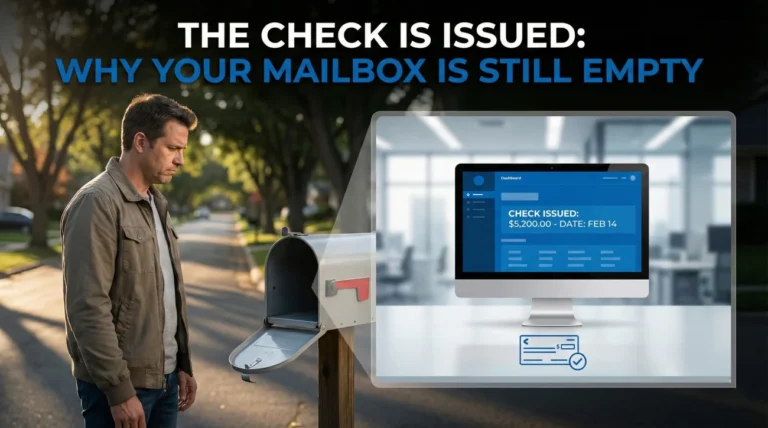

- The Reality: “Pending Review” is often a catch-all parking lot, not an active process. It usually means the file is sitting in a queue waiting for a human to look at it.
- The Hidden Cause: The most common operational reason for this delay is “Dollar Authority.” Your adjuster might need a supervisor’s permission to pay the specific amount you requested.
- The Strategy: Stop asking “Is it done yet?” and start asking “Who is the specific person reviewing it?” and “What specific document is missing?”
- The Timeline: While timelines vary by carrier, a review taking longer than 7 to 10 business days without an update is often an operational red flag.
- Action Item: Use the “Blocker Questions” below to force the adjuster to identify the exact obstacle.
The “Black Box” Status
In the dashboard of almost every claims management system I have worked with, there is a status option called “Pending Review.” It looks official. It sounds active. When a homeowner logs into the portal or calls the helpline and sees this status, they imagine a team of experts sitting around a table, analyzing their photos with magnifying glasses. They picture progress.
The reality is often much less exciting and much more frustrating. In my experience, “Pending Review” is rarely a verb. It is a noun. It is a digital bucket where files go to sit when they cannot move forward for some administrative reason. It is the “waiting room” of the insurance world. When you feel your claim pending review too long, it usually means your file is stuck in a bottleneck, not under a microscope.
For a homeowner, this is the most dangerous status because it creates a false sense of security. You wait politely, thinking work is being done. You don’t want to interrupt the experts. Meanwhile, days turn into weeks, and your repair timeline slips further away. To get your claim moving, you need to stop treating this status as a valid update and start treating it as a non-answer that requires active investigation.
Decoding the Operational Meaning
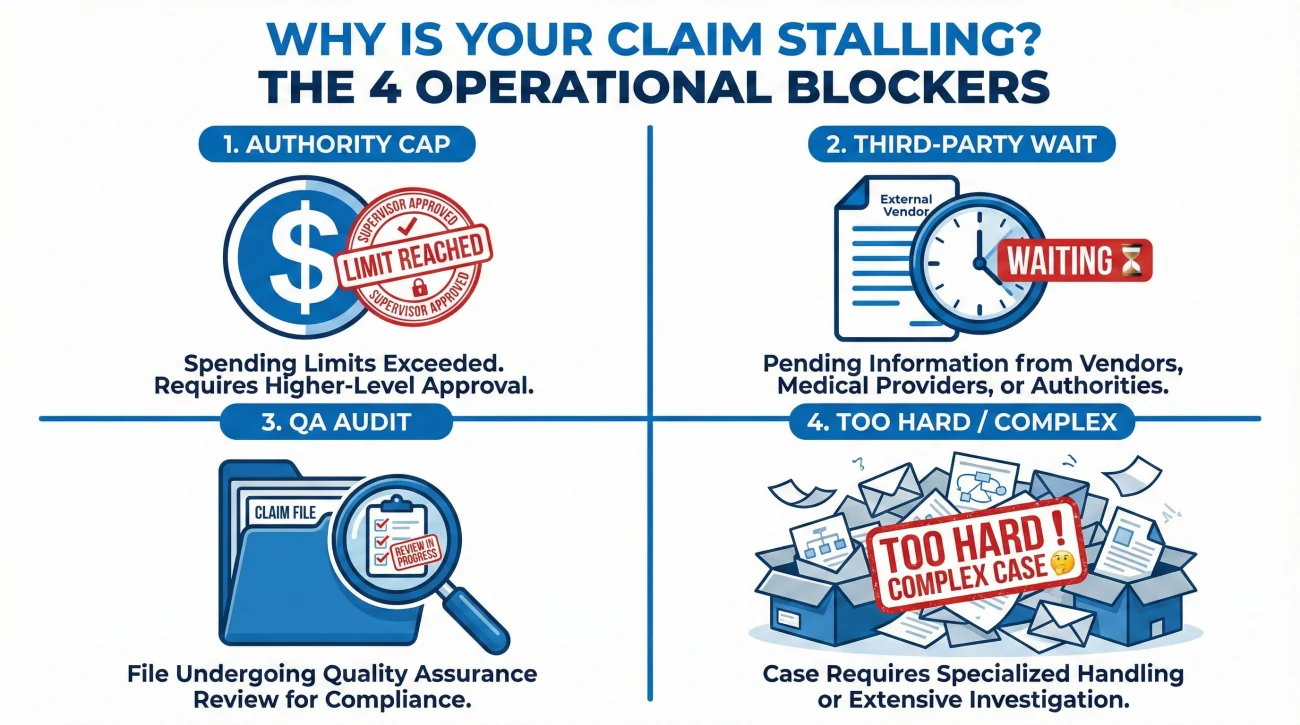
When an adjuster toggles a file to “Pending Review,” they usually do it for one of four specific operational reasons. Knowing which one applies to you is the key to unlocking the delay. Adjusters rarely volunteer this level of detail, so you have to deduce it.
1. The Authority Cap (The Dollar Limit)
This is the most common reason for a sudden stall after an estimate is written. Every desk adjuster has a strict “checkbook limit” or “authority level.” These limits vary widely by carrier and experience level, but a junior adjuster might only be allowed to approve claims up to $10,000, while a senior adjuster might handle up to $50,000.
If your damage estimate comes in at $12,000, a junior adjuster physically cannot click the “Issue Payment” button. The software greys it out. They are forced to send the file up to a manager or a “Large Loss” team for approval. The file sits in the manager’s inbox, marked “Pending Review.” The delay isn’t because your claim is wrong. It is simply because the manager has dozens of other files in their inbox and hasn’t clicked “Approve” yet.
2. The Third-Party Wait
Sometimes, the adjuster is paralyzed because they are waiting for a piece of paper from a vendor. This is not a coverage review; it is a dependency delay. Common examples include:
- 🚧 Engineering Reports: Waiting for an engineer to confirm if the wall crack is structural.
- 🪜 Ladder Assist Reports: Waiting for a steep-roof inspector to upload photos.
- 🏠 ALE Validation: Waiting for a housing vendor to confirm rental rates.
Until that document arrives, the adjuster cannot finalize the coverage decision. They park the file in “Pending Review” as a placeholder.
3. The Quality Assurance (QA) Audit
Insurance companies randomly audit files to ensure adjusters are following the rules. If your file gets pulled for a random QA audit, everything freezes. The adjuster cannot touch it until the auditor releases it. This is purely internal bureaucracy, but it stops your check cold.
4. The “Too Hard” Pile
I hate to admit this, but it happens. If a file is messy, disorganized, or the homeowner has sent 50 separate emails with unlabelled photos, an overworked adjuster might skip it to work on easier files. They mark it “Pending Review” to buy time until they have the mental energy to tackle the mess.
💡 The Fix: If you suspect you are in this pile, stop sending new emails for a few days. Then, send one clean “Recap Email” that attaches the specific missing items in a single PDF. Make it easy for them to say “yes” and close the file.
Field Note: The $50 Hold Up
I once audited a claim that had been “Pending Review” for 25 days. The homeowner was furious, assuming the carrier was investigating them for fraud. They were threatening to hire a lawyer over a $15,000 payout that was stalling their kitchen renovation.
When I dug into the claim notes, I found the problem. The desk adjuster was actually ready to pay the $15,000 claim. However, in the notes, they had mentioned needing an invoice for a $50 tarp the homeowner bought at Home Depot. The adjuster had marked the file “Pending Review” while waiting for that $50 invoice. But here is the kicker: they never explicitly emailed the homeowner to ask for it. They just assumed the homeowner would send it. The homeowner assumed the adjuster had everything.
The file sat for nearly a month because of a lack of communication over $50. Once we identified the missing item, the homeowner emailed the receipt, and the $15,000 check was issued the next day. This taught me a valuable lesson: never assume “Pending Review” involves big, complex issues. Usually, it is something tiny blocking the gears.
How to Unstick the Process
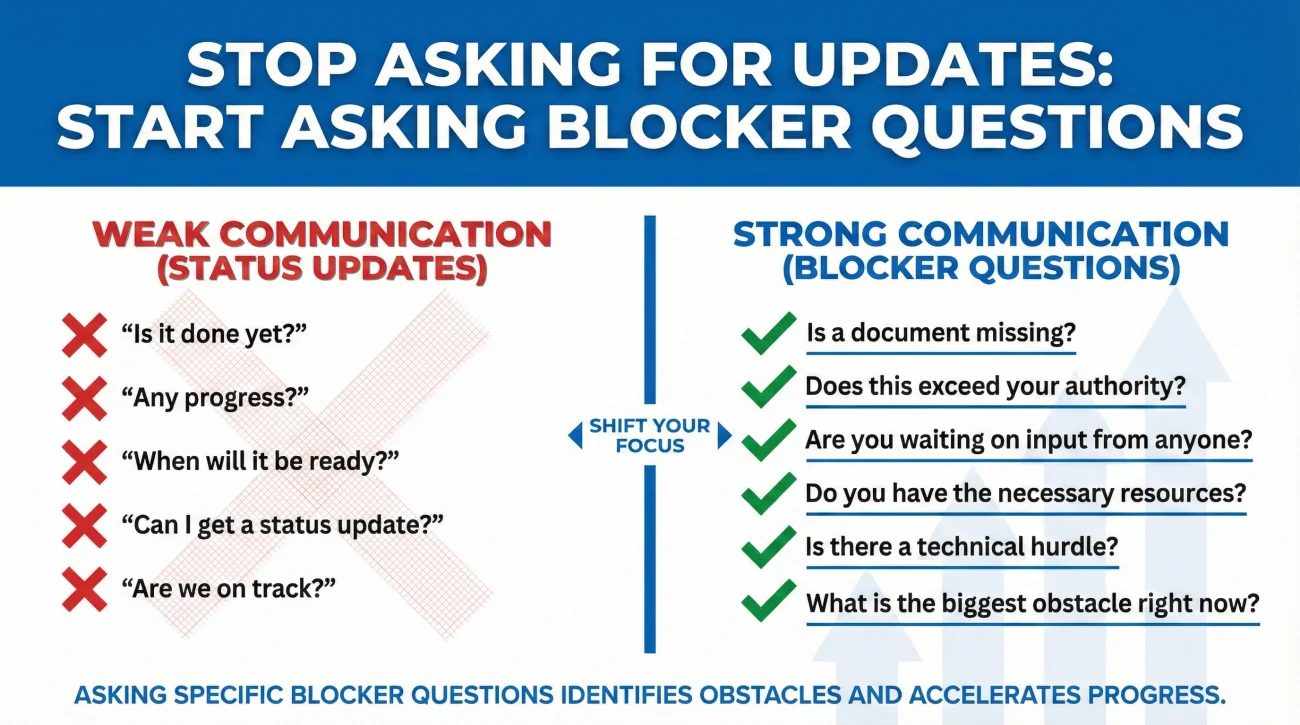
If your claim has been in this status for more than a week without an update, polite patience is no longer your friend. You need to shift your questioning strategy. Most people ask, “Is it done yet?” or “Any updates?” These are weak questions that invite weak answers like “Not yet, we are working on it.”
Instead, you need to ask questions that force the adjuster to define the operational blocker. This is part of a broader insurance claim follow up system that focuses on specific hurdles rather than general status.
The Blocker Questions
When you contact the adjuster, try asking these specific questions to diagnose the problem. Notice how precise they are:
- ❓ “Is there a specific document missing that prevents you from closing this file today?” (This checks for the Missing Vendor/Invoice trap).
- ❓ “Does this claim amount exceed your current settlement authority?” (This checks for the Supervisor Queue trap).
- ❓ “Is the file currently with a specific vendor or auditor?” (This checks for Third-Party delays).
- ❓ “Who is the specific person currently holding the file?” (This prevents them from blaming a nameless “committee”).
Guidance: Writing the “Pending” Inquiry
When you write to your adjuster about a pending status, your tone should be “project manager,” not “angry customer.” You are trying to help them clear a task off their desk. Angry emails often get ignored or flagged for “special handling,” which takes even longer. An effective inquiry often looks like a checklist.
Start by acknowledging the status: “I see the file is marked Pending Review in the portal.” Then, pivot immediately to the blocker. Ask them to confirm if the file is with a supervisor for authority approval. If it is, ask for the supervisor’s name and when it was sent to them. This signals that you understand how the backend works. If they know you know about “authority limits,” they are less likely to give you a vague excuse.
If they claim they are waiting on a vendor (like an engineer), do not try to call the vendor yourself, as they often cannot speak to you. Instead, ask the adjuster for the expected due date of the report and ask them to confirm they have pinged the vendor for a status update.
The Reassignment Limbo
There is one other scenario that causes the “Pending Review” status to drag on indefinitely: Reassignment. The turnover rate for insurance adjusters is incredibly high. It is very common for an adjuster to quit or transfer in the middle of a claim.
When an adjuster leaves, their files are often dumped into a “Team Queue” or “Pending Reassignment” bucket. The system might display “Pending Review” to you, but internally, the file has no owner. It is sitting in a digital orphanage. If your emails to your adjuster are bouncing back, or if their voicemail says they are “no longer with the company,” your file is likely in this limbo.
In this case, you must call the main claims line immediately. Do not email the old adjuster. Call the 1-800 number and say: “My adjuster seems to have left. Who is the new owner of this file?” You need to get a new name attached to your claim as fast as possible, or it will sit in the pending bucket for months.
The “Undisputed Payment” Move

Sometimes, a claim is pending review because the adjuster disagrees with one part of it. For example, they agree to pay for the kitchen floor ($10,000) but are reviewing the custom cabinets ($15,000). Many adjusters will hold the entire $25,000 check while they figure out the cabinets.
This is bad for you. You need the $10,000 now to start the floors. In this situation, you should explicitly request an “Undisputed Payment.” Write to them and say: “I understand the cabinets are still pending review. Please issue the payment for the undisputed flooring portion immediately so we can begin repairs, and we can resolve the cabinets later.”
Many states have regulations requiring insurers to pay undisputed amounts within a certain timeframe, though timelines vary widely. By asking for this, you decouple the easy money from the hard money, keeping your cash flow moving while the “Pending Review” drama continues for the complex items.
Final
“Pending Review” is not a destination; it is a waiting room. While some review time is normal, an indefinite hold is usually a sign of a broken process loop. It could be a missing document, a busy supervisor, a missing vendor report, or a file that has lost its owner. By asking specific questions about authority limits, missing items, and file ownership, you turn the lights on in the black box. You force the system to stop treating you like a passive waiter and start treating you like a priority.
❓ FAQ
⏳ How long should “Pending Review” take?
In routine claims, a review status typically lasts 3 to 7 business days, though this can range widely depending on the carrier and complexity. If it drags beyond 10 days without a specific explanation, it is often considered an operational delay that warrants a firm follow-up.
👨💼 What does “Pending Supervisor Approval” mean?
It means the desk adjuster has agreed to pay your claim, but the dollar amount is higher than their personal limit. They are waiting for a manager to click the final “approve” button.
📄 Can a missing receipt pause the whole claim?
Yes. Adjusters often cannot close a file if even one line item is unverified. They might pause the entire $20,000 payout just to wait for a $100 receipt. Always ask if you can separate the verified items for immediate payment.
📞 Should I call or email about a pending status?
Email is usually better because it creates a paper trail. If you call, the adjuster might just say “still working on it.” An email forces them to write down the reason for the delay.
🏗️ What if they are waiting for an engineer’s report?
Operational standards often request reports within 7 to 14 days of the site visit, but delays happen. Ask your adjuster to confirm the specific due date they are expecting the report so you know when to follow up next.
🛑 Does “Pending Review” mean my claim is denied?
Not necessarily. It usually just means it is being processed. However, if it stays pending for weeks after an inspection, it could mean they are running a coverage question by a legal team. Asking for the specific blocker helps reveal this.
💸 Can I ask for a partial payment while pending?
Yes. This is called an “undisputed payment.” If the review is only about the roof, but the kitchen damage is clear, ask them to issue the check for the kitchen now while they debate the roof.
🔄 How often should I check in?
Once a week is a standard operational rhythm. Calling every day can backfire and make the adjuster avoid you. A polite, firm email every Tuesday shows you are persistent but professional.
💻 Why does the portal say pending but the adjuster says approved?
Portals often lag behind the actual claim system. Trust the written email from your adjuster over the generic status label on a website.
📋 What if they say they are “reviewing the policy”?
This is a potential red flag for a coverage issue. Ask specifically: “Is there a specific exclusion or policy provision you are analyzing?” This forces them to be transparent about what they are looking for.
⚠️ Disclaimer: PropertyClaimChecklist.com provides practical guidance, process checklists, and example follow-ups to help you organize a property claim and move it forward. It is not policy language, claim documentation, legal content, or a substitute for your insurer's instructions. Always rely on your carrier's requirements and your actual policy terms for what must be submitted and how decisions are made.