
- “Detach and reset” refers to the necessary labor to carefully remove an undamaged item, store it, and reinstall it so that repairs can happen behind or underneath it.
- In many estimates I review, I often see this labor missing because estimating software typically requires adjusters to manually click and add these line items one by one.
- Commonly missed items include toilets (to replace bathroom flooring), baseboards (to paint walls), and light fixtures (to replace ceiling drywall).
- If you do not catch these missing line items early, your contractor may pause the work or ask you to pay for the extra prep labor out of pocket.
- You can effectively recover these costs by presenting a clean, room-by-room list of the physical items that block the repair path before you sign a final contract.
Field Note: The Estimating Software Blind Spot
When property owners realize these items are missing, their first reaction is often anger. They assume the adjuster intentionally left off the cost of moving the refrigerator to save the company a few bucks. While that is an understandable reaction, my experience on the operational side tells a different story. To understand why this happens, you have to understand the software.
Desk adjusters build their estimates using incredibly complex software platforms. A common misconception is that this software is “smart” enough to add all related tasks automatically. It usually is not. The software relies heavily on manual inputs and macros.
If an adjuster selects a shortcut macro for “Replace Drywall,” the software instantly populates the costs for the drywall boards, the mud, the tape, and the paint. However, the software has no eyes. It does not automatically know that in your specific living room, there is a wall sconce, a heavy window treatment, an air conditioning register, and three electrical outlet covers attached to that damaged wall.
To include those specific items, the adjuster has to stop, manually search the database for “Detach and Reset Light Fixture,” and click to add it. During busy storm seasons, desk adjusters are handling heavy workloads, sometimes processing a high volume of claims each week. In the sheer speed of their workflow, they focus entirely on the primary damage and simply forget to manually click the buttons for the secondary detach and reset tasks. In most cases, it is not a deliberate attempt to shortchange you; it is usually a byproduct of high-volume administrative processing.
Walking the File: A Room-by-Room Detach and Reset Audit
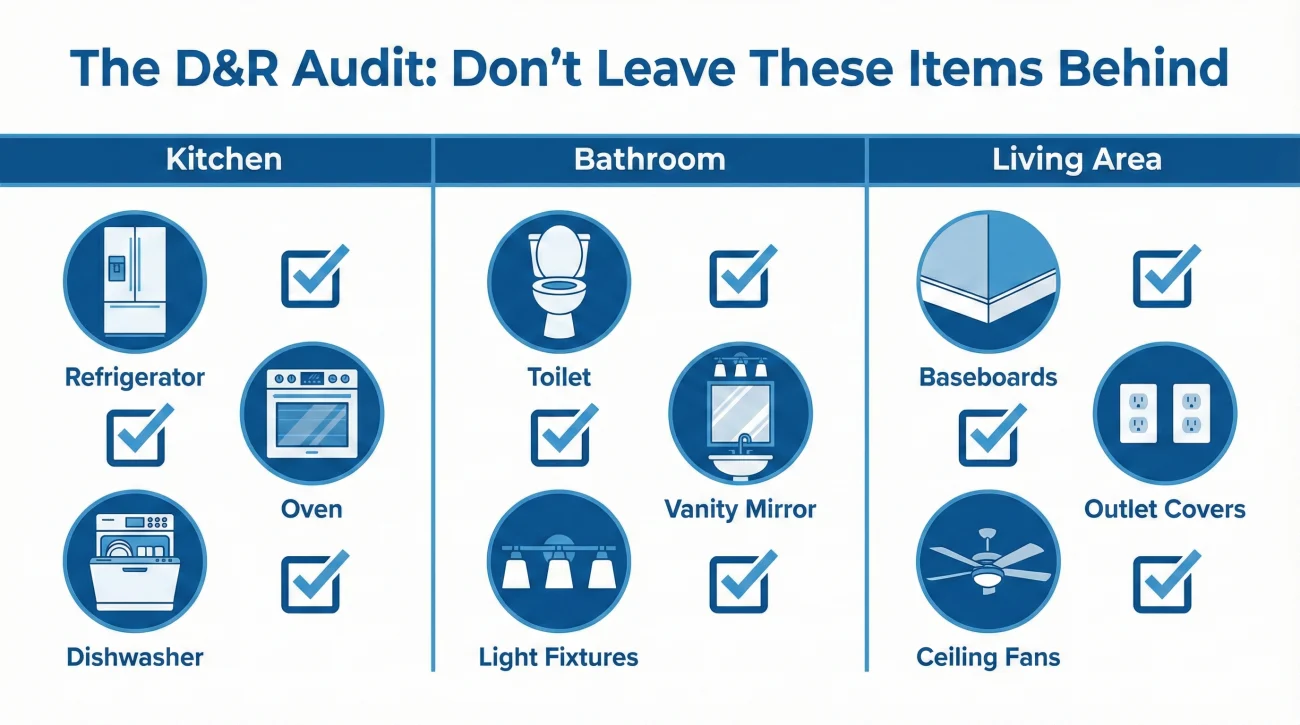
Because of this software blind spot, it is generally not a good idea to rely solely on the adjuster to catch every single screw, fixture, and appliance that needs to be moved. You have to audit the estimate yourself. When I teach people how to evaluate an insurance claim low estimate, I tell them to put the paperwork down and physically walk through their damaged property.
Go to the room with the primary repair (like a damaged ceiling or floor). Stand in the doorway, look at the damage, and ask yourself a simple operational question: “What is physically in the way of the contractor right now?”
Let me share the specific traps I look for when I audit different rooms.
The Kitchen Traps
Kitchens are incredibly dense. They are packed with built-in appliances and fragile plumbing, making a simple floor or wall repair a logistical nightmare for a repair crew.
Whenever I review a kitchen floor claim, the first thing I check for is the refrigerator and the stove. If those appliances need to be moved to repair the floor or drywall behind them, the estimate must include the labor to unhook water lines (for ice makers) and gas lines. I also look very closely at continuous flooring. If your hardwood or tile runs continuously under your base cabinets, the lower cabinets and the island may need to be completely detached to do the job right. This often means the heavy quartz or granite countertops resting on them must also be detached, though this is not always required depending on the exact kitchen layout. Granite is notoriously fragile and requires specialized, expensive labor to move safely. I frequently see this entire sequence missing from the initial offer.
The Bathroom Traps
Bathrooms are tight, confined spaces. Even a minor drywall repair requires removing fixtures just to give the contractor room to swing a hammer.
One of the most common missed items I see in a bathroom claim is the toilet. You cannot properly install new tile or vinyl flooring around the base of a toilet; the toilet must be pulled up. I typically verify that there is a line item to detach the toilet, pay for a new wax ring, and reset it. Furthermore, if the wall behind the sink is damaged, the vanity cabinet, the plumbing lines, and the large wall-mounted mirror must come down. Large mirrors are often glued directly to the drywall, making them highly susceptible to breaking during removal.
The Living Area Traps
While living rooms are less complex than kitchens, they contain dozens of small finish items that block painters and drywall installers.
If you are getting new floors, I make it a habit to check the estimate for baseboard removal. Contractors usually need to remove the baseboards to allow for a proper flooring expansion gap. Detaching, carefully storing, and resetting baseboards throughout an entire house takes significant labor hours. Additionally, I look for the tiny details: every single outlet cover and light switch plate must be removed before painting a wall. Ceiling fans and flush-mount lights must be safely un-wired and taken down to replace ceiling drywall. While an outlet cover seems minor, across a large house, it adds up to hundreds of dollars in missing labor.
Operational Friction: Detach vs. Replace
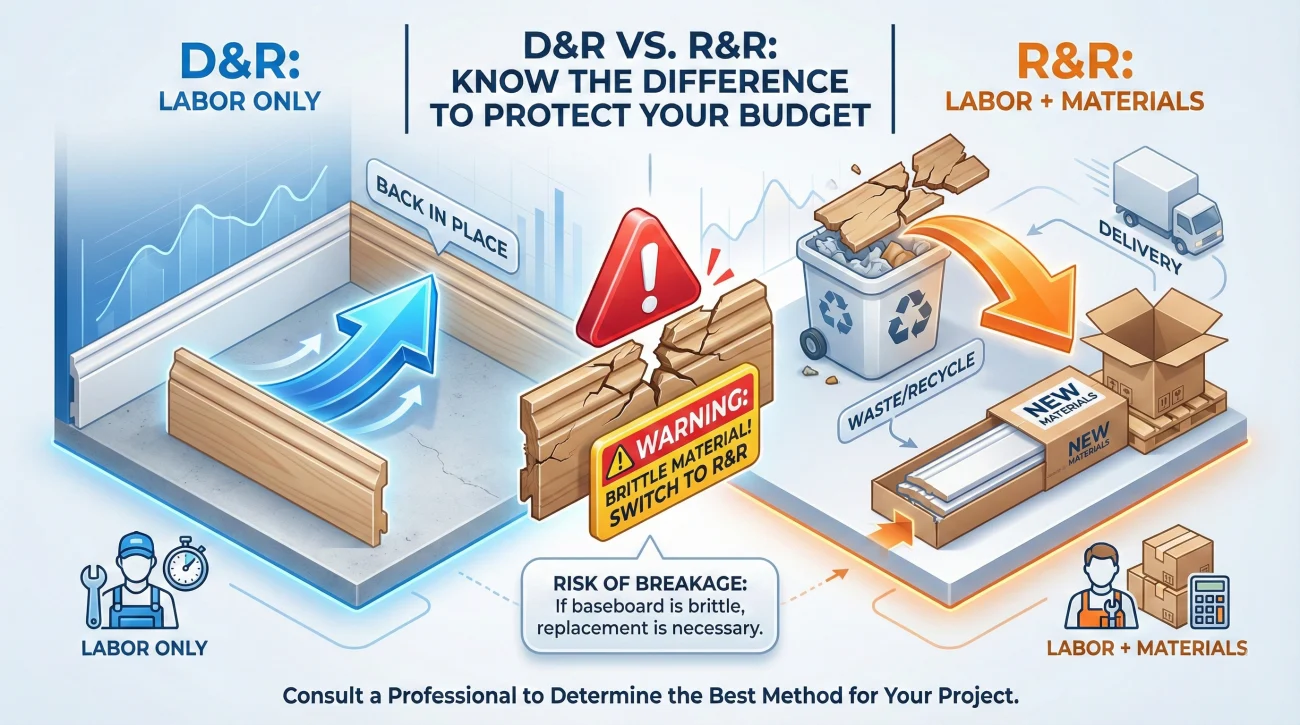
When you are auditing your estimate, you will likely encounter two different codes: D&R (Detach and Reset) and R&R (Remove and Replace). Understanding the operational difference between these two is critical for keeping your claim moving smoothly.
Detach and Reset (D&R) assumes the item is completely undamaged. The contractor will carefully take it off the wall, store it in another room, and put that exact same item back when the repair is finished. The insurance company is only paying for the labor of moving it.
Remove and Replace (R&R) means the item is damaged, or it broke during the removal process. The contractor will throw the old item away and install a brand new one. The insurance company is paying for the demolition labor, the installation labor, and the actual material cost of the new item.
One operational headache I frequently navigate is when an item simply cannot survive being detached. For example, older wooden baseboards that have been glued and painted over for twenty years will often snap in half when a contractor tries to pry them off the wall. Older plastic outlet covers become brittle and crack when you turn the screw. If your contractor informs you that an item cannot be safely detached because of its age or condition, you must actively request that the insurance adjuster change that specific line item from D&R to R&R to cover the cost of the new materials.
How to Present the Missing Scope to Your Adjuster
Finding the missing items is only half the battle. How you communicate these gaps determines whether your file gets updated quickly or gets stalled in an argument. If you just call customer service and complain that “the estimate is missing a bunch of stuff,” the representative will likely just tell you that the estimate is final. You need a highly structured approach.
When I coach property owners, I tell them to build a clean, objective list mapped directly to the rooms in their property. You want to remove all emotion and simply state physical facts.
| Room Name | Missing D&R Item | The Objective Justification |
|---|---|---|
| Master Bathroom | Toilet & Wax Ring | Must be detached to install the approved continuous tile flooring. |
| Living Room | Ceiling Fan | Must be un-wired and dropped to scrape and repair the ceiling drywall. |
| Kitchen | Refrigerator | Must be moved out of the room to lay the approved vinyl plank flooring. |
The Scope Correction Script
Once you have your list, send a formal request for an estimate revision (commonly called a supplement). Use this calm, professional phrasing in your email to the desk adjuster to ensure your request is taken seriously.
Subject: Missing Scope Items for Revision – Claim #[Your Claim Number]
Hello [Adjuster Name],
I have reviewed the initial estimate you provided. While the primary repairs are listed accurately, I noticed several necessary “Detach and Reset” line items were omitted from the scope of work.
In order for my contractor to physically complete the approved repairs, the following items must be detached and reset:
– [Living Room]: Baseboards (to allow for required flooring expansion gaps)
– [Living Room]: 4 Outlet covers and 1 ceiling fan (to allow for full drywall painting)
– [Kitchen]: Dishwasher and Oven (to allow for continuous flooring installation)
Could you please review this list and issue a revised estimate including the labor for these necessary D&R tasks? Please let me know if you need any photos to confirm these specific items are present in the rooms.
Thank you,
[Your Name]
This script is effective because it does not argue about pricing or fairness. It focuses entirely on undeniable, physical facts. An adjuster cannot reasonably argue that a ceiling fan does not exist if it is clearly visible in your photos.
Common Mistakes When Managing Prep Labor
Navigating missing scope is a delicate process. Over the years, I have watched property owners make a few consistent administrative errors that end up costing them money they were fully entitled to recover.
Mistake 1: Doing the prep work yourself without logging it.
In an effort to speed things up, homeowners will often unhook their own appliances, unscrew their own light fixtures, and tear off their own baseboards before the contractor arrives. While this is incredibly helpful to the crew, the insurance company may still owe you for that labor value. If you do the work yourself, you can sometimes claim the labor, but you must document it thoroughly. Take “before” photos showing the items installed, and keep a simple log of the hours you spent doing the detach work.
Mistake 2: Assuming the contractor will handle it for free.
I see this pattern frequently: a homeowner assumes the contractor will just absorb the cost of moving furniture or unhooking plumbing as a courtesy. They usually will not. If it is not on their bid, they will likely hand you a surprise invoice at the very end of the project for “unforeseen prep labor.” You must align the insurance estimate with the contractor’s bid before any work begins.
Mistake 3: Throwing away detached items too early.
If a contractor detaches an old, heavy wall mirror to paint behind it, and you decide you want to buy a modern mirror anyway, do not throw the old one in the trash immediately. If the adjuster later reviews your supplement and asks for proof that the heavy mirror existed to justify the detachment labor cost, you will need to prove it. Always keep detached items safely stored on the property until the final estimate is officially approved and paid.
Final Takeaway
Finding missing “Detach and Reset” line items is often the fastest and easiest way to close the financial gap on a low insurance estimate. I often remind people that adjusters usually miss these items because of the speed of their software workflow, not out of a desire to trick you.
By conducting a careful, room-by-room visual audit of your damaged areas, you can easily identify every fixture, appliance, and piece of trim that physically blocks the repair path. Present this list cleanly and objectively to your adjuster. Getting these labor costs documented upfront ensures your contractor is paid for the hard work they actually perform, and it protects you from stressful, surprise out-of-pocket expenses at the end of your project.
❓ FAQ
🛠️ What does detach and reset mean on an insurance estimate?
Detach and reset (D&R) refers to the labor required to carefully remove an undamaged item (like a toilet, light fixture, or appliance), store it temporarily, and reinstall it after the primary property repairs are completed.
🚽 Will insurance pay to remove and reinstall a toilet for flooring?
Yes. If your bathroom flooring is approved for replacement, the estimate should generally include a line item to detach the toilet, provide a new wax ring, and reset the toilet once the new floor is installed.
📄 Why did my adjuster miss so many items on the estimate?
Adjusters use software that often requires them to manually click and add secondary labor items one by one. During busy periods, adjusters may rush through the macros and simply overlook the secondary tasks required to complete the main repair.
🤔 What is the difference between detach and reset vs remove and replace?
Detach and reset means keeping the original, undamaged item and reinstalling it. Remove and replace (R&R) means tearing out a damaged item, throwing it away, and paying for the material cost to install a brand new item in its place.
🚪 Does insurance cover removing baseboards to install floors?
In many cases, yes. Hardwood and laminate floors often require an expansion gap near the wall. The estimate should account for the labor to carefully detach the existing baseboards and reinstall them after the floor is laid.
💡 Will insurance pay to remove light fixtures for painting?
Yes. If a ceiling or wall is approved for drywall repair and painting, the labor to safely un-wire, detach, and reset light fixtures, ceiling fans, and outlet covers should typically be included in the scope.
🔌 Can I ask insurance to pay for moving my refrigerator?
Yes. If your kitchen floor is being replaced, heavy appliances like refrigerators and ovens must be unhooked and moved out of the room. This physical labor should be listed as a detach and reset item on your estimate.
🔨 What if an item breaks while the contractor is detaching it?
If an item, such as a brittle outlet cover or a glued mirror, breaks during standard removal, you should ask your adjuster to update that specific line item from “Detach and Reset” to “Remove and Replace” to cover the cost of a new one.
✉️ How do I ask my adjuster to add missing items?
Send a written email listing the specific missing items grouped by room. Explain exactly why each physical item must be moved to accommodate the approved repairs, and request a revised estimate (a supplement) to cover the labor.
👷♂️ Do contractors do detach and reset work for free?
Typically, no. Contractors bill for their time. If the insurance estimate does not include the labor to move appliances or fixtures, the contractor may pause work or bill you directly for those additional labor hours.
⚠️ Disclaimer: PropertyClaimChecklist.com provides practical guidance, process checklists, and example follow-ups to help you organize a property claim and move it forward. It is not policy language, claim documentation, legal content, or a substitute for your insurer's instructions. Always rely on your carrier's requirements and your actual policy terms for what must be submitted and how decisions are made.