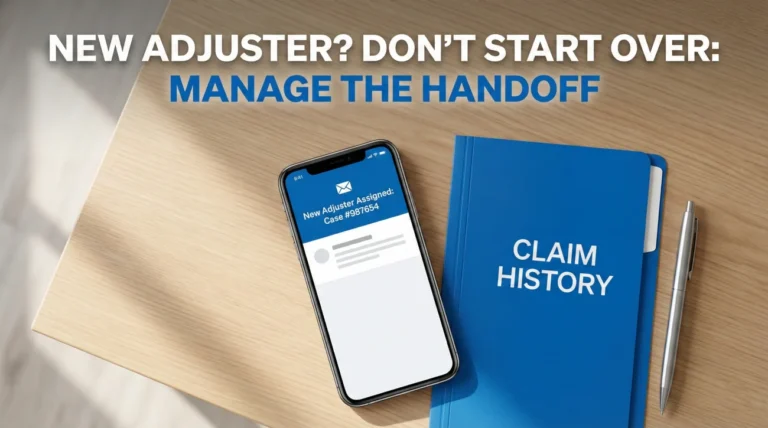

- Don’t Be a “Karen,” Be an Auditor: Screaming “I want your manager” gets you labeled as difficult. Presenting a list of three missed deadlines gets you labeled as a priority.
- The “Process Failure” Framing: Supervisors are protected from angry customers. They are not protected from documented process failures. Frame your request around the timeline, not the person.
- The “Chain of Command” Rule: Never skip the Team Lead. If you email the Executive Office first, you will likely just be routed back to the adjuster, wasting two weeks.
- The “Supervisor Packet”: Never escalate empty-handed. Forward the full email chain so the supervisor can see the silence with their own eyes.
The Nuclear Option (That Isn’t Nuclear)
There comes a point in every stalled claim where being polite stops working. You have sent the emails. You have left the voicemails. You have waited the standard turnaround times three times over. And still, nothing moves.
The natural impulse is to pick up the phone and demand to speak to a manager. In my years in claims operations, I have listened to thousands of these calls. The vast majority of them fail. They fail because the homeowner vents their frustration instead of presenting their case.
Asking for a supervisor is not a declaration of war. It is a procedural tool. When used correctly, it is simply a way to say: “The current resource assigned to this file is stuck; I am requesting a resource who can unstick it.” This guide will teach you how to ask for a claim supervisor without sounding like a threat, and more importantly, how to get them to actually solve the problem.
Operational Reality: Who Are You Actually Calling?

Before you escalate, you need to understand the hierarchy. Insurance companies often run on strict chain-of-command logic. They respect the hierarchy, and skipping steps usually results in being pushed back down the ladder.
In many large carriers, the structure typically looks like this:
- 🔻 The Desk Adjuster: Your day-to-day contact. They are often managing a high volume of open files (sometimes 100+).
- 🔻 The Team Lead (TL): The first layer of management. They usually approve payments over the adjuster’s limit and handle “soft” escalations.
- 🔻 The Unit Manager: They manage the metrics of the whole team. They care about “Cycle Time” (how fast claims close) and “Complaint Ratio.”
Field Note: Most homeowners try to jump straight to the Unit Manager or the VP. This often backfires. The system is designed to route you back down to the lowest level you skipped. To make an escalation stick, you must usually climb the ladder one rung at a time.
The “Three Strikes” Checklist: Are You Ready?
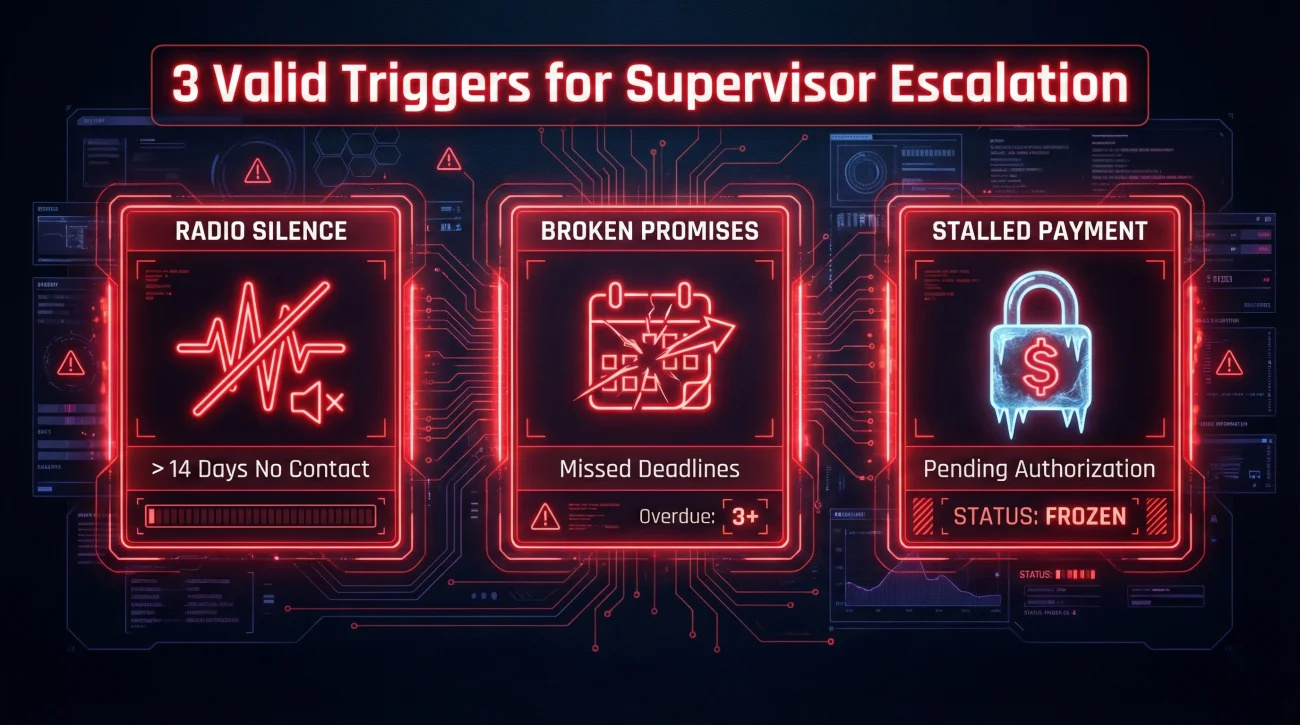
Supervisors are busy. Their job is to protect their team from “noise.” To get past the gatekeeper, you need a valid trigger. “I am annoyed” is not a trigger. “Process failure” is a trigger.
In my experience, an escalation is most effective when you can demonstrate one of these specific failures:
✅ The “Radio Silence” Trigger
The adjuster has not responded to distinct attempts (e.g., email, voicemail, email) over an extended period (typically 7-10 business days).
✅ The “Broken Promise” Trigger
The adjuster stated in writing “You will have the estimate by Tuesday,” and it is now Friday with no update. This has happened at least twice.
✅ The “Stalled Payment” Trigger
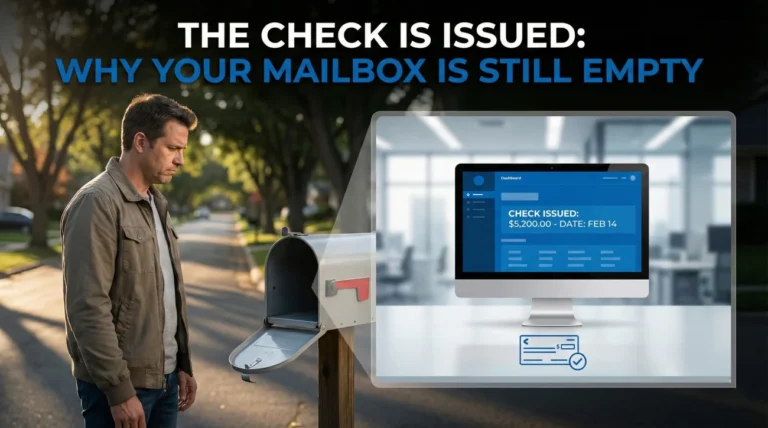
You received a written confirmation that payment was issued, but a significant time has passed (e.g., 14 days) and no check has arrived, and the adjuster cannot provide a tracking number.
If you don’t have these specific facts, pause. Go back to our Insurance Claim Follow-Up System and build your paper trail first. You cannot audit a file that has no data.
Step 0: Before You Dial (The 3-Line Timeline)
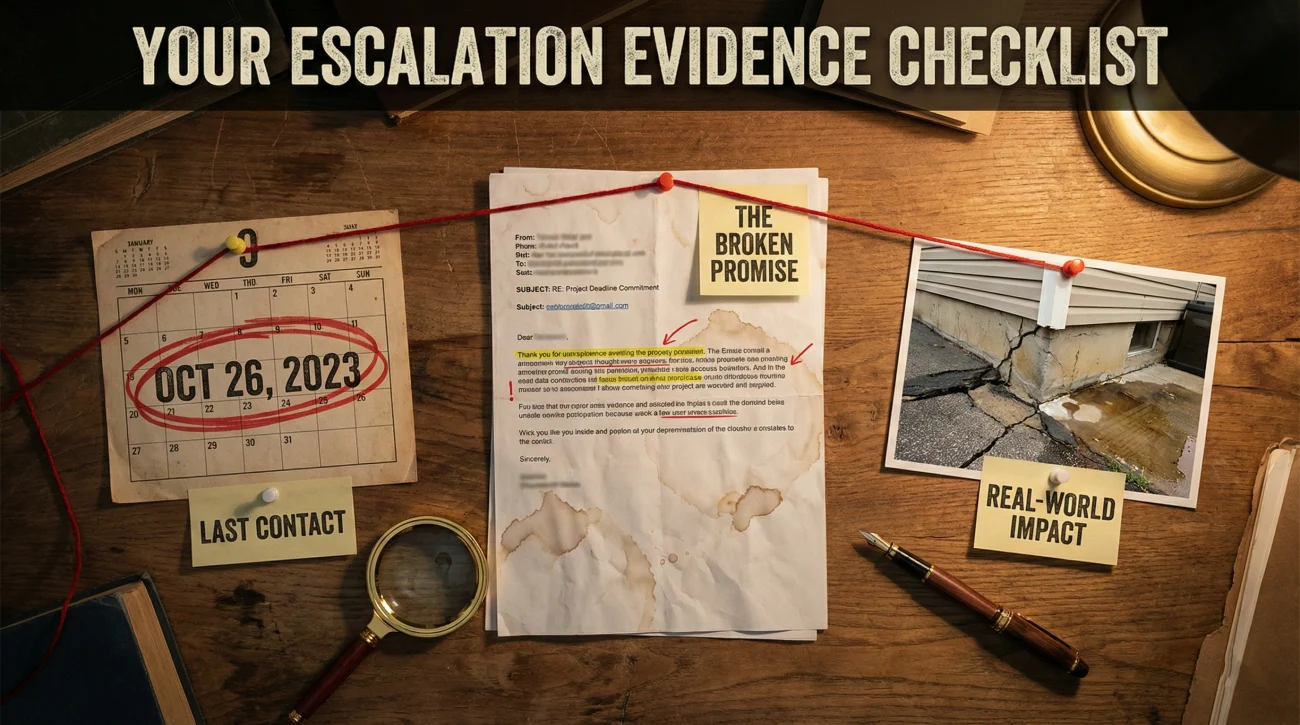
Before you send the email or make the call, write down these three lines. This is your “entry ticket” to the supervisor’s attention. If you ramble, they tune you out. If you read this list, they start typing notes.
1. Last Contact: “I attempted contact on [Date] via [Method] and [Date] via [Method].”
2. The Promise: “Adjuster [Name] stated in an email on [Date] that the estimate would be ready by [Date].”
3. The Impact: “Because this is missing, my contractor cannot begin [Specific Task], causing further delay.”
The 3 Levels of Escalation Emails
One size does not fit all. Depending on how severe the delay is, choose the script that matches your situation.
Level 1: The “Soft” Nudge (To the Team Lead)
Use this when the relationship is good but the adjuster has gone quiet.
Subject: Check-in on Claim #[Number] – Adjuster Unavailable?
Hi [Team Lead Name],
I am cc’ing you because I haven’t been able to reach [Adjuster Name] since [Date]. We are past the date discussed for the [Estimate/Review].
Could you please check if they are out of office or if this file needs a nudge? I just need to keep the timeline moving.
Thanks,
[Your Name]
Level 2: The “Firm” Request (To the Unit Manager)
Use this when promises have been broken multiple times.
Subject: Process Failure – Supervisor Review Requested – Claim #[Number]
To the Claims Department,
I am requesting a supervisor review of my file due to a recurring stall in the process. My desk adjuster has missed three consecutive deadlines ([Date 1], [Date 2], [Date 3]) regarding the missing estimate.
I simply need a manager to step in, locate the file, and provide the status update that was promised.
Please have a Manager contact me by [Date + 48 hours].
[Your Name]
Level 3: The Pre-DOI Notice (Polite but Serious)
Use this only after Level 2 has failed. This is your last internal step before going external.
Subject: Urgent: Unresolved Claim Delay – Claim #[Number]
To the Claims Manager,
Despite previous requests to [Adjuster] and [Team Lead], my claim remains stalled with no communication since [Date]. This lack of response appears to fall outside of standard handling guidelines.
I am attempting to resolve this through your internal grievance process first. Please provide a substantive update by [Date] so I do not need to seek assistance from the Department of Insurance to get a response.
Regards,
[Your Name]
The “Supervisor Packet” Checklist
When you escalate, make it easy for the manager to say “yes.” Do not make them hunt for information. Attach or paste these items at the bottom of your email:
| Item | Why Include It |
|---|---|
| The Forwarded Chain | Don’t start a new email. Forward the chain showing your 3 unanswered emails. Let them see the silence. |
| Claim Number & Loss Date | Put this in the subject line and the first sentence. |
| The Stall Point | “Stuck at Estimate Review.” Be specific about the stage. |
| One-Sentence Ask | “I need a confirmed date for the inspection.” Clear and actionable. |
| Screenshot of Promise | If they texted “I’ll call Tuesday,” screenshot it and attach it. |
What Success Looks Like (Setting Expectations)
When a supervisor takes ownership, don’t expect a check in 10 minutes. Here is what a successful operational outcome actually looks like:
- ✅ The “Manager Review” Pause: They will say “Give me 24 hours to read the file.” This is good. It means they are auditing.
- ✅ Reassignment: Often, the “fix” is moving your file to a different adjuster who has capacity.
- ✅ A “Firm” Date: They might not pay you today, but they will give you a hard date (e.g., “Thursday at 2 PM”) for the next step.
💡 Operational Tip: If they ask for 24 hours to review, grant it. But pin them down: “I agree to the review. Can we schedule a 5-minute call for tomorrow at 2 PM to discuss your findings?”
How to Blow Your Escalation (Don’t Do This)
I have seen homeowners ruin valid escalations by losing their cool. If you act irrationally, the supervisor switches from “Problem Solver” mode to “Security” mode.
- ❌ The “Bad Faith” Threat: Screaming “This is bad faith!” in the first 5 minutes shuts down conversation. Save legal terms for lawyers.
- ❌ Insulting the Adjuster: Calling the adjuster “lazy” or “stupid” makes the supervisor defensive. They hired that adjuster. Stick to facts: “The adjuster is unresponsive.”
- ❌ Refusing to Hang Up: Saying “I’m not hanging up until this is fixed” doesn’t work. They will just mute you. Ask for a callback time and hang up professionally.
Final Words: It’s Just Business
Escalating to a supervisor feels personal, but it isn’t. It is a business transaction. You paid for a service (coverage), and the delivery of that service is delayed. You are simply asking management to troubleshoot the delivery mechanism.
Keep your tone flat, your dates accurate, and your requests specific. A supervisor is a powerful tool to unlock a claim, but only if you hand them the right key.
❓ FAQ: Supervisor Escalation
📞 Can they refuse to let me speak to a supervisor?
Technically, call center reps can refuse to transfer you if they think they can solve it. But if you insist “I have a recurring process failure that requires management review,” most will escalate a ticket for a callback. They may not transfer you live, but they must log the request.
📧 How do I find the supervisor’s email address?
Ask the adjuster. Send a simple email: “Please provide the name and contact information for your Team Lead.” In many cases, they should provide this upon request. If they ignore you, call the main claims hotline and ask the operator.
🔄 What does it mean if my claim is “Reassigned”?
This is often a good thing. It means the supervisor realized the original adjuster was overloaded or inactive. The file is moved to a new adjuster with more capacity. It’s not a restart; it’s a rescue.
🤝 Can I escalate without damaging the relationship?
Yes. If you frame it as “I know you are busy, so I’m asking your manager for resources to help us,” you maintain professional ground. Most adjusters are actually relieved when a difficult file gets management attention because it takes the pressure off them.
🛑 What if the supervisor ignores me too?
If the Team Lead ignores you for an extended period (e.g., 3-5 business days), you repeat the process up to the Unit Manager. If that fails, you may have grounds for a formal Department of Insurance complaint, as the carrier may be failing its internal grievance process.
📝 Should I tell my agent I’m escalating?
Yes. Your insurance agent (the one who sold you the policy) often has a “back door” number to the claims department. CC them on your escalation email. Their name on the email often gets faster attention.
⚖️ Is asking for a supervisor the same as filing a complaint?
No. Asking for a supervisor is an internal operational step. Filing a complaint (with the state DOI) is an external regulatory step. Always exhaust the internal supervisor options before going external.
⏳ How long should I wait for a callback?
Typical industry turnaround for a supervisor callback is often 24 to 48 hours. If you call at 4 PM on Friday, don’t expect a call until Tuesday morning.
⚠️ Disclaimer: PropertyClaimChecklist.com provides practical guidance, process checklists, and example follow-ups to help you organize a property claim and move it forward. It is not policy language, claim documentation, legal content, or a substitute for your insurer's instructions. Always rely on your carrier's requirements and your actual policy terms for what must be submitted and how decisions are made.