
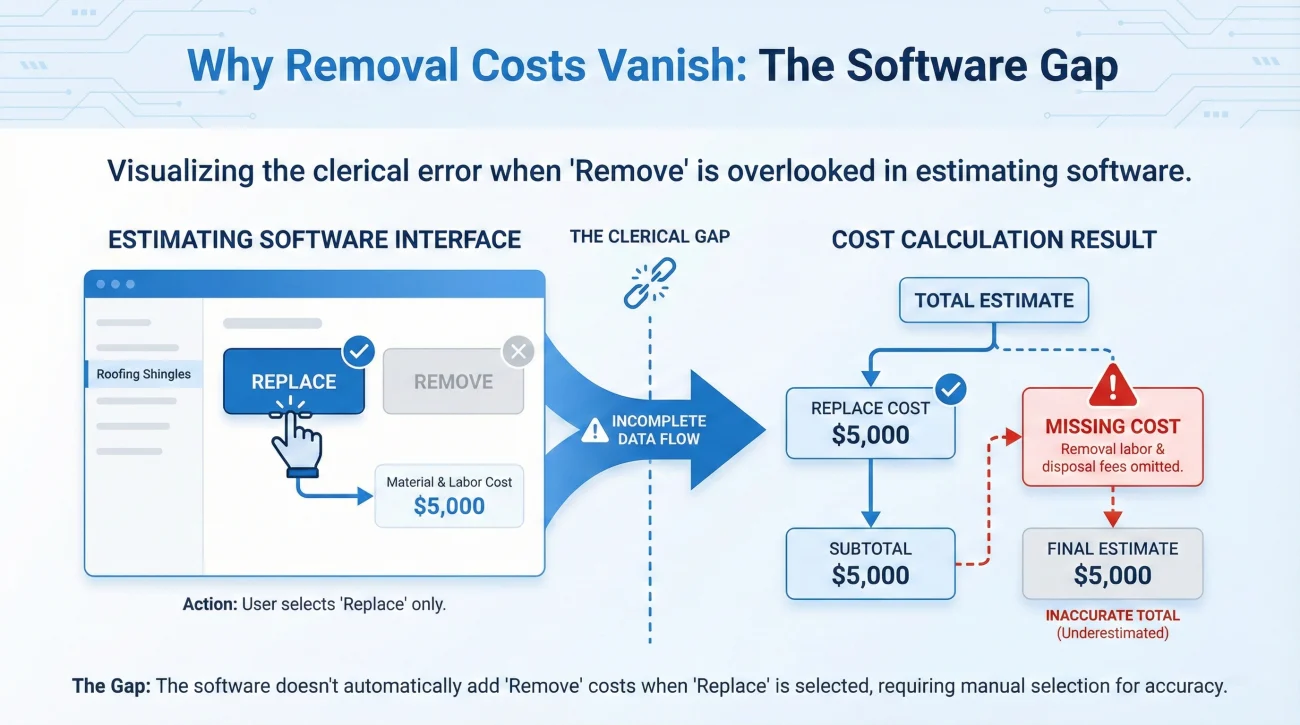
- Demo and debris removal are frequently missing from initial estimates because estimating software often separates “remove” from “replace” line items.
- A complete scope must account for tear out labor, bagging materials, carrying debris, dumpster rental fees, and final dump weight tickets.
- Keep a structured gap log to track exactly which rooms are missing demolition costs before you request a revision.
- It is a good practice to ask for requirements in writing when presenting your missing scope log, and keep receipts and photos of all debris piles.
The Silent Leak in Property Claims
When I review property claim files in my day to day operations, finding that the initial paperwork completely ignores tear out costs is one of the most common patterns I see. When dealing with a demo disposal debris removal missing estimate, it is often a quiet gap. You look at the document, you see line items for new drywall, new baseboards, and new flooring, and it feels like everything is covered. But a critical phase of the project is entirely missing: the hard, physical work of tearing the damaged house apart and throwing it away.
In many cases, the estimating software used in the field requires the user to specifically select both a “remove” action and a “replace” action for every single material. If someone is moving quickly, they might only click “replace.” As a result, you are left with an estimate that pays for the new paint and materials, but offers zero accounting for the labor to rip out wet carpet, carry fifty pound bags of debris down a flight of stairs, or pay the local landfill fees.
I always tell people that documentation hygiene starts with organizing your proof of what was actually removed. You cannot just tell a desk reviewer, “Hey, we had a lot of trash.” You have to show them exactly what was taken out, where it came from, and what it cost to haul it away. This guide will walk you through exactly how to audit your paperwork, build a gap log, and communicate clearly when tear out costs are missing.
Why Tear Out and Cleanup Get Left Behind
To understand how to fix a missing scope issue, it helps to understand why it happens in the first place. When a property is damaged, the immediate focus is usually on drying it out or stabilizing it. By the time an estimator walks through, the pile of wet drywall or charred wood might already be sitting in the driveway, or it might have been hauled away by an emergency mitigation crew.
A common pattern I see is a disconnect between the emergency services invoice and the repair estimate. The repair estimator might assume the emergency crew already billed for the dumpster and the tear out. Meanwhile, the emergency crew might only bill for the exact items they touched, leaving the remaining demolition for the general contractor. In this gap, the remaining demo costs simply vanish from the paperwork.
Key Point: Do not assume that “replacement” line items automatically include the labor or costs to remove the old materials. In most estimating platforms, removal and replacement are handled as two separate line items with two separate costs.
Another reason these costs disappear is the complexity of debris removal itself. Hauling away trash is not a single action. It involves labor to fill contractor bags, labor to carry those bags outside, the rental cost of the dumpster, the delivery fee for the dumpster, and the final weight ticket at the landfill. If any of these links in the chain are overlooked, your estimate will be short.
If you are finding that the entire scope is light, not just the demo, it often helps to step back and look at the whole picture. I put together a framework for responding to a low estimate that shows how to map out all your missing items and build a complete response packet.
The Master Demo and Disposal Checklist
When I help people organize their claim files, I have them stop looking at the dollar amounts and start looking purely at the actions. We go room by room and ask: what physically had to be broken, detached, or thrown away here?
If you are doing a quick triage of your paperwork, check these five categories first: floors, drywall and insulation, cabinets and fixtures, hauling fees, and final cleaning. If any are missing, use the detailed breakdown below to spot exactly what needs to be added.

Flooring and Subfloor Removal
Flooring tear out is highly variable. Pulling up carpet pad requires a different amount of labor compared to chipping out ceramic tile set in mortar.
- ✅ Carpet and pad removal (often billed by the square yard or square foot).
- ✅ Hardwood floor tear out (requires cutting, prying, and heavy lifting).
- ✅ Tile demolition (requires chipping, scraping thinset, and heavy bagging).
- ✅ Subfloor removal (if water or fire damaged the plywood beneath).
- ✅ Tack strip removal (often a separate line item from the carpet itself).
Walls, Ceilings, and Insulation
This is where volume adds up quickly. Drywall is incredibly heavy, especially when wet, and it takes up massive space in a dumpster.
- ✅ Drywall tear out (usually measured in square feet, separated by walls vs ceilings).
- ✅ Plaster and lath removal (significantly more expensive and labor intensive than drywall).
- ✅ Insulation removal (bagging wet fiberglass or scooping blown in cellulose).
- ✅ Baseboard, crown molding, and trim removal.
- ✅ Wallpaper scraping or paneling removal.
Cabinetry and Fixtures
Sometimes items are not thrown away, but they still have to be removed to perform the repair. If they are thrown away, they take up massive dumpster volume.
- ✅ Kitchen and bathroom cabinet tear out.
- ✅ Countertop removal (granite and quartz require heavy labor).
- ✅ Plumbing fixture detachment (sinks, toilets, tubs).
- ✅ Light fixture and ceiling fan removal.
- ✅ Appliance moving and resetting.
Hauling and Dump Fees
This is the category that is most frequently missing from standard estimates. Hauling is the logistical cost of getting the mess off your property.
- ✅ Dumpster delivery and pickup fees.
- ✅ Daily or weekly dumpster rental fees.
- ✅ Landfill tipping fees (usually billed per ton).
- ✅ Load and sweep labor (the hours spent walking debris from the house to the street).
- ✅ Specialty disposal fees (for hazardous materials, appliances, or heavy masonry – ask your contractor for separate disposal receipts for these).
⚠️ Warning: Do not let a single line item that says “Debris Removal – 1 Load” trick you into thinking all your dump costs are covered. In a major loss, you might need three dumpsters, and a single generic line item will not cover the actual tonnage.
How to Document Multiple Loads
When dealing with a major loss, one generic debris line item will not cut it. To document multiple loads effectively: photograph each dumpster while it is loaded, ask your hauling company for an invoice per pickup, keep the specific weight ticket for every single trip, and map each of those tickets to the corresponding rooms in your gap log.
Building Your Missing Scope Gap Log
Once you have identified what is missing, you need a clean way to present it. In my experience, sending a long, angry paragraph about how “the estimate is completely wrong and you forgot the dumpsters” usually results in delays. The desk reviewer has to translate your paragraph into their estimating software, and if it is not clear, they will push it back.
Instead, I recommend building a simple gap log. A gap log is just a table that lists the room, the item that is being replaced on the estimate, and the missing removal action that corresponds to it. This makes it incredibly easy for the reviewer to verify your request against their own file.
| Room Location | Item to be Replaced (On Estimate) | Missing Demo Scope & Quantity | Photo & Receipt Name |
|---|---|---|---|
| Kitchen | Line 14: Replace lower cabinets | Labor to detach and discard 12 linear ft of cabinets | kitchen_debris_pile.jpg |
| Living Room | Line 22: Replace 5/8 drywall | Labor to tear out, bag, and carry out 400 sq ft of wet drywall | contractor_labor_log.pdf |
| General Site | Not listed | 30 yard roll off dumpster rental and 2 tons of landfill fees | dumpster_invoice_#123.pdf |
By framing the problem this way, you are not arguing about money. You are simply pointing out a mechanical error in the scope: if new drywall is going in, the old drywall had to come out, and the removal phase was left off the document.
Operational Scenario: A Kitchen Water Leak
Let’s look at a realistic mini-scenario to see how this plays out operationally. Imagine a supply line breaks under a kitchen sink. The water ruins the base cabinets, the laminate flooring, and part of the drywall behind the sink.
When the initial paperwork arrives, it lists replacement costs for the cabinets, the laminate, and the drywall. However, it entirely omits the demo phase. What does good process look like in this situation?
First, the homeowner does not immediately call and demand more money. Instead, they organize their proof. They save the photos showing the contractor tearing out the cabinets. They save the image of the massive debris pile in the garage. They collect the receipt from the local landfill where the contractor dropped off the wet materials.
Next, they build their gap log, noting exactly which removal actions are missing for the cabinets, flooring, and drywall. Finally, they write a neutral, process focused message requesting a scope revision based on the documented evidence. They do not talk about unfairness; they talk about scope alignment. This calm, structured approach is what moves files forward.
“Your estimate is terrible. You didn’t pay my contractor for all the tearing out he did, and the dump charged us a fortune.”
“I am reviewing the initial estimate and noting that while replacement materials for the kitchen are included, the scope does not include the tear out labor, bagging, and hauling fees for the damaged materials. Please advise what documentation you need to review these missing demo items.”
How to Request a Scope Revision for Demolition
When you are ready to submit your gap log and your proof, your communication hygiene needs to be spotless. Keep the email brief, reference the claim number in the subject line, and ask a clear question about what is required next.
I always suggest using a standard formula for these types of messages.
💡 Formula: [State the gap] + [List the attached proof] + [Ask for written requirements]
Here is a copy-paste safe script you can adapt for your own file. It is neutral, polite, and creates a clear written trail of your request.
Hello [Name],
I am reviewing the initial estimate provided on [Date]. I noticed that while the replacement of [List 2-3 main items, e.g., drywall and flooring] is included, the scope does not currently account for the demolition labor, debris bagging, and dump fees required to remove the damaged materials.
I have attached a brief gap log outlining the missing tear out scope, along with photos of the debris and the landfill weight tickets for your review.
Please let me know if you need any additional documentation to update the scope to include these missing demolition and disposal items.
Thank you,
[Your Name]
Common Mistakes When Documenting Debris Removal
In the stress of cleaning up a property, people often make fast decisions that hurt their documentation later. Based on the files I have reviewed, here are the most common mistakes to avoid when dealing with demo and hauling costs.
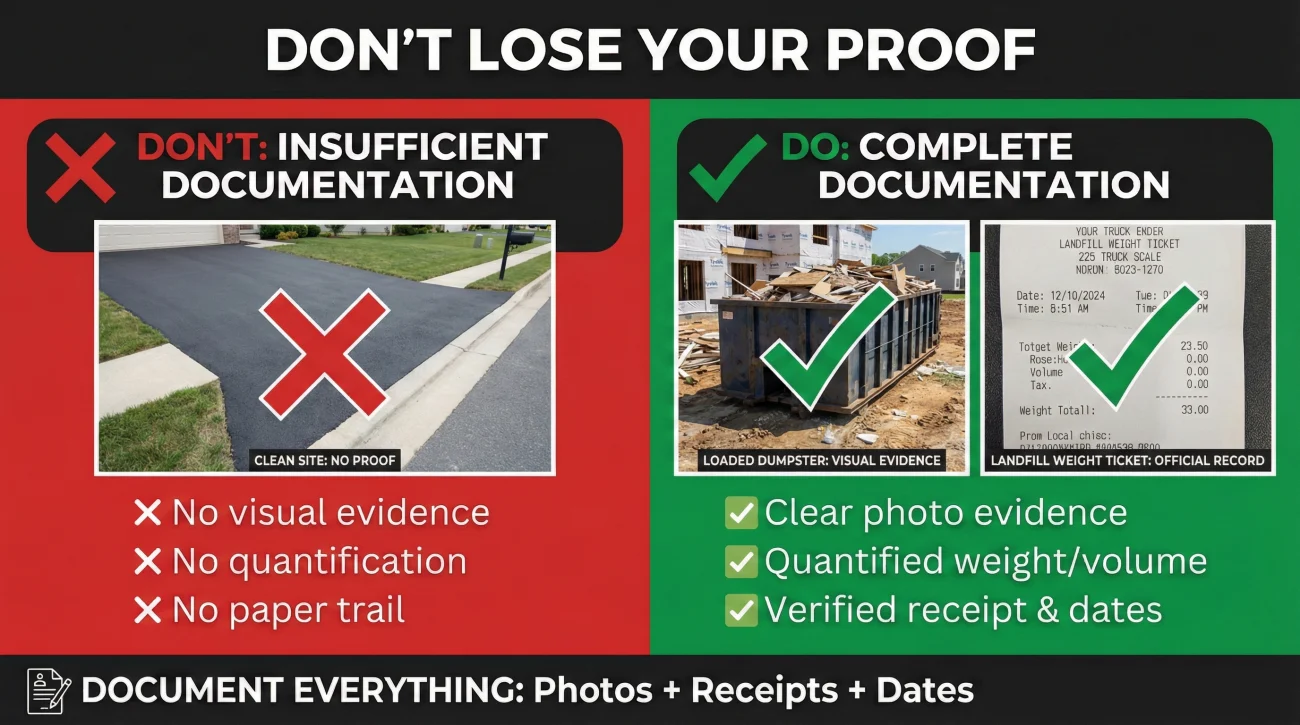
Mistake 1: Throwing Debris Away Without Photos
This is a very common issue I see. A homeowner or contractor gets tired of looking at the pile of ruined drywall and hauls it to the dump before anyone takes a picture. If there is no photo of the debris pile or the full dumpster, it is much harder to prove the volume of tear out that occurred. Always take photos of the trash before it leaves the property.
Mistake 2: Losing the Dump Weight Tickets
Landfills charge by weight. A receipt that just says “Dump Fee – $300” is often not enough. You want the actual weight ticket that shows the gross weight, the tare weight, and the net tons of debris dropped off. This piece of paper is hard proof of exactly how much physical material was removed from your home.
Mistake 3: Grouping Demo Labor with Repair Labor
If you are submitting a contractor invoice to prove your costs, make sure the contractor separates their demolition time from their rebuilding time. If an invoice just says “Labor for kitchen – 40 hours,” it is impossible for a reviewer to tell how much of that time was spent tearing out wet cabinets versus installing new ones. Ask your contractor to itemize demo labor separately.
Final Thoughts on Managing Missing Scope
Finding a demo disposal debris removal missing estimate is not a reason to panic. It is a very normal part of the claims process, usually stemming from how estimating software handles removal versus replacement line items. The key to resolving it is your documentation habit.
Stop trying to argue the total dollar amount, and start proving the physical actions. Use the checklist to audit every room, build your gap log, gather your dump tickets and photos, and present a clean, organized request. When you treat the missing costs as a simple clerical gap rather than a massive dispute, you make it much easier for the reviewer to verify your proof and update the file.
❓ FAQ
🗑️ Why is debris removal not on my initial paperwork?
It is commonly left off because estimating software often treats “remove” and “replace” as two separate actions. If the person writing the scope only focuses on the materials needed to rebuild, the removal phase simply drops off the document.
💧 Does mitigation include demolition, or is that separate?
It depends on the emergency crew’s specific invoice. Often, a mitigation crew only tears out the immediately wet materials (like baseboards or lower drywall) to dry the framing. They rarely do full structural demolition, leaving a gap between what they billed and what the general contractor still needs to remove.
🚚 Do standard estimates usually include dumpster rental fees?
They should, but they frequently do not. Dumpsters involve delivery fees, rental time, and tonnage fees. You often have to specifically request these line items be added by providing your actual dumpster invoices.
💼 How do I prove I had to pay for hauling?
The best proof consists of three things: photos of the debris pile at the property, the invoice from the hauling company or dumpster rental, and the official weight ticket from the local landfill.
🛠️ Is tear out labor included in the replacement cost?
In almost all cases, no. Installing a new item and removing a destroyed item are two different line items with different labor calculations. Always check to see if there is a specific removal line item for every replacement line item.
📸 What photos do I need before throwing damaged items away?
Take wide angle photos of the debris piled in the room, photos of the contractor bags sitting outside, and a photo of the loaded dumpster. You want to clearly document the volume of the materials removed.
📝 How do I ask them to add the missing demolition costs?
Create a simple list matching the replacement items on the document to the missing tear out actions. Send this list via email, attach your dump receipts and debris photos, and ask what is needed to revise the scope.
💰 What happens if my contractor’s demo bill is higher than the estimate?
Compare the line items first. Usually, a higher contractor bill means the contractor accounted for hauling fees, dump tickets, and heavy labor that the initial document simply missed. Present the contractor’s itemized breakdown to show the gap.
🧾 Can I just send my dump receipts to get the file updated?
Sending receipts is good, but sending them with context is better. Always include a brief note or gap log explaining exactly which rooms and materials those dump receipts correspond to, so the reviewer can map the cost to the damage.
🏷️ What do the line items for tear out actually look like?
They typically appear right next to the replacement items and say things like “Tear out and bag wet drywall,” “Remove carpet and pad,” or “Debris removal – pickup truck load.” If you only see the word “Replace,” the tear out is likely missing.
⚠️ Disclaimer: PropertyClaimChecklist.com provides practical guidance, process checklists, and example follow-ups to help you organize a property claim and move it forward. It is not policy language, claim documentation, legal content, or a substitute for your insurer's instructions. Always rely on your carrier's requirements and your actual policy terms for what must be submitted and how decisions are made.