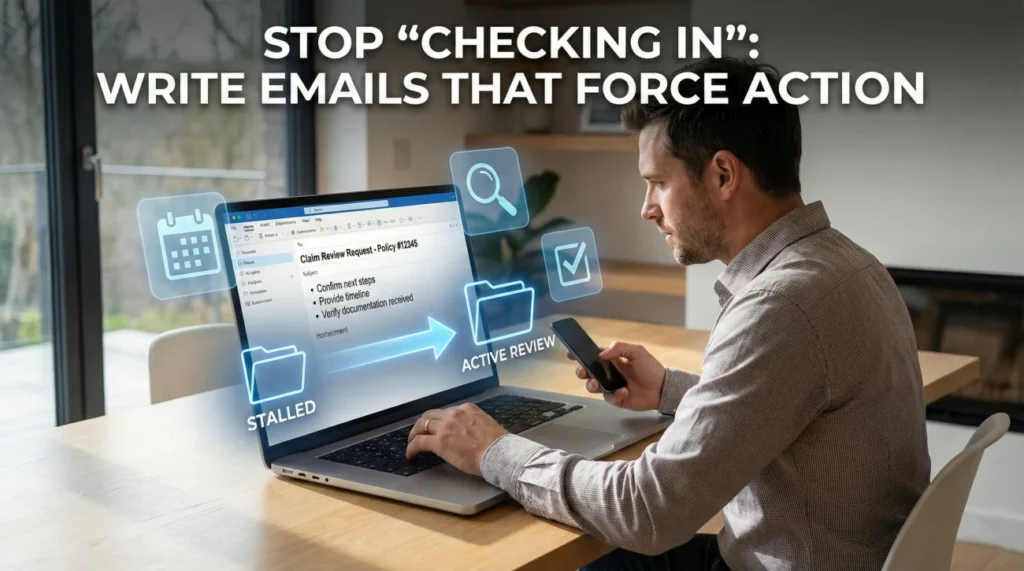
- A generic “checking in” email often gets ignored because it does not ask a specific question that forces a process update.
- To get a clear reply, you must ask targeted questions about the current stage of your file and whether the adjuster is waiting on you for anything.
- Always include your claim number in the subject line and format your emails using short, readable bullet points.
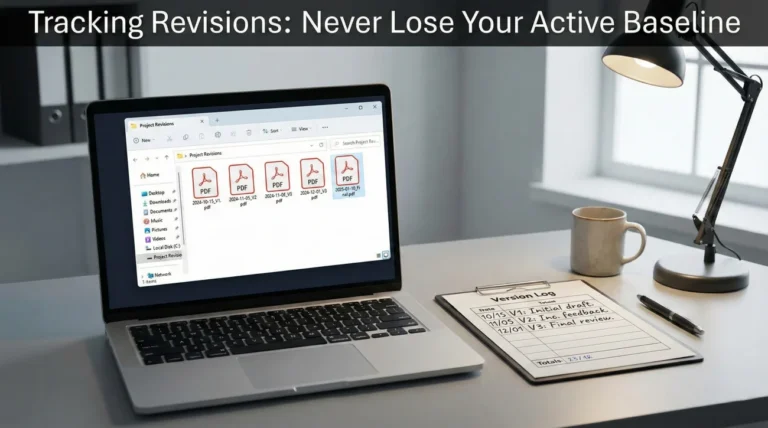
- If you attach documents to a status update, use a clear index so you do not accidentally create duplicate files in the insurer system.
The Frustration of the Silent Waiting Period
In my experience handling claim operations, the most stressful part of the process for a homeowner is not the paperwork itself. It is the silence that follows. You spend days gathering photos, organizing receipts, and filling out forms. You hit send, and then you hear absolutely nothing for a week or two.
When you are living in a damaged house, every day feels like a month. It is incredibly tempting to fire off a quick message asking, “Can you tell me what is going on?” But I often see files where this approach actually slows things down. Adjusters handle dozens, sometimes hundreds, of open files at the same time. When they receive a vague email asking for an update, it is very easy for them to look at the file, see no immediate red flags, and put that email at the bottom of their to-do list.
Key Point: If your email does not require a specific, factual answer, it will likely be treated as low priority. The goal of a claim status update email is to force a snapshot of exactly where your file sits in their system right now.
To get a reply that actually helps you plan your next steps, we have to change the way we ask for updates. We need to stop asking for general feelings and start asking about specific process milestones.
Why the Standard “Checking In” Email Fails
Let me share a common pattern I see in communication logs. A homeowner sends a message on Tuesday saying, “Just checking in to see if there is any news.” Thursday arrives with no reply. The homeowner sends another message on Friday: “Hello, checking in again, please call me.”
This creates a messy communication trail. The mistake here is not the frequency of the emails, but the lack of a clear prompt. From an operational standpoint, a desk adjuster reviewing that message does not know what you need. Do you need temporary housing? Are you asking if a specific receipt was accepted? Are you waiting for a field inspection date?
When you write a claim status update email, you must remove the guesswork. You need to make it as easy as possible for the person on the other end to give you a one-sentence, factual answer.
“Hi, I am just following up on my claim. It has been a while and I really need an update. Please let me know the status.”
“Hello, I am writing to check if my file has moved past the field inspection review stage. Are you currently waiting on any specific documents from me to complete your evaluation?”
⚠️ Warning: Avoid using language that sounds accusatory or overly emotional in your written requests. Stick strictly to the administrative facts. A neutral, process-focused email is often processed much faster than a complaint.
Status vs. Milestone vs. Owner
In my operational experience, asking for a general “status” is the wrong approach. “Status” is a feeling; “under review” is the most common status given to homeowners, and it means absolutely nothing.
Instead, your email needs to uncover the “milestone” and the “owner.” What specific stage is the file in right now (the milestone), and whose desk is it currently sitting on (the owner)? If a file is “under review,” is it waiting for a desk adjuster to read it, a manager to approve it, an external engineer to submit a report, or a payment processor to cut a check?
Shifting your vocabulary from general status inquiries to asking about specific milestones and file owners changes the entire dynamic of your follow-ups.
The Anatomy of a High-Response Email
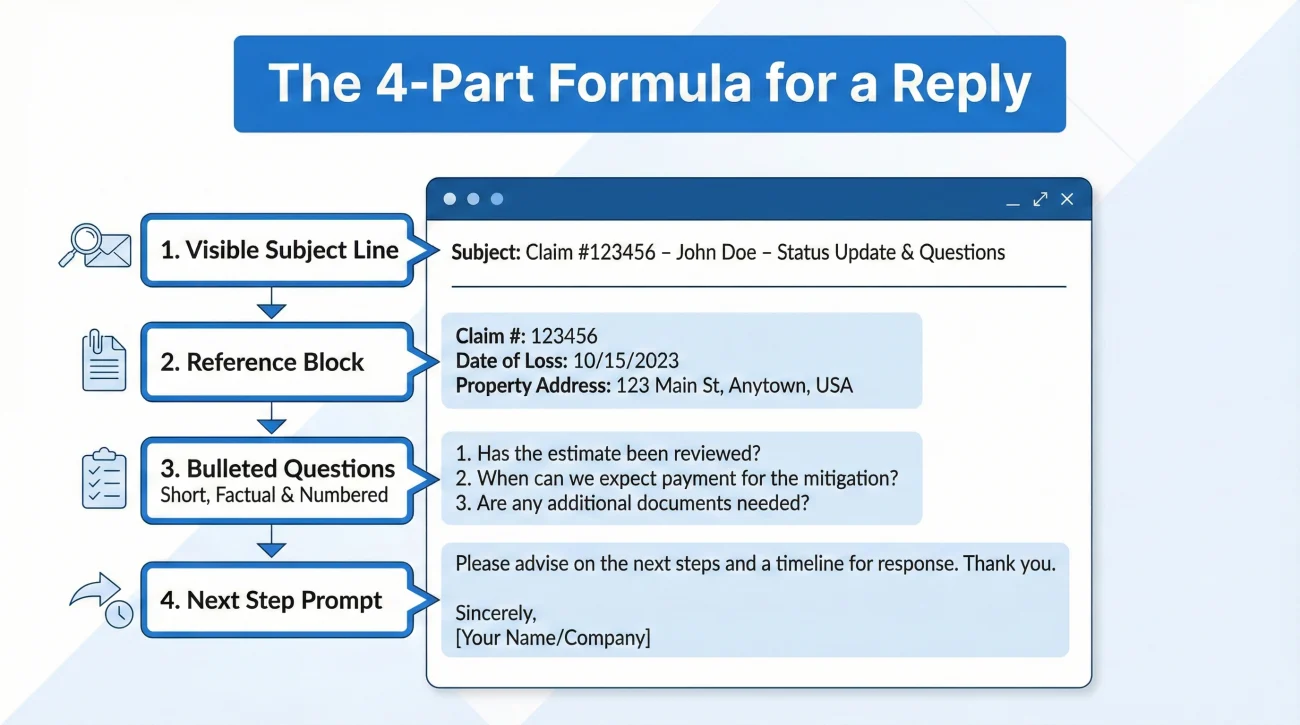
A highly effective claim status update email is built on a very specific structure. It is designed to be read quickly on a screen, often by someone who is scanning for critical information. Every message you send should follow this basic formula.
[Clear Subject Line] + [Current File Assumption] + [Direct Process Question] + [Next Step Prompt]
1. The Highly Visible Subject Line
Your subject line helps with routing; the questions in the body force the action. If the subject just says “Update” or “My Claim,” it can easily get lost or misrouted in a large corporate email system. Always format your subject line to include your claim number, your last name, and the specific purpose of the message.
2. The Reference Block
At the very top of the email body, before you even say hello, drop in a reference block. This saves the adjuster from having to search their system to find out who you are. Include the claim number, the date of loss, and the property address. I always advise making this a standard habit for every single piece of correspondence.
3. The Bulleted Questions
Never bury your questions in a massive paragraph. People skim emails. If you have three questions, put them in a bulleted list. Keep each point to one sentence. If an adjuster can read your email in fifteen seconds and reply quickly, you are much more likely to get an answer today instead of next week.
9 Questions That Force a Useful Reply
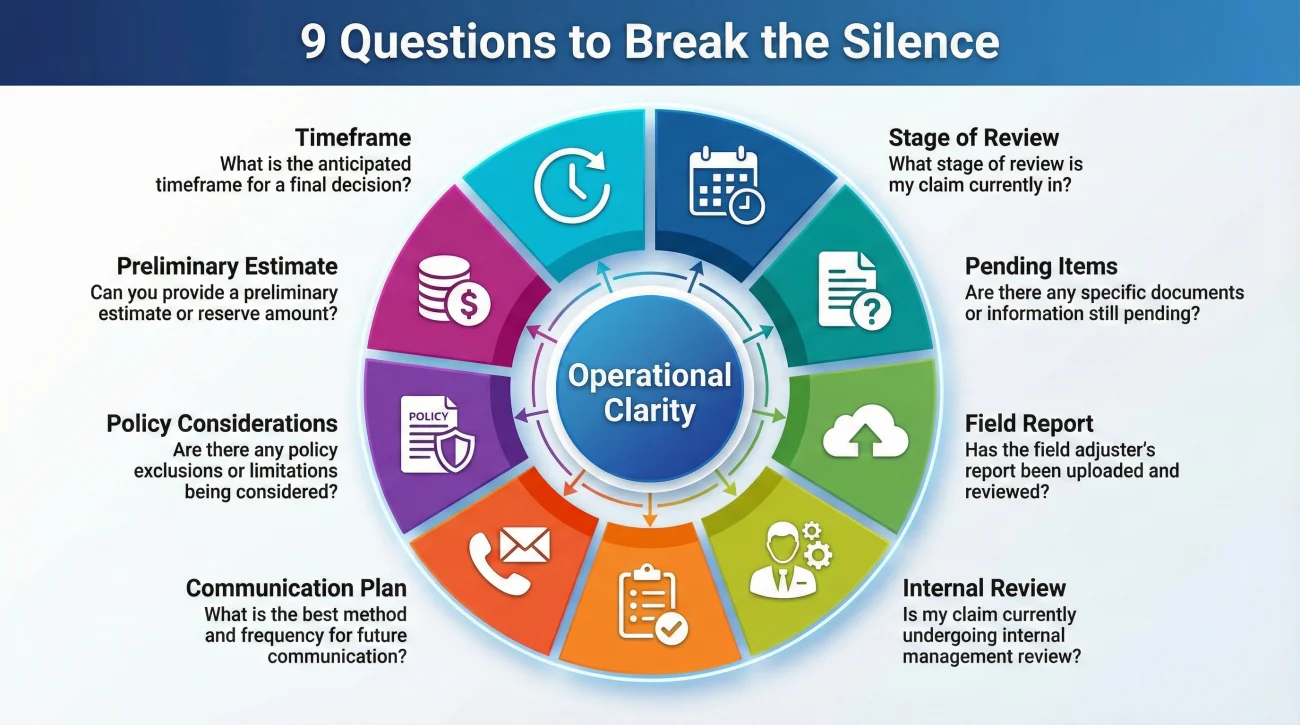
Depending on where you are in the timeline, you will need to ask different things. Do not ask all nine of these questions at once. Choose the one or two that fit your current situation. These are designed to target specific operational bottlenecks.
- 📌 1. “What specific stage of review is my file in right now?”
This stops the adjuster from saying “it is in process.” It politely demands a stage name, such as “in initial review,” “waiting for field report,” or “in management approval.” - 📌 2. “Are there any pending documents you need from me?”
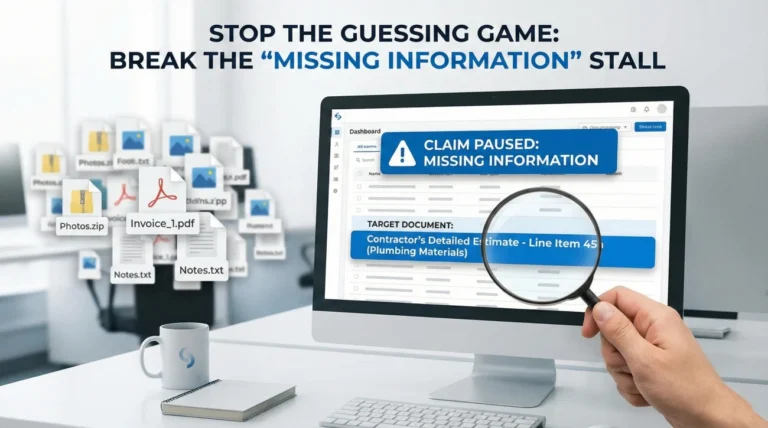
This is the ultimate defensive question. Sometimes a file sits dormant simply because the insurer needs a single photo or receipt, but nobody called to tell you. Asking this puts the burden on them to confirm your file is complete. - 📌 3. “Has the field inspection report been uploaded to the system?”
If you had an adjuster visit your home, the desk team cannot move forward until that person uploads their notes and photos. This question pinpoints whether the delay is internal. - 📌 4. “Is my file currently waiting for internal management review?”
Many files get stuck because the assigned adjuster has finished their work, but their manager has not signed off on it yet. If they say yes to this, you know the delay is not your fault. - 📌 5. “Do you need any clarification on the items I submitted on [Date]?”
If you recently sent a large batch of paperwork, ask this. It prompts them to actually open the file you sent and verify they understand it. - 📌 6. “Have the contractor estimates been reviewed by your desk team?”
If your builder submitted an estimate, it often has to be reviewed by a specialized desk appraiser. This question isolates that specific step. - 📌 7. “Is there a specific vendor report causing a delay?”
Sometimes the insurer sends an engineer, a water mitigation expert, or a roof inspector. The main adjuster is waiting on that third-party report. Asking this clarifies exactly who is holding up the line. - 📌 8. “What is the specific diary date set for the next review of this file?”
In claims operations, a “diary date” is the scheduled day the software prompts the adjuster to touch the file again. Asking for this date gives you the exact timeline for your next follow-up. - 📌 9. “What is the very next step in your internal process, and when should I follow up again?”
This is a great closing question. It forces them to outline the next milestone and sets a mutually agreed-upon date for communication.
Status Update Scripts You Can Use
Here are three ways to structure your claim status update email, depending on what you need. You can copy and paste these, but be sure to fill in your specific details. Keep the tone exactly as written: polite, brief, and factual.
Scenario A: The 7-Day Gentle Nudge
I find this template works best when you submitted your initial paperwork about a week ago. Your main goal here is just to make sure everything was categorized correctly by the mailroom and that the file is actually moving forward.
Subject: Claim Status Update Request – Claim #12345678 – Smith
Reference: Claim #12345678
Property: 123 Main Street
Date of Loss: October 1
Hello [Adjuster Name],
I am reaching out to request a brief status update on my file. On [Date], I uploaded the requested inventory forms to the portal.
Could you please reply and let me know:
1. Have those documents been successfully attached to my file?
2. Are there any additional documents you need from me at this time?
3. What is the current stage of review for this claim?
Thank you for your time,
[Your Name]
[Your Phone Number]
Scenario B: The Post-Inspection Follow Up
I highly recommend sending this format roughly three to five days after a field adjuster visits your property. You are not trying to rush the estimate; you are simply ensuring their notes made it back from the field to the main desk adjuster.
Subject: Post-Inspection Status – Claim #12345678 – Smith
Reference: Claim #12345678
Property: 123 Main Street
Hello [Adjuster Name],
I am following up regarding the field inspection that took place on [Date] with [Name of Field Adjuster].
Could you please provide a quick update on the following:
1. Has the field report been uploaded and reviewed by your desk team?
2. Is the file currently waiting for an internal management review?
3. What is the next step in the process, and when would be the best time for me to check back in?
I appreciate your help in keeping this moving.
Best regards,
[Your Name]
Scenario C: The “Missing Information” Check
When you hit a complete dead end (usually two weeks or more with zero replies), this is your escalation tool. It is a very direct way to force the adjuster to either confirm the file is proceeding or admit they need something from you.
Subject: Status Check / Missing Items Inquiry – Claim #12345678 – Smith
Reference: Claim #12345678
Hello [Adjuster Name],
I am checking the current status of my claim. It has been [Number] days since our last update on [Date].
I want to ensure I am not holding up the process on my end. Please let me know:
1. Are you currently waiting for any specific documents, photos, or forms from me?
2. If yes, please provide a written list of what is missing so I can supply it immediately.
3. If no, could you please confirm the current stage of my file?
Thank you,
[Your Name]
The Rule for Attaching Documents to Status Emails
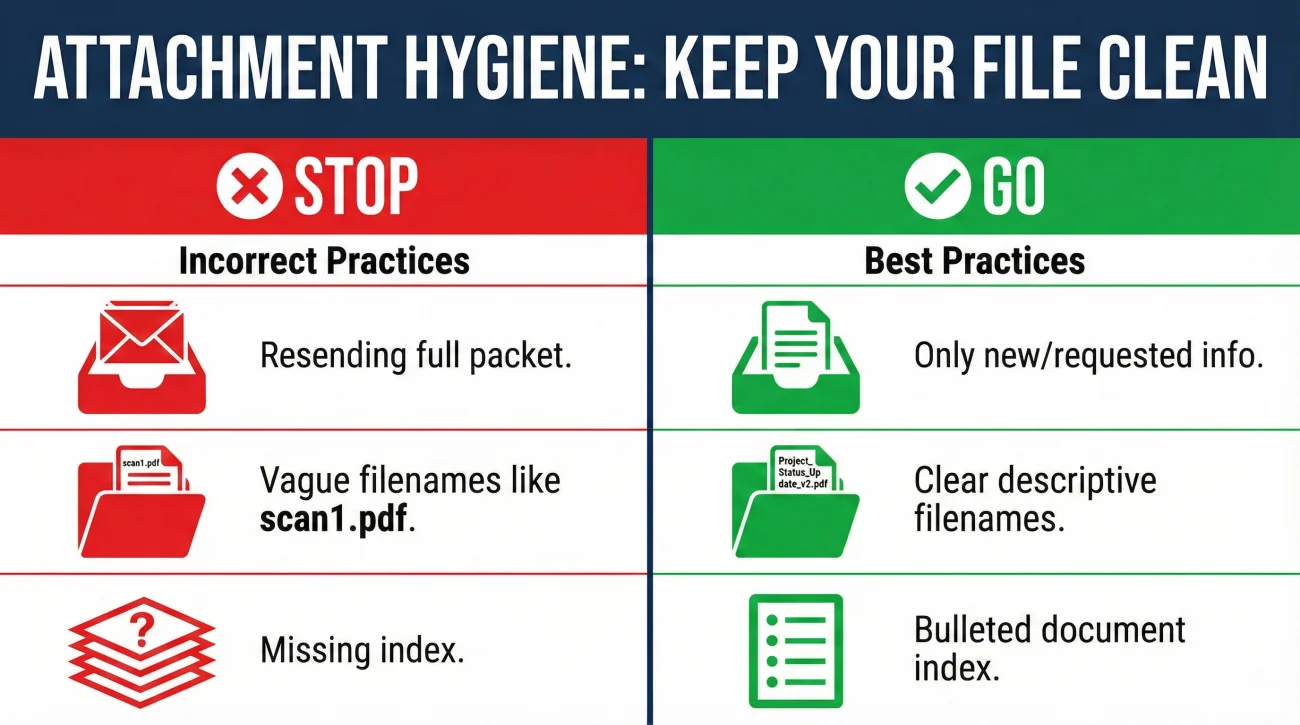
A common issue I see during the follow-up process relates to attachments. Sometimes, a homeowner will ask for an update and decide to re-attach every single document they have ever sent, just in case the adjuster lost them. This is usually a mistake.
When you dump old files into a new email, the insurer’s digital mailroom often creates duplicate entries. In my experience, the three fastest ways to create garbage in the claim system are:
- ❌ Resending your full initial claim packet just to be safe.
- ❌ Using vague file names like “scan1.pdf” instead of “Smith_Plumbing_Receipt_Oct12.pdf”.
- ❌ Attaching files without a bulleted index line explaining exactly what each document is.
Only attach documents if you are providing new information, or if the adjuster explicitly stated they did not receive a specific file.
If you are attaching a new file, your status update email must act as a clear index. Tell them exactly what is attached and what it proves. If you want to understand the master system for organizing everything before you send it, you should review our property insurance claim documents checklist. Building a clean packet from day one makes these status update emails much more effective.
💡 Pro Tip: If you must re-send a document, clearly state in your email: “I am re-attaching the [Name of Document] that was originally sent on [Date] for your convenience.” This tells the adjuster it is a duplicate, not a new submission.
Real-World Patterns: Bottlenecks and Glitches
To see how this works in practice, let me walk you through a few common situations where targeted status update emails uncover the real problem.
The 14-Day Silence (Third-Party Delay)
A homeowner experienced a severe plumbing leak. They submitted their forms, a field adjuster came out, and then 14 days went by with absolute silence. Calling the 1-800 number only got them a vague “it is processing” response.
The homeowner switched tactics and sent a written email directly to the adjuster using the exact structure from Scenario B above. They specifically asked: “Has the field report been uploaded, and are you waiting on any documents from me?”
While response times vary heavily depending on the carrier, in this specific instance, an email reply came back four hours later. The adjuster stated, “The field report is in, but we are waiting for a water mitigation dry-out log from your contractor.” By asking a targeted question, the homeowner uncovered the bottleneck immediately, retrieved the log, and the file moved forward.
Mini Case: The Silent Reassignment
Sometimes you send two perfect update emails and hear nothing. In one case I observed, the homeowner escalated by emailing the manager. The reply revealed that the original adjuster had left the company, and the file had been reassigned. The old email inbox was unmonitored. Asking for the “current owner” is what broke the silence.
Mini Case: The Portal Upload Gap
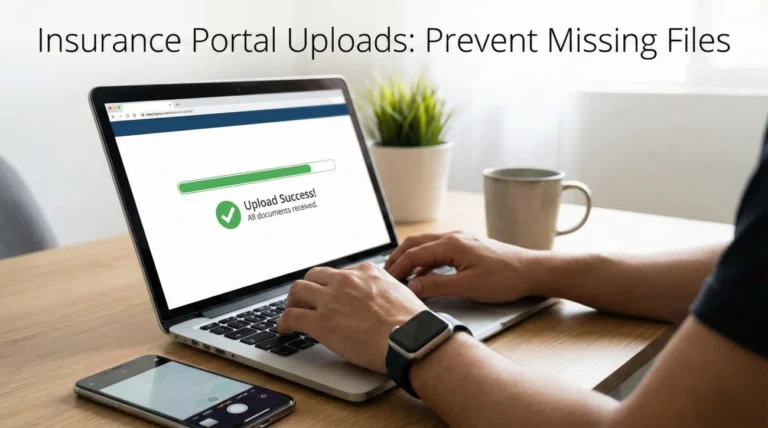
Another homeowner uploaded a massive structural estimate to the insurer portal and waited ten days. They sent an email asking, “Are you waiting on my contractor’s estimate?” The adjuster replied, “Yes, please send it.” The portal had accepted the document, but a glitch prevented it from generating a task on the adjuster’s end. The status email forced a manual check.
Final Steps: Maintaining the Communication Loop
Sending the claim status update email is only half the battle. You also have to log the reply. Every time you send one of these messages, make a note in your claim diary.
If the adjuster replies and says, “We will have this reviewed by Friday,” you now have a hard date. Set a calendar reminder. If Friday passes with no news, your next email on Monday morning is incredibly simple. You do not have to be angry; you just rely on the administrative facts.
You simply write: “Hello, following up on your previous message stating the file would be reviewed by Friday. Could you please provide the current milestone?”
Keep your emails short, keep your questions factual, and always ask what is needed from you. This structured approach builds a clear paper trail and shows the adjuster that you are organized, attentive, and actively managing your side of the claim.
❓ FAQ
⏱️ How long should I wait before asking for a claim update?
A good rule of thumb is to wait 5 to 7 business days after submitting documents or completing a milestone (like an inspection) before asking for an update, unless you were given a specific different timeline. Please note that exact timelines vary by carrier and state regulations.
📧 Is it better to call or email for a claim status?
Email is generally better because it creates a permanent written record of what was said, what stage the file is in, and who is responsible for the next step. If you do call, always send a follow-up email summarizing the conversation.
🤷♂️ What if my adjuster ignores my status update email?
If two business days pass with no reply to a politely worded email, send a second brief email forwarding the first one. State that you are following up to ensure the message was received and ask for a quick confirmation. Do not send daily emails, as this can clutter the file and slow down the process.
📎 Should I reattach my documents when asking for an update?
No, do not attach old documents just to be safe. It clutters the file system. Only attach documents if the adjuster specifically states they are missing, or if you are providing brand new information.
📝 How do I ask if they need more information from me?
Keep it direct. Ask: “Are there any pending documents, photos, or forms you need from me to complete your current review?” This forces them to either request items or confirm your file is complete.
📱 Can I text my adjuster for a quick update?
If the adjuster has provided a dedicated business text number and indicated they use it, yes. However, if you do text, always follow up important milestones with a quick email for your records. For formal updates confirming stages or missing items, email remains the safest method.
🗣️ What exactly does “under review” mean?
It is a vague corporate term that usually means your file is sitting in a queue waiting for someone to look at it. When told this, always reply by asking, “What specific internal process is being reviewed, and who is reviewing it?”
🔄 How often is too often to check on my claim?
Emailing every single day is too often and usually counterproductive. Once a week is a reasonable cadence for a standard claim, unless there is an active emergency or you are waiting on an urgent temporary housing approval.
🛑 What is the worst thing to say in a status email?
Avoid emotional venting, vague complaints like “this is taking too long,” or sending massive blocks of text. Stick to bullet points and factual questions about the administrative process.
🎯 How do I find out who my adjuster’s manager is?
If you have sent multiple update requests over a long period with zero response, you can call the main customer service line, provide your claim number, and politely ask for the name and email of the supervisor assigned to your desk adjuster.
⚠️ Disclaimer: PropertyClaimChecklist.com provides practical guidance, process checklists, and example follow-ups to help you organize a property claim and move it forward. It is not policy language, claim documentation, legal content, or a substitute for your insurer's instructions. Always rely on your carrier's requirements and your actual policy terms for what must be submitted and how decisions are made.