
- A standard “lump-sum” contractor quote is often not enough for a claim file; reviewers need detailed line items.
- Your contractor quote documentation for an insurance claim must clearly separate labor, materials, and scope of work room-by-room.
- Always ask contractors to include their license number, business details, and specific measurements on the written estimate.
- Use clear, polite communication to set expectations with your contractor about insurance paperwork requirements before they arrive.
- Save the final quote as a PDF and link it directly to your master evidence folder to prevent it from getting lost in email threads.
The Gap Between a “Normal” Quote and an Evidence-Grade Quote
If I look back over the hundreds of claim files I have helped organize, there is one bottleneck I see constantly: the contractor’s estimate. You call a local professional, they come out, look at the damage, and hand you a piece of paper that says something like, “Repair kitchen drywall, replace cabinets, paint – $X.”
In a normal home renovation project, that might be all you need to make a decision. But when you are dealing with contractor quote documentation for an insurance claim, that piece of paper is not just a price tag; it is a critical piece of evidence. The reviewer at the desk cannot see your kitchen. They have to justify every action based strictly on what is written on that page.
I often see files stall for weeks simply because the quote lacks the structural details needed for review. The goal is not to force your contractor to use a specific software, but to ensure the document they provide is structured so the reviewer does not have to come back with follow-up questions. Let’s walk through exactly what needs to be on that document to reduce back-and-forth delays.
The “Lump-Sum” Issue: Why Simple Quotes Cause Delays
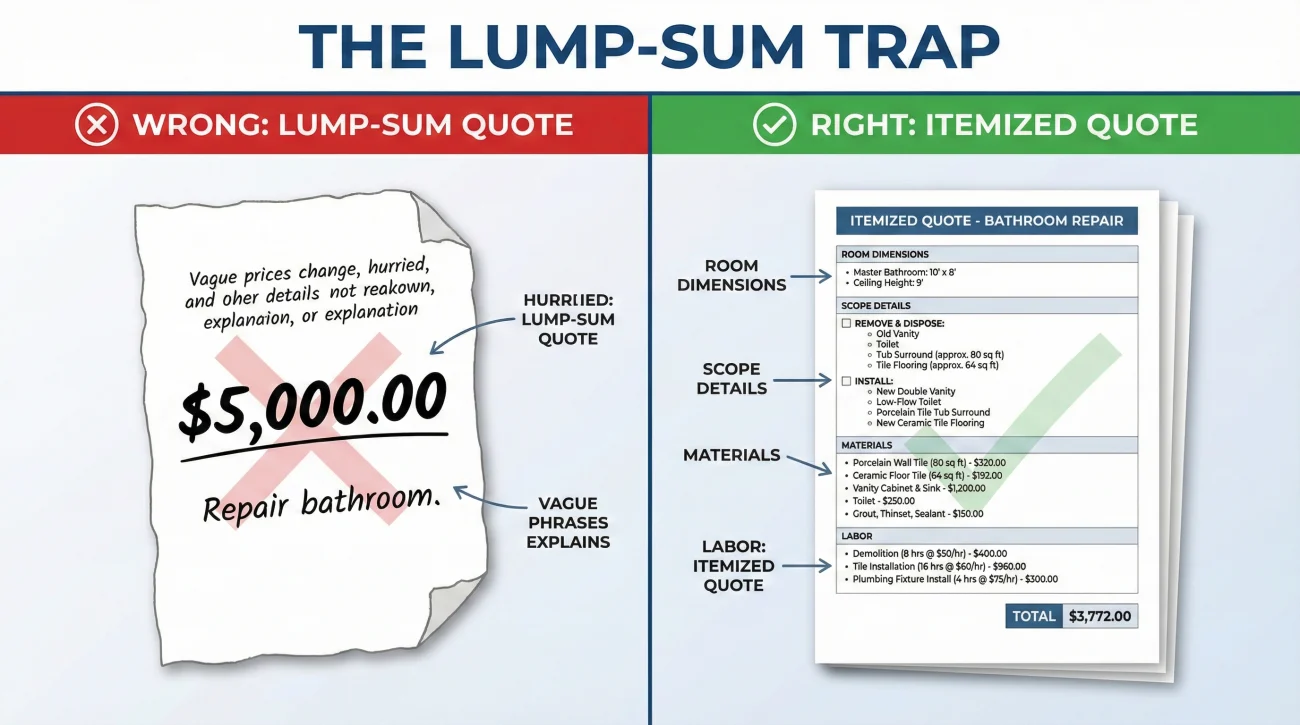
When a reviewer looks at a quote, they are trying to match the proposed repairs to the verified damage. If a quote just has one giant total at the bottom, they cannot tell how much of that is for materials, how much is for labor, or exactly what dimensions are being repaired.
Key Point: A quote submitted as evidence must show the “math” behind the work. It proves not just what needs fixing, but exactly how the contractor plans to fix it.
Consider this common scenario: A homeowner submits a basic quote for flooring replacement. The reviewer sees the total but does not know if the contractor is planning to replace just the damaged section, the whole room, or if they are including the baseboards. The file goes into a “pending information” status, and the homeowner is asked to get a revised quote. This loop can happen multiple times if the requirements are not clear from the start.
“Repair master bathroom water damage. Replace vanity, fix drywall, paint. Includes all labor and materials.”
“Master Bathroom (12×10): Remove and dispose of 36-inch water-damaged oak vanity. Install new 36-inch vanity. Replace 32 sq ft of 1/2 inch drywall behind vanity. Tape, mud, and texture to match. Apply 1 coat primer, 2 coats semi-gloss paint to entire 120 sq ft wall. Labor: [Amount], Materials: [Amount].”
The Contractor Quote Content Checklist
To avoid the back-and-forth, I always recommend homeowners review a quote against a specific checklist before accepting it as final. You want to make sure the document stands on its own as a solid piece of proof.
Here are the non-negotiable elements that should be clearly visible on the written estimate:
| Required Element | Why It Matters for Your File |
|---|---|
| Full Business Information | Letterhead must include business name, physical address, phone number, and email. It proves this is a legitimate, verifiable business. |
| License & Tax ID | Depending on the area, reviewers often need to verify the contractor is licensed to perform the specific trade. Requirements vary by state or carrier, but providing this upfront prevents administrative hold-ups. |
| Room-by-Room Breakdown | Damage rarely happens in just one abstract area. The quote should clearly state which room the line items apply to (e.g., “Guest Bedroom,” “Downstairs Hallway”). |
| Measurements & Quantities | “Replace flooring” is weak. “Replace 150 sq ft of laminate flooring” is strong. Measurements allow the reviewer to verify the scope against their own data. |
| Labor vs. Materials Separation | Breaking down the cost of materials separately from the hourly or project-based labor helps reviewers understand the structure of the estimate. |
| Scope Details | Does the drywall repair include painting? Does the floor replacement include removing the old debris? Every step of the physical work should be listed. |
⚠️ Warning: Never alter, edit, or write over a contractor’s quote yourself. If a detail is missing, you must ask the contractor to revise the document and send you a new, updated version.
Estimate vs. Invoice vs. Supplement
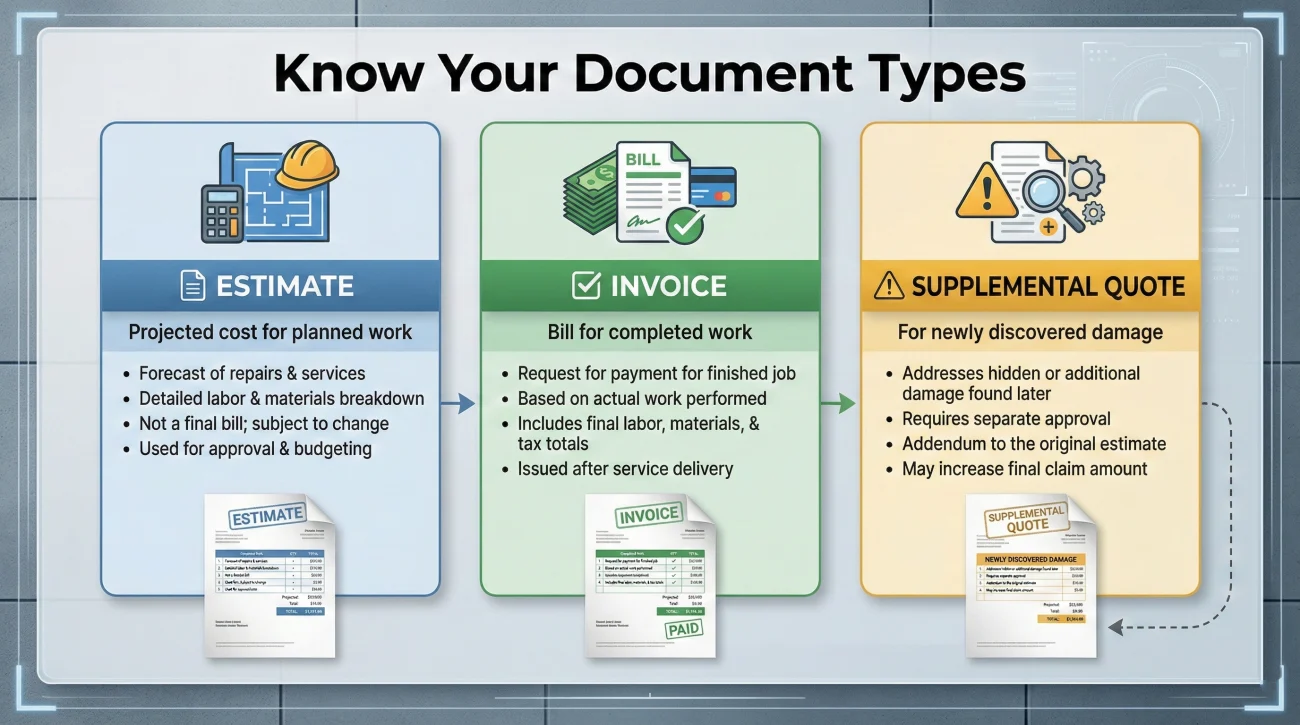
It is very common for paperwork to get rejected simply because the wrong type of document was submitted. In claims operations, these three documents do entirely different jobs and should never be mixed up:
- 📄 Estimate: This is the projected cost for planned work. This is what you submit to get the repair budget reviewed and approved.
- ✅ Invoice: This is the bill for completed work. You usually submit this to release final payments, recover depreciation, or prove emergency mitigation costs.
- ⚠️ Supplemental Quote: If the contractor opens a wall and finds newly discovered damage, they must stop work immediately. They need to document the new damage and write a supplemental quote. This must be submitted and reviewed before that specific new work continues.
The 60-Second Quote Intake Checklist
Before you thank the contractor and forward the PDF, do a quick visual scan to ensure it is review-ready. Look for these specific items:
- ✅ Room names are clearly labeled
- ✅ Exact quantities and measurements are listed
- ✅ Labor and materials are split
- ✅ Debris removal and disposal costs are included
- ✅ Detach and reset items (baseboards, trim, hardware) are noted
- ✅ Supporting photos are attached
- ✅ Date and contractor signature are present
- ✅ Scope Consistency Check: The repair items match your submitted damage inventory without major contradictions.
Building the “Quote Pack”: Necessary Attachments
A strong piece of evidence rarely travels alone. In my experience, the most effective submissions treat the contractor’s quote as the cover page for a small “quote pack.”
When your contractor visits, they will often take their own photos, draw sketches, or write up a specific materials list. These supporting documents are incredibly valuable. I recall a situation where a homeowner’s photos missed a cracked pipe behind a wall, but the plumber had taken a clear photo of it with their tablet while writing the quote. Because the homeowner asked the plumber to attach that specific photo to the PDF quote, the reviewer had the exact proof needed to understand the requested pipe repair.
Always ask your contractor to include these attachments if they have them:
- 📄 Contractor Photos: Especially of hidden damage (roof decking, behind walls, under flooring) that you could not safely photograph yourself.
- ✅ Diagrams or Sketches: Simple room outlines showing where the work will happen.
- 📄 Material Tear Sheets: If they are quoting a specific grade of material (like a specific class of roofing shingle), a printout of the material specifications helps prove the quality matches what was lost.
How to Ask Your Contractor for Detailed Paperwork
I know this can feel awkward. Contractors are busy professionals, and nobody likes being asked to do extra paperwork. However, setting the expectation early is much easier than asking them to rewrite a quote three weeks later when they have moved on to other projects.
The best approach is to be polite, clear, and frame the request as a necessity for the review process, not as you questioning their expertise. Here are standard subject lines and scripts to handle this communication.
Clear Email Subject Lines
Using a clear subject line helps both your contractor and the reviewer keep the file organized. Here are three standard formats I recommend:
- 📄 Initial Request:
Claim #[Number] Contractor Estimate: [Trade] [Room] - 📄 Asking for Fixes:
Revised Estimate Request: Quote #[Number] - 📄 New Damage:
Supplemental Estimate: Newly Discovered Damage for Claim #[Number]
Script 1: Setting Expectations Before the Visit
Send this when you are scheduling the appointment, so they know exactly what you need before they even step foot on your property.
Hi [Contractor Name],
I am looking forward to meeting you on [Date/Time]. Since this estimate will be submitted for a review process, they require specific details on the paperwork.
When you build the quote, could you please ensure it includes a room-by-room breakdown, line items separating labor and materials, and exact measurements for the repair areas?
Please let me know if you are able to provide the estimate in this format. Thank you for your time!
Best regards,
[Your Name]
Script 2: Asking for a Revision to a Lump-Sum Quote
If you already received a quote that is just a single total amount, use this neutral script to request the necessary breakdown.
Hi [Contractor Name],
Thank you for sending over the estimate so quickly. I am preparing my file for submission, and I was informed that they cannot accept lump-sum quotes for review.
Would it be possible to send an updated version of this estimate that breaks down the costs line-by-line (separating labor, materials, and specific measurements for each room)?
I appreciate your help in getting this formatted correctly so we can keep the process moving.
Thank you,
[Your Name]
Organizing the Quote in Your Evidence File
Once you receive a detailed quote, do not let it sit in your email inbox. An organized file is a fast file.
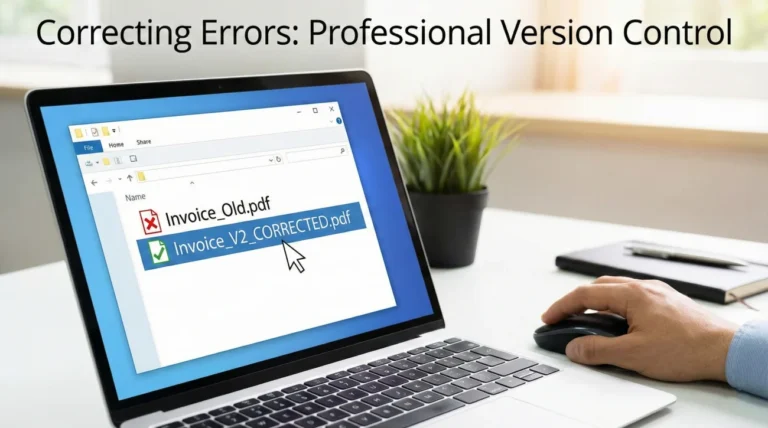
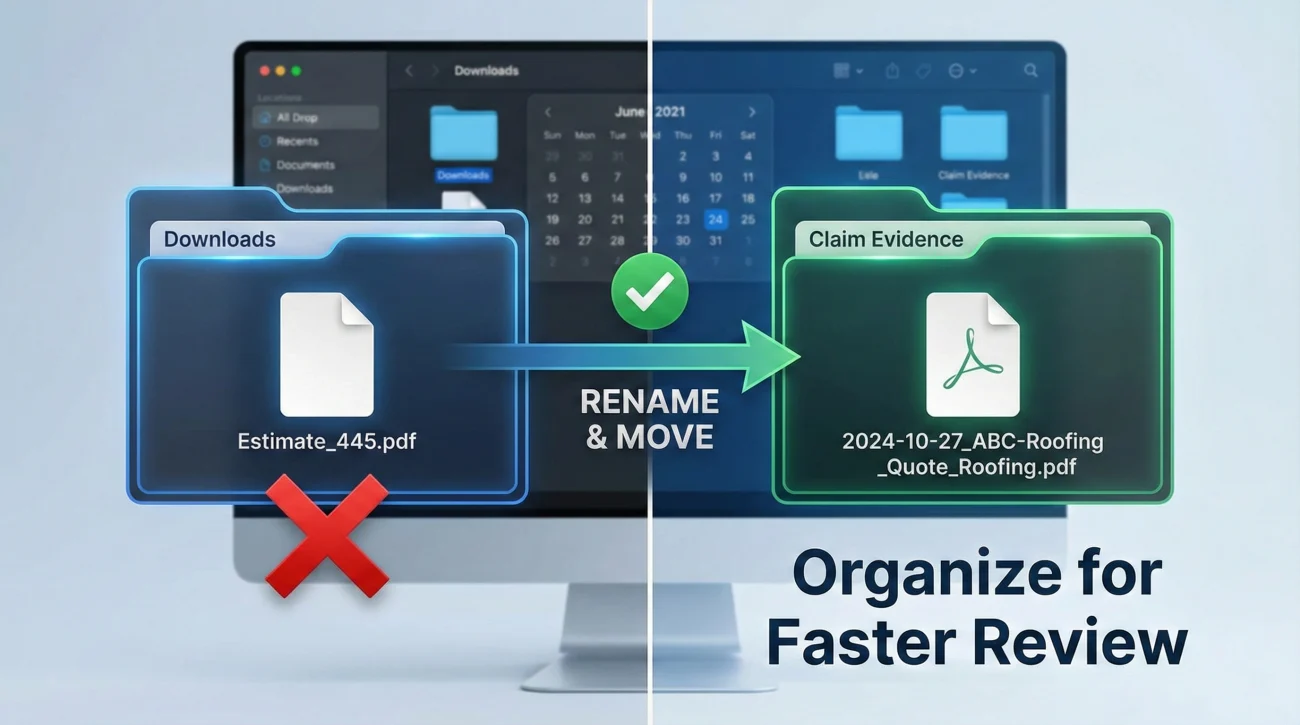
First, always request the quote in PDF format. Word documents can be easily altered accidentally, and links to web-based quoting software can expire. A PDF is a static snapshot of the evidence at that moment in time.
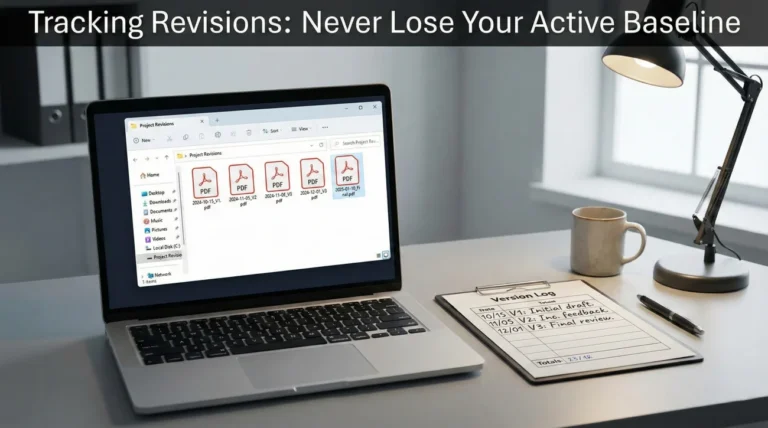
When you save it, use a clear file naming convention. A file named Estimate_445.pdf means nothing to a reviewer. Instead, rename the file to something clear: [Date]_[Contractor Name]_Quote_[Trade].pdf. For example: 2024-10-15_SmithPlumbing_Quote_Bathroom.pdf.
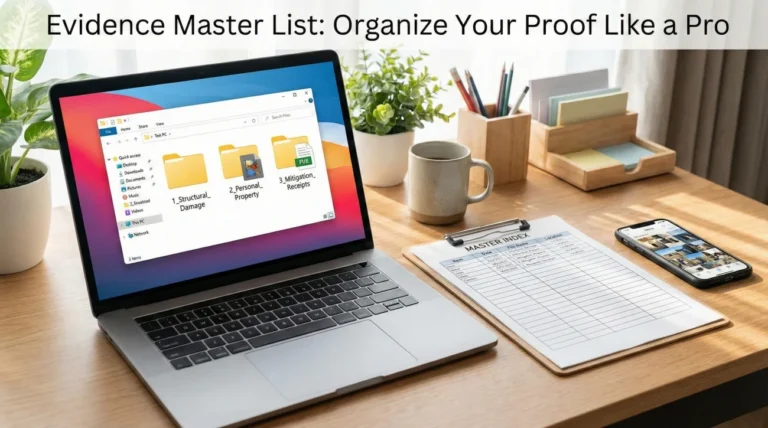
💡 Pro Tip: Once you have the PDF saved and labeled, move it directly into your central documentation folder. This contractor quote will eventually sit right alongside your photo logs and lists as part of your complete property claim evidence pack. Keeping everything in one digital location ensures you never accidentally submit incomplete proof.
Final
Treating your contractor’s quote as a formal piece of evidence rather than just a price tag is a significant shift in mindset. It takes a little more effort upfront to ask for the right level of detail, but in my experience, it is one of the most reliable ways to prevent weeks of frustrating delays.
Remember to keep communication polite, rely on written requests, and always save a digital PDF copy for your own organized records. When your paperwork is clear, structured, and easy to read, it allows the review process to function exactly as it should.
❓ FAQ
📝 Do I need three different quotes for my file?
There is no universal rule that applies everywhere. The best approach is to send a written request to your assigned representative asking for their specific requirement regarding the number of estimates needed, and save their written reply in your file.
⏱️ How long should I wait for a contractor to send the estimate?
A standard timeframe is usually 3 to 7 business days after the physical inspection. If you haven’t received it after a week, send a polite follow-up email requesting a status update to maintain a paper trail.
🤷♂️ What if my contractor refuses to break down the costs?
If a contractor is unable or unwilling to provide a line-item breakdown, their quote will likely stall the review process. In many cases, it is safer to find a contractor who is accustomed to standard documentation requirements.
💸 Can a contractor charge me a fee just to write the estimate?
Yes, some contractors charge an inspection or estimating fee, especially for highly detailed, line-item quotes. Always ask about estimate fees upfront before scheduling the appointment and get the answer in writing.
📸 Should the contractor include their own photos with the quote?
Absolutely. Contractor photos are excellent supporting evidence, especially for damage that is difficult to reach or requires professional expertise to identify. Ask them to attach these photos directly to the PDF quote.
🛠️ Does the quote need to include temporary repairs they already did?
Usually, past temporary repairs are invoiced separately from future repair estimates. Ask the contractor to provide a clear, paid invoice for the emergency mitigation work, distinct from the quote for the permanent rebuild.
📏 How detailed do the measurements on the quote need to be?
They should be specific enough to verify the scope. Instead of “replace baseboards,” it should state “replace 42 linear feet of 4-inch baseboard.” Exact measurements prevent confusion during the review.
📧 How should I send the contractor quote once I have it?
Always send it as a PDF attachment. Avoid forwarding the contractor’s email directly or sending links to quoting software. Ensure your email subject line clearly states your file number and the contents.
🔄 What happens if the contractor finds more damage after they start work?
This is common. The contractor will need to stop work, document the newly discovered damage with photos, and write a “supplemental quote” detailing the extra labor and materials. This new quote must be reviewed before that specific work continues.
📑 Does the quote need to perfectly match my own personal damage list?
It doesn’t need to match word-for-word, but there should be no major contradictions. If your inventory lists a damaged oak floor, but the quote says “replace carpet,” you need to clarify that discrepancy before submitting.
⚠️ Disclaimer: PropertyClaimChecklist.com provides practical guidance, process checklists, and example follow-ups to help you organize a property claim and move it forward. It is not policy language, claim documentation, legal content, or a substitute for your insurer's instructions. Always rely on your carrier's requirements and your actual policy terms for what must be submitted and how decisions are made.