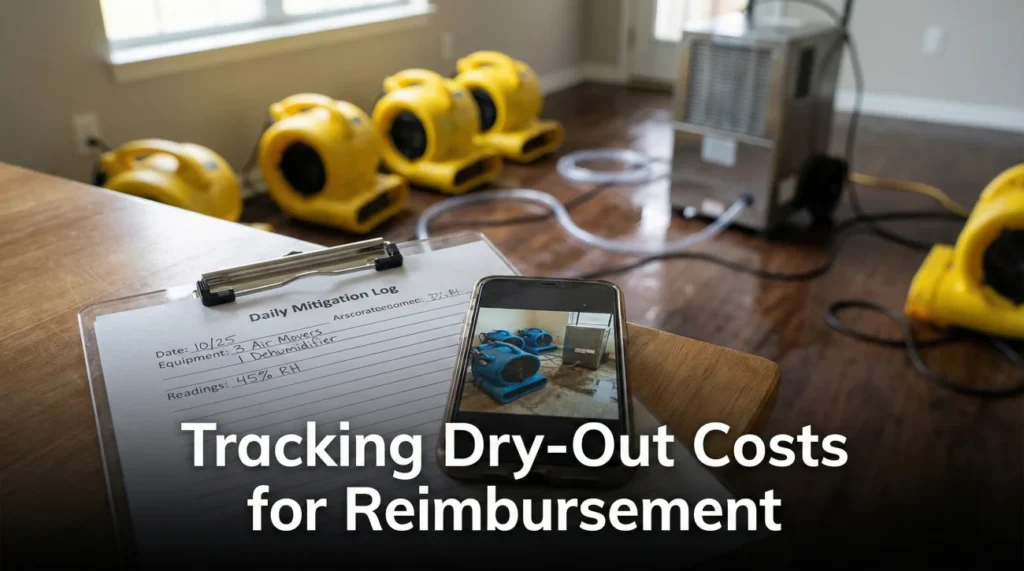
- Never accept a lump-sum invoice for emergency dry-out or mitigation; always request a daily breakdown of equipment, labor hours, and materials used.
- Keep your own daily log of how many fans and dehumidifiers are running in your home and take photos of them as secondary proof.
- Keep mitigation expenses strictly separated from permanent repair quotes to prevent delays in the initial review process.
The Chaos of Emergency Mitigation
When a pipe bursts or a fire is extinguished, the immediate aftermath is pure chaos. The first priority is to stop the damage from spreading. This emergency phase is known as mitigation. Whether you hire a professional dry-out crew or rent equipment yourself, money is being spent rapidly just to stabilize the property.
In my experience handling claims operations, mitigation is one of the most heavily scrutinized parts of any property file. Adjusters often look at these invoices with a magnifying glass. Why? Because emergency services usually happen before the insurance company can get their own field adjuster on site. They have to rely entirely on the documentation provided after the fact to justify the costs.
I often see files stall for weeks simply because a homeowner submitted a mitigation invoice that just said “Water extraction and drying: $4,500.” From an operational standpoint, a reviewer cannot approve that. They need to know how many days the fans ran, what type of dehumidifiers were used, and how many labor hours were spent tearing out wet carpet. In this guide, I will share the typical logging methods and receipt hygiene I often recommend to help prove your mitigation costs without triggering a prolonged audit.
Key Point: Mitigation is about stopping the bleeding. The documentation you capture during this frantic phase is the only proof you will have that the emergency measures were necessary and billed accurately.
What a Claim-Ready Mitigation Receipt Looks Like
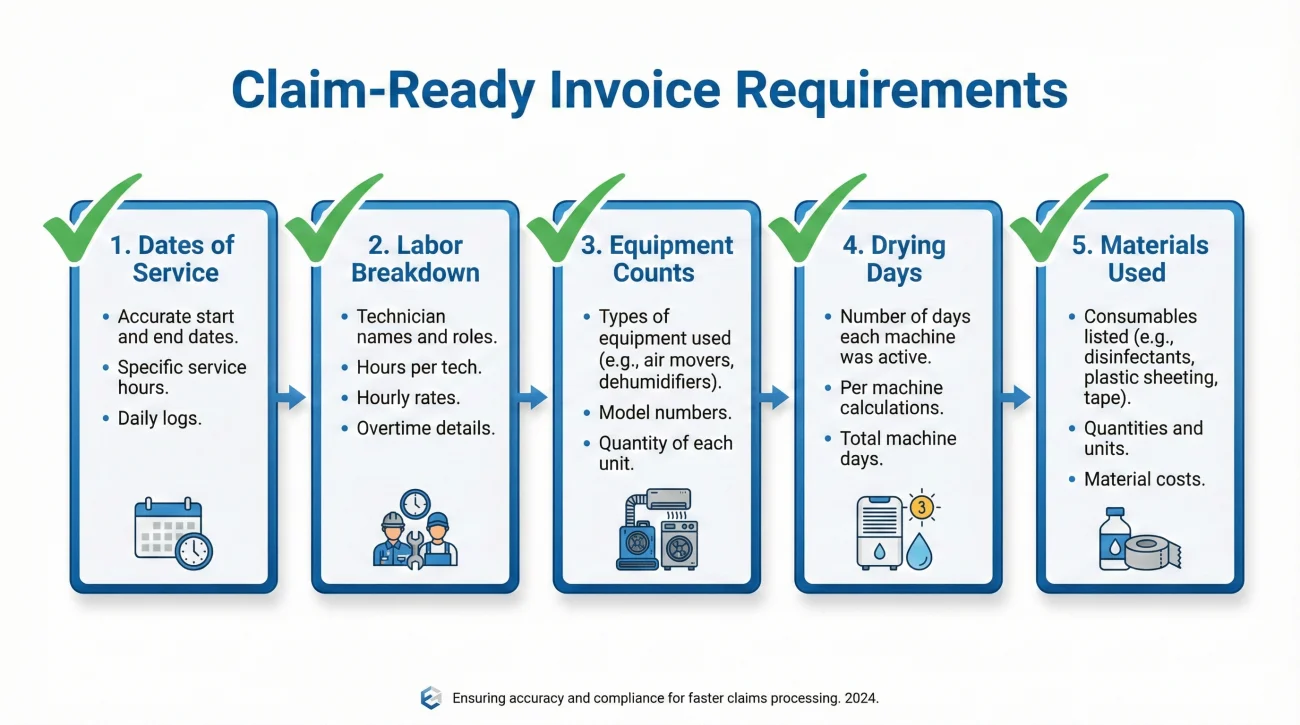
If you hire an emergency services vendor, they will eventually hand you a bill. The quality of this document often dictates how quickly your claim moves forward. You cannot just pass whatever they give you to the insurance company and hope for the best. You need to verify its contents first.
A high-quality mitigation receipt or invoice should read like a daily diary of the work performed. If the document lacks specific details, it tends to get pushed back for clarification, which eats into your timeline.
The Required Line Items
When you review the vendor’s invoice, look for these specific breakdowns. If any of these are missing, you should request a revised copy before submitting it to your adjuster.
- ✅ Dates of Service: The exact start and end dates of the mitigation work.
- ✅ Labor Breakdown: The number of technicians on site, their hourly rate, and the specific hours they worked each day.
- ✅ Equipment Counts: The exact number and type of machines used (for example, “4 XL Air Movers” or “2 LGR Dehumidifiers”).
- ✅ Drying Days: How many days each specific piece of equipment was left running on the property.
- ✅ Materials Used: An itemized list of consumables, such as antimicrobial spray, plastic sheeting, or tape.
How to Ask Your Vendor for Better Documentation
Many homeowners feel uncomfortable pushing back on a contractor who just saved their home from further ruin. However, professional mitigation companies know how insurance billing works. Asking for an itemized invoice is a standard administrative request.
If you receive a vague, lump-sum bill, you need to request the breakdown in writing. This creates a paper trail showing that you are actively trying to gather the right evidence for the carrier.
Subject: Request for itemized mitigation invoice
Hello [Vendor Contact Name],
Thank you for your team’s hard work stabilizing my property this week. I received the final invoice today.
In order to process this through my insurance claim efficiently, my adjuster requires a fully itemized breakdown. Could you please provide a revised invoice that details the labor hours per day, the exact counts of equipment used, the number of days the equipment was running, and any specific materials applied?
Once I have the itemized version, I will submit it immediately to keep the file moving.
Thank you,
[Your Name]
This script is neutral and blames the “process.” It takes the friction out of the request and clarifies exactly what you need to build your evidence packet.
Creating Your Own Daily Mitigation Log
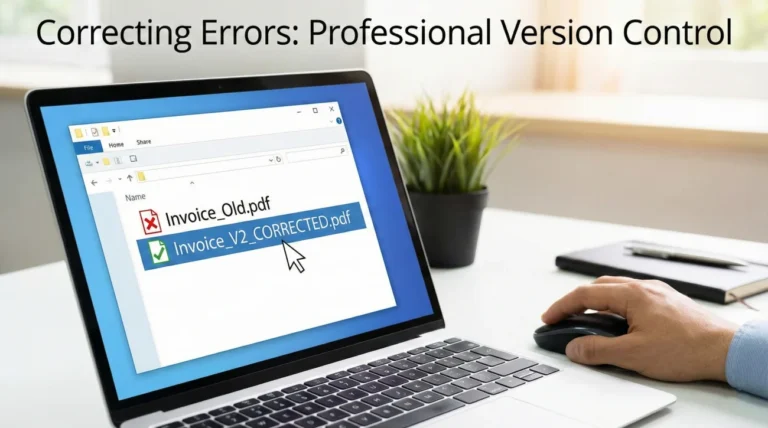
Here is an operational reality: vendor invoices sometimes contain errors. In the rush of a local disaster, a crew might leave fans at your house for three days but accidentally bill you for five. If the insurance adjuster spots inconsistencies, they may flag the entire invoice.
I always recommend that homeowners keep their own simple daily log while mitigation equipment is in the house. You do not need to be an expert to do this. You just need to count what is sitting in your living room.
By spending two minutes each evening recording the equipment, you create a secondary layer of evidence. This log is a powerful addition to your property claim evidence pack. It shows the reviewer that you are organized and paying attention.
The Essential Log Fields
You can keep this log in a simple notebook or a digital spreadsheet. Here is the structure I prefer to see when reviewing a well-documented file:
| Date | Vendor on Site | Equipment Running | Labor Hours Observed | Notes / Action Taken |
|---|---|---|---|---|
| Oct 12 | XYZ Water Dry | 4 fans, 1 dehumidifier | 3 hours (2 techs) | Extracted standing water, sprayed antimicrobial. |
| Oct 13 | XYZ Water Dry | 4 fans, 1 dehumidifier | 0 hours (equipment only) | Machines running all day. No techs visited. |
| Oct 14 | XYZ Water Dry | 0 fans, 0 dehumidifier | 1 hour (1 tech) | Tech picked up all equipment at 10:00 AM. |
A Mini-Scenario: Solving the Ghost Equipment Problem
Let me share a common pattern I see regarding mitigation billing and why your personal log matters. During local disaster rushes, when vendors are stretched thin, I have seen this exact type of billing audit repeat across dozens of files.
A homeowner had a flooded basement. The vendor dropped off six industrial fans and two large dehumidifiers on Monday. On Wednesday morning, the vendor came back, realized the basement was mostly dry, and took away three of the fans to use on another emergency job.
Two weeks later, the homeowner received the invoice. The vendor billed for six fans running for a full five days. The insurance desk adjuster pushed back on the cost, stating that five days of drying time for that specific square footage was excessive and suspicious.
Because the homeowner had maintained a daily log, they could clearly see the error. They checked their notes and saw that three fans were removed on Wednesday. They contacted the vendor, pointed out the specific pickup date from their log, and asked for a correction. The vendor realized their scheduling software had not updated, issued a corrected invoice, and the insurance company approved it the next day.
This is the value of overlapping your evidence. When your daily log cross-references with your photos and the vendor’s invoice, the file becomes highly defensible during review.
Documenting DIY Mitigation Expenses
Sometimes you cannot wait for a professional crew. If water is pouring in, you might run to the hardware store to buy a shop vac, tarps, and bleach. Or you might spend twelve hours of your own weekend tearing out soaked carpet padding.
These are legitimate mitigation efforts, and the costs associated with them often belong in your claim. However, proving DIY expenses requires a strict paper trail because there is no third-party vendor to vouch for the work.
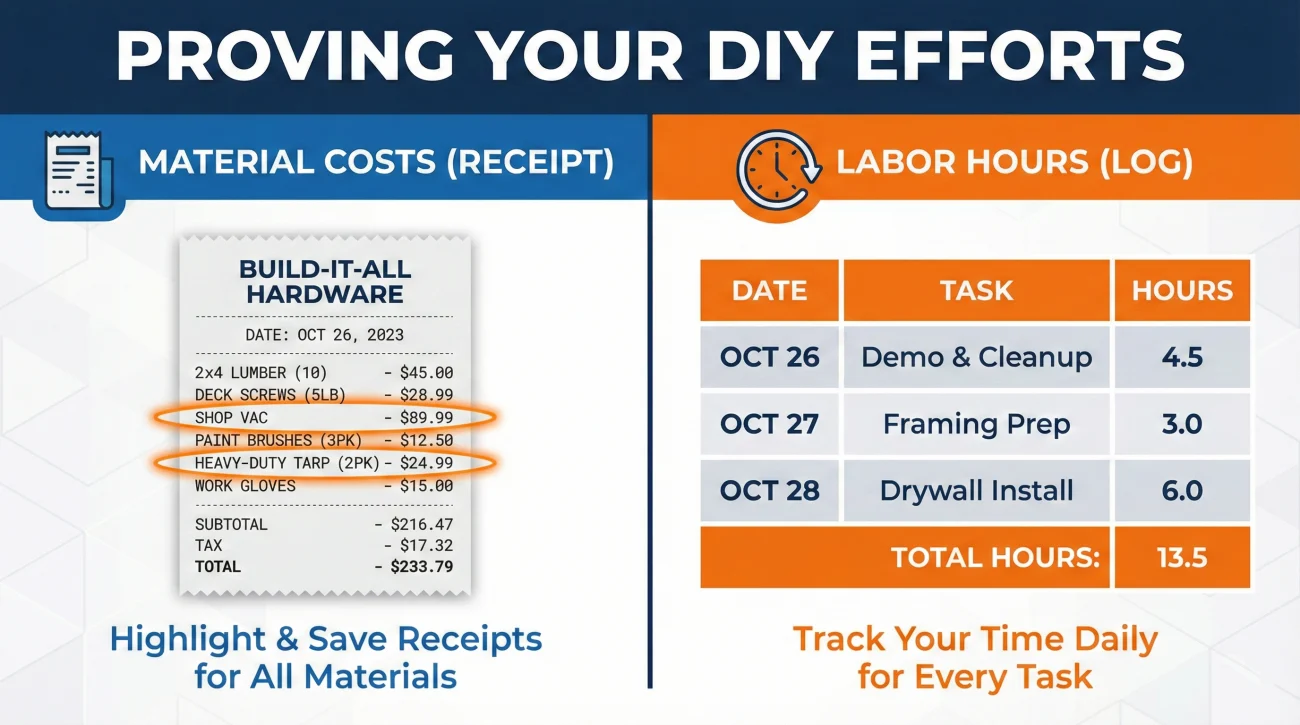
Organizing Retail Receipts
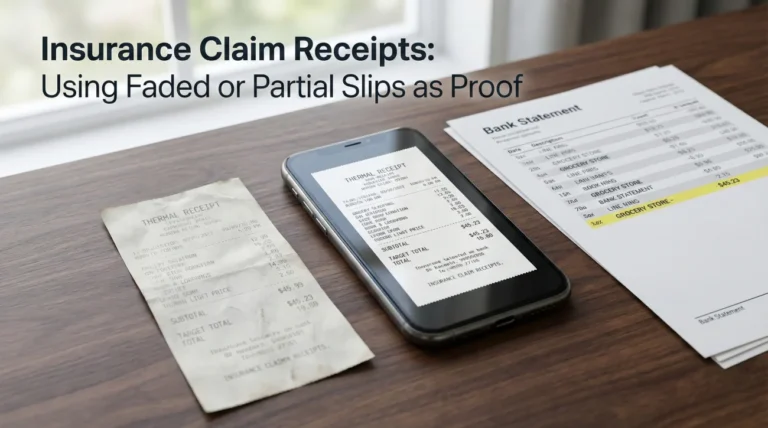
Hardware store receipts are notoriously difficult to read, and the ink fades quickly. If you buy supplies for mitigation, you must process those receipts immediately.
- ✅ Take a clear, well-lit photo of the receipt the moment you get to your car.
- ✅ Highlight or circle the items that were specifically purchased for the mitigation effort (e.g., the shop vac filter, the heavy-duty trash bags).
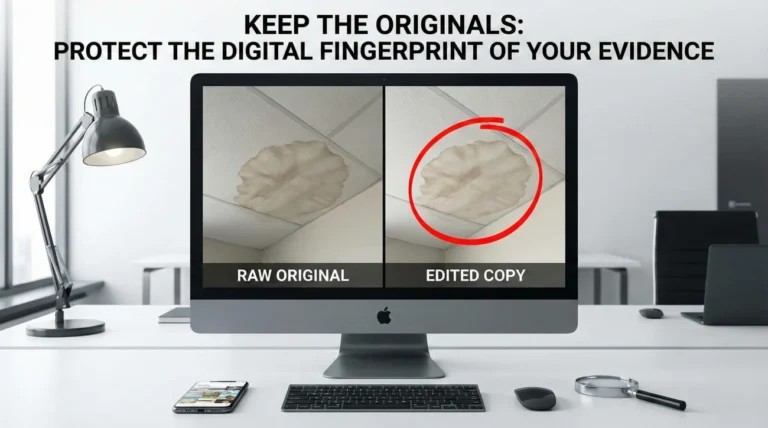
- ✅ If the receipt contains personal items alongside claim items (like buying a tarp and a pack of gum), clearly note the non-claim items without defacing the original text so the reviewer does not have to guess.
Logging Your Own Time
If your policy allows for reimbursement of your own labor for emergency mitigation (which varies, so check your documents), you cannot just estimate “about a weekend of work.” You must log it in a vendor-like format.
Use the same daily log format. Note the date, the exact hours you worked, and the specific task you completed. For example: “Oct 15: 4 hours, removed wet carpet and padding from master bedroom.” Take “before” and “after” photos to prove the labor actually occurred.
Filing Rules: Naming Your Mitigation Proof
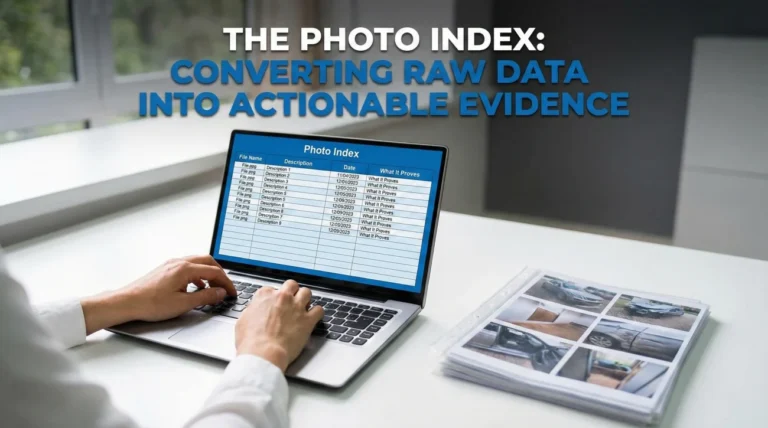
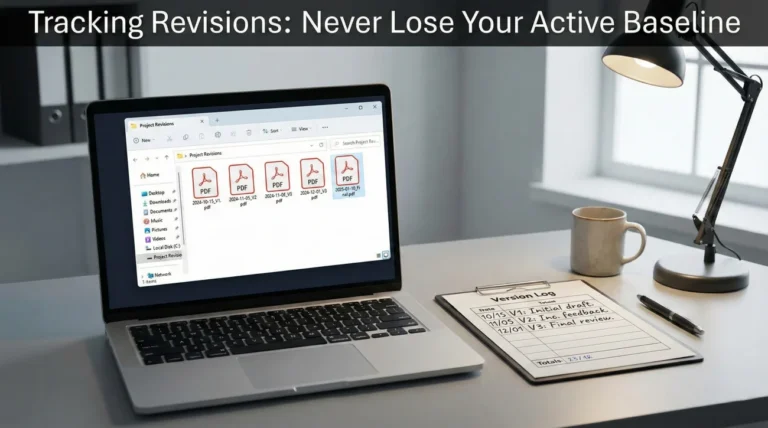
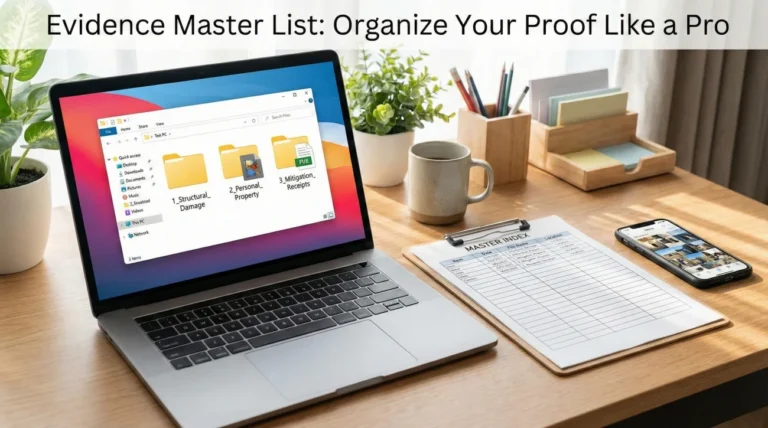
Once you have gathered the vendor invoice, your daily log, and your hardware store receipts, you need to store them logically. Dropping them all into an email as attachments like `IMG_9921.jpg` and `scan.pdf` creates a messy file that an adjuster has to decipher.
I recommend keeping all mitigation evidence in its own dedicated subfolder, completely separate from your personal property inventory or structural repair quotes. Apply a simple, descriptive naming convention so the reviewer knows exactly what they are opening.
Attaching files named
Receipt_1.jpg, log.pdf, and invoice_final.pdf.Attaching files named
2023-10-15_HomeDepot_Mitigation_Supplies.jpg, 2023-10-20_Homeowner_Daily_Drying_Log.pdf, and 2023-10-22_XYZWater_Itemized_Invoice.pdf.When an adjuster sees a properly labeled batch of files, it signals that you are organized and that your numbers are likely accurate. It removes the friction from the review process.
The Missing Link: Moisture Logs
There is one piece of documentation that professionals create but homeowners often forget to ask for: the moisture log. A reputable water mitigation company does not just guess when a room is dry. They take daily readings of the moisture levels in the walls, floors, and air using specialized meters.
While specific policy language and carrier requirements vary significantly, the core principle of combining itemized invoices with cross-referenced moisture readings is universally helpful. These readings help prove exactly why equipment was left running for three days instead of two. It is often the strongest piece of scientific evidence for mitigation. When you ask for your final itemized invoice, you should also ask for a copy of their daily moisture readings or “drying log.”
“A lump-sum bill tells the adjuster what you paid. A moisture log tells them why it was necessary.”
Save this document right next to the invoice. If the insurance company questions the duration of the dry-out process, the moisture log is an excellent way to justify the timeline, even if the carrier still has questions about specific pricing or scope.
The 20-Minute Submission Packet Structure
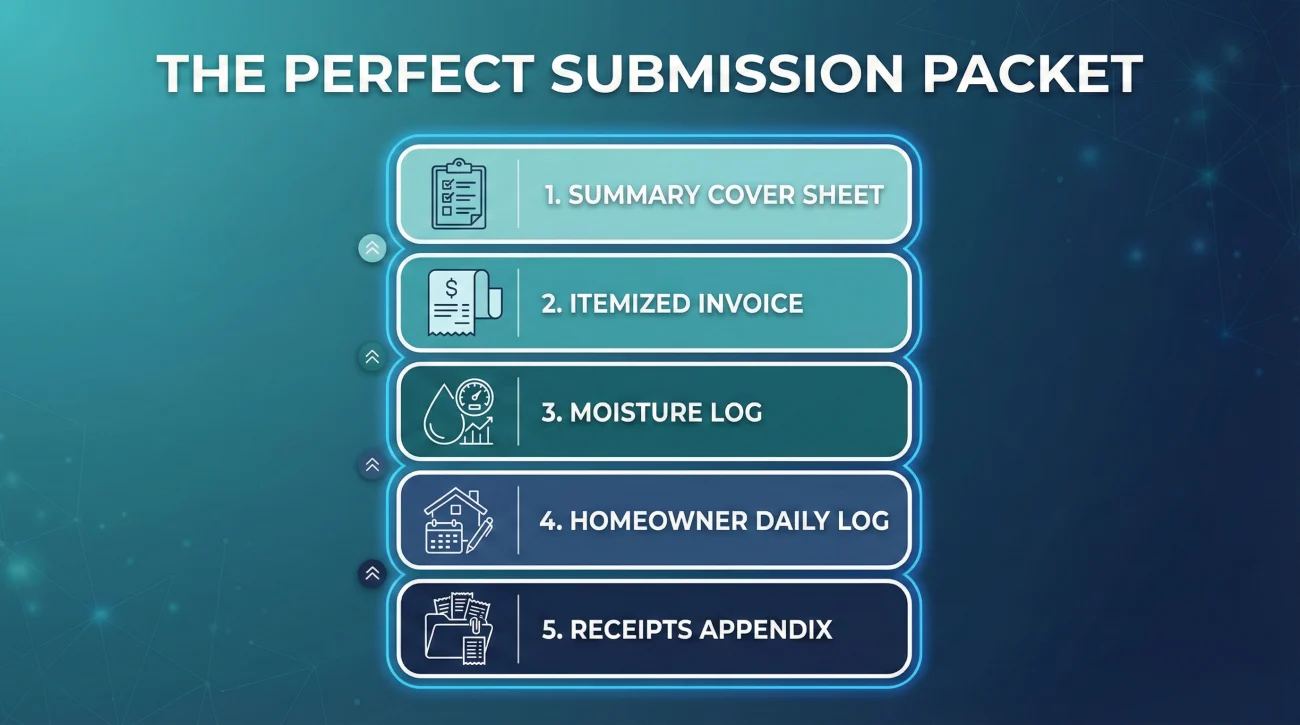
When you are ready to submit your mitigation expenses, do not just forward a dozen loose emails. Structure your submission packet in a specific order so the desk adjuster can read it like a book. Here is the 5-step stack I recommend:
- 1️⃣ Mitigation Summary: A one-page cover sheet listing the dates of service, vendor name, and the total amount billed.
- 2️⃣ Itemized Invoice: The daily breakdown from the vendor.
- 3️⃣ Moisture Log: The daily drying readings to justify the timeline.
- 4️⃣ Homeowner Daily Log: Your personal notes overlapping the vendor’s timeline.
- 5️⃣ Receipts Appendix: Properly named photos of any hardware store purchases.
Batching Rules for Mitigation Proof
If you are submitting this packet via email instead of a portal, you need clear batching rules to ensure nothing gets lost in the carrier’s system.
Always use a structured subject line, such as: Claim # [Your Claim Number] - Mitigation Packet - [Date Range]. If your PDF files and photos are too large for one email, clearly label the subject line with “Part 1 of 2.” Inside the email body, explicitly list the names of the attachments you are sending. This forces the reviewer to check if they received all the parts.
Price Pushback Without Drama
Even with perfect documentation, an adjuster may question the price of the labor or the length of the drying time. If this happens, do not argue or get emotional.
Respond simply by using “evidence mapping.” Point them back to the data: match the specific invoice line to the moisture reading for that day, and reference the corresponding photo from your daily log. When you connect the proof points cleanly, you let the paperwork do the talking rather than turning it into a dispute.
Quick Submission Checklist
Before you hit send on your mitigation packet, run through this quick checklist to ensure your file is ready for review:
- Are the labor hours, materials, and equipment counts broken down by day?
- Are mitigation expenses strictly separated from permanent rebuild quotes?
- Did you attach the vendor’s moisture log to justify the drying timeline?
- Are all DIY hardware receipts highlighted clearly without defacing the original ink?
- Are your files named logically instead of standard image numbers?
- Does your email body list the exact names of the attached files?
❓ FAQ
📄 What if the vendor says their software can’t itemize by day?
Politely tell them your insurance carrier strictly requires it for reimbursement. If their billing software is rigid, request that they manually type a daily breakdown on company letterhead and sign it.
🔌 What if power outages stopped the equipment?
Note the exact hours of the outage in your daily log. The vendor should not bill for equipment runtime when there was no power. Catching this early prevents timeline disputes with your adjuster later.
📉 What if moisture readings aren’t available?
If the vendor failed to take readings, submit your personal daily log and photos of the standing water receding. State in writing to your adjuster that the vendor did not provide moisture logs despite your request.
📸 Should I take pictures of the mitigation equipment in my house?
Yes. Take a quick photo of the room showing the fans and dehumidifiers on the first day and the last day. This visually backs up the equipment counts listed in your daily log.
⏳ How detailed does my personal daily log need to be?
Keep it simple. Note the date, the number of fans, the number of dehumidifiers, and roughly how long any technicians were working inside the house that day.
🧾 What if I lost the hardware store receipt for the tarps I bought?
If you used a credit card, you can submit the bank statement showing the transaction date and amount, along with a photo of the tarp actually installed on your property, as alternative proof.
🛠️ Can I include the cost of a wet-vac I purchased for the cleanup?
Often, yes. Equipment purchased specifically to prevent further damage is usually considered a mitigation expense. Keep the receipt and note why it was urgently needed.
🛑 Should mitigation costs be on the same estimate as my roof repair?
No. Emergency mitigation (stopping damage) should always be billed and documented separately from the permanent repairs (rebuilding) to prevent delays in the initial review.
⏱️ How do I prove the hours I spent doing my own cleanup?
Log your time in a vendor-like format. Write down the date, the specific task (e.g., “removed wet carpet”), and the hours spent. Support it with before-and-after photos of the task.
🗂️ Where do I save the mitigation invoice once I get it?
Save it in a dedicated digital folder named “Mitigation Evidence.” Rename the file with the date and the vendor’s name so it is easy to identify when you bundle your claim packet.
⚠️ Disclaimer: PropertyClaimChecklist.com provides practical guidance, process checklists, and example follow-ups to help you organize a property claim and move it forward. It is not policy language, claim documentation, legal content, or a substitute for your insurer's instructions. Always rely on your carrier's requirements and your actual policy terms for what must be submitted and how decisions are made.