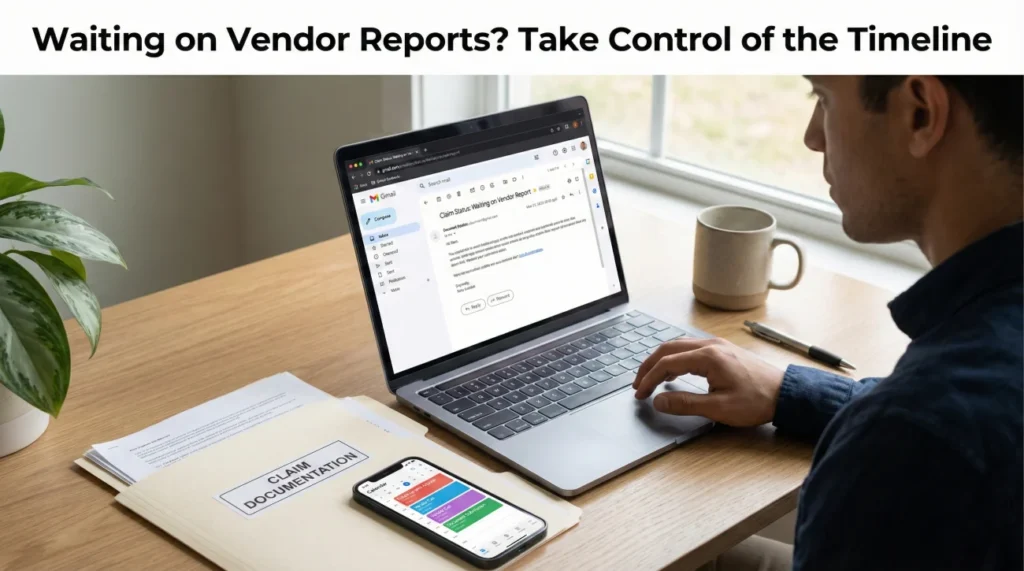
- “Waiting on a vendor report” is the most common operational excuse for a stalled insurance claim, but you do not have to wait passively.
- Insurance adjusters rarely chase third-party vendors proactively; you must create a communication loop that forces visibility.
- Always collect the direct contact information and expected report delivery date from any vendor before they leave your property.
- Use a structured email follow-up cadence, copying both the adjuster and the vendor, to clear up bottlenecks like misdirected emails or missing files.
The Third-Party Waiting Game: Why Your Claim Suddenly Stops
You have done everything right. You filed the claim promptly, organized your initial photos, and met the field adjuster on time. Then, the insurance company sends out a specialized third party, perhaps a structural engineer to look at your roof, or a water mitigation company to handle the dry-out process. They do their inspection, pack up their gear, and tell you they will send the report to the insurance company.
Two weeks later, you ask your desk adjuster for a status update. The reply is a standard, one-line email: “We are still waiting on vendor report for your insurance claim.”
In my experience managing claims operations, this specific status is where many files stall. It is the operational black hole of the insurance industry. The desk adjuster blames the vendor for being slow. The vendor says they are busy or claims they already sent it. Meanwhile, your house is still damaged, and your claim is completely paused.
When you hear that your file is pending a third-party report, your mindset must shift immediately. You cannot rely on the insurance company to chase down external vendors. If a vendor does not proactively send the required document, the carrier’s system often just sets an automated diary task to check back in 14 to 30 days. Thirty days is often too slow for most homeowners. Today, I am going to show you exactly how to manage third-party dependencies, set firm internal deadlines, and keep your claim moving while you wait.
Field Note: The Illusion of the Automated Handoff
A common misconception I see among property owners is the belief that the insurance carrier and their assigned vendors operate on a tightly integrated, automated system. Homeowners assume that when a water mitigation company finishes a job, their system automatically uploads the dry-out logs directly into the adjuster’s claim file.
Key Point: There is rarely a seamless technical integration between third-party vendors and the insurance carrier. In most cases, “sending a report” literally means a vendor is manually attaching a heavy PDF to an email and sending it to a generic claims inbox.
Because it is a manual process, it is highly prone to human error. I have seen claims delayed for a month simply because a vendor misspelled the adjuster’s email address, forgot to include the claim number in the subject line, or tried to send a file that exceeded the carrier’s 20-megabyte attachment limit.
If a vendor ever mentions to you that their report file is heavy or limits are an issue, proactively suggest three operational workarounds. Ask them to split the PDF into smaller parts, use a secure download link, or have them email the adjuster and CC you so you have a copy to manually upload to your carrier portal. Do not let a file size limit become a two-week delay.
Identifying the Vendor Roadblocks in Your Claim
To effectively push a third party for their report, you need to understand who they are and what specific nuance causes their delay. Not all vendors stall for the same reason. Knowing their internal bottlenecks allows you to ask the right questions before they leave your property.
Please keep in mind that the exact timeline varies by carrier, vendor workload, claim severity, and specific policy requirements, but the operational patterns below are highly consistent.
| Vendor Type | What They Provide | The Bottleneck & What to Ask |
|---|---|---|
| Independent Field Adjuster (IA) | Initial damage estimates and site photos. | Bottleneck: Prioritizing new inspections over writing. Ask: “Are you submitting a final estimate or just initial photos today?” |
| Specialty Engineer (Structural) | Cause and origin reports. | Bottleneck: Internal peer-review processes. Ask: “Does your report require an internal peer review before you send it to the carrier?” |
| Water Mitigation / Dry-out | Moisture maps and dry-out logs. | Bottleneck: Waiting to compile final billing. Ask: “Are you waiting on final billing to send the dry-out logs, or can you send the logs now?” |
| Contents Specialists | Cleaning estimates or inventory valuations. | Bottleneck: Waiting on external pricing. Ask: “Are you waiting on pricing from suppliers before finalizing this list?” |
The Third-Party Dependency Checklist
The best time to manage a vendor delay is before the vendor even leaves your driveway. If you let a third-party expert leave your property without getting specific information, you lose your leverage. Whenever any vendor inspects your property, you must complete this mental checklist.
- ✅ Get a Direct Contact: Ask for the inspector’s direct email and phone number, not just the general 1-800 number for their corporate office.
- ✅ Confirm the Scope: Know exactly what the adjuster is waiting for based on the table above.
- ✅ Establish the Timeline: Ask the most critical question: “How many business days does it typically take for your office to send the final report to the insurance carrier?”
- ✅ Request a Copy: Ask if they are allowed to provide you with a copy of the report at the same time they send it to the carrier.
Your Follow-Up Log and Cadence
If you write down that the engineer expects to send the report in five business days, you now have a concrete internal deadline. To manage this without turning it into a stressful memory game, document these five details in your claim notes:
- 📝 Date of contact: When the vendor inspected.
- 📝 Who you spoke to: The vendor’s direct name and email.
- 📝 Promised ETA: The exact date they said the report would be ready.
- 📝 Where they send it: The email address they plan to use.
- 📝 Next follow-up date: The day you will reach out if you hear nothing.
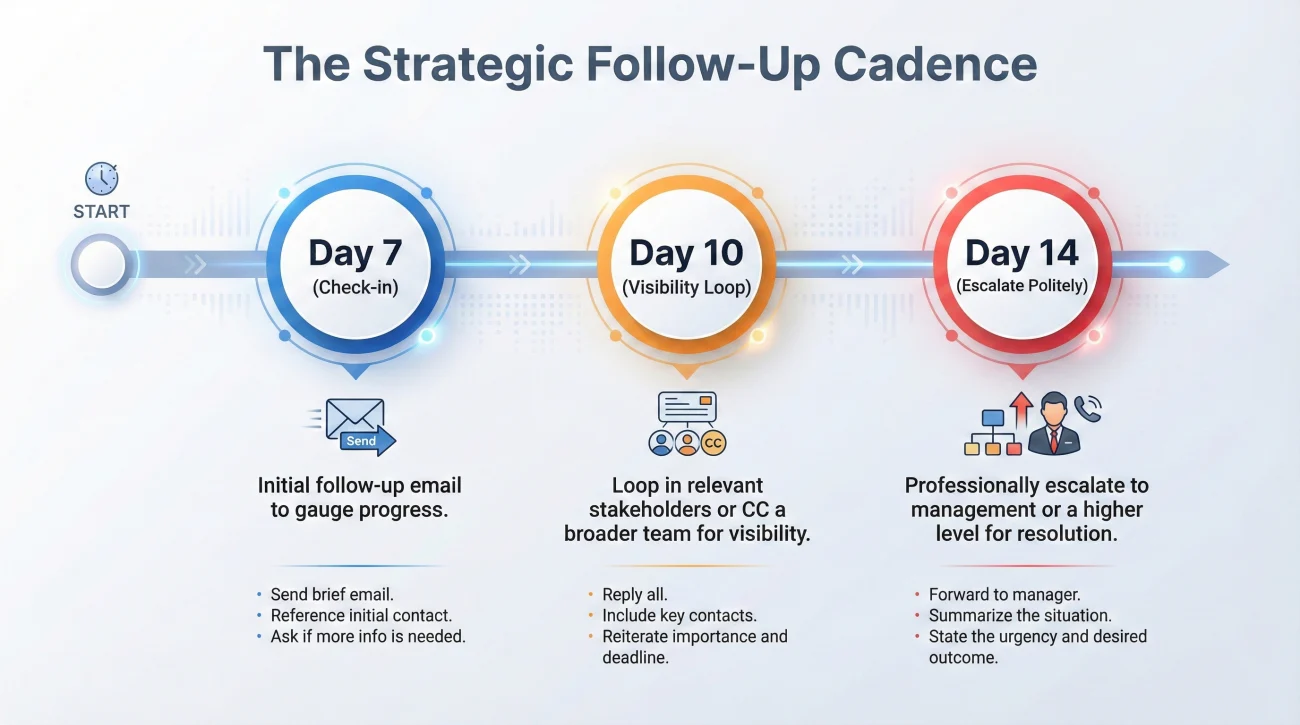
With this log, you can follow a clean operational cadence. If the expected ETA was Day 5, your timeline should look like this:
- 📅 Day 7 (Check-in): Send a polite email directly to the vendor asking if the report was finalized.
- 📅 Day 10 (Visibility Loop): Send an email CCing both the vendor and the desk adjuster to force an update.
- 📅 Day 14 (Escalate Politely): If still missing, email the adjuster asking to escalate to a manager or reassign the vendor.
Communication Scripts: The Visibility Loop
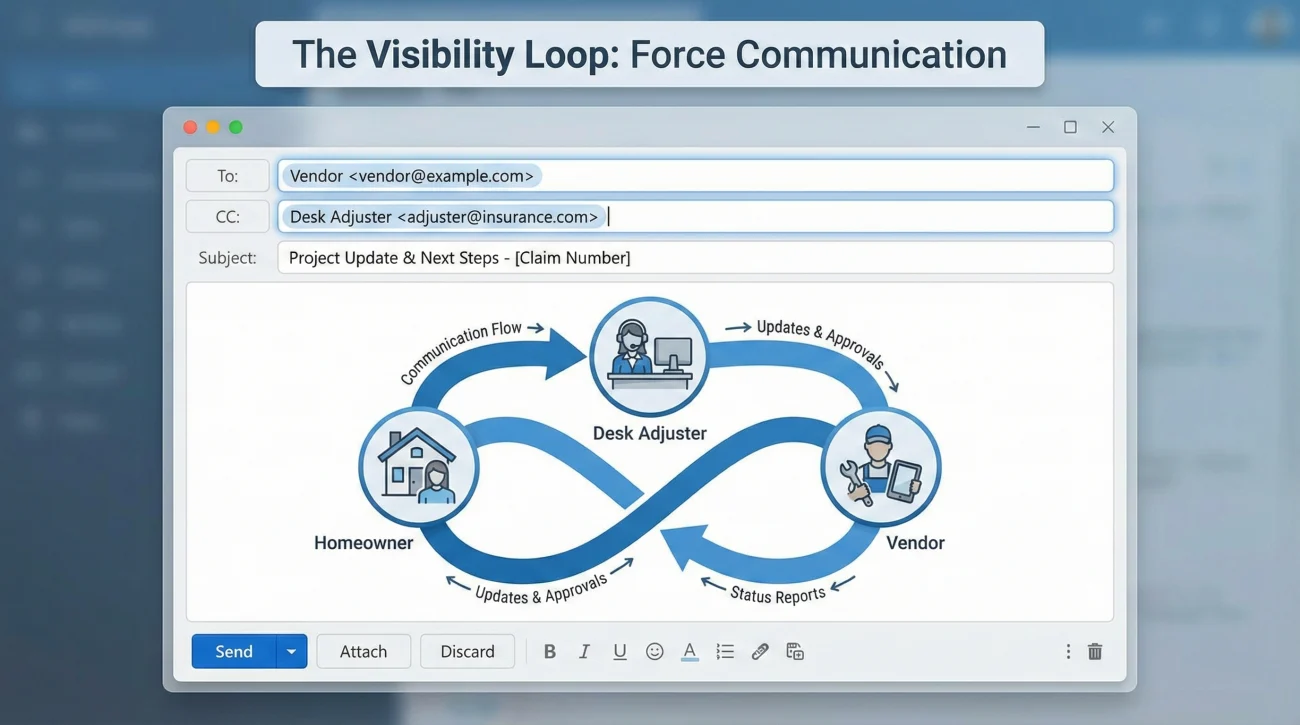
When day 10 hits and the claim is still stalled, you must use a strategy I call the “Visibility Loop.” This involves sending a single email that includes both the desk adjuster and the vendor, forcing them to talk to each other on a thread where you can see the outcome.
First, if you do not have the vendor’s email address, you must ask the adjuster for it. Use a polite, direct format.
[Acknowledge Status] + [Request Vendor Contact Info] + [State Intent to Assist]
Subject: Claim #12345678 – Request for Engineer Contact Info
Hello [Adjuster Name],
Thank you for the update letting me know we are still waiting on the structural engineering report.
Could you please provide me with the email address and contact name for the engineering firm? Since the inspection was completed last week, I would like to reach out to them directly to see if they need any additional information from me to finalize their file, and to politely request an ETA.
I want to help keep this process moving forward.
Thank you,
[Your Name]
Once you have the email address, you send the Visibility Loop email. You put the vendor in the “To” line, and you put your desk adjuster in the “CC” line.
Subject: Claim #12345678 – Status of Inspection Report (Property at 123 Main St)
Hello [Vendor/Engineer Name],
I hope you are doing well. I am following up on the inspection you completed at my property on [Date].
During the visit, you mentioned the report would likely be submitted to the carrier by [Date]. I am CCing my desk adjuster, [Adjuster Name], on this email. Could you please reply to both of us and confirm if the report has been submitted yet?
If it was already sent, please confirm the email address it was sent to, as it appears it may not have reached the claim file yet. If it is still pending, could you provide an updated ETA?
Thank you for your time,
[Your Name]
Handling the “Already Sent” Standoff
Sometimes this visibility loop reveals a classic operational failure: the vendor says they already sent it, but the adjuster says they never received it. Do not let them point fingers. Immediately reply to both and ask for three specific actions:
- ✅ Ask the vendor to confirm the exact “sent-to” email address they used.
- ✅ Ask the vendor to resend the email, ensuring your specific claim number is in the subject line.
- ✅ Ask the desk adjuster to manually confirm receipt the moment it arrives in their inbox.
Common Mistakes When Dealing with Vendor Delays
Managing third parties requires discipline. The biggest mistake you can make is assuming that the phrase “I will follow up” from an adjuster means they are actively prioritizing your file. In claims operations, “I will follow up” usually means they clicked a button in their software to send an automated, generic reminder email to the vendor. It rarely means they picked up the phone to demand answers.
Note: As a rule of thumb, check in weekly unless you were given a firm ETA. If you wait a full month to check in, you are essentially telling the insurer and the vendor that your claim is not urgent. If you are struggling with a broader pattern of silence, you should implement our complete claim follow-up system to manage the entire timeline.
Another frequent error is aiming your frustration at the wrong person. Yelling at your desk adjuster because an independent engineer is slow will not speed up the engineer; it will only damage your working relationship with the adjuster. Keep your tone strictly operational.
“This is ridiculous! It has been three weeks! Why haven’t you made them send the report yet? You guys are dragging your feet!”
“Since the report is past the vendor’s expected delivery date, let’s get them on a thread together to clarify the bottleneck. What is their direct email?”
Finally, avoid the mistake of accepting partial reports without a timeline for the rest. If a mitigation company sends a dry-out log but forgets to attach their final invoice, the adjuster cannot pay the claim. When a report arrives, confirm with the adjuster in writing: “Does this vendor report contain everything you need to move to the estimate phase, or are we still waiting on supplemental documents from them?”
Final Thoughts: Your 24-Hour Vendor Action Plan
Waiting on a vendor report is a natural part of a complex property claim, but allowing that wait to become an indefinite delay is a choice. You have to actively manage the gaps between the people working on your file. By treating vendor reports as concrete deliverables with expected deadlines, rather than vague future events, you regain control of your timeline.
If you are currently stuck waiting on a third party, here is your checklist for the next 24 hours:
- ✅ Identify exactly which vendor the adjuster is waiting for.
- ✅ Check your follow-up log to see if you recorded an expected delivery date from the inspection.
- ✅ If you do not have the vendor’s direct email, message your adjuster to request it.
- ✅ Execute the “Visibility Loop” email, CCing both the vendor and the adjuster to force an update.
- ✅ Log the new ETA on your calendar and follow up exactly on that date if the report has not materialized.
❓ FAQ
🕵️ Why is my insurance claim waiting on a vendor report?
Insurance adjusters often rely on outside experts like structural engineers, independent field adjusters, or water mitigation teams to provide technical data, cause-and-origin findings, or exact measurements before they can finalize your coverage and repair estimates.
⏱️ How long does an engineer report take for an insurance claim?
It typically ranges from a few days to two weeks depending on the complexity of the damage and the engineer’s workload. Always ask the engineer for their specific turnaround time before they leave your property.
📞 Should I call the vendor or the adjuster for the report?
Both. The most effective method is to email the vendor directly and CC the desk adjuster. This creates a transparent paper trail and prevents either side from claiming they did not know the status of the document.
🤷 What happens if the vendor never sends the report to my insurance?
If a vendor hired by the insurance company fails to produce a report, you must escalate the issue internally. Ask for a claims manager or supervisor, ask what specific document is missing, and request that they reassign the inspection to a new vendor so your claim does not sit in permanent limbo.
📝 Can I ask the insurance vendor for a copy of their report?
Yes, you can and should always ask. However, some vendors hired directly by the insurance carrier may state their contract only allows them to release the report to the insurer. If that happens, request the copy directly from your desk adjuster.
⏳ How long can insurance delay my claim for a third-party report?
While state laws dictate general claim handling timelines, waiting on third-party documentation is a common reason for extensions. This is why you must aggressively manage the communication loop to prevent operational, non-legal delays.
🏢 What if the water mitigation company delays sending their dry-out logs?
Water mitigation companies you hire work for you, not the insurer. Call their billing or administrative department directly, state that the delay is holding up your claim processing, and request that the logs be emailed to you and the adjuster immediately.
🔄 How do I follow up when the adjuster says they are waiting on a vendor?
Do not just accept the wait. Ask the adjuster to confirm exactly what data is missing, request the vendor’s contact information, and initiate a joint email thread to ask the vendor for an ETA.
🛑 Does waiting on a vendor report mean my claim is denied?
No. It simply means the carrier lacks the technical information or formal documentation required to make a decision or write an estimate. It is an administrative hold, not a coverage decision.
📧 How do I speed up a vendor report for my property claim?
Create visibility. Most delays are caused by misdirected emails or administrative backlog. By sending an email to both the vendor and the adjuster, you highlight the delay and often force someone to hit “send” on a document that was already finished.
⚠️ Disclaimer: PropertyClaimChecklist.com provides practical guidance, process checklists, and example follow-ups to help you organize a property claim and move it forward. It is not policy language, claim documentation, legal content, or a substitute for your insurer's instructions. Always rely on your carrier's requirements and your actual policy terms for what must be submitted and how decisions are made.