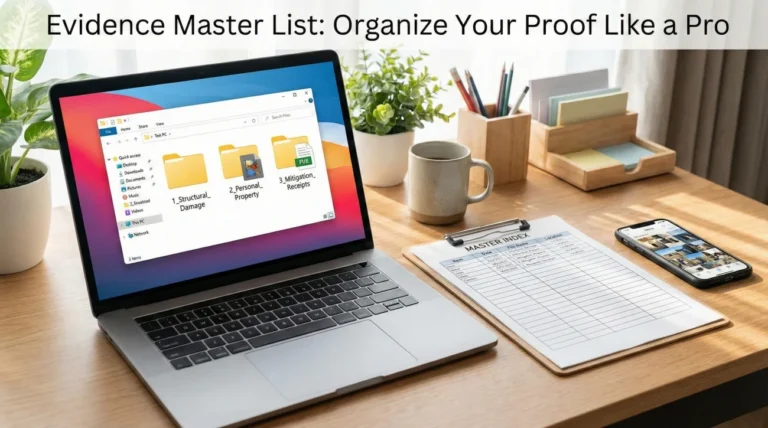
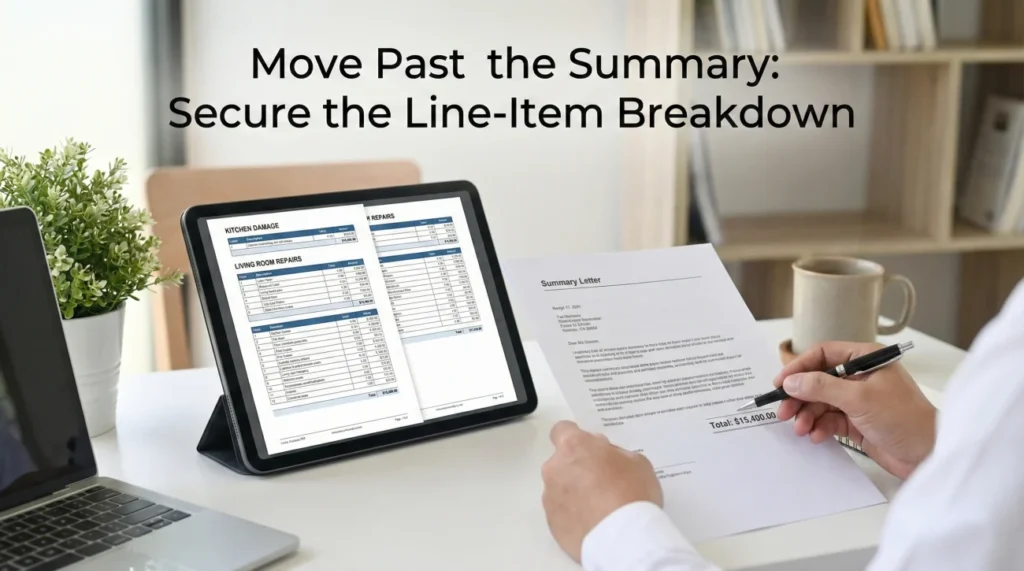
- ✅ The goal: Move past the vague “lump sum” summary and secure the multi-page, line-by-line breakdown of your claim.
- ✅ The method: Send a polite, specific written request asking for the “complete, line-item adjuster estimate including the detailed scope of work.”
- ✅ The verification: When received, check for room dimensions, specific material quantities, and unit measurements, not just broad categories.
- ✅ The hygiene: Save every version with a clear date and version number to prevent confusion as the claim evolves.
The Trap of the “Lump Sum” Summary
In my daily work organizing claim operations, I frequently see people get stuck in a frustrating loop. They receive a single page or a brief email from their adjuster outlining a broad settlement figure. It might say something like “Roof and Interior Repairs,” followed by a total. The homeowner looks at it, realizes it does not seem to cover the visible damage, and immediately responds with an argument about the total figure.
This usually turns into an operational dead end. When you argue about a broad summary, you are fighting a shadow. The file needs a factual list, not a debate. You cannot effectively review, compare, or correct a claim file if you do not know exactly how that total was calculated.
What you actually need to request is the full line-item PDF. I often tell people that the summary page is just the cover letter; the room-by-room scope with quantities is the actual document that matters. Without it, you cannot verify if the adjuster included the correct square footage, the right materials, or all the affected rooms.
In this guide, I will walk you through exactly how to request this detailed breakdown in writing, how to verify that you received the complete version, and how to organize these highly detailed documents so your claim stays on track.
Key Point: Do not waste time debating a summary page. Your safest first step is requesting the complete, line-by-line breakdown so you can see exactly what is, and what is not, included in the adjuster’s assessment.
Understanding the Anatomy of a Complete Estimate
Before you request the detailed paperwork, it helps to understand what you are actually asking for. In many cases, adjusters use specialized software to generate these reports. A complete report is rarely just one or two pages. For a moderate property claim, a true line-item estimate can easily run anywhere from five to twenty pages or more.
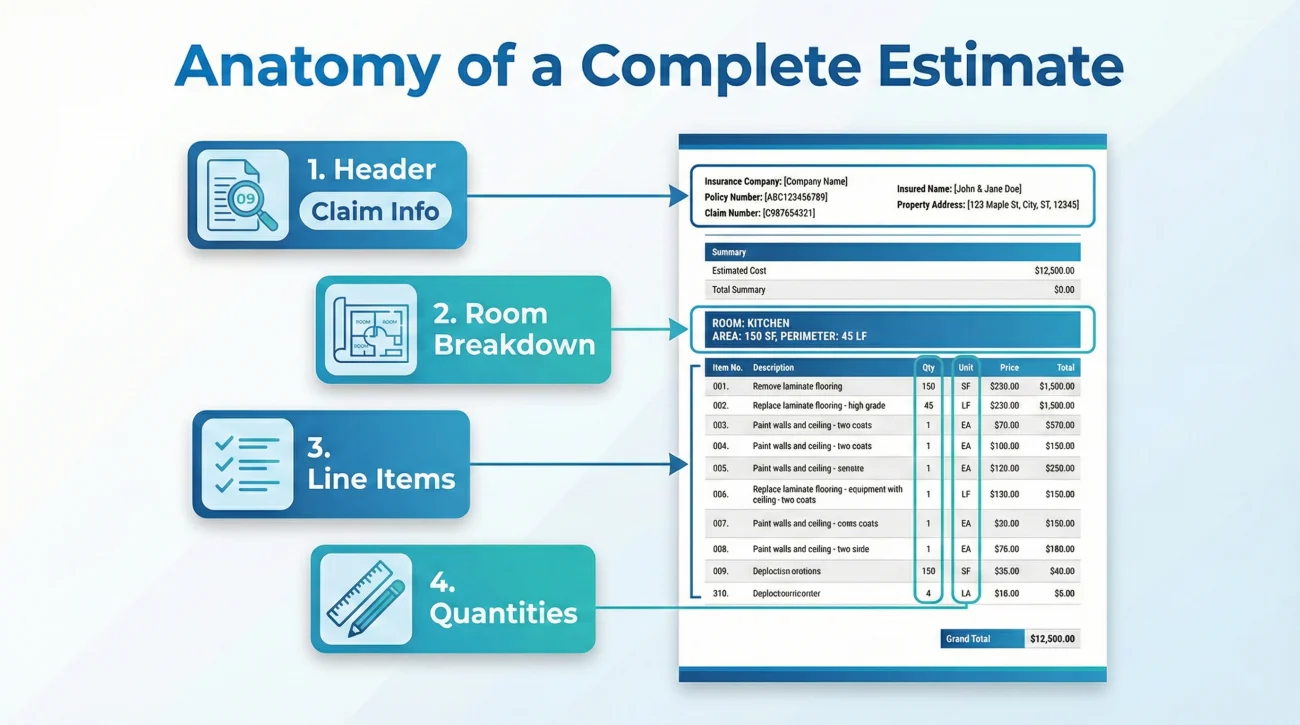
When I review claim files that have stalled, the most common culprit is a missing detailed scope. The homeowner thinks they have the estimate, but they actually only have the summary block. Here is what a complete, itemized document usually contains:
- 📄 The Header and Claim Info: This section lists the date of loss, the claim number, the property address, and the names of the assigned adjusters.
- 📄 The Room-by-Room Breakdown: This is the core of the document. It should break down the property into specific areas (e.g., “Primary Bedroom,” “Guest Bathroom,” “East Elevation Roof”).
- 📄 The Line Items: Under each room or area, you should see individual lines for specific actions and materials. Instead of “Fix floor,” it will say something like “Remove laminate flooring,” “Replace laminate flooring,” and “Remove baseboards.”
- 📄 Quantities and Units: Every line item must have a measurement. You might see SF (Square Feet) for flooring, LF (Linear Feet) for baseboards, SY (Square Yards) for carpet, or EA (Each) for fixtures.
- 📄 The Summary Pages: Usually placed at the very end, this summarizes the totals by category or trade.
If the document you received goes straight from the Header to the Summary Pages without the detailed Room-by-Room Breakdown and Quantities, you do not have the complete file. That’s your cue to request the full export.
Copy-Paste Scripts to Request the Itemized Estimate
Keeping it neutral and written is critical here. When you request the full line-item breakdown, your goal is clarity, not conflict. I always advise keeping these requests completely process-focused. Do not use this email to complain about the delay or argue about missing items. You cannot argue about missing items until you have the definitive list of what is included.
Here are a few practical scripts you can use to request the complete document. Modify them to fit your specific situation.
Script 1: The Initial Request
Use this script if the adjuster has informed you of a total but has not provided any documentation, or if they only sent a one-page summary letter.
Subject: Claim # [Your Claim Number] – Request for Itemized Estimate
Hello [Adjuster Name],
Thank you for the update on my claim. Before we move forward, I need to review the detailed breakdown of the assessment.
Could you please provide a copy of the complete, itemized estimate, including the room-by-room line items and the detailed scope of work? A PDF copy sent to this email address works best for my records.
Please let me know when I can expect to receive this document.
Best regards,
[Your Name]
[Your Contact Information]
Script 2: The Follow-Up for a Partial Document
In many cases, an adjuster might reply to your request by sending a slightly longer summary, but still omit the line-item details with quantities. This is a very common pattern in day-to-day claims ops. When this happens, stay calm and clarify what you need.
Subject: Claim # [Your Claim Number] – Follow-up regarding itemized breakdown
Hello [Adjuster Name],
Thank you for sending over the summary document on [Date].
To ensure my records are complete, I still need the full line-item breakdown. The document I received summarizes the categories, but I am requesting the detailed, itemized scope that shows the specific quantities, measurements, and line items for each room and area affected.
Could you please generate the full itemized report from your system and email it to me as a PDF?
Thank you for your help,
[Your Name]
Script 3: When They Say “The Portal Only Shows a Summary”
Sometimes, an adjuster will point you to the insurance portal, but the portal only displays a high-level summary. If that happens, use this short request.
Subject: Claim # [Your Claim Number] – Request for detailed scope report
Hello [Adjuster Name],
I see the summary in the portal, but I need the full export of the detailed scope report from your estimating system. This is for my recordkeeping and for accurate contractor comparison.
Could you please email the full line-item PDF when you have a moment?
Thank you,
[Your Name]
How to Verify the Document When It Arrives
Once the adjuster sends over a file, your job is not quite done. One of the most common points where files go missing or claims stall is when a homeowner assumes they have the right paperwork, forwards it to their contractor, and the contractor replies, “I cannot use this, there are no measurements.”
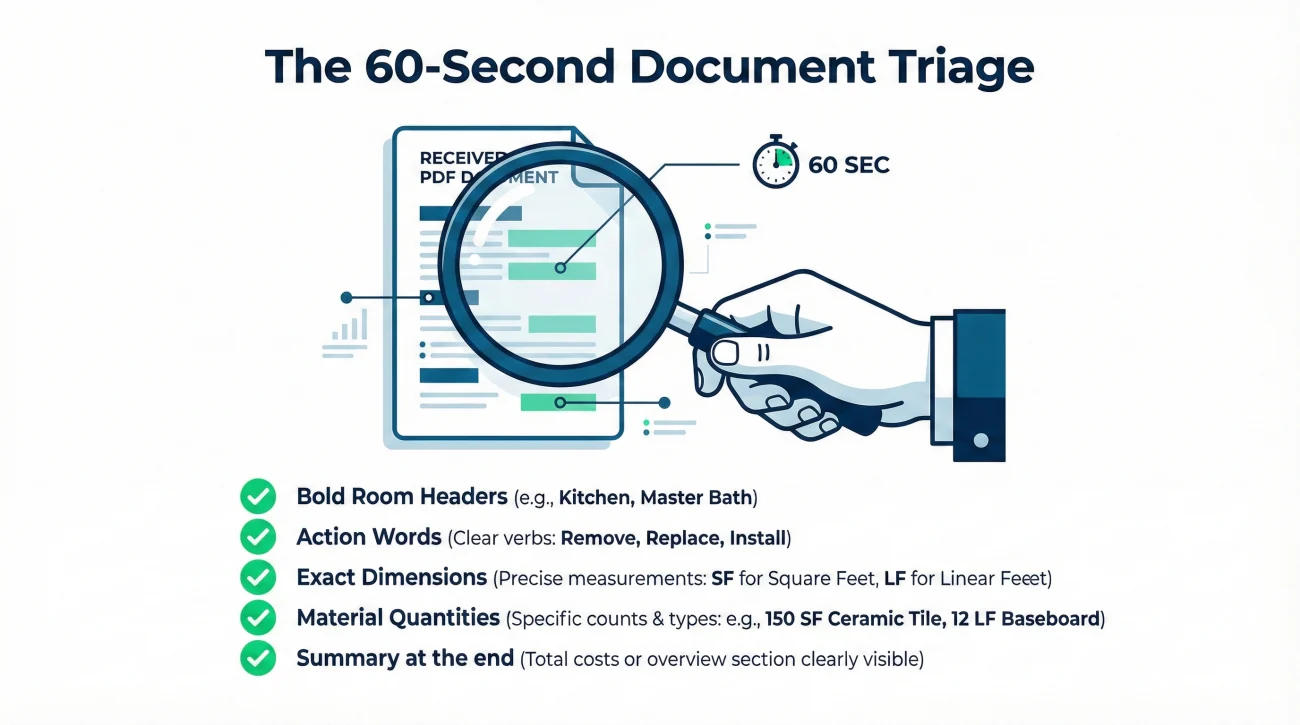
I recommend doing a quick 60-second “triage” the moment the PDF hits your inbox. Do not worry about reading every single word right away; just run through this checklist to ensure the document is complete:
- ✅ Are there bold room headers organizing the damage?
- ✅ Do the line items specify action words like “Remove” and “Replace”?
- ✅ Are exact dimensions and units (SF, LF, EA) clearly visible?
- ✅ Are the material quantities listed next to those units?
- ✅ Is the broad category summary placed correctly at the very end?
| What to Look For | Why It Matters for Your Claim File |
|---|---|
| Page Count Warning | A detailed estimate will rarely be 1-2 pages. However, page count alone is not enough; a long document might just be a summary by trade. You still need to look for room headers and units. |
| Room Headers | You should clearly see bold headers for different areas (e.g., “Living Room,” “Kitchen”). This proves the scope is organized spatially. |
| Line-Item Descriptions | Look for specific actions. It should break down tasks into “Remove” and “Replace” rather than just “Repair.” |
| Exact Quantities | Look for numbers attached to units like SF (Square Feet) or LF (Linear Feet). This is the most crucial part of an itemized estimate. |
💡 Pro Tip (Room Naming Consistency): One detail to watch out for is naming consistency. If the adjuster’s estimate labels an area as “Main Level” but you and your contractor call it the “Living Room,” make a note of this mapping in your file. Ensuring everyone is speaking the same language prevents confusion during comparisons.
Common Mistakes When Asking for the Document
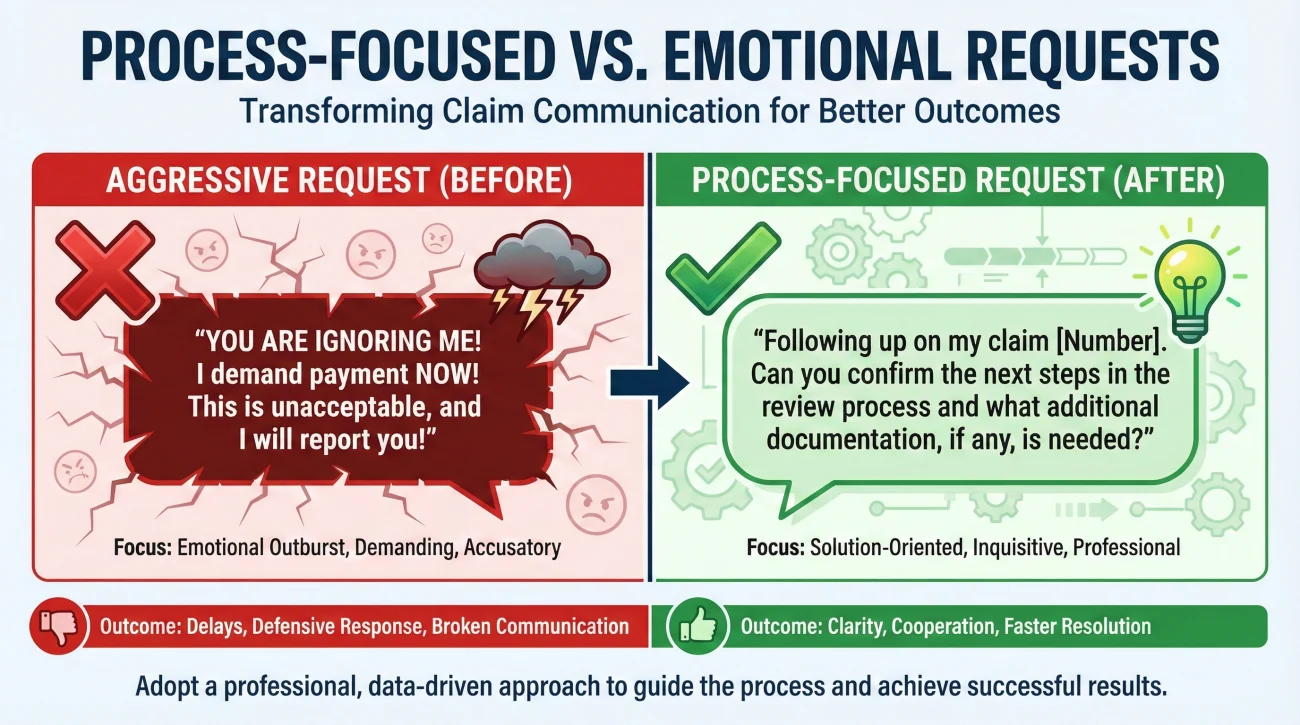
The biggest hurdle in property claims is often communication breakdown, especially when emotions are high. The reason you want this detailed breakdown is so that you have a factual basis to compare against your contractor’s scope of work. When people write aggressive or disorganized requests, they often experience delays. Let’s look at some common mistakes.
The first mistake is using the wrong terminology. Many people ask for a “better offer” or a “new number.” Do not do this. Asking for the itemized document is a process step, not a negotiation.
“This summary is far too low. I need a real estimate that covers my whole house, this is ridiculous.”
“Thank you for the summary. Please provide the complete, line-item estimate so I can review the detailed scope of work.”
Another major mistake is not getting the request in writing. I have seen countless timelines slip because a homeowner verbally requested the scope of work during a quick phone call. The adjuster got busy, forgot, and two weeks passed. In most cases, you should follow up a phone call with a short email confirming what you asked for. This creates a paper trail.
📌 Note: Never assume the adjuster is withholding the document on purpose. In many cases, their software defaults to exporting a summary view. A polite written request is usually all it takes to get the full version.
Organizing the Itemized Document in Your File System
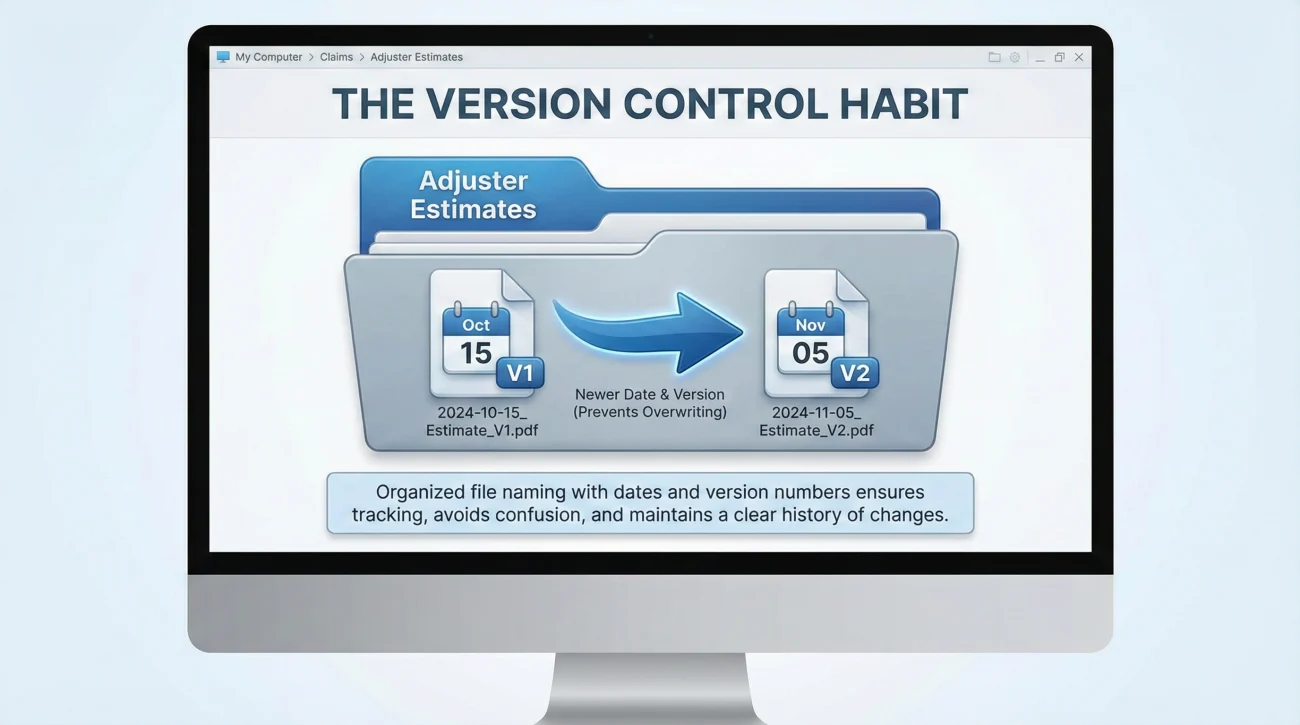
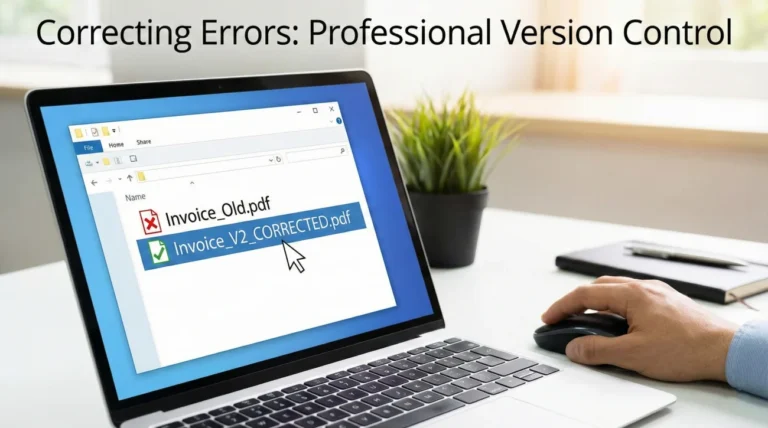
Once you successfully request the file and verify its completeness, your safest next step is to save it correctly. This is where file hygiene comes in. A property claim is a living process. It is highly likely that the adjuster will revise this estimate multiple times throughout the life of your claim. If you just save every email attachment as “Estimate.pdf” to your desktop, you will quickly lose track of which version is the most current.
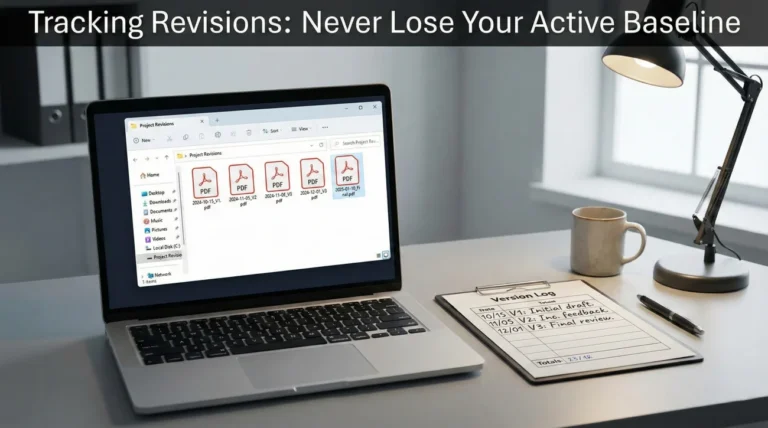
To avoid a scattered claim file, I strongly advise using a standardized naming convention. Your system should prioritize the date of the document, the sender, the type of document, and a version number.
For example, when you receive the first line-item breakdown, save it immediately as:
2024-10-15_Adjuster_Itemized_Estimate_V1.pdf
If they send a revised version three weeks later, you save that new document as:
2024-11-05_Adjuster_Itemized_Estimate_V2.pdf
This simple habit prevents you from accidentally forwarding an outdated, incomplete scope of work to your contractor. Maintaining this level of organization is central to the property claim documents checklist system, ensuring you always know exactly what proof you have on hand.
Final Thoughts on the Itemized Breakdown
When you focus on the process rather than the outcome, securing the itemized insurance estimate becomes a straightforward task. The summary page is not the end of the road; it is merely the opening correspondence. By sending a calm, written request for the line-item details, verifying the document when it arrives, and storing it with clear version control, you put yourself in a much stronger position to manage your claim effectively.
Remember, the goal is clarity. You need to see exactly what the adjuster included in their scope of work, down to the square footage and linear feet. Once you have that detailed breakdown, you can compare it factually against any other assessments, organize your proof, and move the process forward.
❓ FAQ
🎯 How do I ask my insurance company for an itemized estimate?
Send a short, polite email to your adjuster requesting the “complete, line-item estimate including the detailed scope of work.” Ask for it to be sent as a PDF so you have a digital copy for your records.
👀 What does an itemized insurance estimate look like?
Unlike a brief summary, an itemized estimate breaks down the damage room by room. It lists specific tasks (like “remove drywall” and “replace drywall”) and includes exact quantities and measurements (like square footage) for every single item.
📝 Why did the adjuster only give me a summary?
Many estimating software programs default to printing a summary page. It is often faster for the adjuster to send, but it is not sufficient for a detailed review. A polite written request is usually all it takes to get the full version.
⏳ Can I request the adjuster’s line-item estimate before repairs start?
Yes, absolutely. You should always request and review the itemized breakdown before authorizing extensive repairs so you know exactly what is included in the adjuster’s scope of work.
🔍 What should I do if the insurance estimate doesn’t show line-item details?
Reply to the email, acknowledge receipt of the summary, and clearly state that you still need the full itemized breakdown showing specific quantities, measurements, and line items for each affected area.
⏱️ How long does it take to get an itemized estimate from insurance?
If the adjuster has already completed their report and provided a summary, they can usually generate and email the itemized PDF very quickly. If they are still processing the file, it may take several days or longer depending on the complexity of the claim.
🗣️ How do I respond if the adjuster says a summary is enough?
Keep your request in writing. Politely reiterate that for your records and to ensure an accurate comparison with your contractor’s scope, you require the detailed, line-by-line breakdown.
📑 What is the difference between an estimate and a scope of work?
The scope of work is the detailed list of tasks required to fix the damage (the “what” and “how much”). The estimate assigns values to those tasks. A complete itemized document usually contains both.
📖 How do I read an itemized insurance claim estimate?
Start by looking at the room headers. Under each room, review the line items to see what actions are listed (remove, replace, clean) and verify that the quantities (square feet, linear feet) match the actual size of the damaged area.
🏗️ What if my contractor needs the insurance itemized estimate?
It is very common for a contractor to ask for this document to ensure their scope matches the adjuster’s scope. Always ensure you are providing them with the full line-item version, not just the summary page, and save a copy for your own records first.
⚠️ Disclaimer: PropertyClaimChecklist.com provides practical guidance, process checklists, and example follow-ups to help you organize a property claim and move it forward. It is not policy language, claim documentation, legal content, or a substitute for your insurer's instructions. Always rely on your carrier's requirements and your actual policy terms for what must be submitted and how decisions are made.